
Impulse and Momentum Review Momentum SI Units Vector
- Slides: 11
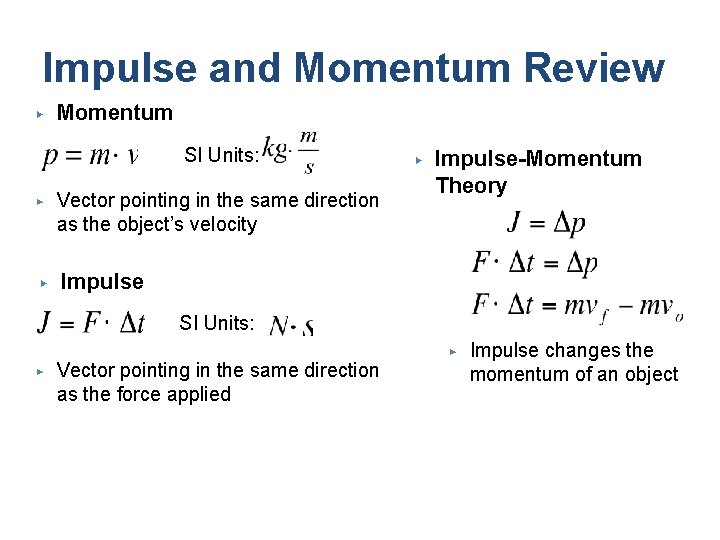
Impulse and Momentum Review ▶ Momentum SI Units: ▶ ▶ Vector pointing in the same direction as the object’s velocity ▶ Impulse-Momentum Theory Impulse SI Units: ▶ ▶ Vector pointing in the same direction as the force applied Impulse changes the momentum of an object
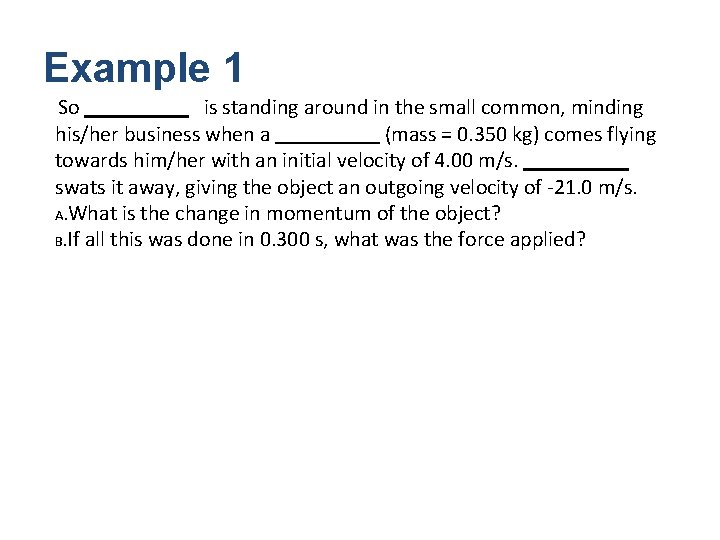
Example 1 So is standing around in the small common, minding his/her business when a (mass = 0. 350 kg) comes flying towards him/her with an initial velocity of 4. 00 m/s. swats it away, giving the object an outgoing velocity of -21. 0 m/s. A. What is the change in momentum of the object? B. If all this was done in 0. 300 s, what was the force applied?
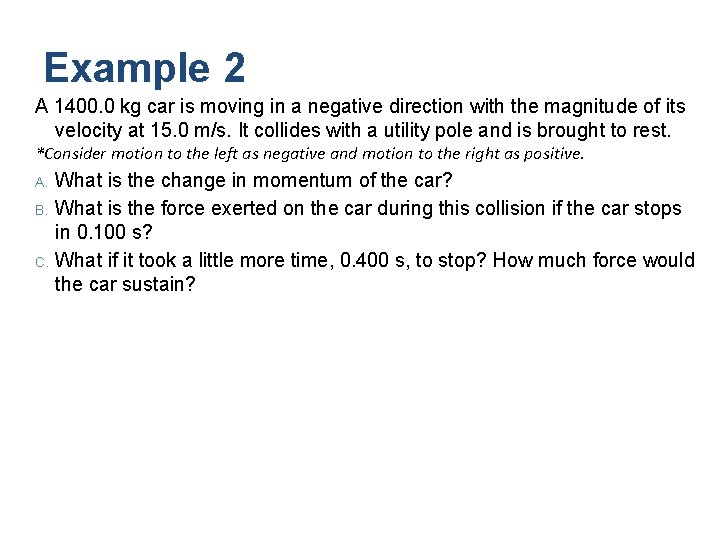
Example 2 A 1400. 0 kg car is moving in a negative direction with the magnitude of its velocity at 15. 0 m/s. It collides with a utility pole and is brought to rest. *Consider motion to the left as negative and motion to the right as positive. A. B. C. What is the change in momentum of the car? What is the force exerted on the car during this collision if the car stops in 0. 100 s? What if it took a little more time, 0. 400 s, to stop? How much force would the car sustain?
Conceptual Question ▶ When you fall a significant distance and hit the ground, why do they tell you to tuck and roll when you hit the ground rather than just landing right on your feet?
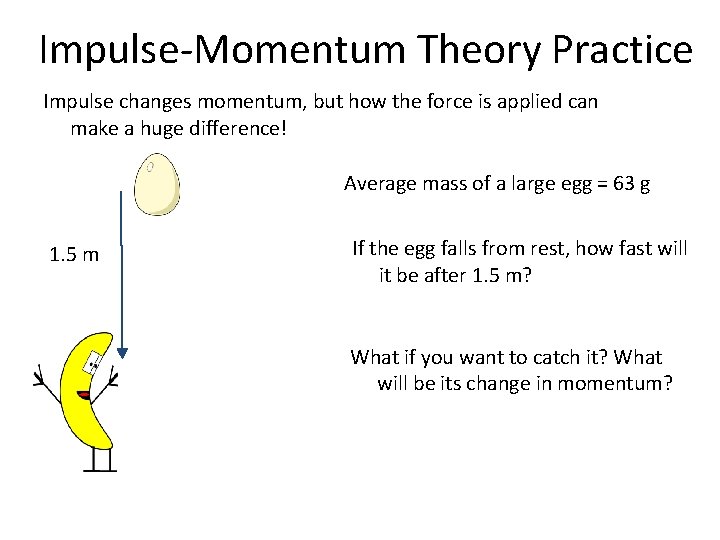
Impulse-Momentum Theory Practice Impulse changes momentum, but how the force is applied can make a huge difference! Average mass of a large egg = 63 g 1. 5 m If the egg falls from rest, how fast will it be after 1. 5 m? What if you want to catch it? What will be its change in momentum?
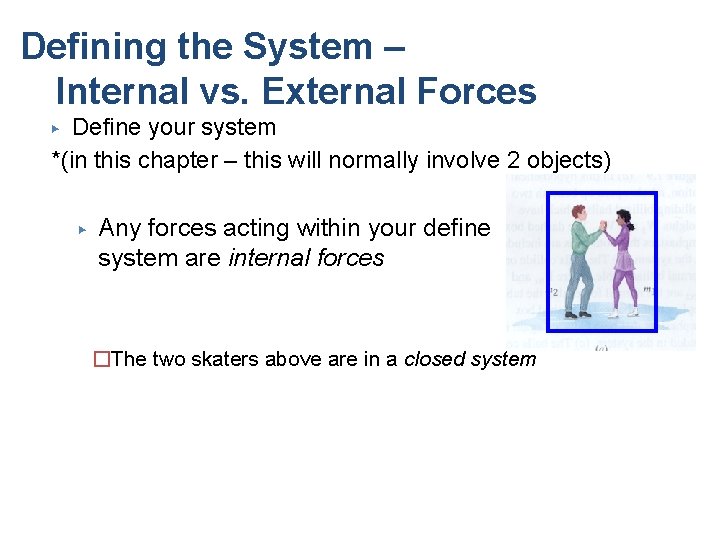
Defining the System – Internal vs. External Forces Define your system *(in this chapter – this will normally involve 2 objects) ▶ ▶ Any forces acting within your define system are internal forces �The two skaters above are in a closed system
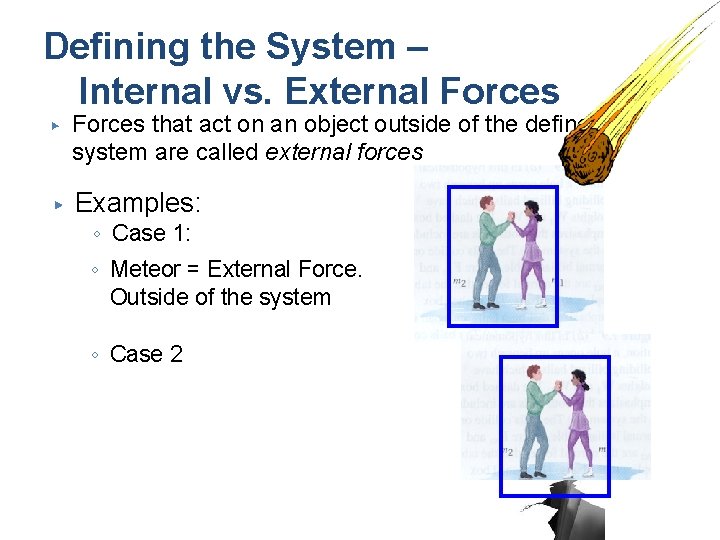
Defining the System – Internal vs. External Forces ▶ Forces that act on an object outside of the defined system are called external forces ▶ Examples: ◦ Case 1: ◦ Meteor = External Force. Outside of the system ◦ Case 2
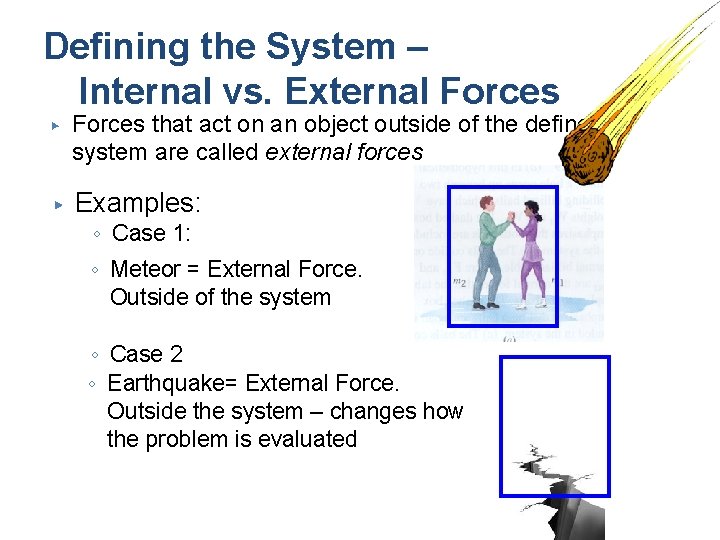
Defining the System – Internal vs. External Forces ▶ Forces that act on an object outside of the defined system are called external forces ▶ Examples: ◦ Case 1: ◦ Meteor = External Force. Outside of the system ◦ Case 2 ◦ Earthquake= External Force. Outside the system – changes how the problem is evaluated
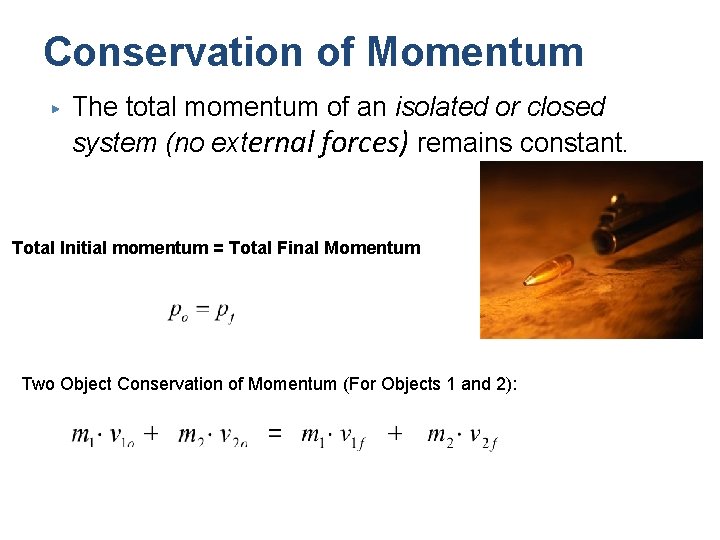
Conservation of Momentum ▶ The total momentum of an isolated or closed system (no external forces) remains constant. Total Initial momentum = Total Final Momentum Two Object Conservation of Momentum (For Objects 1 and 2):
Conceptual Example Two students (m 1 = m and m 2 = 2 m ) are in rolling chairs. Beginning from rest, they push off away from each other. Student 1 moves to the right with a positive velocity. A. What was the initial momentum of the two students? B. What can we infer about the velocity of student 2 after they push off of each other?
Example 3 You have a system with two objects, Object A (mass = 2. 30 kg) and Object B (mass = 0. 800 kg). Initially, Object A has an initial velocity of 1. 40 m/s to the right. Object B is stationary. The two collide. After the collision, Object A is still moving to the right, but only with a velocity of 0. 200 m/s. Object B also is moving to the right with an unknown velocity. What is the velocity of Object B after the collision? *Draw a sketch for Object A and B before and after the collision.