
Improving the Student Learning Experience through Dialogic FeedForward
- Slides: 16
Improving the Student Learning Experience through Dialogic Feed-Forward Assessment JGHE Celebration of Learning & Teaching in HE Geography Jennifer Hill Associate Professor in Teaching & Learning | UWE, Bristol Harry West Associate Lecturer & Researcher | UWE, Bristol
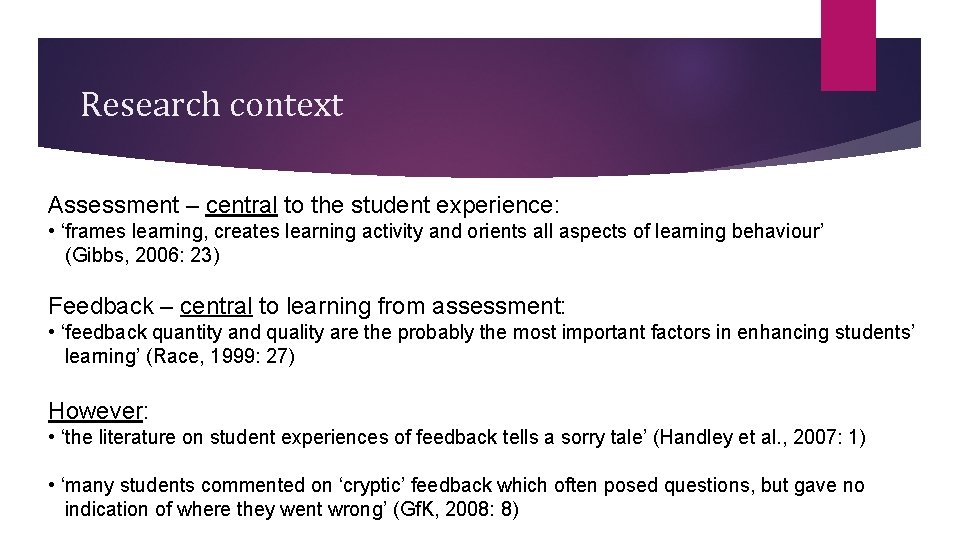
Research context Assessment – central to the student experience: • ‘frames learning, creates learning activity and orients all aspects of learning behaviour’ (Gibbs, 2006: 23) Feedback – central to learning from assessment: • ‘feedback quantity and quality are the probably the most important factors in enhancing students’ learning’ (Race, 1999: 27) However: • ‘the literature on student experiences of feedback tells a sorry tale’ (Handley et al. , 2007: 1) • ‘many students commented on ‘cryptic’ feedback which often posed questions, but gave no indication of where they went wrong’ (Gf. K, 2008: 8)
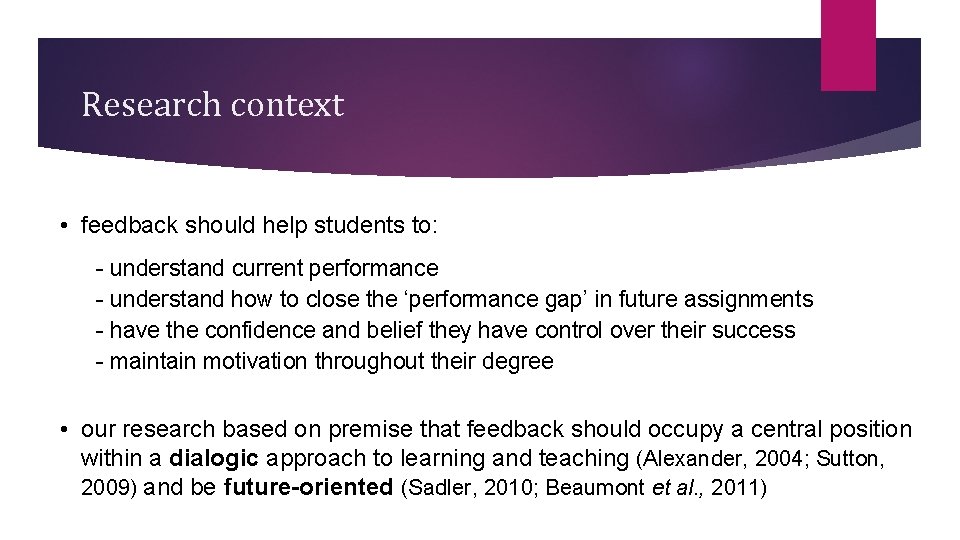
Research context • feedback should help students to: - understand current performance - understand how to close the ‘performance gap’ in future assignments - have the confidence and belief they have control over their success - maintain motivation throughout their degree • our research based on premise that feedback should occupy a central position within a dialogic approach to learning and teaching (Alexander, 2004; Sutton, 2009) and be future-oriented (Sadler, 2010; Beaumont et al. , 2011)
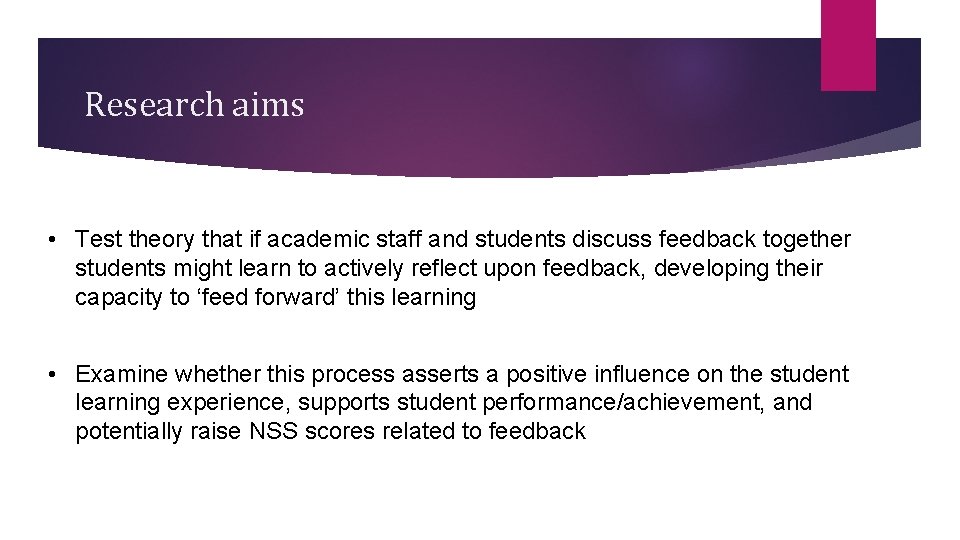
Research aims • Test theory that if academic staff and students discuss feedback together students might learn to actively reflect upon feedback, developing their capacity to ‘feed forward’ this learning • Examine whether this process asserts a positive influence on the student learning experience, supports student performance/achievement, and potentially raise NSS scores related to feedback
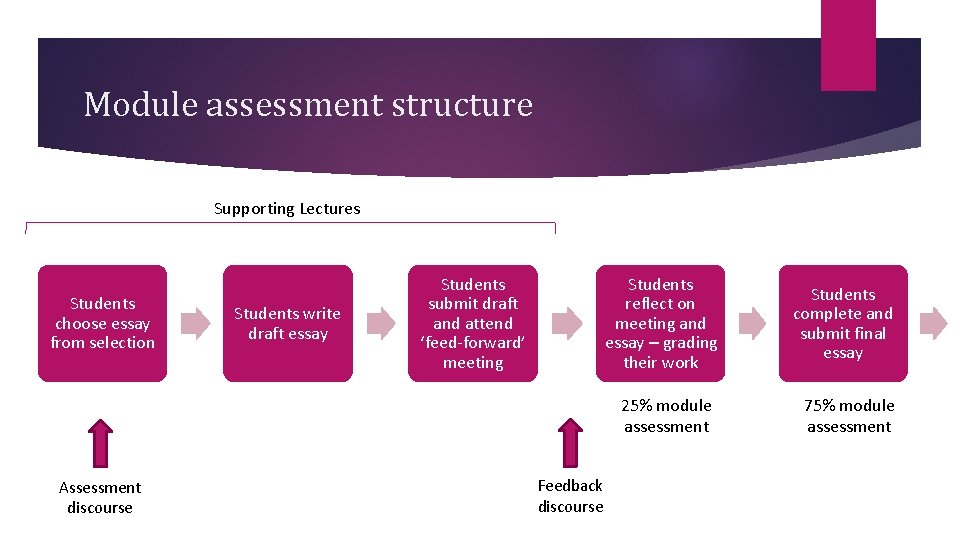
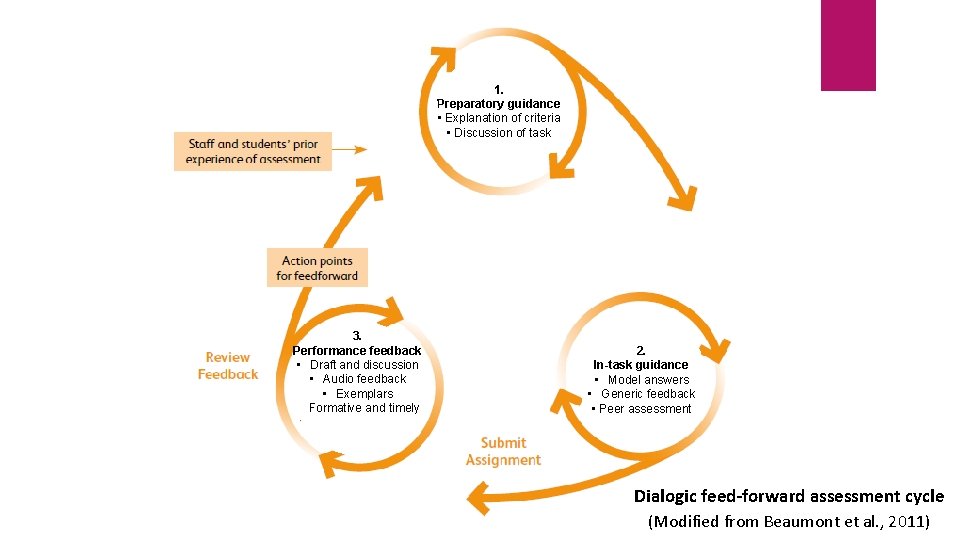
Module assessment structure Supporting Lectures Students choose essay from selection Students write draft essay Students submit draft and attend ‘feed-forward’ meeting Students reflect on meeting and essay – grading their work 25% module assessment Assessment discourse Feedback discourse Students complete and submit final essay 75% module assessment
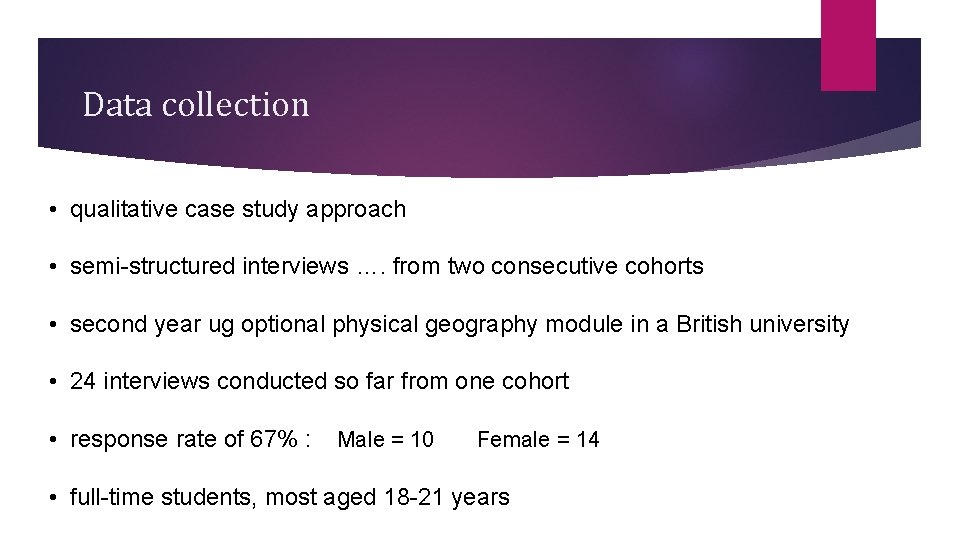
Data collection • qualitative case study approach • semi-structured interviews …. from two consecutive cohorts • second year ug optional physical geography module in a British university • 24 interviews conducted so far from one cohort • response rate of 67% : Male = 10 Female = 14 • full-time students, most aged 18 -21 years
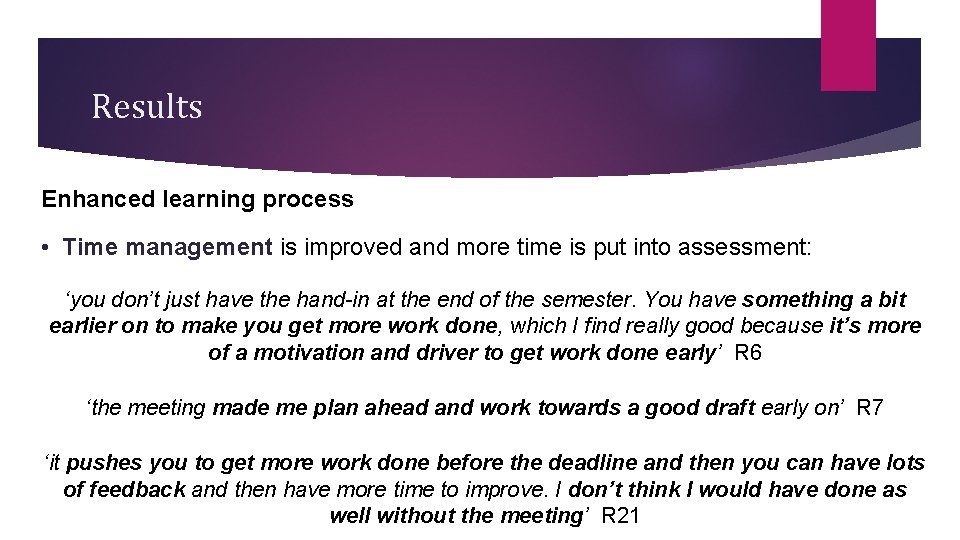
Results Enhanced learning process • Time management is improved and more time is put into assessment: ‘you don’t just have the hand-in at the end of the semester. You have something a bit earlier on to make you get more work done, which I find really good because it’s more of a motivation and driver to get work done early’ R 6 ‘the meeting made me plan ahead and work towards a good draft early on’ R 7 ‘it pushes you to get more work done before the deadline and then you can have lots of feedback and then have more time to improve. I don’t think I would have done as well without the meeting’ R 21
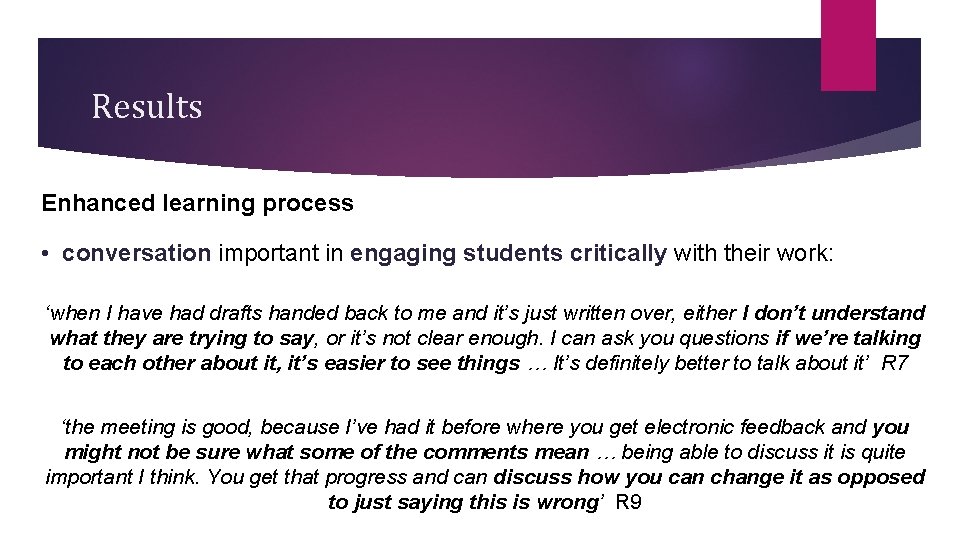
Results Enhanced learning process • conversation important in engaging students critically with their work: ‘when I have had drafts handed back to me and it’s just written over, either I don’t understand what they are trying to say, or it’s not clear enough. I can ask you questions if we’re talking to each other about it, it’s easier to see things … It’s definitely better to talk about it’ R 7 ‘the meeting is good, because I’ve had it before where you get electronic feedback and you might not be sure what some of the comments mean … being able to discuss it is quite important I think. You get that progress and can discuss how you can change it as opposed to just saying this is wrong’ R 9
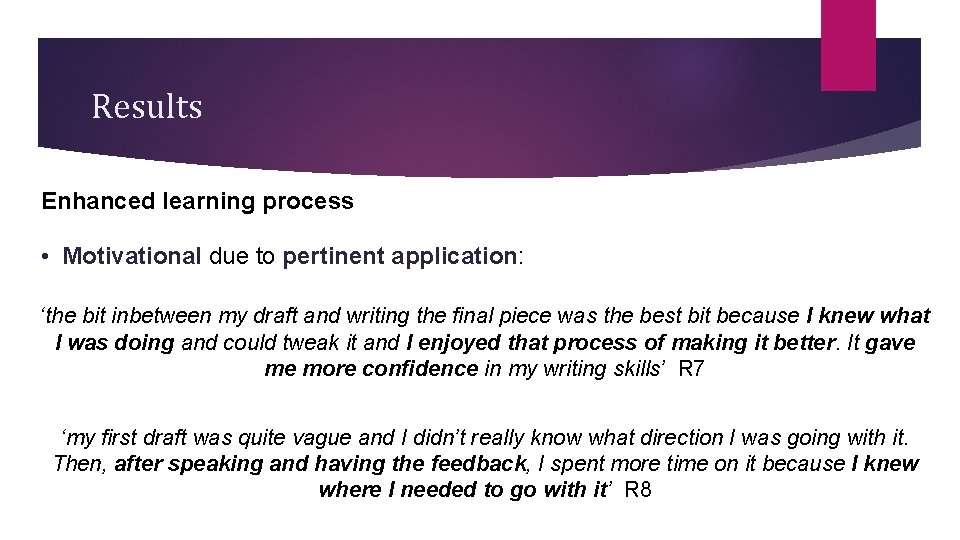
Results Enhanced learning process • Motivational due to pertinent application: ‘the bit inbetween my draft and writing the final piece was the best bit because I knew what I was doing and could tweak it and I enjoyed that process of making it better. It gave me more confidence in my writing skills’ R 7 ‘my first draft was quite vague and I didn’t really know what direction I was going with it. Then, after speaking and having the feedback, I spent more time on it because I knew where I needed to go with it’ R 8
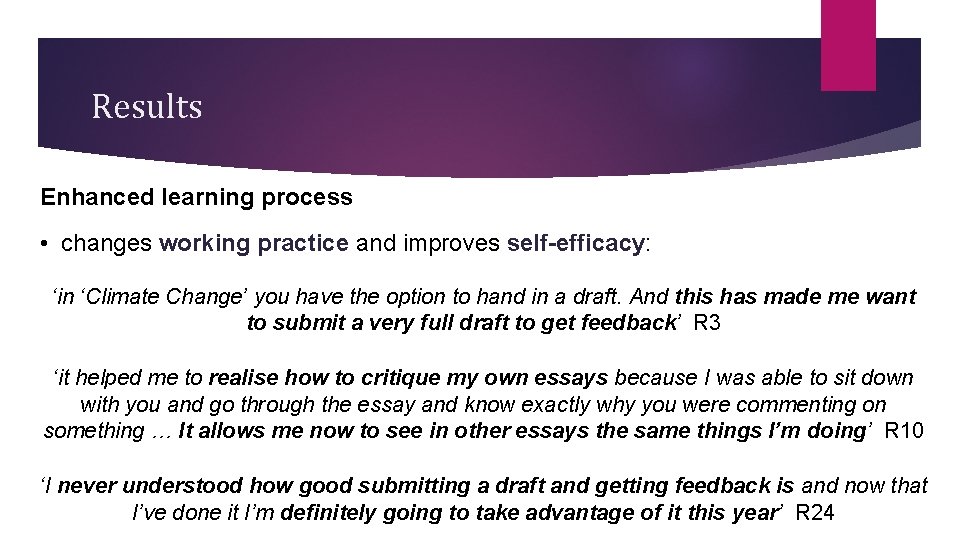
Results Enhanced learning process • changes working practice and improves self-efficacy: ‘in ‘Climate Change’ you have the option to hand in a draft. And this has made me want to submit a very full draft to get feedback’ R 3 ‘it helped me to realise how to critique my own essays because I was able to sit down with you and go through the essay and know exactly why you were commenting on something … It allows me now to see in other essays the same things I’m doing’ R 10 ‘I never understood how good submitting a draft and getting feedback is and now that I’ve done it I’m definitely going to take advantage of it this year’ R 24
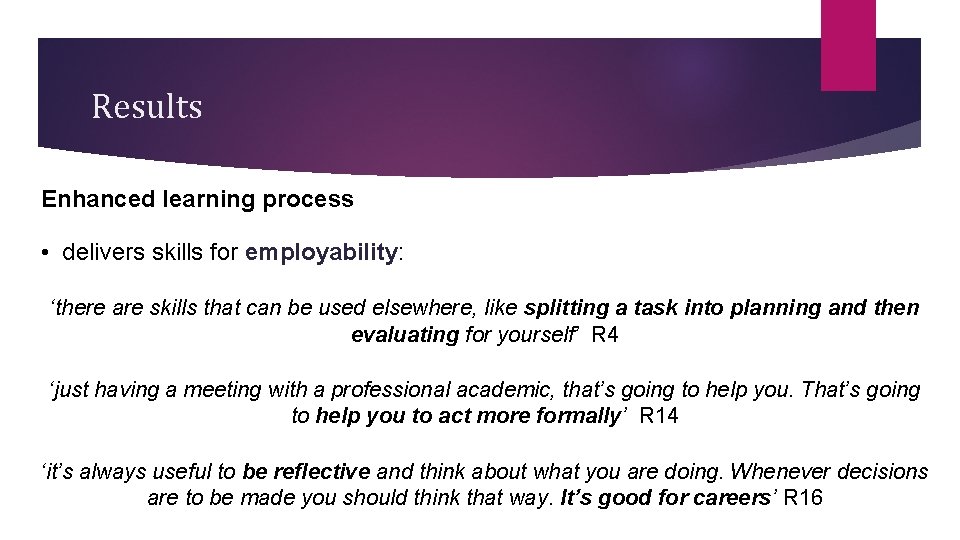
Results Enhanced learning process • delivers skills for employability: ‘there are skills that can be used elsewhere, like splitting a task into planning and then evaluating for yourself’ R 4 ‘just having a meeting with a professional academic, that’s going to help you. That’s going to help you to act more formally’ R 14 ‘it’s always useful to be reflective and think about what you are doing. Whenever decisions are to be made you should think that way. It’s good for careers’ R 16
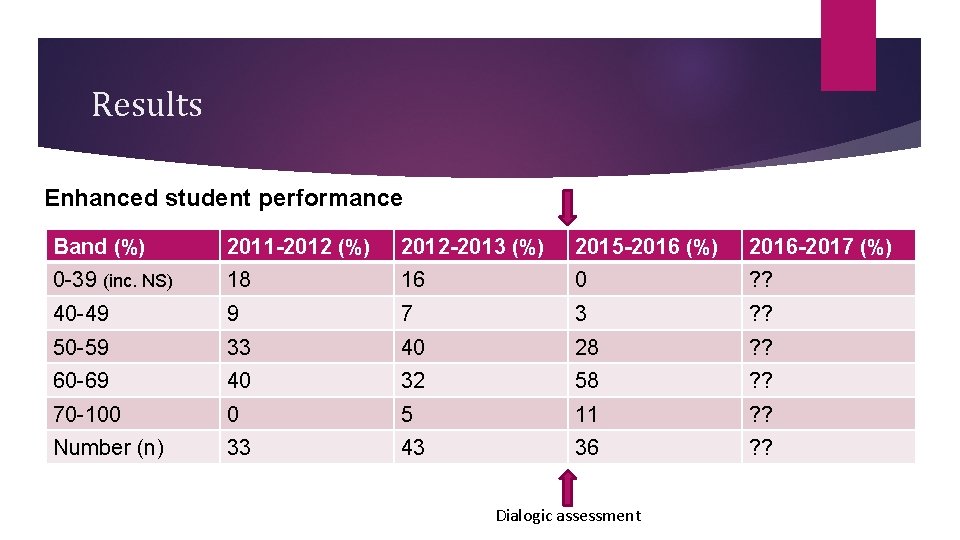
Results Enhanced student performance Band (%) 2011 -2012 (%) 2012 -2013 (%) 2015 -2016 (%) 2016 -2017 (%) 0 -39 (inc. NS) 18 16 0 ? ? 40 -49 9 7 3 ? ? 50 -59 33 40 28 ? ? 60 -69 40 32 58 ? ? 70 -100 0 5 11 ? ? Number (n) 33 43 36 ? ? Dialogic assessment
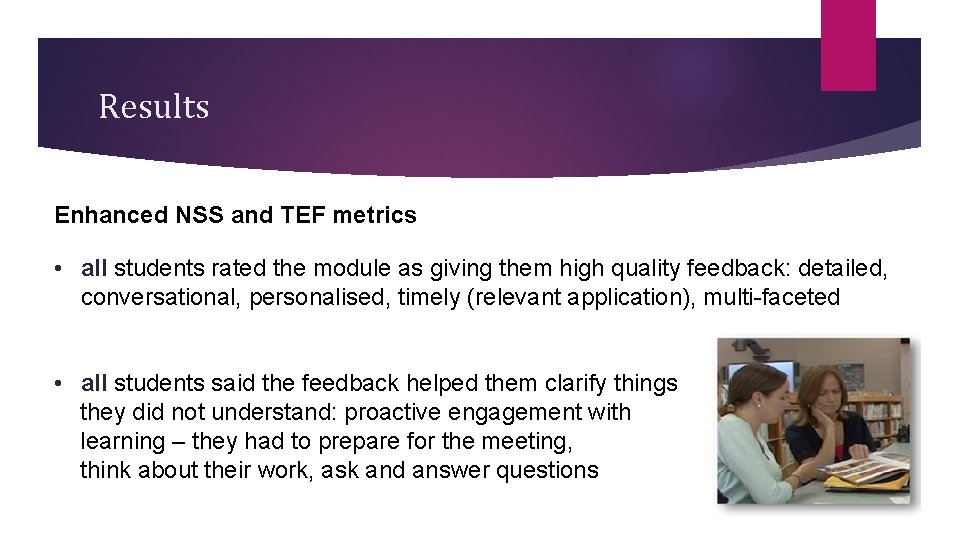
Results Enhanced NSS and TEF metrics • all students rated the module as giving them high quality feedback: detailed, conversational, personalised, timely (relevant application), multi-faceted • all students said the feedback helped them clarify things they did not understand: proactive engagement with learning – they had to prepare for the meeting, think about their work, ask and answer questions
Conclusions Dialogic feed-forward assessment enhanced the student learning experience by: - Increasing motivation to engage with the assignment - Increasing confidence in their ability to complete the assignment - Solidifying good practice & supporting higher assignment grades - Increasing satisfaction with the feedback process (potentially boosting NSS metrics) - Positively changing behaviour in working towards future assignments (fostering selfefficacy) & boosting employability skills
1. Preparatory guidance • Explanation of criteria • Discussion of task 3. Performance feedback • Draft and discussion • Audio feedback • Exemplars • Formative and timely 2. In-task guidance • Model answers • Generic feedback • Peer assessment Dialogic feed-forward assessment cycle (Modified from Beaumont et al. , 2011)
References Alexander, R. (2004) Towards Dialogic Teaching: rethinking classroom talk (Third edition) University of Cambridge: Dialogos. Beaumont, C. , O’Doherty, M. & Shannon, L. (2011) Reconceptualising assessment feedback: a key to improving student learning? Studies in Higher Education, 36, 671 -687. Gf. K (2008) NUS/ HSBC Students Research. Gf. K Financial London, Study Number 154021. Gibbs, G. (2006) Why assessment is changing. In C Bryan and K Clegg (eds) Innovative Assessment in Higher Education. London, Routledge. Handley, K. , Price, M. & Millar J. (2011) Beyond ‘doing time’: investigating the concept of student engagement with feedback. Oxford Review of Education, 37, 543 -560. Sadler, D. R. (2010) Beyond Feedback: Developing student capability in complex appraisal. Assessment and Evaluation in Higher Education, 35, 535 -550. Sutton, P. (2009) Towards dialogic feedback. Critical and Reflective Practice in Education, 1, 1 -10.