
IMPROVING THE SPECTRAL FIT FOR THE DIFFUSE SOFT




- Slides: 24
IMPROVING THE SPECTRAL FIT FOR THE DIFFUSE SOFT X-RAY BACKGROUND USING ATOMDB CHARGE EXCHANGE MODELS By German Vazquez Perez University of Puerto Rico, Mayagüez - Physics Department Adam Foster (Advisor) - Smithsonian Astrophysical Observatory
The diffuse Soft X-ray Background
The diffuse Soft X-ray Background 1960’s • The first cosmic soft X-rays (2 -6 ke. V) were observed using a sounding rocket (Giacconi et al. , 1962). • Most of this X-ray emission must be due to extragalactic sources.
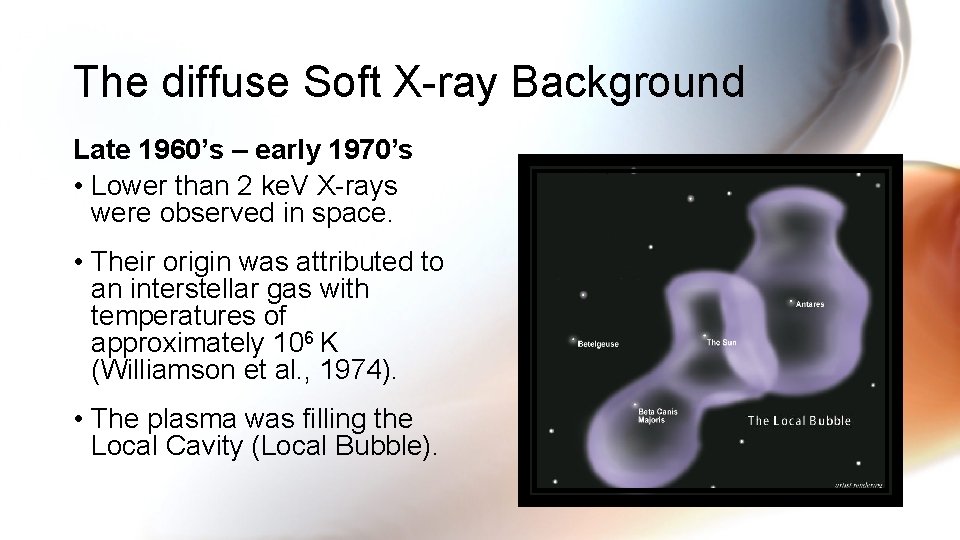
The diffuse Soft X-ray Background Late 1960’s – early 1970’s • Lower than 2 ke. V X-rays were observed in space. • Their origin was attributed to an interstellar gas with temperatures of approximately 106 K (Williamson et al. , 1974). • The plasma was filling the Local Cavity (Local Bubble).
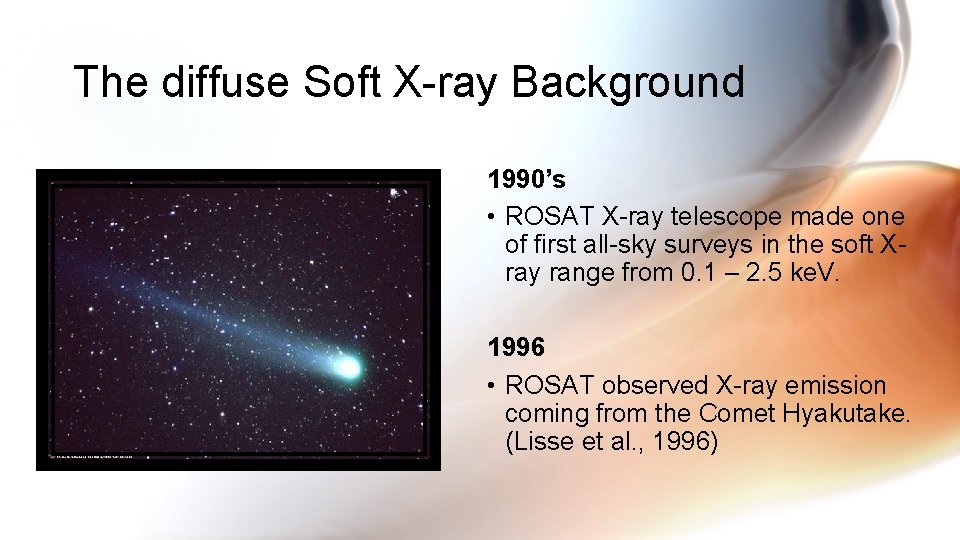
The diffuse Soft X-ray Background 1990’s • ROSAT X-ray telescope made one of first all-sky surveys in the soft Xray range from 0. 1 – 2. 5 ke. V. 1996 • ROSAT observed X-ray emission coming from the Comet Hyakutake. (Lisse et al. , 1996)
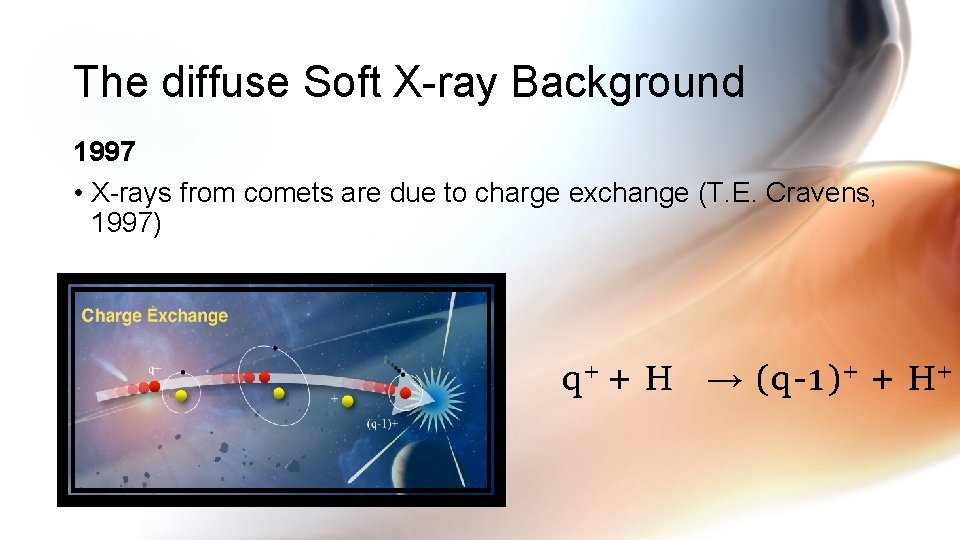
The diffuse Soft X-ray Background 1997 • X-rays from comets are due to charge exchange (T. E. Cravens, 1997) q+ + H → (q-1)+ + H+
The diffuse Soft X-ray Background 2000’s • Cravens proposed that approximately ~50% percent of the diffuse soft X-ray background could be explained by solar wind charge exchange (T. E. Cravens 2000). • Models were created to explain this idea, but they lacked some atomic data.
The diffuse Soft X-ray Background • Charge exchange emission depends on the composition, density and relative velocities of the solar wind ions and the neutral donors, which these models implemented. • Also depends on the cross sections for all possible energy states and the radiative decay. • The models the first dependencies, but they did not include calculations for the cross sections nor the radiative decay.
Atom. DB Charge Exchange Model (ACX)
Atom. DB Charge Exchange Model (ACX) • ACX model, introduced in (Smith et al. , 2014), used simple analytic formulae for the rates to capture an electron into each n and l shell (cross sections). • For the principal quantum number (n), they assumed that the electron always gets captured in the into the peak n’ shell (Janev & Winter, 1985). • For the angular momentum (l) they used four distributions: Even, Statistical, Landau-Zener and Separable (Janev & Winter, 1985).
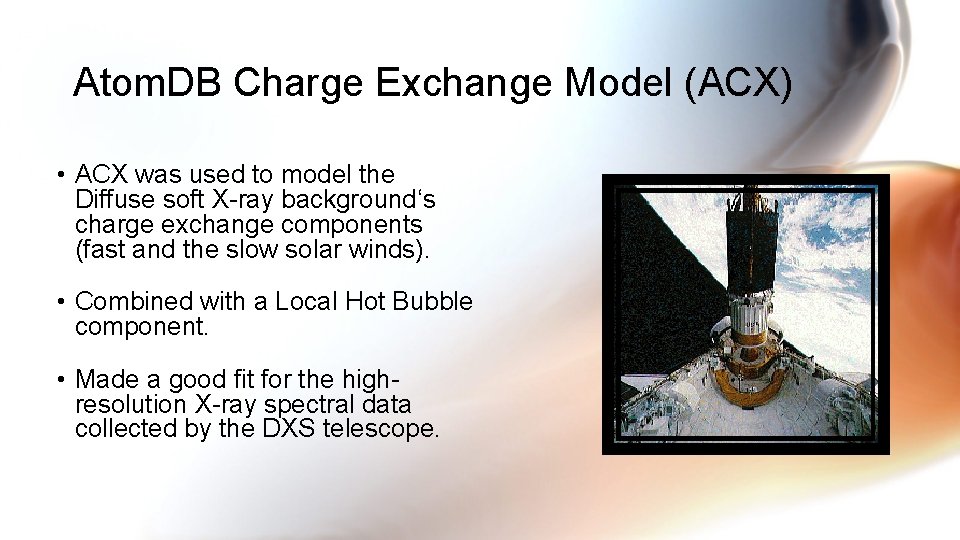
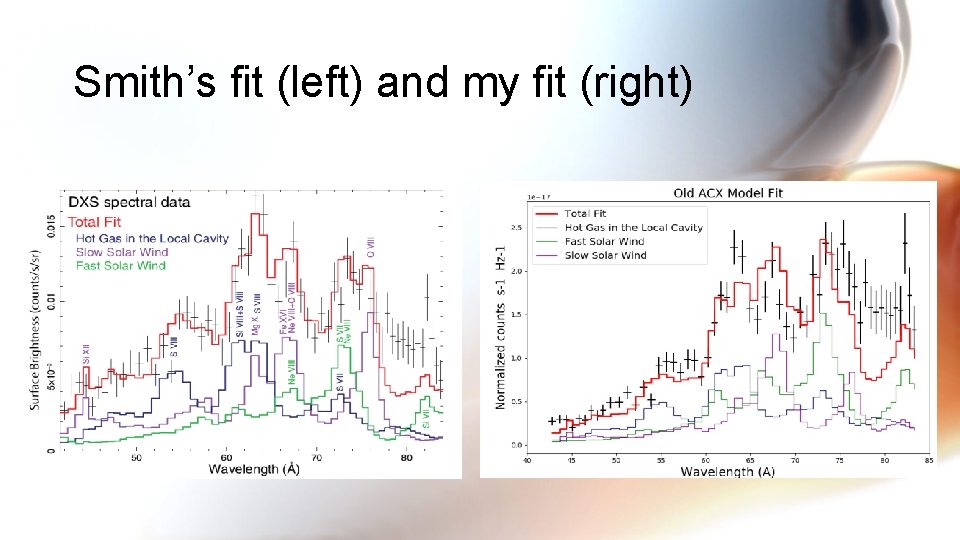
Atom. DB Charge Exchange Model (ACX) • ACX was used to model the Diffuse soft X-ray background‘s charge exchange components (fast and the slow solar winds). • Combined with a Local Hot Bubble component. • Made a good fit for the highresolution X-ray spectral data collected by the DXS telescope.
Now, what I actually did. Finally!
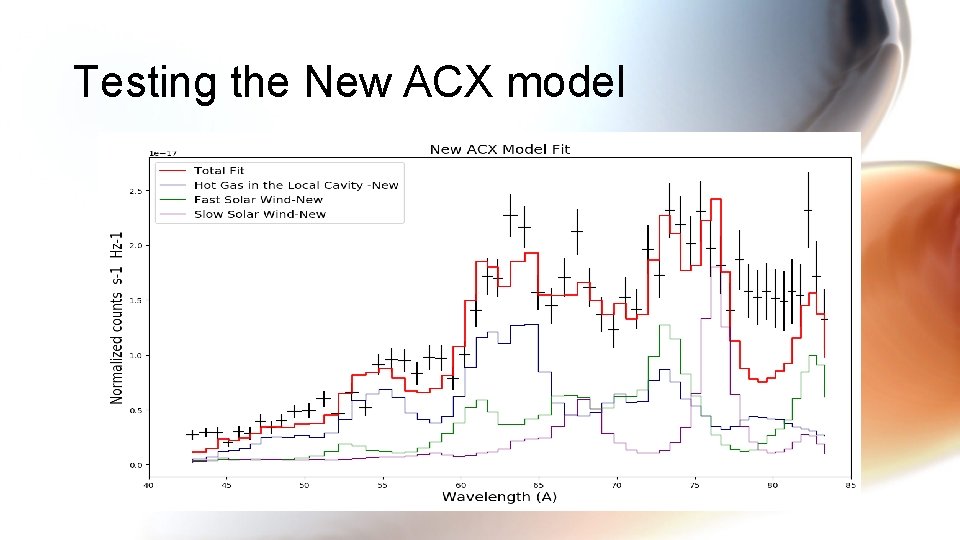
Atom. DB Charge Exchange Model (ACX): Latest version • The model was updated to use more accurate and velocitydependent calculations for the n and l quantum numbers, provided by the Kronos project (Cumbee et al. , 2016 )(Mullen et al. , 2017). • I used Py. Xspec, a X-ray spectral fitting package for Python, provided by NASA to reanalyze this new model and compare it to the previous version.
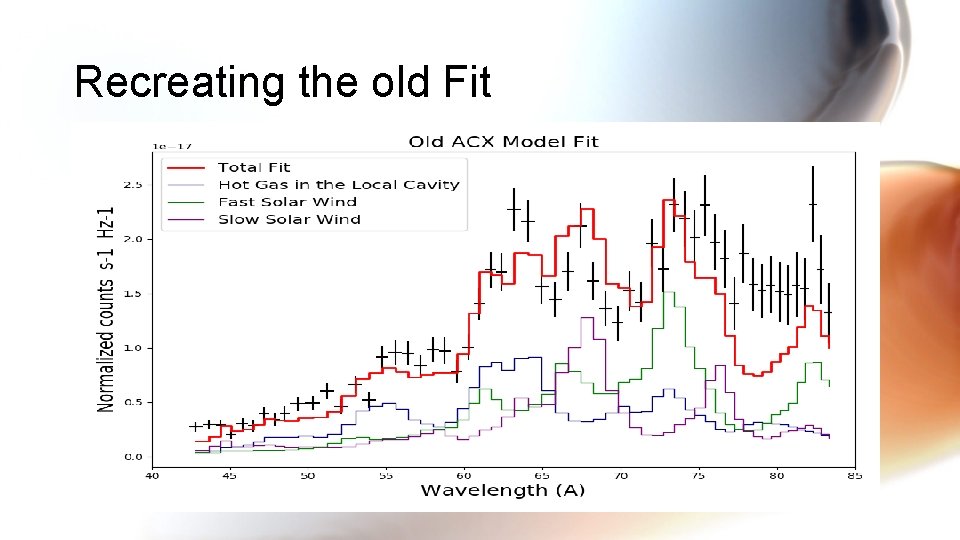
Recreating the old Fit
Smith’s fit (left) and my fit (right)
Testing the New ACX model
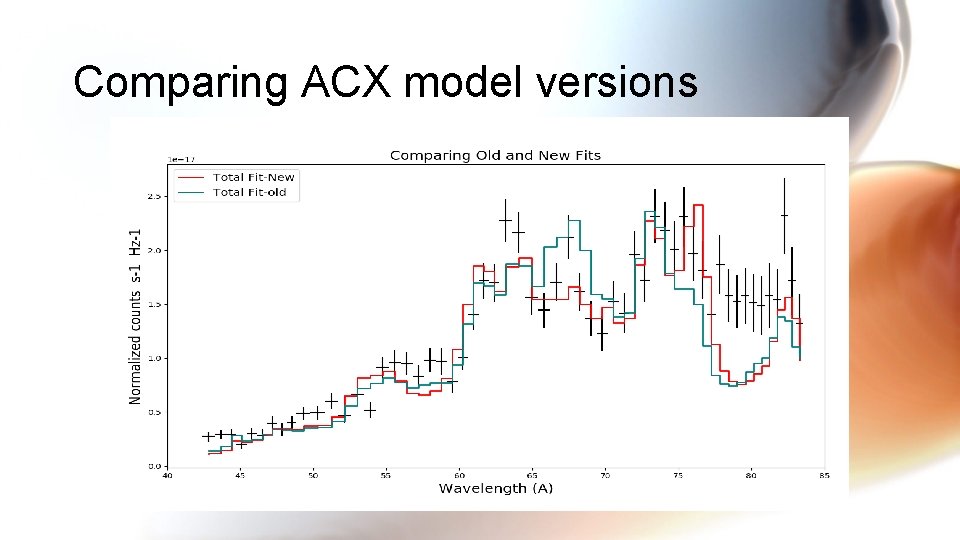
Comparing ACX model versions
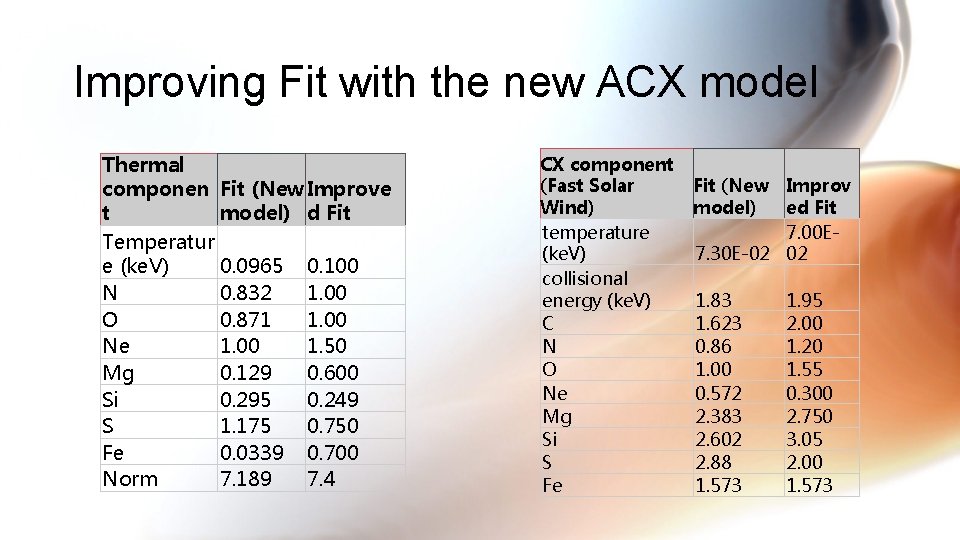
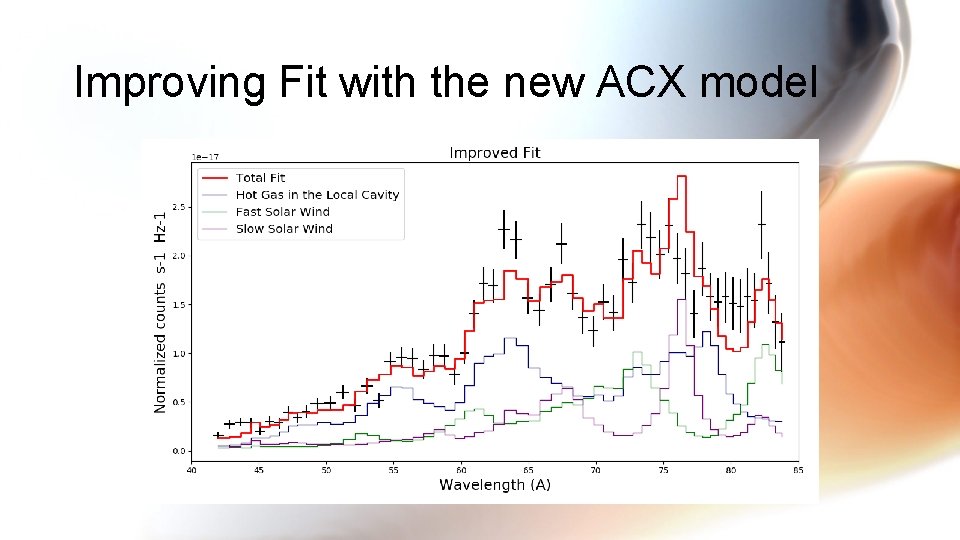
Improving Fit with the new ACX model Thermal componen Fit (New Improve t model) d Fit Temperatur e (ke. V) 0. 0965 0. 100 N 0. 832 1. 00 O 0. 871 1. 00 Ne 1. 00 1. 50 Mg 0. 129 0. 600 Si 0. 295 0. 249 S 1. 175 0. 750 Fe 0. 0339 0. 700 Norm 7. 189 7. 4 CX component (Fast Solar Wind) temperature (ke. V) collisional energy (ke. V) C N O Ne Mg Si S Fe Fit (New Improv model) ed Fit 7. 00 E 7. 30 E-02 02 1. 83 1. 623 0. 86 1. 00 0. 572 2. 383 2. 602 2. 88 1. 573 1. 95 2. 00 1. 20 1. 55 0. 300 2. 750 3. 05 2. 00 1. 573
Improving Fit with the new ACX model
Conclusion • New ACX model proves to be consistent and provides a slightly better fit than the previous version. • The new and more accurate calculations make a notable correction in the spectrum, especially in the oxygen lines. • A more improved fit for the DXS data implies slight adjustments to the temperature and elemental abundances for the three components and to the collisional energy parameters from the solar wind components. • This model could still need more development and to be implemented in other X-ray data.
Questions
Acknowledgements Special thanks to everyone that helped me make this project possible. Including, but not limiting to: Adam Foster, Randall Smith, Amy Gall, Katharine Reeves and the Smithsonian Minority Awards Internship program.
References • Cravens, T. (1997). Comet Hyakutake x-ray source: Charge transfer of solar wind heavy ions. Geophysical Research Letters, 24(1), pp. 105 -108. Rossi, B. (1962). Evidence for x Rays From Sources Outside the Solar System. Physical Review Letters, 9(11), pp. 439 -443. • Janev, R. and Winter, H. (1985). State • Cravens, T. (2000). Heliospheric X-ray selective electron capture in atom-highly Emission Associated with Charge Transfer of charged ion collisions. Physics Reports, 117(5 the Solar Wind with Interstellar Neutrals. The -6), pp. 265 -387. Astrophysical Journal, 532(2), pp. L 153 -L 156. • Lisse, C. , Dennerl, K. , Englhauser, J. , Harden, • Cumbee, R. , Liu, L. , Lyons, D. , Schultz, D. , M. , Marshall, F. , Mumma, M. , Petre, R. , Pye, Stancil, P. , Wang, J. and Ali, R. (2016). Ne x J. , Ricketts, M. , Schmitt, J. , Trumper, J. and X-ray emission due to charge exchange in West, R. (1996). Discovery of X-ray and M 82. Monthly Notices of the Royal Extreme Ultraviolet Emission from Comet Astronomical Society, 458(4), pp. 3554 -3560. C/Hyakutake 1996 B 2. Science, 274(5285), pp. 205 -209. • D. Bodewits, The charge exchange process. • Mc. Cammon, D. (1990). The Soft X-Ray [image] Available at: https: //www 2. le. ac. uk/departments/physics/re Background And Its Origins. Annual Review of Astronomy and Astrophysics, 28(1), pp. 657 search/xroa/astrophysics-1/SWCX -688. • Giacconi, R. , Gursky, H. , Paolini, F. and
• • Mullen, P. , Cumbee, R. , Lyons, D. , Gu, L. , Kaastra, J. , Shelton, R. and Stancil, P. (2017). Line Ratios for Solar Wind Charge Exchange with Comets. The Astrophysical Journal, 844(1), • p. 7. • NASA/Rick Scott & Joe Orman. Hyakutake Comet. [image] Available at: https: //www. space. com/20016 -comethyakutake. htm. • NASA CHIPS. The Local Bubble. [image] Available at: https: //www. skyandtelescope. com/astronomynews/local-hot-bubble-07282014/ • NASA HEASARC. Diffuse soft X-ray Spectrometer. [image] Available at: https: //heasarc. gsfc. nasa. gov/docs/dxs_ima ges. htm Pradhan, A. and Nahar, S. (2015). Atomic astrophysics and spectroscopy. Cambridge: Cambridge University Press. Smith, R. , Foster, A. , Edgar, R. and Brickhouse, N. (2014). Resolving the Origin of the Diffuse Soft X-ray Background. The Astrophysical Journal, 787(1), p. 77. • Williamson, F. , Sanders, W. , Kraushaar, W. , Mc. Cammon, D. , Borken, R. and Bunner, A. (1974). Observation of features in the soft X-ray background flux. The Astrophysical Journal, 193, p. L 133.