
Improving the RF Active Circuit Design Cycle Through



- Slides: 38
Improving the RF Active Circuit Design Cycle Through Innovations in Electrothermal Modeling, Characterization, and Design Techniques Dr. Charles Baylis Faculty Candidate baylis@eng. usf. edu April 11, 2008
Overview • • USF RACAM Research Group The RF Active Circuit Design Cycle Research Strategy/Overview Nonlinear Modeling of Thermal and Trapping Effects in Ga. N HEMTs • Radar Power Amplifier Combining Techniques for Sidelobe Reduction • Prediction of Phase Noise in Amplifiers and Frequency Multipliers • Development of Microwave Measurement Techniques for Cell Cultures School of Engineering & Computer Science
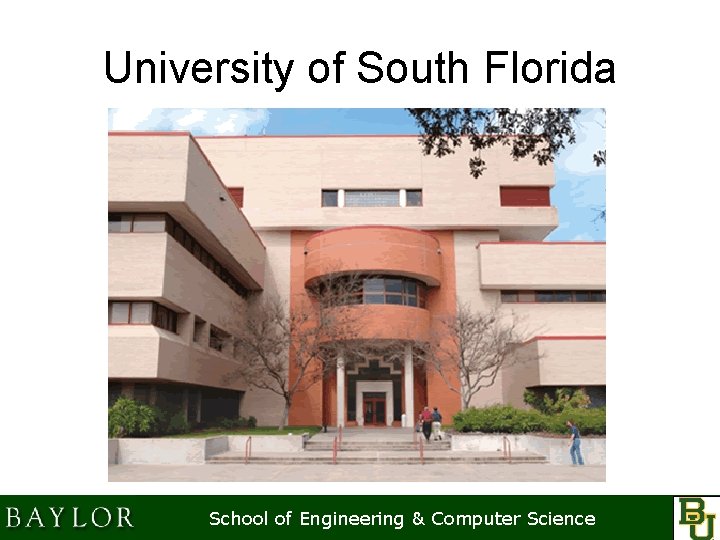
University of South Florida School of Engineering & Computer Science
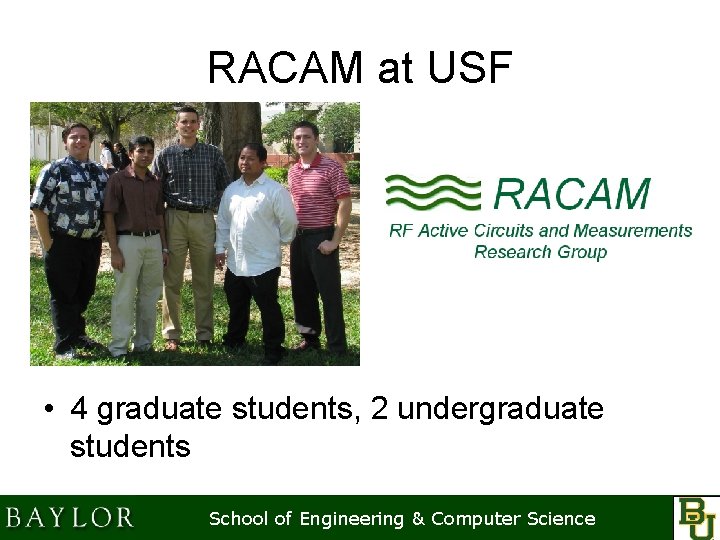
RACAM at USF • 4 graduate students, 2 undergraduate students School of Engineering & Computer Science
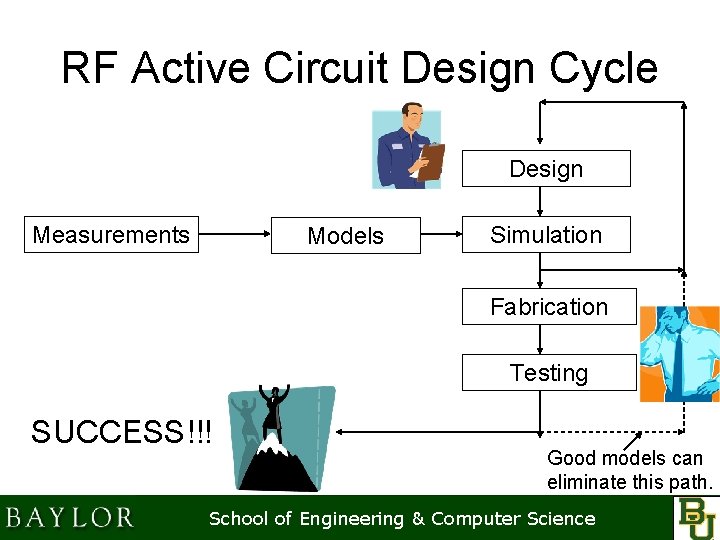
RF Active Circuit Design Cycle Design Measurements Models Simulation Fabrication Testing SUCCESS!!! Good models can eliminate this path. School of Engineering & Computer Science
Strategy for Obtaining Funds • Obtain initial grass-roots funding from industry contacts. • From this foundation, apply for agency funding. School of Engineering & Computer Science
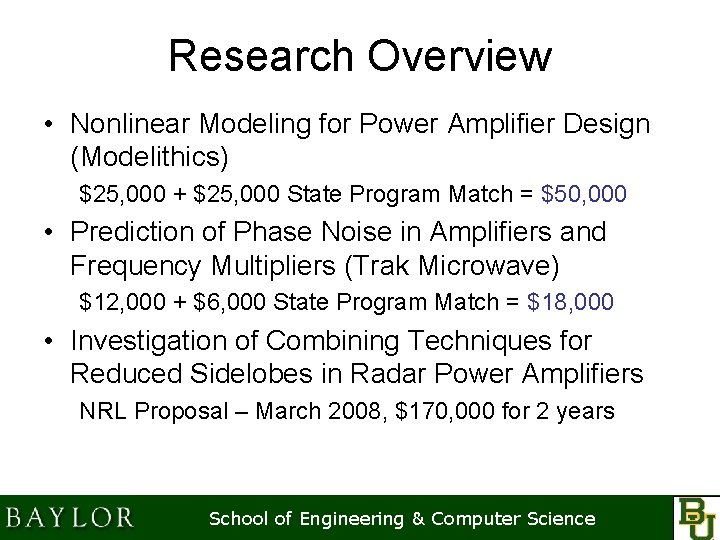
Research Overview • Nonlinear Modeling for Power Amplifier Design (Modelithics) $25, 000 + $25, 000 State Program Match = $50, 000 • Prediction of Phase Noise in Amplifiers and Frequency Multipliers (Trak Microwave) $12, 000 + $6, 000 State Program Match = $18, 000 • Investigation of Combining Techniques for Reduced Sidelobes in Radar Power Amplifiers NRL Proposal – March 2008, $170, 000 for 2 years School of Engineering & Computer Science
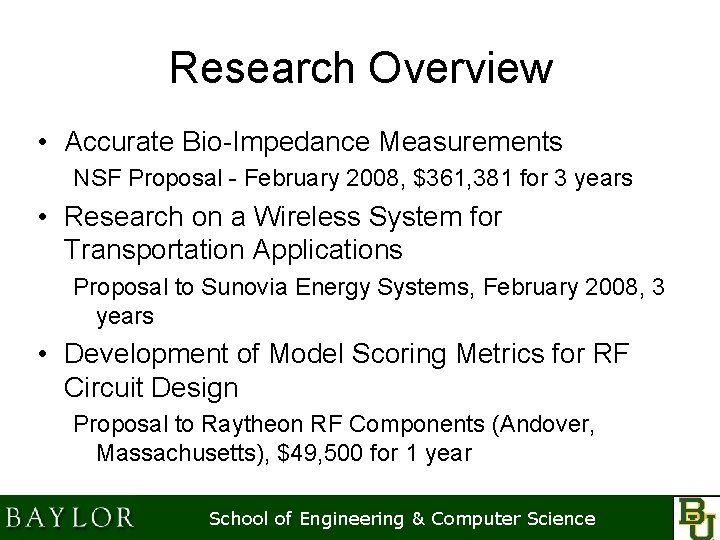
Research Overview • Accurate Bio-Impedance Measurements NSF Proposal - February 2008, $361, 381 for 3 years • Research on a Wireless System for Transportation Applications Proposal to Sunovia Energy Systems, February 2008, 3 years • Development of Model Scoring Metrics for RF Circuit Design Proposal to Raytheon RF Components (Andover, Massachusetts), $49, 500 for 1 year School of Engineering & Computer Science
Electrothermal FET Modeling • Nonlinear RF CAD Models are extracted from measurements of Field-Effect Transistors (FETs): – Current-Voltage (IV) – S-Parameters – Load Pull • Pulsed IV measurements allow thermal and trap effects to be accurately modeled. School of Engineering & Computer Science
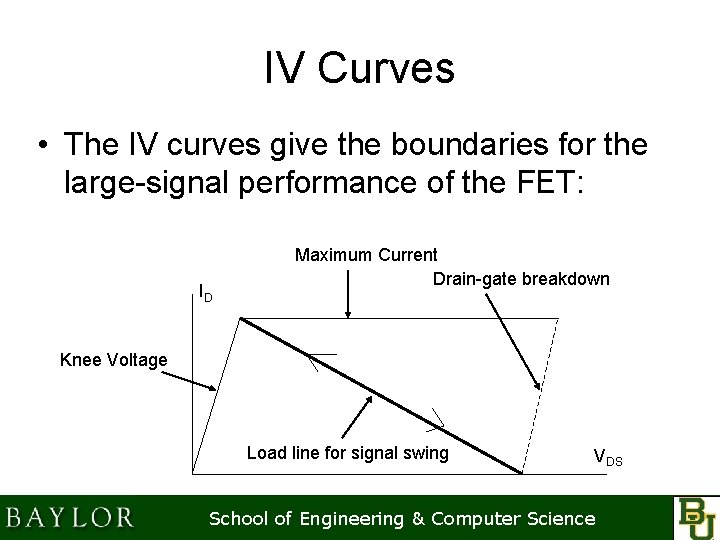
IV Curves • The IV curves give the boundaries for the large-signal performance of the FET: ID Maximum Current Drain-gate breakdown Knee Voltage Load line for signal swing VDS School of Engineering & Computer Science
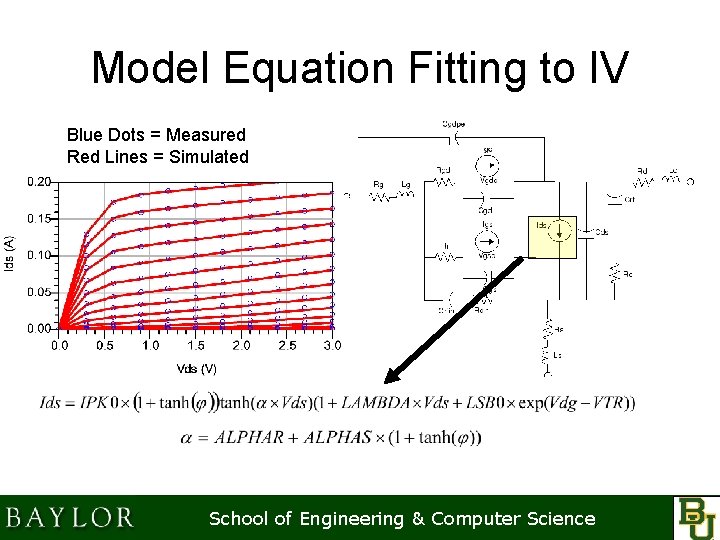
Model Equation Fitting to IV Blue Dots = Measured Red Lines = Simulated School of Engineering & Computer Science
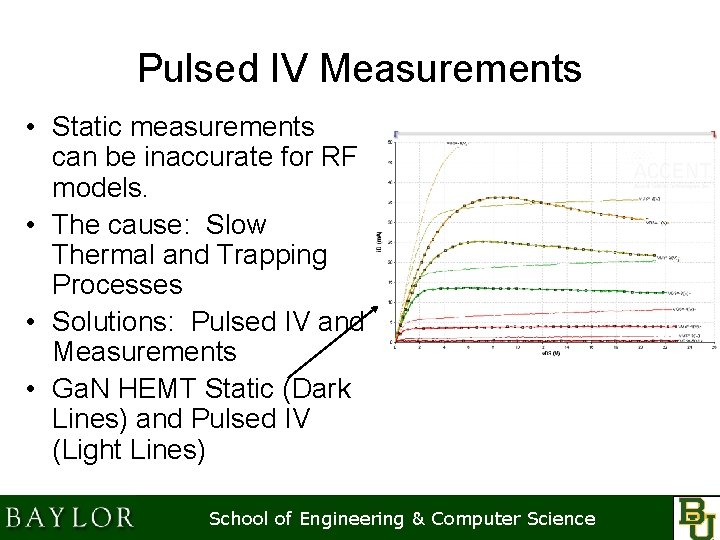
Pulsed IV Measurements • Static measurements can be inaccurate for RF models. • The cause: Slow Thermal and Trapping Processes • Solutions: Pulsed IV and Measurements • Ga. N HEMT Static (Dark Lines) and Pulsed IV (Light Lines) School of Engineering & Computer Science
Pulsed IV Measurement • Measurements are performed during brief (~0. 2 μs) excursions from a quiescent bias. • The pulses are usually separated by at least 1 ms. • Thermal and trap conditions during the measurement are those of the quiescent bias, as in high-frequency operation. School of Engineering & Computer Science
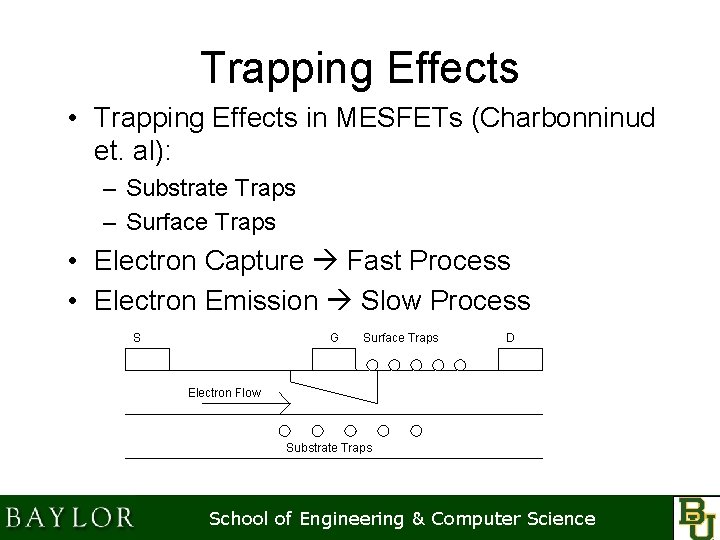
Trapping Effects • Trapping Effects in MESFETs (Charbonninud et. al): – Substrate Traps – Surface Traps • Electron Capture Fast Process • Electron Emission Slow Process S G Surface Traps D Electron Flow Substrate Traps School of Engineering & Computer Science
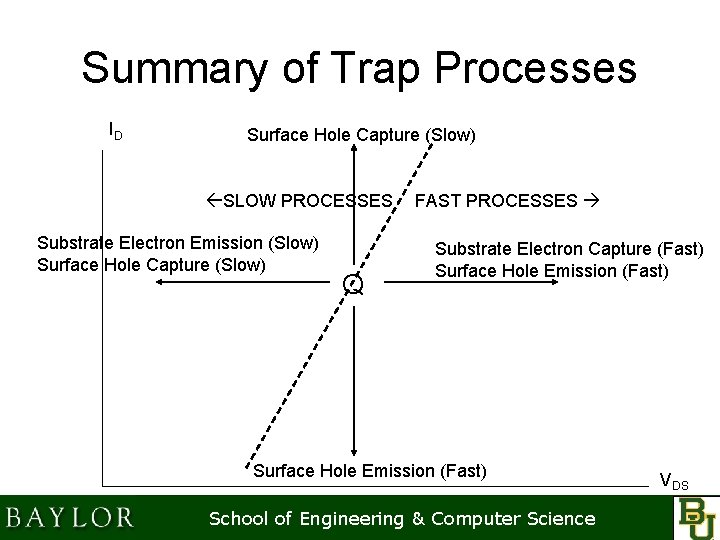
Summary of Trap Processes ID Surface Hole Capture (Slow) SLOW PROCESSES Substrate Electron Emission (Slow) Surface Hole Capture (Slow) Q FAST PROCESSES Substrate Electron Capture (Fast) Surface Hole Emission (Fast) School of Engineering & Computer Science VDS
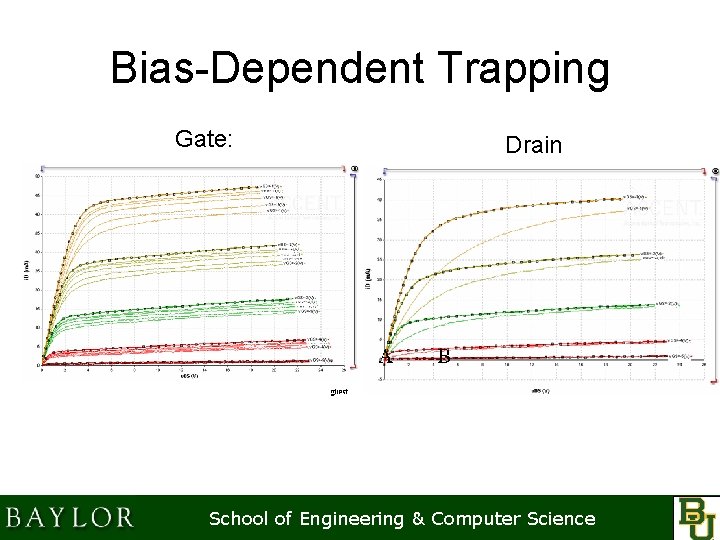
Bias-Dependent Trapping Gate: Drain School of Engineering & Computer Science
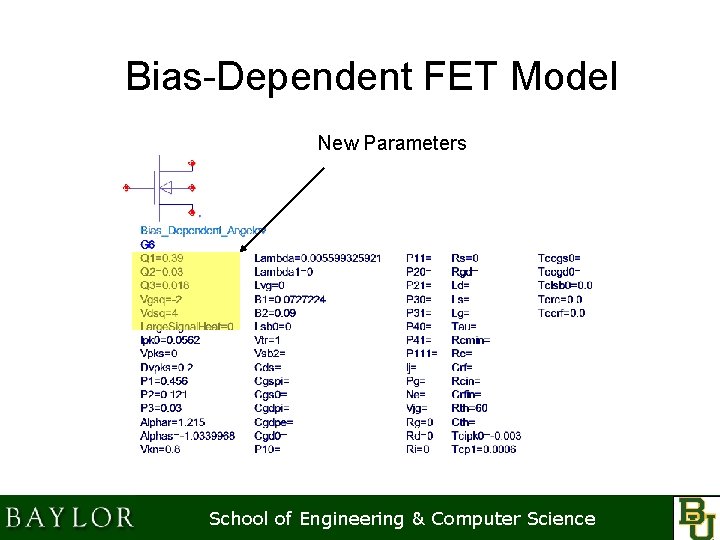
Bias-Dependent FET Model New Parameters School of Engineering & Computer Science
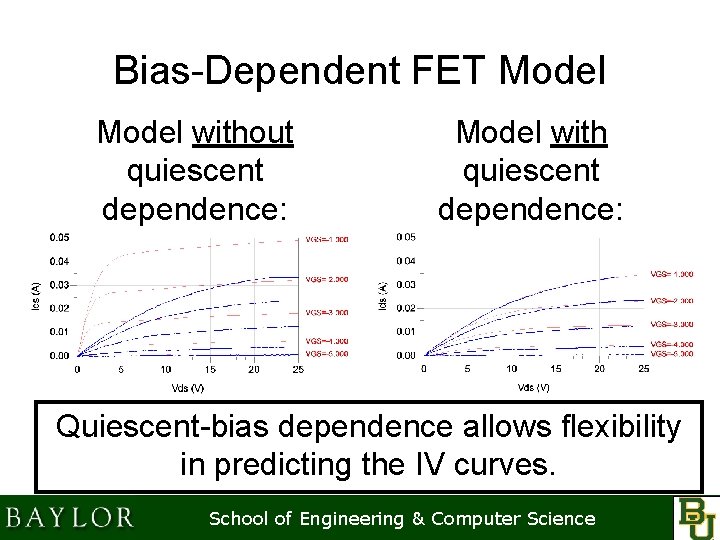
Bias-Dependent FET Model without quiescent dependence: Model with quiescent dependence: Quiescent-bias dependence allows flexibility in predicting the IV curves. School of Engineering & Computer Science
Proposed Upcoming Work • Adapt USF bias-dependent approach for use on other desired models. • Add time-dependence of capture and emission trapping as well as thermal effects. • Develop a straightforward characterization scheme for the bias and time dependence of thermal and trapping effects. School of Engineering & Computer Science
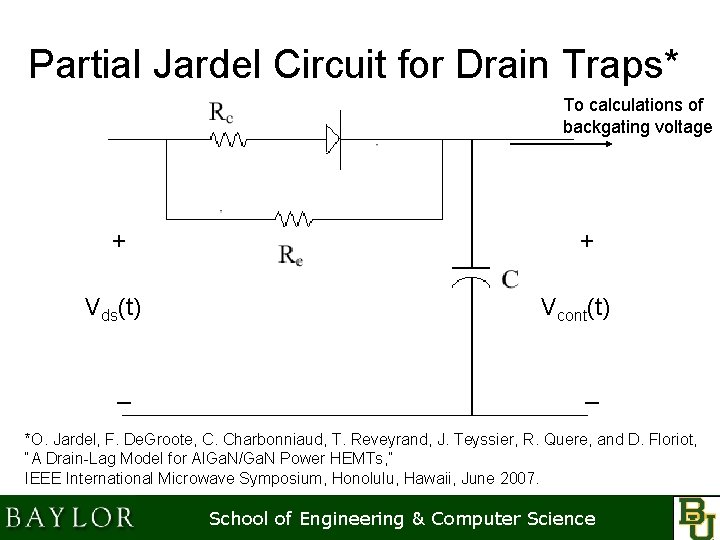
Partial Jardel Circuit for Drain Traps* To calculations of backgating voltage + Vds(t) _ + Vcont(t) _ *O. Jardel, F. De. Groote, C. Charbonniaud, T. Reveyrand, J. Teyssier, R. Quere, and D. Floriot, “A Drain-Lag Model for Al. Ga. N/Ga. N Power HEMTs, ” IEEE International Microwave Symposium, Honolulu, Hawaii, June 2007. School of Engineering & Computer Science
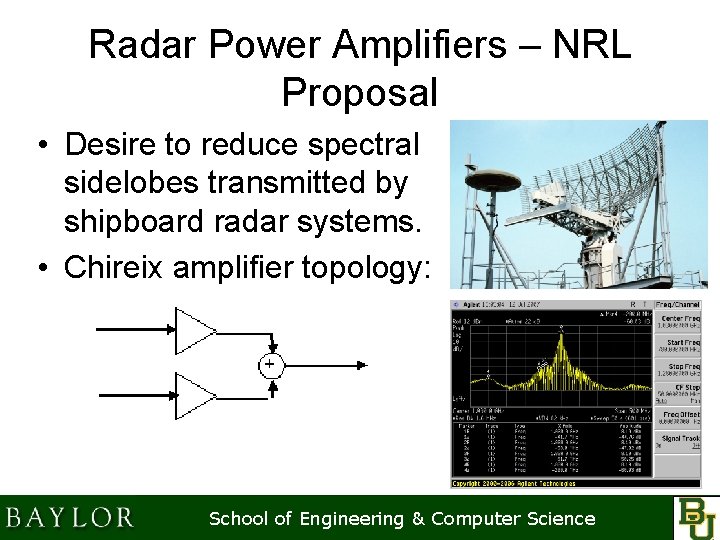
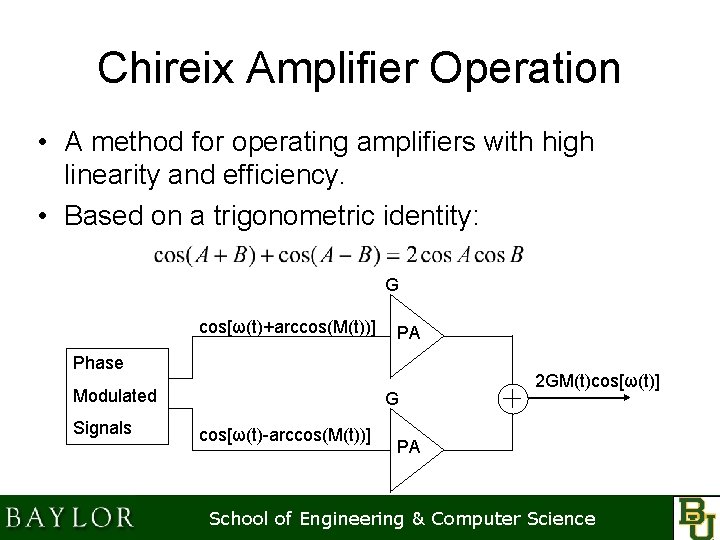
Radar Power Amplifiers – NRL Proposal • Desire to reduce spectral sidelobes transmitted by shipboard radar systems. • Chireix amplifier topology: School of Engineering & Computer Science
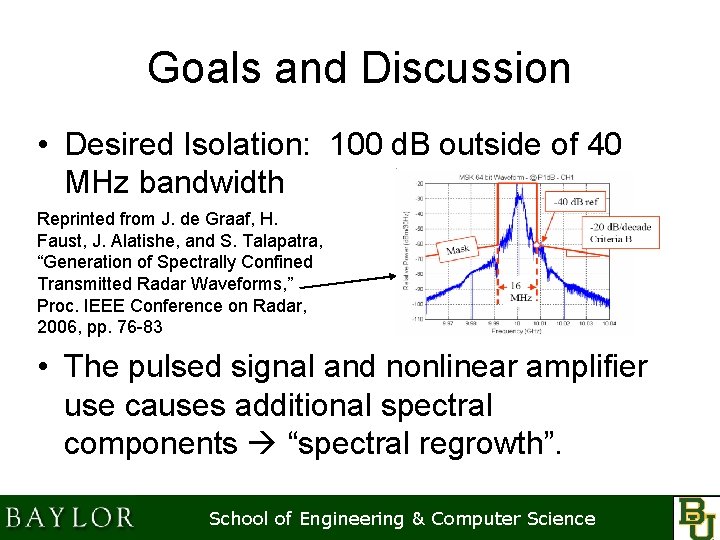
Goals and Discussion • Desired Isolation: 100 d. B outside of 40 MHz bandwidth Reprinted from J. de Graaf, H. Faust, J. Alatishe, and S. Talapatra, “Generation of Spectrally Confined Transmitted Radar Waveforms, ” Proc. IEEE Conference on Radar, 2006, pp. 76 -83 • The pulsed signal and nonlinear amplifier use causes additional spectral components “spectral regrowth”. School of Engineering & Computer Science
Chireix Amplifier Operation • A method for operating amplifiers with high linearity and efficiency. • Based on a trigonometric identity: G cos[ω(t)+arccos(M(t))] PA Phase Modulated Signals G cos[ω(t)-arccos(M(t))] 2 GM(t)cos[ω(t)] PA School of Engineering & Computer Science
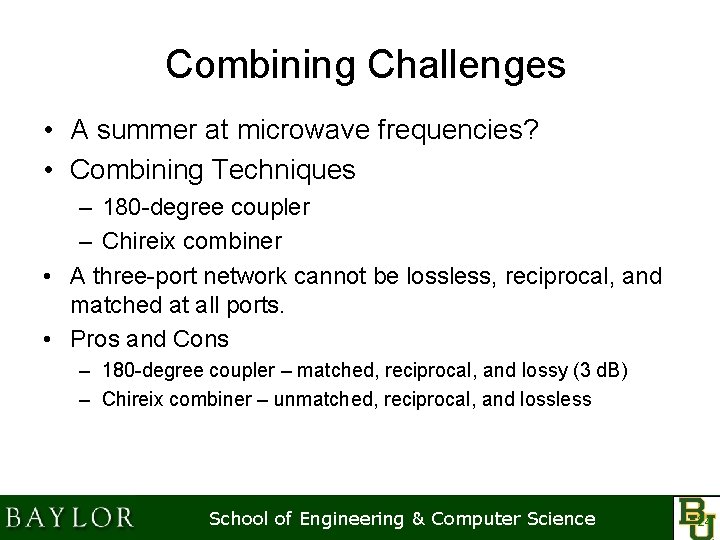
Combining Challenges • A summer at microwave frequencies? • Combining Techniques – 180 -degree coupler – Chireix combiner • A three-port network cannot be lossless, reciprocal, and matched at all ports. • Pros and Cons – 180 -degree coupler – matched, reciprocal, and lossy (3 d. B) – Chireix combiner – unmatched, reciprocal, and lossless School of Engineering & Computer Science 24
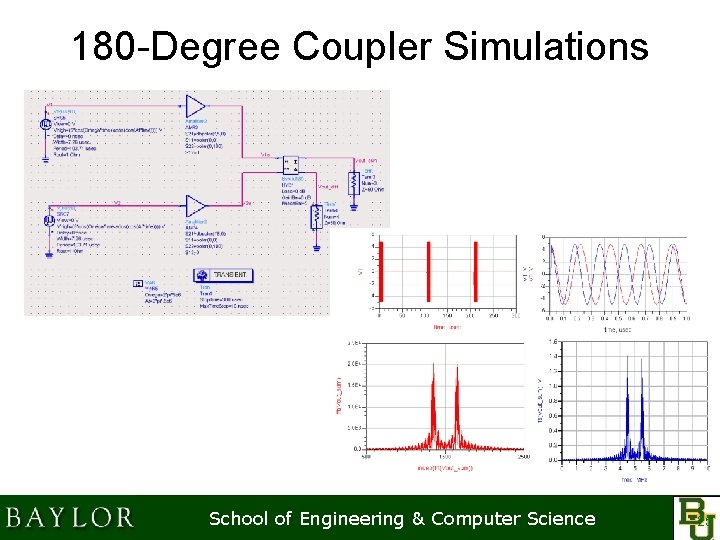
180 -Degree Coupler Simulations School of Engineering & Computer Science 25
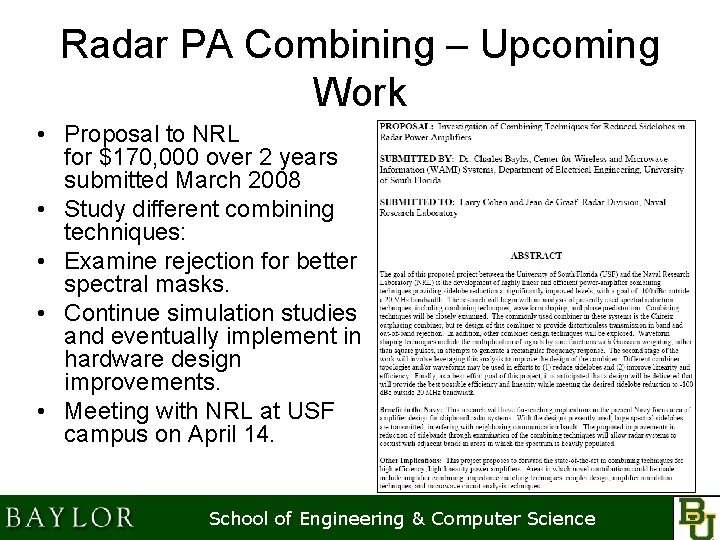
Radar PA Combining – Upcoming Work • Proposal to NRL for $170, 000 over 2 years submitted March 2008 • Study different combining techniques: • Examine rejection for better spectral masks. • Continue simulation studies and eventually implement in hardware design improvements. • Meeting with NRL at USF campus on April 14. School of Engineering & Computer Science
Phase Noise Prediction • Tremendous consequences for system-level design considerations. • Example: Phase Noise in 64 -PSK Amplifier • Transistor 1/f noise is a source of phase noise. • Project Goal: Predicting phase noise accurately in circuits through accurate modeling of 1/f noise. School of Engineering & Computer Science
Demonstration Circuits • Linear Amplifier – Test phase noise prediction at multiple bias currents. – Si BJT, Si. Ge HBT. – Designed circuits presently in test phase. • Frequency Multiplier – Test phase noise prediction due to self-biasing in large-signal operation. – Si BJT, Si. Ge HBT. – Circuits presently in design phase. School of Engineering & Computer Science
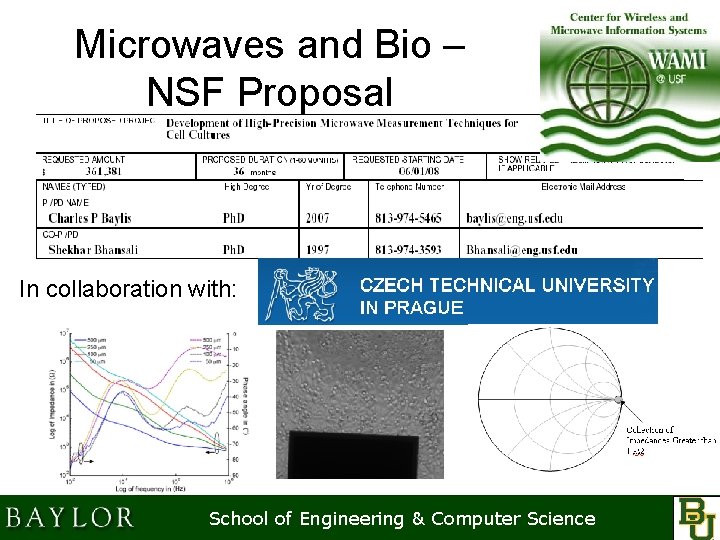
Microwaves and Bio – NSF Proposal In collaboration with: School of Engineering & Computer Science
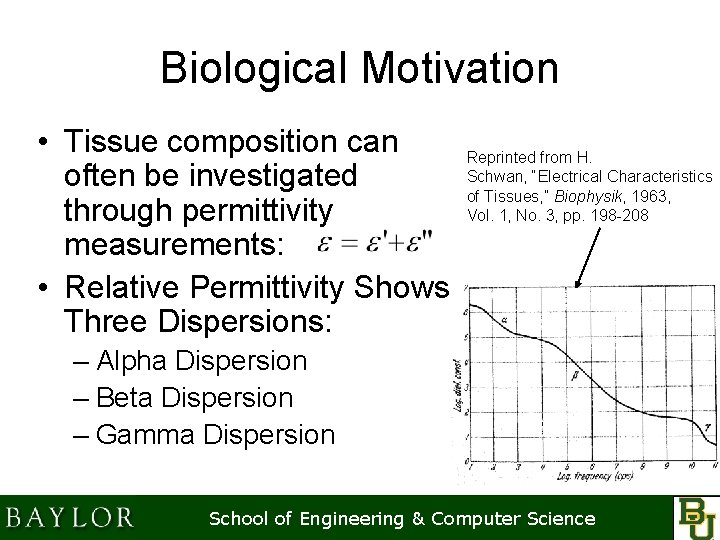
Biological Motivation • Tissue composition can often be investigated through permittivity measurements: • Relative Permittivity Shows Three Dispersions: Reprinted from H. Schwan, “Electrical Characteristics of Tissues, ” Biophysik, 1963, Vol. 1, No. 3, pp. 198 -208 – Alpha Dispersion – Beta Dispersion – Gamma Dispersion School of Engineering & Computer Science
Dispersions • Alpha Dispersion – In k. Hz Range – Ionic diffusion (Foster and Schwan) – Measurable with Low Frequency Impedance Analyzer • Beta Dispersion – Between 1 and 100 MHz – Capacitive charging of the cell membrane (Tamura et al. ) – Can measure above this with microwave techniques • Delta Dispersion – Varying causes – Between 0. 1 and 3 GHz (Foster and Schwan) – Measurable by microwave techniques • Gamma Dispersion – Dipole orientation in water molecules changes (Foster and Schwan) – 20 to 25 GHz (depending on temperature) – Measurable by microwave techniques School of Engineering & Computer Science
Measuring the Water Content of Cells • Above the Beta Dispersion, the cell membrane (a capacitor) appears invisible to the electrical signal. • The measured impedance above the Beta Dispersion is heavily dependent upon the water content of the cells. • Cancer cells often have a higher water content than healthy cells (Foster and Schwan). School of Engineering & Computer Science
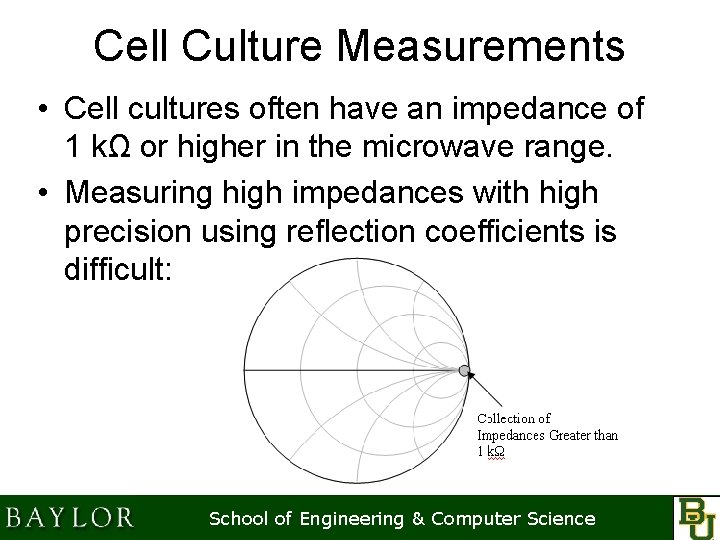
Cell Culture Measurements • Cell cultures often have an impedance of 1 kΩ or higher in the microwave range. • Measuring high impedances with high precision using reflection coefficients is difficult: School of Engineering & Computer Science
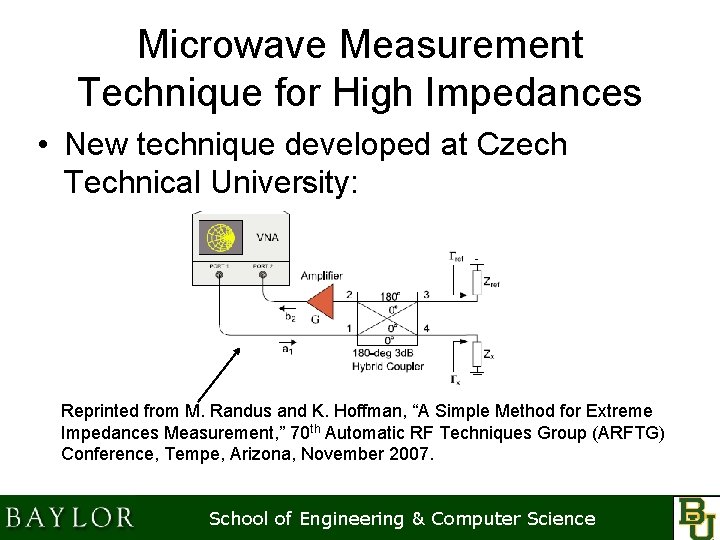
Microwave Measurement Technique for High Impedances • New technique developed at Czech Technical University: Reprinted from M. Randus and K. Hoffman, “A Simple Method for Extreme Impedances Measurement, ” 70 th Automatic RF Techniques Group (ARFTG) Conference, Tempe, Arizona, November 2007. School of Engineering & Computer Science
Future Research • Presently constructing system to verify method of Randus and Hoffman on large impedances. • Modify cell culture impedance measurement setup of Prof. Shekhar Bhansali to perform microwave measurements. • Examine applications (i. e. clinical detection of cancer) School of Engineering & Computer Science
Conclusions • An ambitious first-year approach has allowed expansion of USF’s modeling and characterization program into design and biological applications. • A good industry base has been built, and agency proposals are being generated. • A significant number of publications, as well as additional agency and industry proposals, are expected to be generated from the present work. School of Engineering & Computer Science
Acknowledgments • Larry Cohen and Jean de Graaf, Naval Research Laboratory • Christopher Reul, USF • Brent Seward, USF • Nathaniel Varney, USF • Dorielle Price, USF • Dr. Shekhar Bhansali, USF • Dr. Larry Dunleavy, USF and Modelithics, Inc. • Martin Randus, Czech Technical Institute • Dr. Karel Hoffman, Czech Technical Institute School of Engineering & Computer Science
Thank you for your time and attention! School of Engineering & Computer Science