
Improving the Reliability of Commodity Operating Systems Proc
Improving the Reliability of Commodity Operating Systems Proc. of 19 th ACM Symposium on Operating Systems Principles, 2003. Swift, M. M. , Bershad, B. N. , & Levy, H. M. , (Also appeared in ACM Transactions on Computer Systems, 22(4), 2004). Presented by Hari K. Pyla
Outline • • 2 Introduction Previous work Motivation Nooks Architecture Implementation Performance Analysis and conclusions
Introduction • What issues qualify a good Operating System? – Performance – Functionality – Scalability – Reliability 3
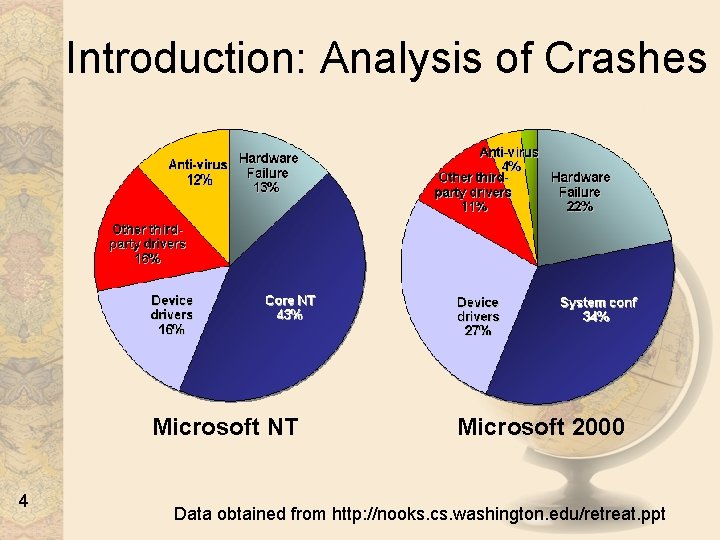
Introduction: Analysis of Crashes Microsoft NT 4 Microsoft 2000 Data obtained from http: //nooks. cs. washington. edu/retreat. ppt
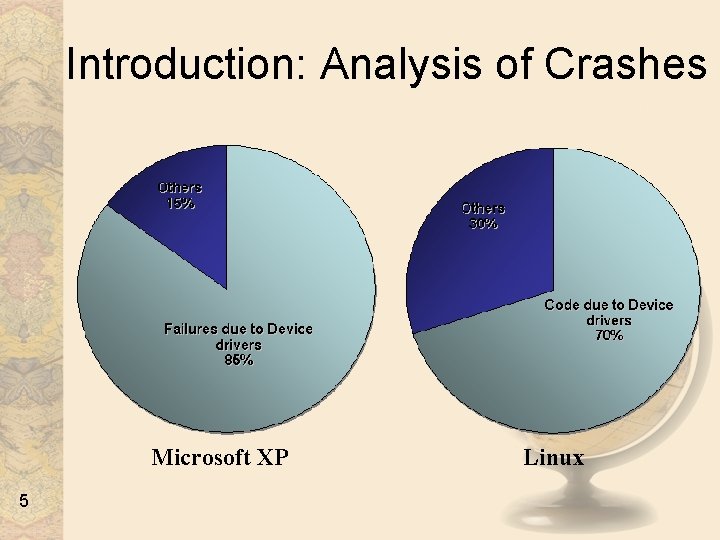
Introduction: Analysis of Crashes Microsoft XP 5 Linux
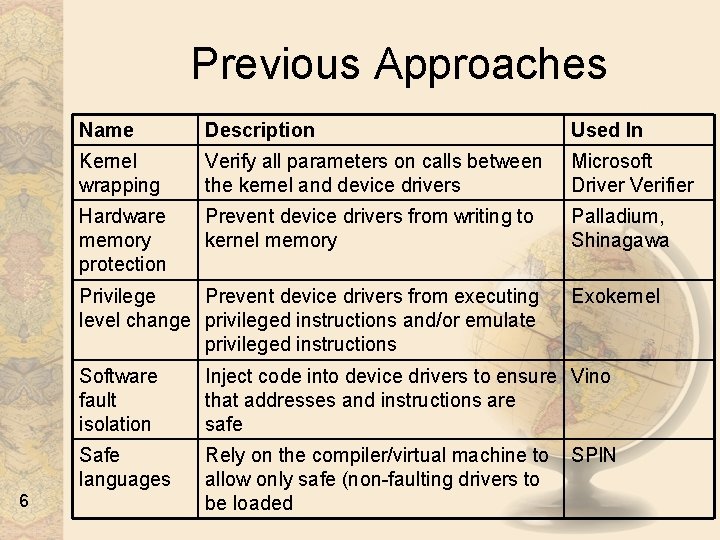
Previous Approaches Name Description Used In Kernel wrapping Verify all parameters on calls between the kernel and device drivers Microsoft Driver Verifier Hardware memory protection Prevent device drivers from writing to kernel memory Palladium, Shinagawa Privilege Prevent device drivers from executing level change privileged instructions and/or emulate privileged instructions 6 Exokernel Software fault isolation Inject code into device drivers to ensure Vino that addresses and instructions are safe Safe languages Rely on the compiler/virtual machine to allow only safe (non-faulting drivers to be loaded SPIN
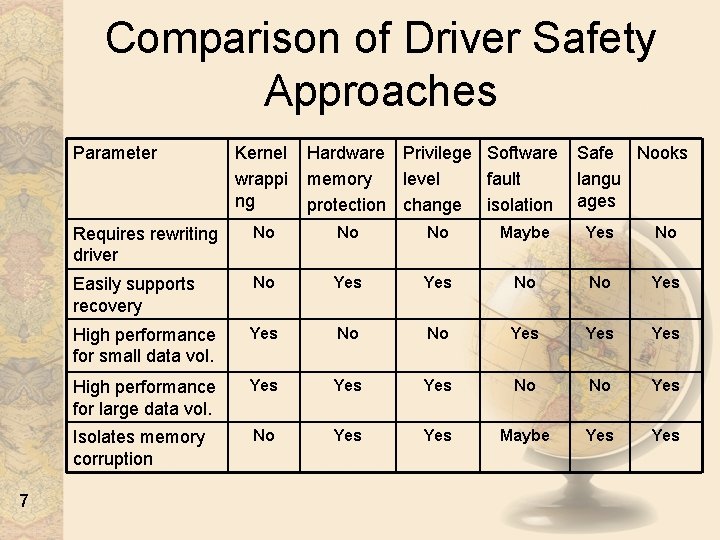
Comparison of Driver Safety Approaches Parameter 7 Kernel wrappi ng Hardware Privilege Software memory level fault protection change isolation Safe Nooks langu ages Requires rewriting driver No No No Maybe Yes No Easily supports recovery No Yes No No Yes High performance for small data vol. Yes No No Yes Yes High performance for large data vol. Yes Yes No No Yes Isolates memory corruption No Yes Maybe Yes
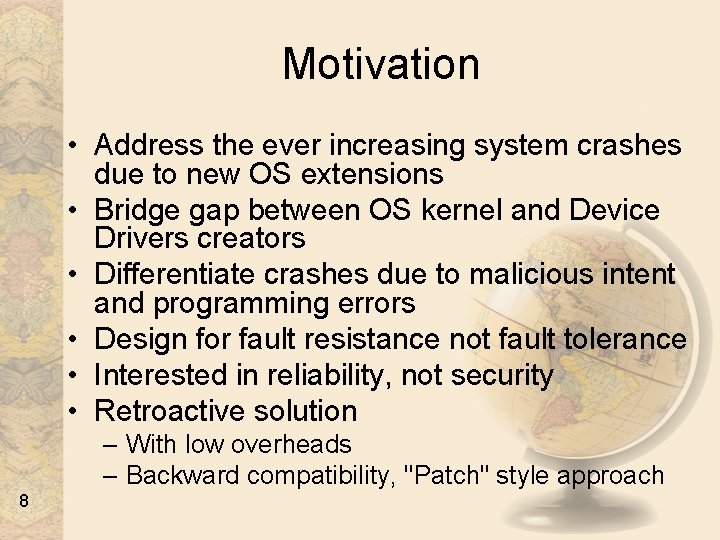
Motivation • Address the ever increasing system crashes due to new OS extensions • Bridge gap between OS kernel and Device Drivers creators • Differentiate crashes due to malicious intent and programming errors • Design for fault resistance not fault tolerance • Interested in reliability, not security • Retroactive solution – With low overheads – Backward compatibility, "Patch" style approach 8
Nooks: Overview • Middleware that isolates OS and device drivers – Reliability subsystem to prevent driver failures – Recovers quickly with no lost application state – Requires only minimal change to the kernel – Requires no source changes for most device drivers 9
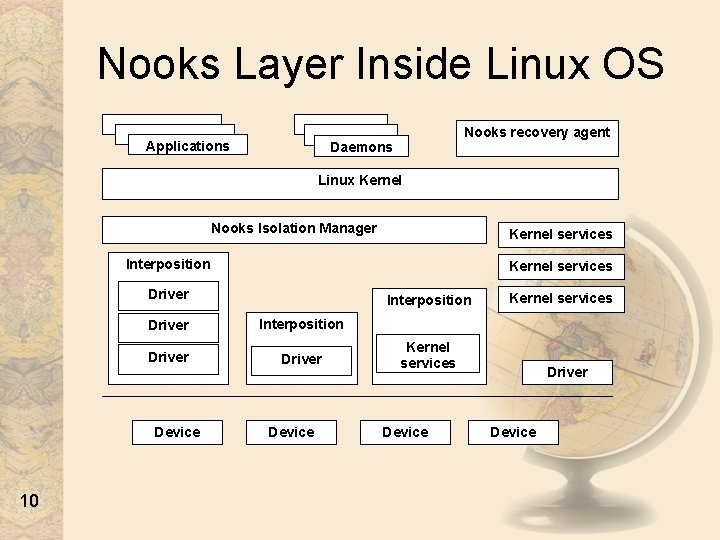
Nooks Layer Inside Linux OS Applications Nooks recovery agent Daemons Linux Kernel Nooks Isolation Manager Kernel services Interposition Kernel services Driver Device 10 Interposition Kernel services Interposition Driver Device Kernel services Device Driver Device

Isolation: Lightweight Kernel Protection Domains • Executes in kernel mode • Is logically part of the kernel • Has read access to kernel data • Has restricted write access to kernel data 11
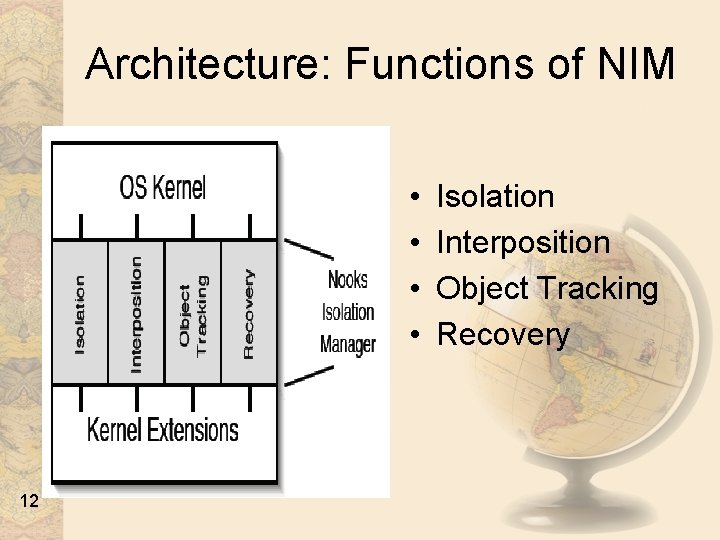
Architecture: Functions of NIM • • 12 Isolation Interposition Object Tracking Recovery
Architecture: "Isolation" in NIM • Functionality Provided – Prevent extension errors from damaging kernel or other extensions – create, manipulate and maintain domains (Protection Domain Management) – Inter domain control transfer • Internals 13 – Memory management (create stacks, heaps, sockets etc. ) – Extension Procedure Call (XPC) e. g. nooks_driver_call() & nooks_kernel_call()
Architecture: "Interposition" • Functionality provided – Transparently integrate extensions into Nooks – Ensure kernel-extension control flow thru XPC – Ensure data transfer between kernel and extension is monitored by object-tracking code • Internals – wrapper stubs – Modified module loader – Modified kernel module initialization code – Function pointers from extension to kernel replaced by wrapper pointers 14
Architecture: "Object Tracking" • Functionality provided – Maintain list of kernel data structures manipulated by an extension – Control modifications to structures – Provide information for cleanup when extensions fail • Internals 15 – Record addresses of kernel objects in use by an extension – Monitor lifetime of objects and perform garbage collection – Maintain per protection domain hash table, current task structure etc.
Architecture: "Recovery" • Functionality provided – Determination of whether to trigger recovery or return error code to invoking extension – Detection and recovery of various extension faults (h/w and s/w) • Internals 16 – – – Disable interrupt processing Start user mode recovery agent release resources in use by extension change configuration Replace, reload and restart extensions
Working of Nooks: An Example 17 • New USB device connected: driver gets loaded • Loader invokes Nooks wrapper stubs at Nooks kernel runtime interface • Wrapper intercepts the call invoking object tracking code – manage parameters passed between the kernel and driver or vice versa – Wrapper transfers control from caller’s to callee’s domain and vice versa using XPC • Neither driver nor kernel is aware of existence of Nooks layer!
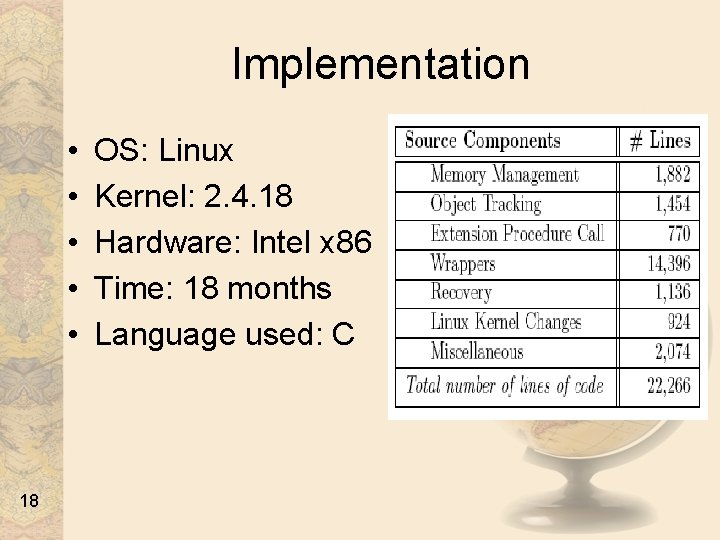
Implementation • • • 18 OS: Linux Kernel: 2. 4. 18 Hardware: Intel x 86 Time: 18 months Language used: C
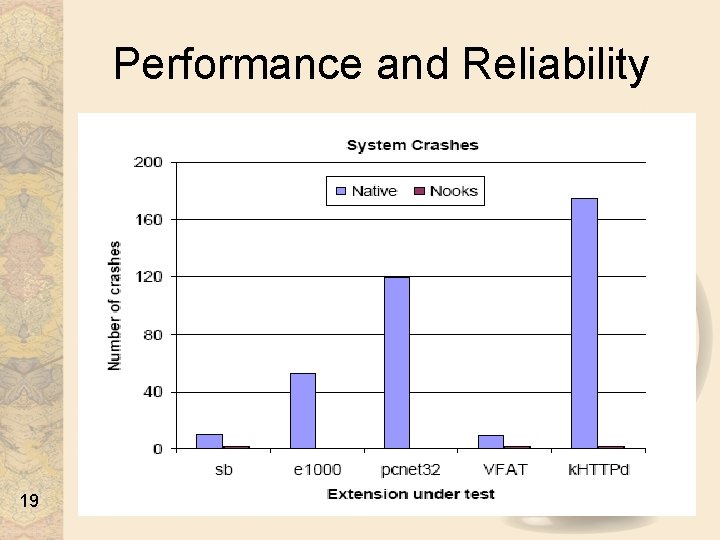
Performance and Reliability 19
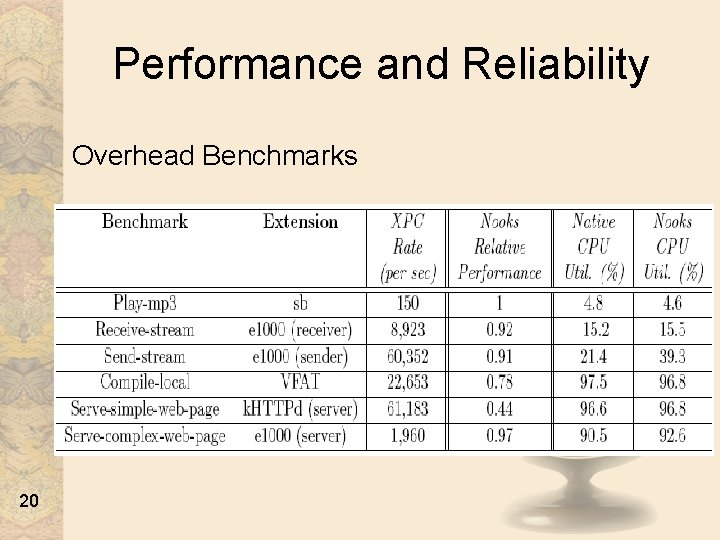
Performance and Reliability Overhead Benchmarks 20
Nooks: Limitations • Does not provide complete fault tolerance • Cannot prevent extensions from deliberately executing privileged instructions • Does not prevent infinite loops inside extensions • Can perform only a static check in terms of parameters passed • Recovery is limited to drivers that can be killed and restarted safely 21
Analysis and Conclusions • Drivers limit OS reliability, are major source of failures • OS should remove dependence on driver safety • Existing OS can be extended to run existing driver code safely • Nooks philosophy is practical and can be easily incorporated • Nooks lightweight kernel protection domains support reliable driver execution by 22 • Preventing kernel corruption • Supporting existing driver API

Thank you 23
- Slides: 23