
Improving the Hydrophobicity of Fabrics with the Use
Improving the Hydrophobicity of Fabrics with the Use of Phosphonic Acids Craig Barretto, Jonathan P. Chen, Ishaan Desai, Samuel Finegold, Aamod George, Madeleine Hu, Karen Nan, Rei Otake, Amrita Rao, Carli Smolen, Lu Yin, David Zhao Supervisor: Dr. Michael Avaltroni Assistant: Darius Rackus
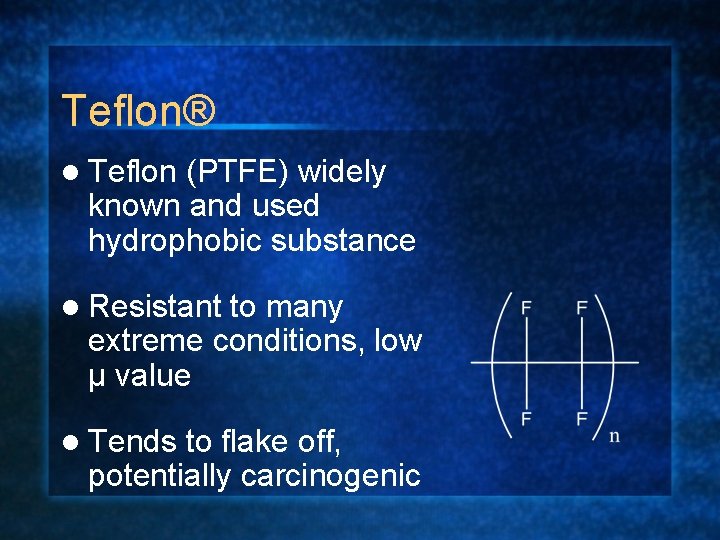
Teflon® l Teflon (PTFE) widely known and used hydrophobic substance l Resistant to many extreme conditions, low µ value l Tends to flake off, potentially carcinogenic
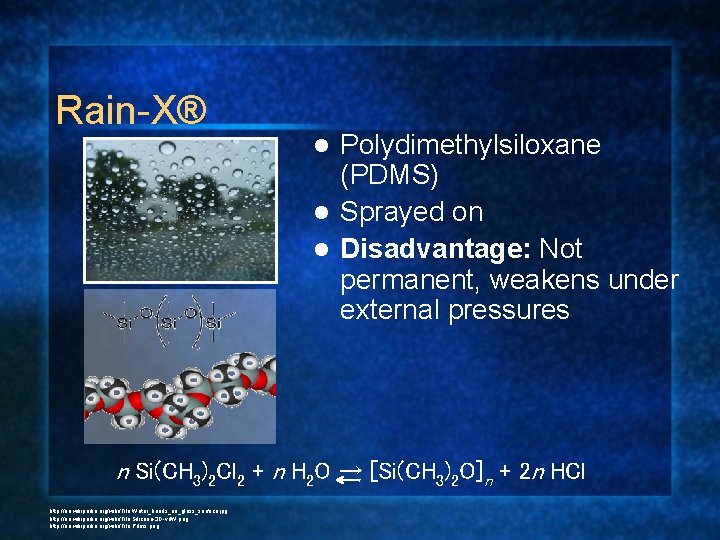
Rain-X® Polydimethylsiloxane (PDMS) l Sprayed on l Disadvantage: Not permanent, weakens under external pressures l n Si(CH 3)2 Cl 2 + n H 2 O → [Si(CH 3)2 O]n + 2 n HCl http: //en. wikipedia. org/wiki/File: Water_beads_on_glass_surface. jpg http: //en. wikipedia. org/wiki/File: Silicone-3 D-vd. W. png http: //en. wikipedia. org/wiki/File: Pdms. png
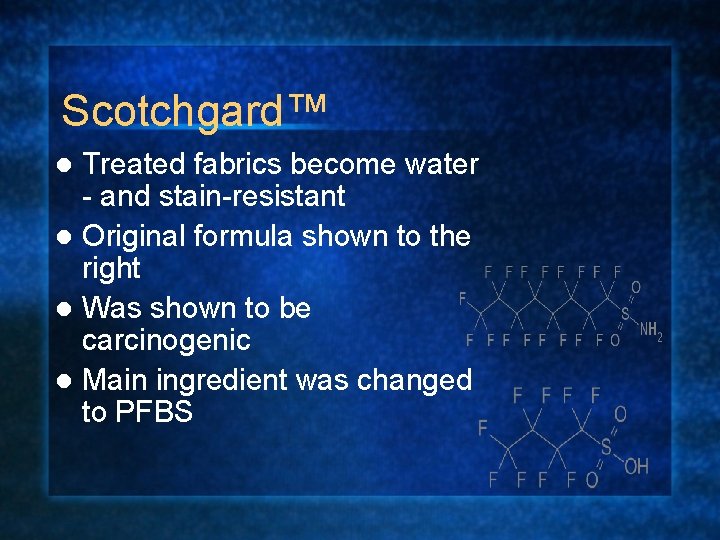
Scotchgard™ Treated fabrics become water - and stain-resistant l Original formula shown to the right l Was shown to be carcinogenic l Main ingredient was changed to PFBS l
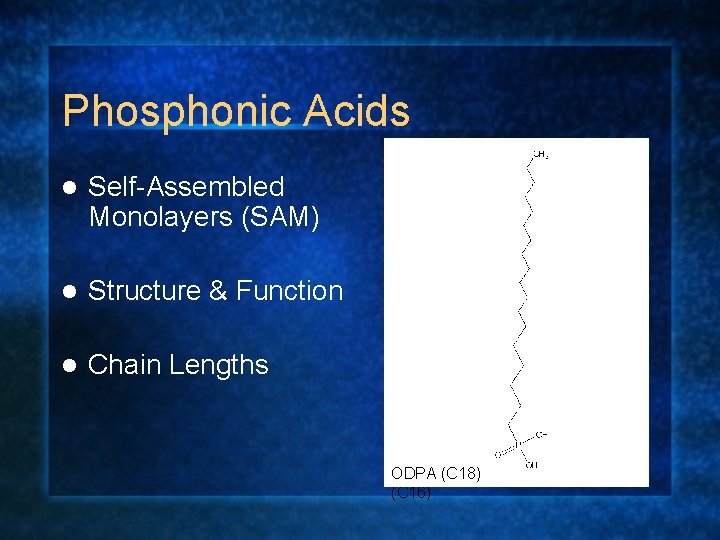
Phosphonic Acids l Self-Assembled Monolayers (SAM) l Structure & Function l Chain Lengths ODPA HPA DDPA TDPA HDPA (C 6) (C 14) (C 12) (C 18) OPA (C 10) (C 8) (C 16)
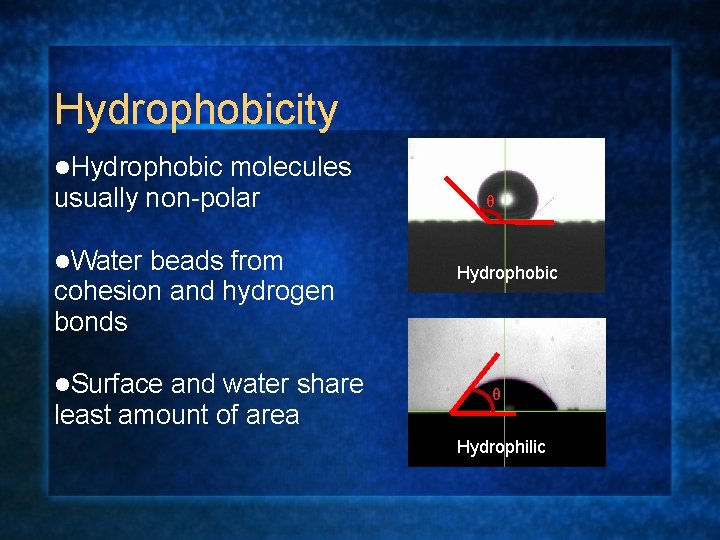
Hydrophobicity l. Hydrophobic molecules usually non-polar l. Water beads from cohesion and hydrogen bonds l. Surface and water share least amount of area θ Hydrophobic θ Hydrophilic
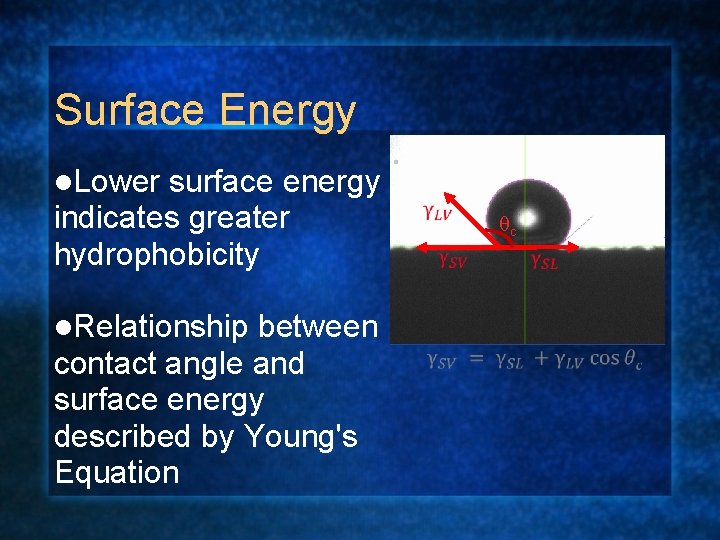
Surface Energy l. Lower surface energy indicates greater hydrophobicity l. Relationship between contact angle and surface energy described by Young's Equation θc
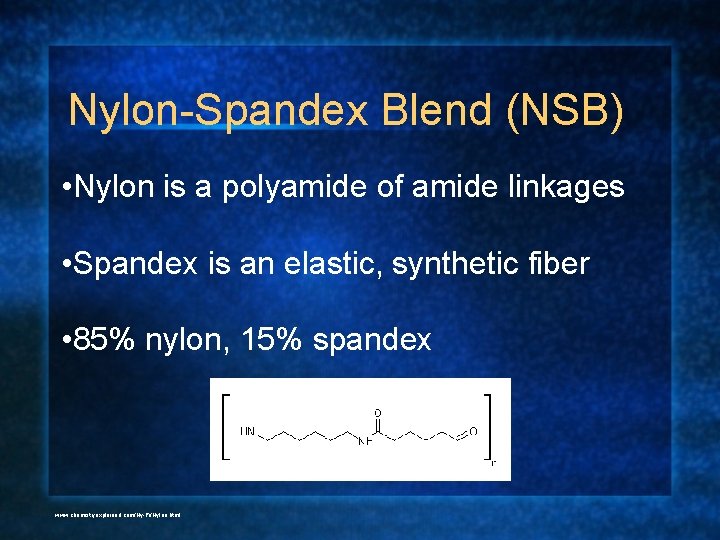
Nylon-Spandex Blend (NSB) • Nylon is a polyamide of amide linkages • Spandex is an elastic, synthetic fiber • 85% nylon, 15% spandex www. chemistryexplained. com/Ny-Pi/Nylon. html
Purpose and Hypothesis l Optimal phosphonic acid and procedure to coat fabric Increase hydrophobicity n Speed up binding process n l Develop more hydrophobic swimwear http: //1. bp. blogspot. com/_ou. C 92 wv. ILSw/SIFspwm. W_BI/AAAACc. Y/m. Yej 0 D 2 f. YMg/s 400/Natural+water+drop+in+the+leaf. jpg
Preliminary Tests on NSB l Qualitative hydrophobicity test l Heat resistance tests: n Conventional oven, iron, microwave, heat gun l Tests to see how NSB handled the solution NSB being ironed www. asia. ru/images/target/photo/51646912/Steam_Iron. jpg
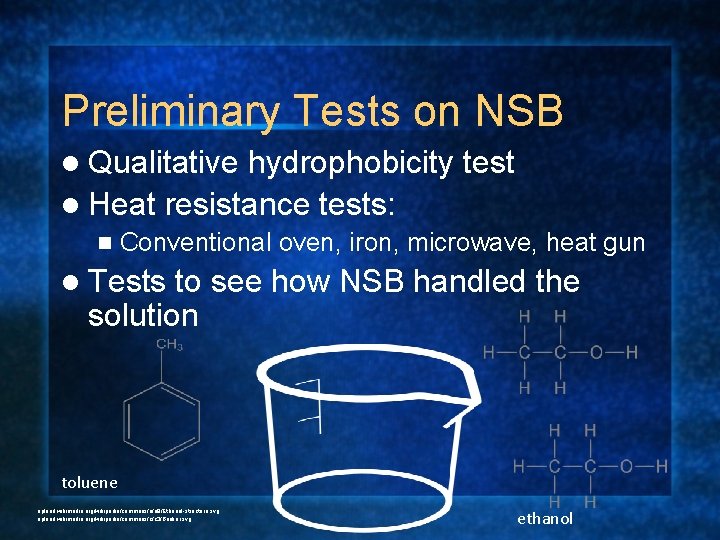
Preliminary Tests on NSB l Qualitative hydrophobicity test l Heat resistance tests: n Conventional oven, iron, microwave, heat gun l Tests to see how NSB handled the solution toluene upload. wikimedia. org/wikipedia/commons/e/e 8/Ethanol-structure. svg upload. wikimedia. org/wikipedia/commons/c/c 3/Beaker. svg ethanol
Chain Length Tests on Glass Slides l Solution l 3 dropped on and spread heating methods for dehydration l Contact angles measured
NSB Hydrophobicity l Dipped l 3 in solution then air dried heating methods for dehydration l Contact angles measured
Cotton Testing Procedure l Dipped in ODPA and air dried l Heated using iron and microwave l Six coatings applied l Contact angles measured
Exposure Tests l Tests n Washing Machine n Chlorinated Water n Deionized Water Control l C 18 l 3 heating methods www. toondoo. com/cartoon/557143
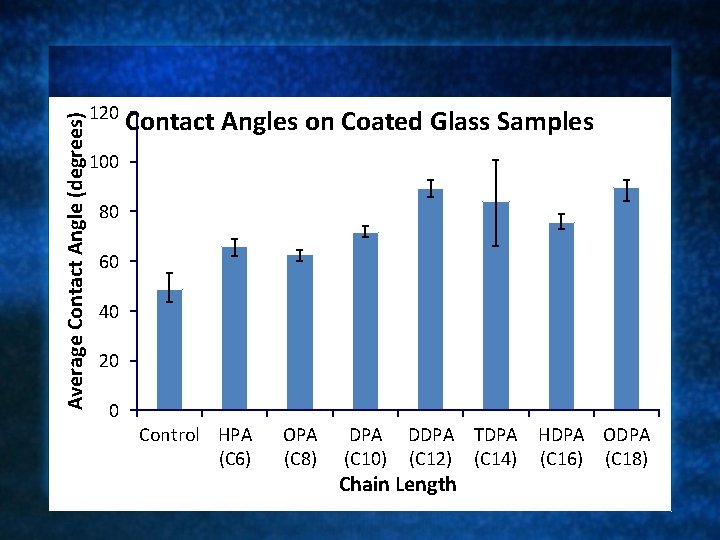
Average Contact Angle (degrees) 120 Contact Angles on Coated Glass Samples 100 80 60 Glass Results 40 20 0 Control HPA (C 6) OPA (C 8) DPA (C 10) DDPA TDPA (C 12) (C 14) Chain Length HDPA ODPA (C 16) (C 18)
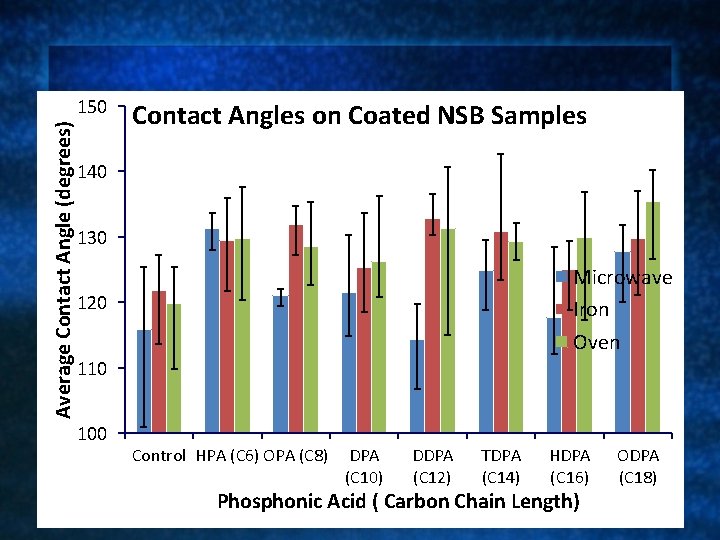
Average Contact Angle (degrees) 150 Contact Angles on Coated NSB Samples 140 130 NSB Results Microwave Iron Oven 120 110 100 Control HPA (C 6) OPA (C 8) DPA (C 10) DDPA (C 12) TDPA (C 14) HDPA (C 16) Phosphonic Acid ( Carbon Chain Length) ODPA (C 18)
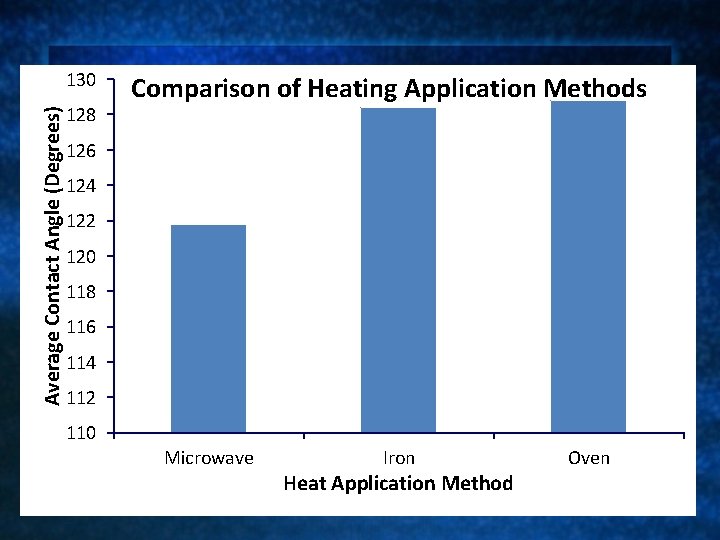
128 Comparison of Heating Application Methods 126 124 Contact Angle (Degrees) Average Contact Angle (Degrees) 130 122 120 118 Comparison of Effectiveness of Drying Methods 116 114 112 110 Microwave Iron Heat Application Method Oven
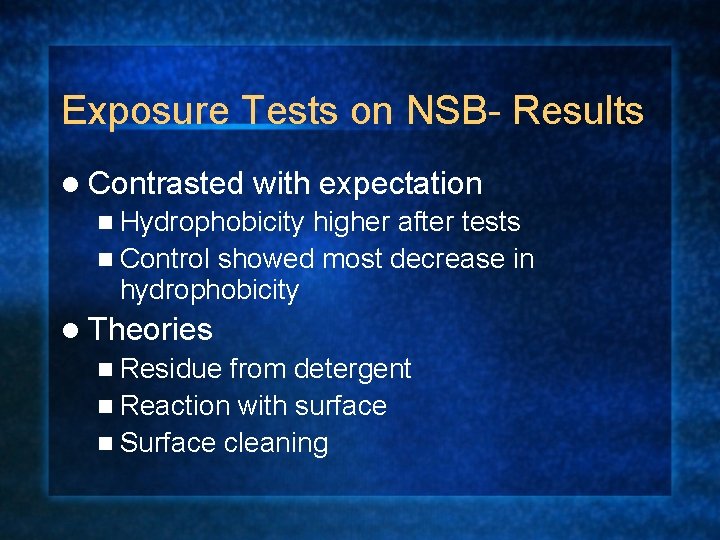
Exposure Tests on NSB- Results l Contrasted with expectation n Hydrophobicity higher after tests n Control showed most decrease in hydrophobicity l Theories n Residue from detergent n Reaction with surface n Surface cleaning
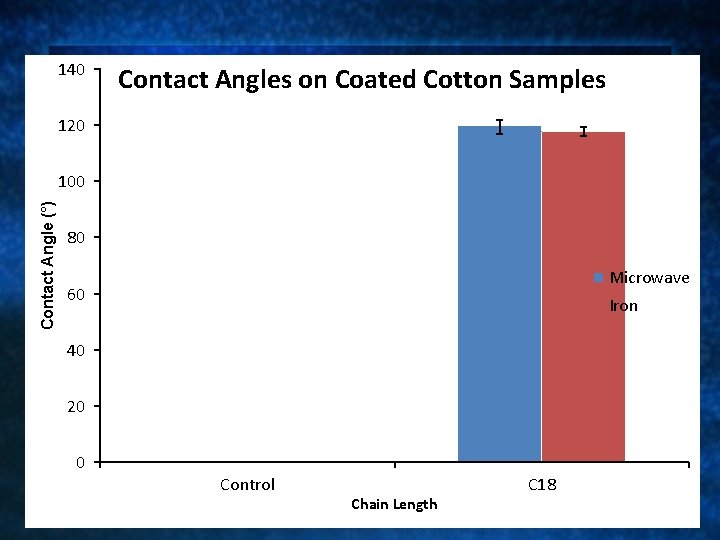
140 Contact Angles on Coated Cotton Samples 120 Contact Angle (°) 100 80 Microwave 60 Iron 40 20 0 Control Chain Length C 18
Future Work l More samples to confirm findings l More chain lengths used for exposure tests, eg. C-12 and C-14 (worked best on glass) l Multiple coatings to one surface to determine its effects l Different surfaces
Conclusion l Based on the results obtained from this project, it can be concluded that the physical properties of a surface can be permanently altered to increase the hydrophobicity of the surface.

Acknowledgements Thanks to: Dr. Michael Avaltroni Darius Rackus Dr. David Miyamoto Ramé-Hart Instrument Company John and Laura Overdeck Sponsors of NJGSS 2010 Program Bayer Health. Care Bristol-Myers Squibb Novartis
Questions?
- Slides: 24