
Improving the classroom environment How to improve classroom


- Slides: 12
Improving the classroom environment • How to improve classroom environment? • My classroom is so unwelcoming and dull! Even I feel my spirits sinking when I walk in. Goodness knows how the learners feel. • Page 23 -25 should be read
Being yourself • What does Authenticity mean?
• Authenticity means behaving in a way that is appropriately real, appropriately you - letting the students see something of your genuine/real reactions to things, your moods and your natural behaviour, rather than covering everything up in a performance.
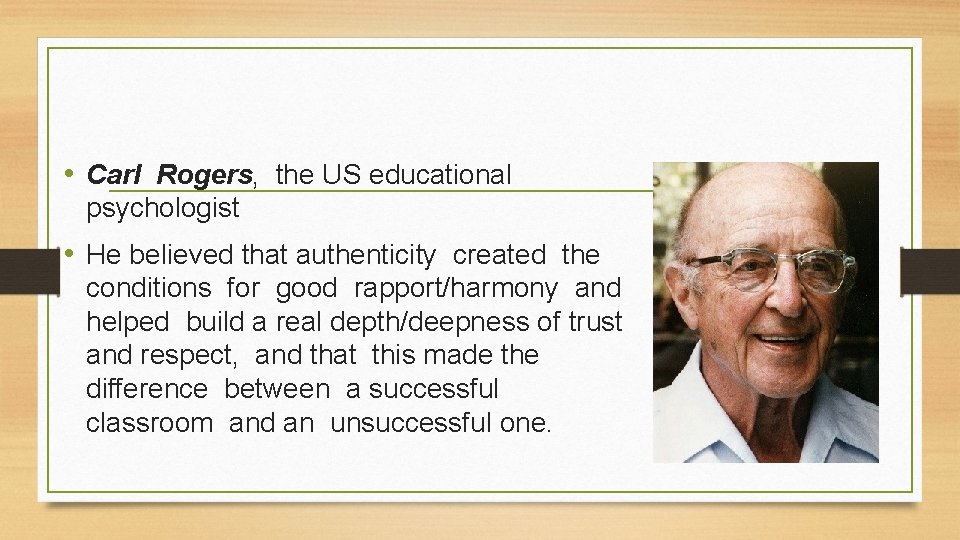
• Carl Rogers, the US educational psychologist • He believed that authenticity created the conditions for good rapport/harmony and helped build a real depth/deepness of trust and respect, and that this made the difference between a successful classroom and an unsuccessful one.
• • • * Five steps to authenticity 1. Don't try to be a 'teacher‘ 2. Have real conversations 3. Don't pretend omniscience 4. Be wary of staffroom advice 5. Be appropriately authoritative
• 1. Don't try to be a 'teacher' • Stop yourself whenever you find yourself behaving more as a job title rather than as yourself. Don't speak as if you are some sort of official mouthpiece for the teaching profession or your school. Don't seek out additional ways of differentiating yourself as a teacher.
• 2 Have real conversations • When you chat informally with a student, make it a rea. I conversation, where you really listen to what they have to say and respond appropriately. Give your own genuine personal reactions to student comments. If something a student says makes you disagree, say so, instead of • 'Hmrnm, interesting'.
• 3. Don't pretend omniscience • If you don't know an answer to a question, say that, rather than pretending that you do know or confusing students with roundabout explanations and avoidances.
• 4. Be wary of staffroom advice • Colleagues may tell you that being genuinely warm and friendly with students is dangerous, or that it is essential for a teacher to keep up a front- as someone reserved, formal and a little distant. Their comments are probably well-intentioned, but treat such advice cautiously, and make sure you think it through for yourself before you decide to follow it.
• 5. Be appropriately authoritative • Being authentic doesn't mean abdicating/abandon the responsibilities and duties of a teacher. You can still give all the instructions, set all the homework and all the things that you need to do. You can be appropriately authoritative. The difference is that it is you being authoritative, not you using the cloak/mask of teacher superiority and hierarchical authority to do it.
• Page 28 -35 should be read