
Improving students learning with effective learning techniques Promising
- Slides: 15
Improving students’ learning with effective learning techniques: Promising directions from cognitive and educational psychology John Dunlosky 1, Katherine A. Rawson 1, Elizabeth J. Marsh 2, Mitchell J. Nathan 3, and Daniel T. Willingham 4 1 Department of Psychology, Kent State University; 2 Department of Psychology and Neuroscience, Duke University; 3 Department of Educational Psychology, Department of Curriculum & Instruction, and Department of Psychology, University of Wisconsin–Madison; and 4 Department of Psychology, University of Virginia Psychological Science in the Public Interest, 14(1), 4 -58 Summarised by Elizabeth Angstmann (no affiliation!) at PERf. ECT Journal Club
Overview • Meta-analysis of effectiveness of techniques students use to study • From cognitive science literature (not about physics, applies to all subjects with exams) • The techniques include elaborative interrogation, self-explanation, summarization, highlighting (or underlining), the keyword mnemonic, imagery use for text learning, rereading, practice testing, distributed practice, and interleaved practice.
Quote from start of paper If simple techniques were available that teachers and students could use to improve student learning and achievement, would you be surprised if teachers were not being told about these techniques and if many students were not using them? What if students were instead adopting ineffective learning techniques that undermined their achievement, or at least did not improve it? Shouldn’t they stop using these techniques and begin using ones that are effective?
Another quote Note, however, that although gaining factual knowledge is not considered the only or ultimate objective of schooling, we unabashedly consider efforts to improve student retention of knowledge as essential for reaching other instructional objectives; if one does not remember core ideas, facts, or concepts, applying them may prove difficult, if not impossible. Students who have forgotten principles of algebra will be unable to apply them to solve problems or use them as a foundation for learning calculus (or physics, economics, or other related domains), and students who do not remember what operant conditioning is will likely have difficulties applying it to solve behavioral problems. We are not advocating that students spend their time robotically memorizing facts; instead, we are acknowledging the important interplay between memory for a concept on one hand the ability to comprehend apply it on the other.
Elaborative interrogation Asking “why” a lot. We rate elaborative interrogation as having moderate utility. Further research demonstrating the efficacy of elaborative interrogation in representative educational contexts would also be useful.
Self-explanation Somewhat similar to elaborative interrogation. The core component of self-explanation involves having students explain some aspect of their processing during learning. We rate self-explanation as having moderate utility. Although most research has shown effects of self-explanation with minimal training, some results have suggested that effects may be enhanced if students are taught how to effectively implement the self-explanation strategy. One final concern has to do with the nontrivial time demands associated with self-explanation, at least at the dosages examined in most of the research that has shown effects of this strategy.
Summarization Students write summaries of to-be-learned texts. Successful summaries identify the main points of a text and capture the gist of it while excluding unimportant or repetitive material. On the basis of the available evidence, we rate summarization as low utility.
Highlighting and underlining When students themselves are asked about what they do when studying, they commonly report underlining, highlighting, or otherwise marking material as they try to learn it. On the basis of the available evidence, we rate highlighting and underlining as having low utility.
The keyword mnemonic This is more relevant for learning languages. To use this mnemonic, the student would first find an English word that sounds similar to the foreign cue word, such as dentist for “la dent” or cliff for “la clef. ” The student would then develop a mental image of the English keyword interacting with the English translation. On the basis of the literature reviewed above, we rate the keyword mnemonic as low utility.
Imagery use for text learning Students were told to read the text and to mentally imagine the content of each paragraph using simple and clear mental images. Imagery instructions were also crossed with drawing: Some students were instructed to draw pictures that represented the content of each paragraph, and others did not draw. The benefits of imagery are largely constrained to imagery-friendly materials and to tests of memory, and further demonstrations of the effectiveness of the technique (across different criterion tests and educationally relevant retention intervals) are needed. Accordingly, we rated the use of imagery for learning text as low utility.
Rereading sections of the textbook. Based on the available evidence, we rate rereading as having low utility. Although rereading is relatively economical with respect to time demands and training requirements when compared with some other learning techniques, rereading is also typically much less effective.
Practice testing Testing is likely viewed by many students as an undesirable necessity of education, and we suspect that most students would prefer to take as few tests as possible. This view of testing is understandable, given that most students’ experience with testing involves high-stakes summative assessments that are administered to evaluate learning. This view of testing is also unfortunate, because it overshadows the fact that testing also improves learning. Note that we use the term practice testing here (a) to distinguish testing that is completed as a low-stakes or no-stakes practice or learning activity outside of class from summative assessments that are administered by an instructor in class, and (b) to encompass any form of practice testing that students would be able to engage in on their own. We rate practice testing as having high utility.
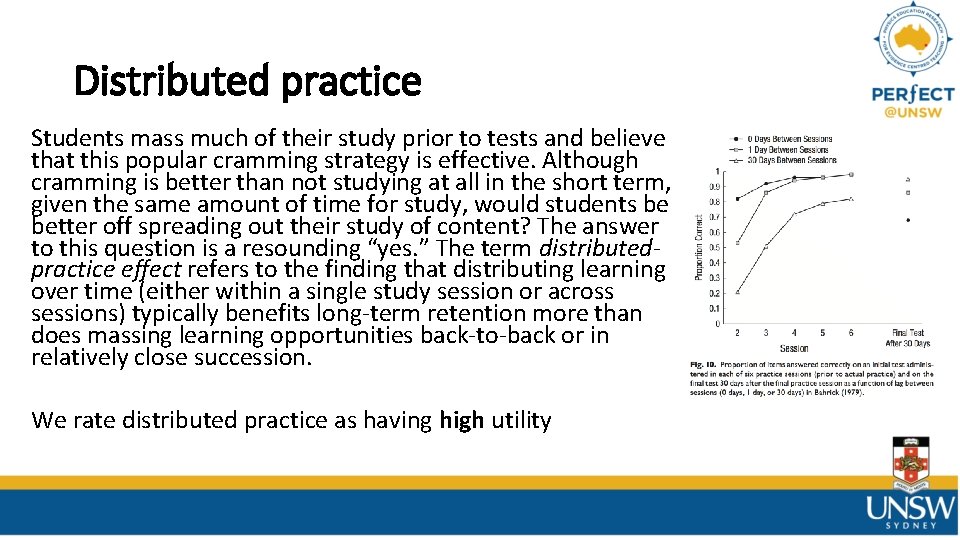
Distributed practice Students mass much of their study prior to tests and believe that this popular cramming strategy is effective. Although cramming is better than not studying at all in the short term, given the same amount of time for study, would students be better off spreading out their study of content? The answer to this question is a resounding “yes. ” The term distributedpractice effect refers to the finding that distributing learning over time (either within a single study session or across sessions) typically benefits long-term retention more than does massing learning opportunities back-to-back or in relatively close succession. We rate distributed practice as having high utility
Interleaved practice, in which students alternate their practice of different kinds of items or problems. We rate interleaved practice as having moderate utility
Take home message • To do well in exams students need to practice answering questions over the term and practice answering questions under test conditions • When designing courses with a heavy reliance on exams we should keep this in mind and provide plenty of opportunities for students to answer questions. This is why we have practice tests in problem solving workshops for Physics 1 A and 1 B and also why students are given the opportunity to practice the in class tests.