
Improving Student Learning One Teacher at a Time
- Slides: 23
Improving Student Learning One Teacher at a Time Jane Pollock Presentation by Jill Allen, Rachel Schneeberger, Georgia Sweetwood, & Susan Urban
Introduction Are students learning in the classroom? Author Jane Pollock explores the Big Four – four principles that teachers must utilize to improve student learning. This strategy takes the “hope” out of teaching. What is an effective teacher? Explore the evidence educators must gather to prove that all students are learning through employing effective teaching strategies. Improving Student Learning One Teacher at a Time will assist teachers to find areas for improvement in the classroom and the resources necessary to get these improvement implemented.
Teaching Today Classrooms today are very different. Public schools open their doors to all children regardless of race, origin, ability, socioeconomic status, or gender. To insure the success of students today, educators must incorporate different learning tools as described in the “Big Four” tenets, especially three, vary assessments, and four, give criterion based feedback. To effectively incorporate these tenets will advance students to higher levels of learning and achievements.
Replacing Hope with Certainty Chapter 1 The Big Four 1. Use a well-articulated curriculum- Rely on learning targets, ones that are robust, not just daily classroom objectives. 2. Plan for delivery- Employ instructional strategies that work to help the learner remember and apply information and skills, not just do schoolwork. 3. Vary assessment- Use varied assessment strategies to clarify learning targets and gather information necessary to achieve these targets. 4. Give criterion-based feedback- Give methodical feedback to students based on learning targets and refine record keeping and reporting.
Evolution of pedagogy Prior to the 19 th century education was religious, to teach theology, or pragmatic, to ensure an economically and socially useful population. Education was based on role in society. Industrial Revolution – required technical education to train workers in specialized occupations. 20 th Century – twofold education: create cultural literacy and patriotism
Researchers & Learning Targets Benjamin Bloom(1956) – Bloom’s taxonomy allowed teachers to discuss student learning based on a set of targets to ensure student success. Roger Mager(1962) - Allowed teachers to write a three part learning objective based on cognitive behavior, condition of learner and acceptable proficiency level. Gronlund (1978) – Suggested that organizing content knowledge moved one from general to specific objective.
Remember Chapter 1 “The most important factor affecting individual student success in schools is the classroom teacher. ” (Marzano, Pickering, & Pollock, 2001)
Learning Targets Chapter 2 Do we use the benchmark, the indicator, or both? Do we use district, state, or National standards?
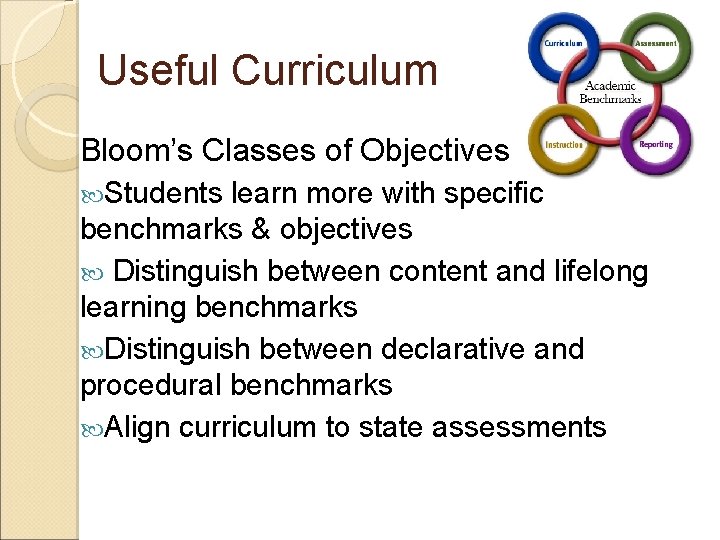
Useful Curriculum Bloom’s Classes of Objectives Students learn more with specific benchmarks & objectives Distinguish between content and lifelong learning benchmarks Distinguish between declarative and procedural benchmarks Align curriculum to state assessments
“Just-Right” Targets Statements that aren’t too broad or too specific 1. Identify standard 2. Locate grade level benchmark � Data improves when students are scored on benchmarks 3. Specific content objectives � Activities connected to each other and to the benchmark � Score activities with a “benchmark” score
Lifelong Learning Benchmarks Most curriculum is based on content areas. 2. Some report cards include study skills such as communication, character, and practice 3. Instruction typically does not support improvement in study skills 1.
Declarative and Procedural Knowledge Declarative Knowledge Procedural Knowledge Content Skill mastery In curriculum documents: ◦ Facts, concepts, generalizations, and principles ◦ understands and knows ◦ Leads to a progression through Bloom’s Requires students to organize facts & information mastery Objective should: ◦ describe the steps that need to be practiced to attain automaticity ◦ Add, compose, sing, draw, or graph Requires tasks of repetition or practice
Curriculum Development Develop every 3 -5 years 1. Make a conceptual timeline 2. Organize meeting times 3. Choose a format and use technology 4. Consult multiple sources 5. Revise, publish, and use
Instruction Planning and Delivery Chapter 3
Varied Classroom Assessment Chapter 4
Feedback, Record Keeping, and Reporting Chapter 5 The final component of the Big Four is to give Methodical, Criterionbased feedback to individual student.
Think about student improvement rather than assessment Enable students to consider graded assignments as information on way to improve and make gains.
Consider the “Space” students have between lessons and recorded grades. Your grade book and how data is tracked is considered the space in between. Examine the number of activities, quizzes, homework etc. one has for a particular skill to determine when a grade should be placed on the report card.
Focus on Benchmarks rather than Activities Teachers must look into modifying grade books and record-keeping practices. Set up grade books by identifying curriculum benchmarks Available resources: Robert Marzano’s Transforming Grading (2000) Jim Popham’s The Truth About Testing (2001)
Give Timely Feedback, Verbal and Written Criterion-based feedback should extend into both verbal and written feedback. Checking for student understanding should also be determined by true cueing and questioning.
Use a Variety of External Measures Create a simple grid called a calibration matrix suggested by Assessment researcher Don Burger. Students who receive A’s in class should receive “advanced” scores on state assessments; students with B’s should receive “proficient” scores (personal correspondence, May 2006) Compare scores to ensure classroom grading is accurate.
Conclusion Expect Student Success! 1. Explain to students what they will learn. 2. Acquire meaningful instructional planning and delivery. 3. Create conscious assessments. 4. Use purposeful assessments and feedback strategies.
References Pollock, J. E. (2007). Improving student learning one teacher at a time. Retrieved October 24, 2008, from https: //www. ascd. org/portal/site/ascd/templ ate. book/menuitem. 83 f 4 b 2 b 5537730 a 98 d 7 ea 23161 a 001 ca/? book. Mgmt. Id=2 cd 4 dd 77 a 7 e 91110 Vgn. VCM 1000003 d 01 a 8 c 0 RCRD