
Improving Shared Decision Making Between Clinicians and LGBTQ
Improving Shared Decision Making Between Clinicians and LGBTQ Racial/Ethnic Minority Patients Scott Cook, Marshall Chin, Susanna Howard, Aviva Nathan and Lucy Xu University of Chicago
Disclosures / Funding Agency for Healthcare Research and Quality U 18 HS 023050 Robert Wood Johnson Foundation Finding Answers: Solving Disparities Through Payment and Delivery System Reform
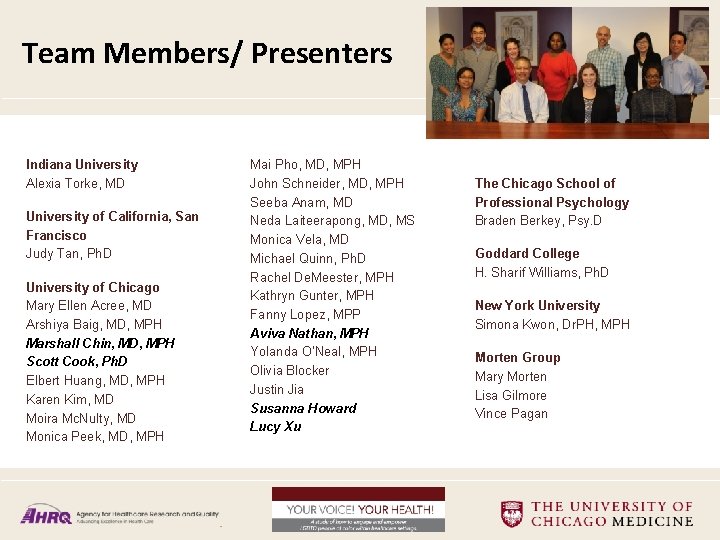
Team Members/ Presenters Indiana University Alexia Torke, MD University of California, San Francisco Judy Tan, Ph. D University of Chicago Mary Ellen Acree, MD Arshiya Baig, MD, MPH Marshall Chin, MD, MPH Scott Cook, Ph. D Elbert Huang, MD, MPH Karen Kim, MD Moira Mc. Nulty, MD Monica Peek, MD, MPH Mai Pho, MD, MPH John Schneider, MD, MPH Seeba Anam, MD Neda Laiteerapong, MD, MS Monica Vela, MD Michael Quinn, Ph. D Rachel De. Meester, MPH Kathryn Gunter, MPH Fanny Lopez, MPP Aviva Nathan, MPH Yolanda O’Neal, MPH Olivia Blocker Justin Jia Susanna Howard Lucy Xu The Chicago School of Professional Psychology Braden Berkey, Psy. D Goddard College H. Sharif Williams, Ph. D New York University Simona Kwon, Dr. PH, MPH Morten Group Mary Morten Lisa Gilmore Vince Pagan
Acknowledgments Harvey Makadon, MD National LGBT Health Education Center www. lgbthealtheducation. org Department of Diversity, Inclusion and Equity The University of Chicago Medicine John Schneider, MD The University of Chicago
Agenda • • • Boundaries – Safe Space Shared Decision Making and Intersectionality Ethical Practice and Culturally Competent Care Case Vignettes – Role Play Report Back Evaluation
Limitations • We do not have all the answers • Many voices – our workshop is a start • All of us will need more practice engaging racial/ethnic minority LGBTQ patients in shared decision making – this workshop is just a start
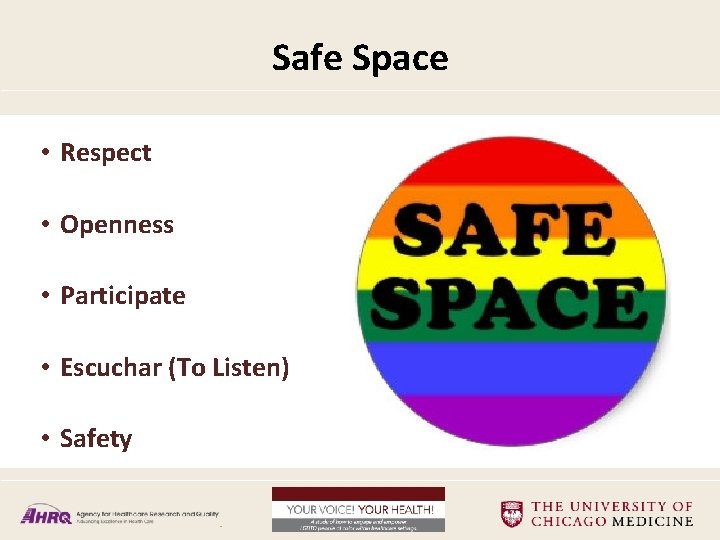
Safe Space • Respect • Openness • Participate • Escuchar (To Listen) • Safety
Shared Decision Making and Intersectionality
Shared Decision-Making and Intersectionality: Race/Ethnicity + LGBT Monica E. Peek, MD, MPH, MSc University of Chicago
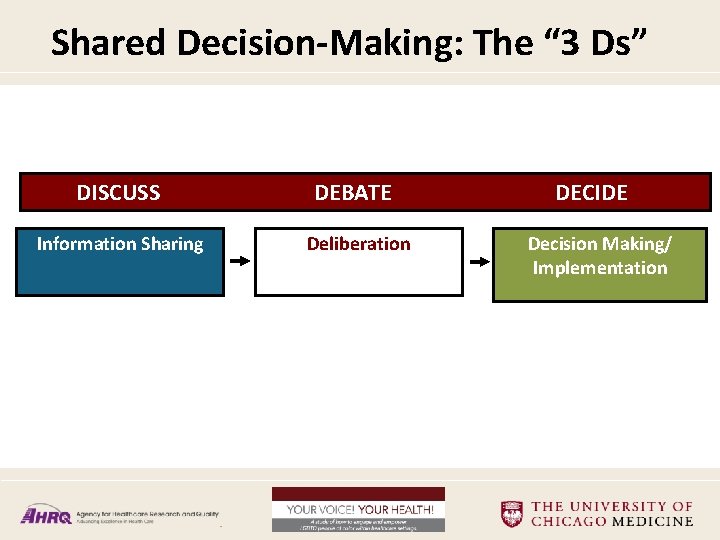
Shared Decision-Making: The “ 3 Ds” DISCUSS DEBATE Information Sharing Deliberation. DECIDE Decision Making/ Implementation
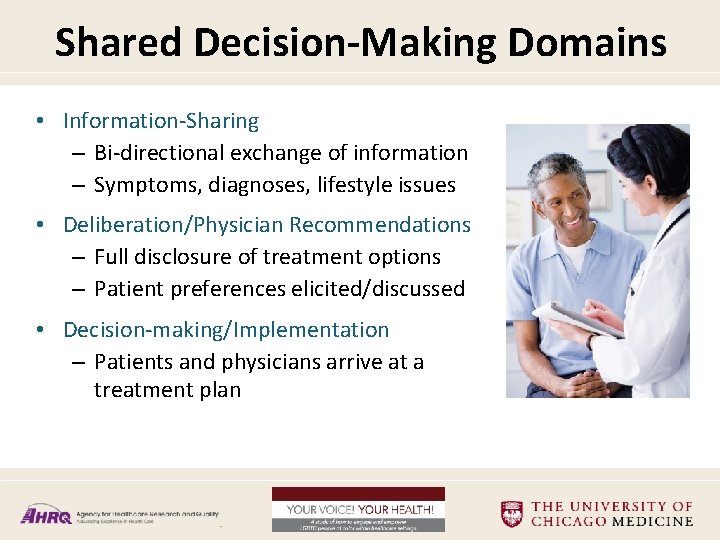
Shared Decision-Making Domains • Information-Sharing – Bi-directional exchange of information – Symptoms, diagnoses, lifestyle issues • Deliberation/Physician Recommendations – Full disclosure of treatment options – Patient preferences elicited/discussed • Decision-making/Implementation – Patients and physicians arrive at a treatment plan
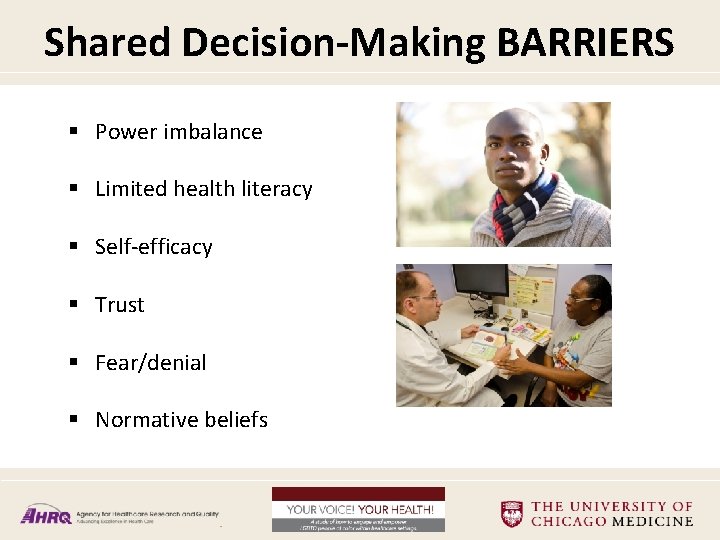
Shared Decision-Making BARRIERS § Power imbalance § Limited health literacy § Self-efficacy § Trust § Fear/denial § Normative beliefs
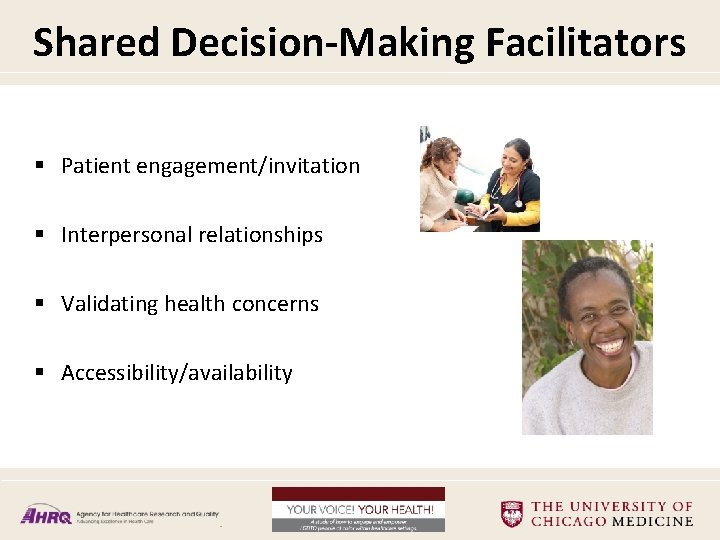
Shared Decision-Making Facilitators § Patient engagement/invitation § Interpersonal relationships § Validating health concerns § Accessibility/availability
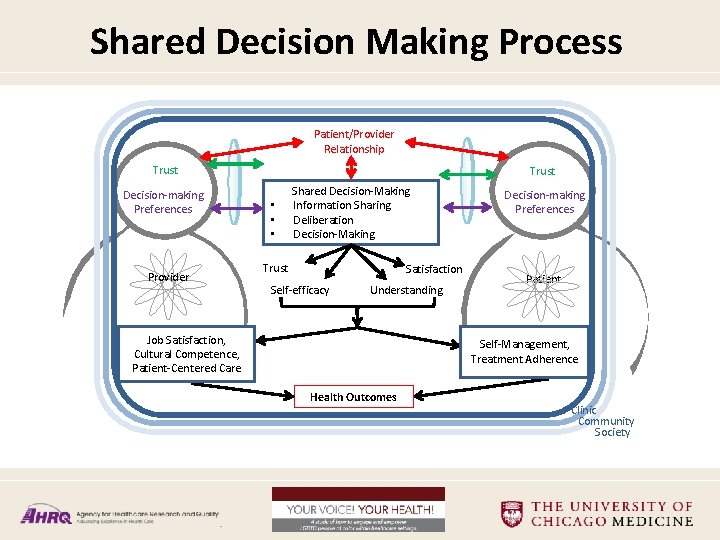
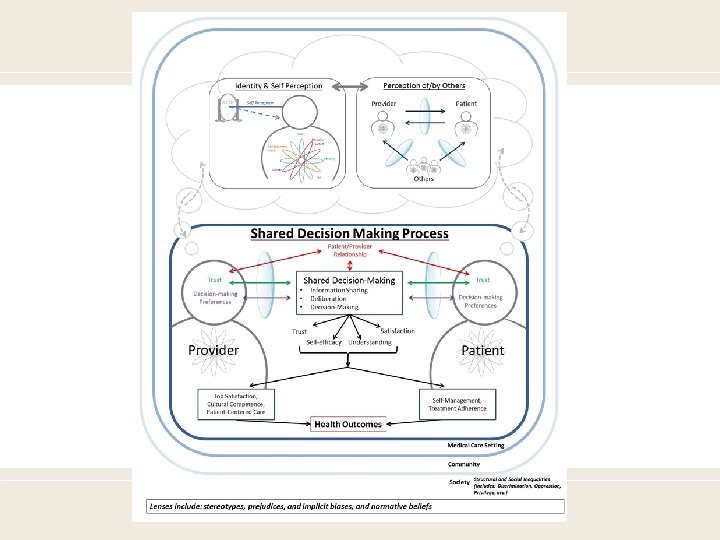
Shared Decision Making Process Patient/Provider Relationship Trust Satisfaction Self-efficacy Understanding 00 Provider • • • Shared Decision-Making Information Sharing Deliberation Decision-Making Decision-making Preferences Patient 0 0 Decision-making Preferences Trust Job Satisfaction, Cultural Competence, Patient-Centered Care Self-Management, Treatment Adherence Health Outcomes Clinic Community Society
Intersectionality “Tell me a story about a time when you had a good healthcare experience. ” “…she knew that top surgery was also different for White people versus People of Color. She actually went and had examples and photos…about how scars might look different or how healing might look different. Never in a healthcare experience have I ever had a doctor, a White doctor especially, who is aware of how something might be different for me and actually give me advice about it. ”
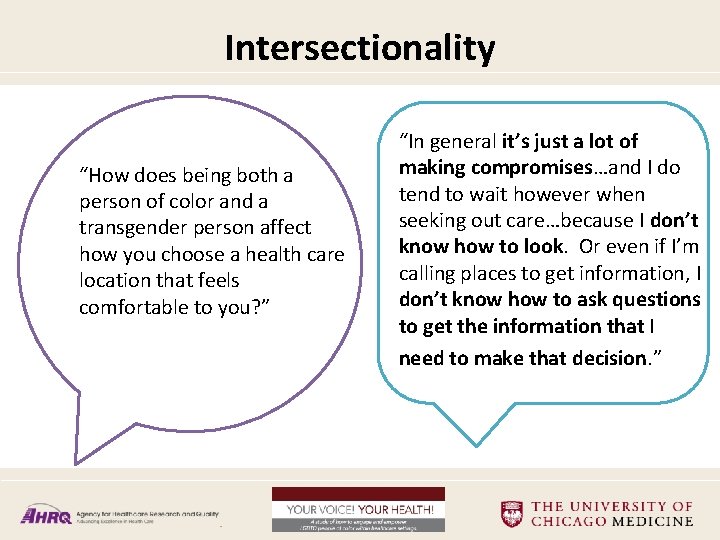
Intersectionality “How does being both a person of color and a transgender person affect how you choose a health care location that feels comfortable to you? ” “In general it’s just a lot of making compromises…and I do tend to wait however when seeking out care…because I don’t know how to look. Or even if I’m calling places to get information, I don’t know how to ask questions to get the information that I need to make that decision. ”
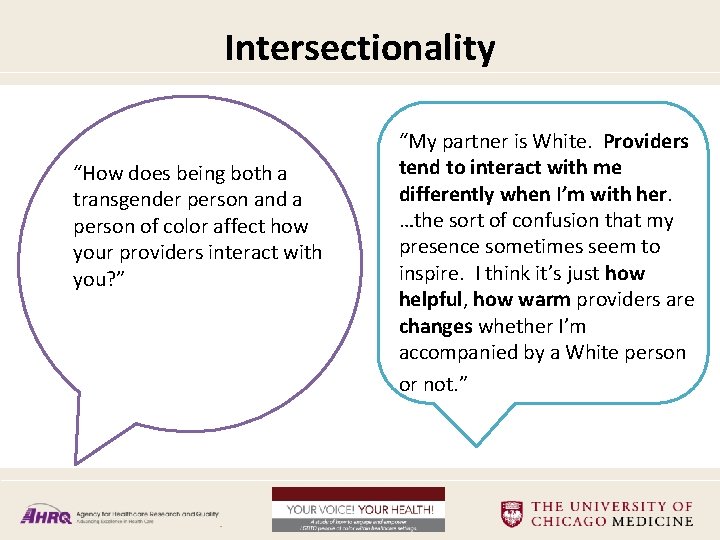
Intersectionality “How does being both a transgender person and a person of color affect how your providers interact with you? ” “My partner is White. Providers tend to interact with me differently when I’m with her. …the sort of confusion that my presence sometimes seem to inspire. I think it’s just how helpful, how warm providers are changes whether I’m accompanied by a White person or not. ”
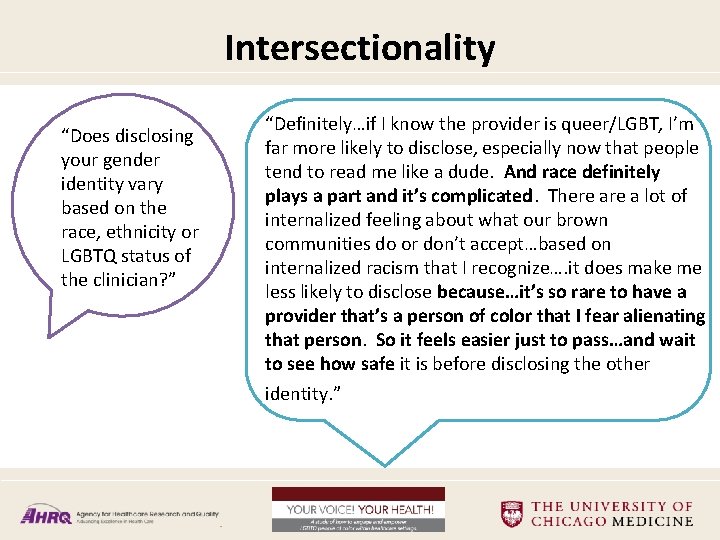
Intersectionality “Does disclosing your gender identity vary based on the race, ethnicity or LGBTQ status of the clinician? ” “Definitely…if I know the provider is queer/LGBT, I’m far more likely to disclose, especially now that people tend to read me like a dude. And race definitely plays a part and it’s complicated. There a lot of internalized feeling about what our brown communities do or don’t accept…based on internalized racism that I recognize…. it does make me less likely to disclose because…it’s so rare to have a provider that’s a person of color that I fear alienating that person. So it feels easier just to pass…and wait to see how safe it is before disclosing the other identity. ”

Intersectionality “In what ways do stereotypes about transgender people of color influence how your provider communicates with you or how they treat you? ” “I don’t think that they do in the sense that I don’t think people really recognize that Asian Trans Men exist. ”
Ethical Practice and Culturally Competent Care Agency for Healthcare Research and Quality
Ethical Practice Recognition of one’s biases and community dynamics, a sensitivity to cultural differences, the avoidance of generalizations about cultures, the provision of culturally competent care and challenging racism, heterosexism, genderism, and sexism among colleagues, the institution, or in the community at large.
Culturally Competent Care • Learn to recognize and reject our preexisting beliefs about a particular culture • Focus on understanding information provided by individuals within the context at hand • Resist the temptation to classify or label; avoid fixed and generalized information
Barriers to Cultural Competence • Fear of being labeled racist, sexist, homophobic, etc. • Our own positive or negative stereotypes about members of other groups • Expectation that we must be certain about issues of diversity and cultural competence
Barriers to Cultural Competence • Lack of awareness of hot buttons to which we are the most vulnerable • Not knowing how to respond to angry comments or anger directed at us • Being overwhelmed by our strong emotions caused by a situation • Lack of skills for cross-cultural communication
Case Vignettes – Role Play Agency for Healthcare Research and Quality
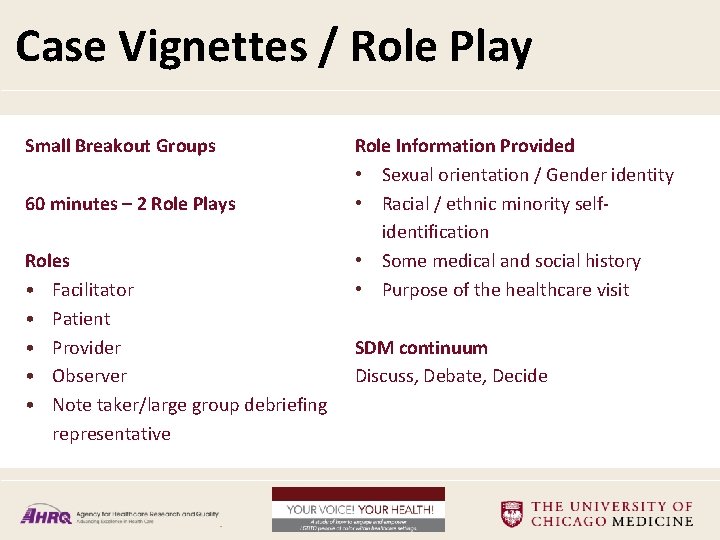
Case Vignettes / Role Play Small Breakout Groups 60 minutes – 2 Role Plays Roles • Facilitator • Patient • Provider • Observer • Note taker/large group debriefing representative Role Information Provided • Sexual orientation / Gender identity • Racial / ethnic minority selfidentification • Some medical and social history • Purpose of the healthcare visit SDM continuum Discuss, Debate, Decide
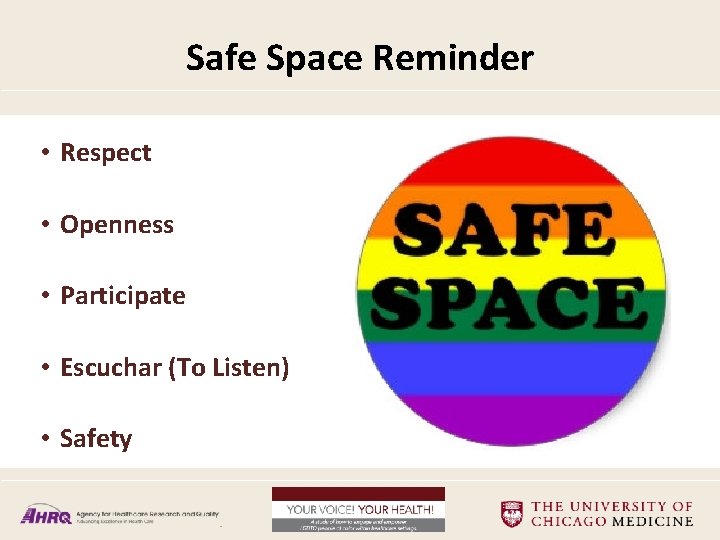
Safe Space Reminder • Respect • Openness • Participate • Escuchar (To Listen) • Safety

Report Back Agency for Healthcare Research and Quality
Additional Resources Agency for Healthcare Research and Quality

Evaluation Agency for Healthcare Research and Quality
- Slides: 31