
Improving School Psychological Service Delivery Using the NASP






- Slides: 37
Improving School Psychological Service Delivery Using the NASP Practice Model Created by: NASP Practice Model Committee Presented by:
This presentation is intended to be adapted to the specific needs of your audience. It can be adjusted in length and specific focus. You can (and probably should) add specifics relevant to your context.
Examples of Purpose/Length • High Level Overview: School Board/District Administration, 3 -5 minutes, Slides (e. g. , 1, 5, 8, 26, 30, 32, 35 -36) • Collaboration Building: School Staff/Families/Community Providers, 7 -10 minutes, Slides (e. g. , 1, 5 -10, 13, 16, 20, 2433, 35 -36) Team Orientation/Planning: School Psychologists, 30 -60 minutes, All Slides Explaining the ESPS Program Only: School Psychologists/District Leaders, 15 -20 minutes, Slides (e. g. , 1, 6 -8, 24 -37) • •
Focus Today • Overview of the NASP Practice Model • Connection of the comprehensive role of school psychologists to student outcomes • Strategies for working toward implementation of the model • Excellence in School Psychology Services (ESPS) recognition program
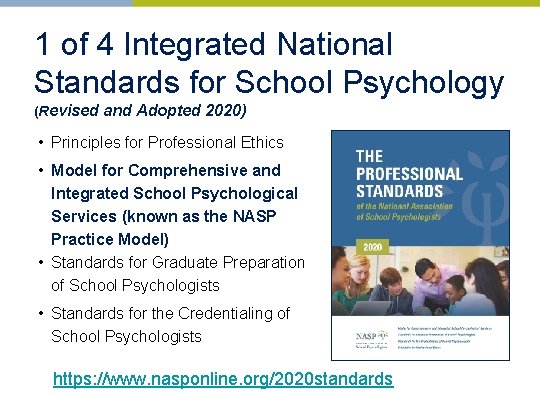
1 of 4 Integrated National Standards for School Psychology (Revised and Adopted 2020) • Principles for Professional Ethics • Model for Comprehensive and Integrated School Psychological Services (known as the NASP Practice Model) • Standards for Graduate Preparation of School Psychologists • Standards for the Credentialing of School Psychologists https: //www. nasponline. org/2020 standards
Critical Realities ü Training matters. School psychologists’ training combines mental and behavioral health, learning and teaching, individual and group factors, school systems and law. This training is essential to effective service delivery in the school context. ü Context matters. The professional conditions, culture, and systems within which school psychologists work determine the scope and efficiency of service delivery. ü Ratios matter. The national recommended ratio is 1: 500. Higher ratios constrain school psychologists’ capacity to meet students’ diverse and comprehensive needs.
The NASP Practice Model ü Provides the framework for the scope of school psychological services ü Defines how systems support comprehensive service delivery ü Equips schools to leverage school psychologists’ skills and expertise to improve student and school outcomes ü Enables schools to improve/expand service delivery even as they work to improve ratios and organizational capacity over time.
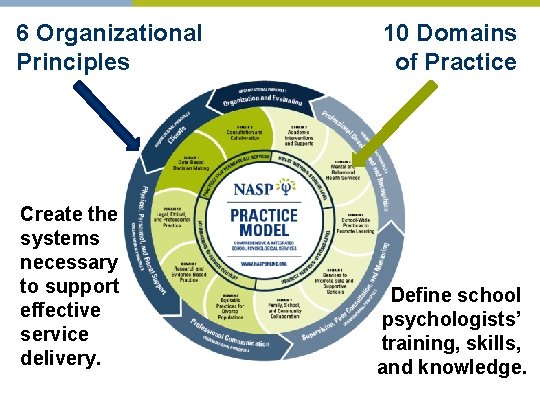
6 Organizational Principles 10 Domains of Practice Create the systems necessary to support effective service delivery. Define school psychologists’ training, skills, and knowledge.
10 Domains of Practice Knowledge, training, and skills to meet the needs of students, families and schools
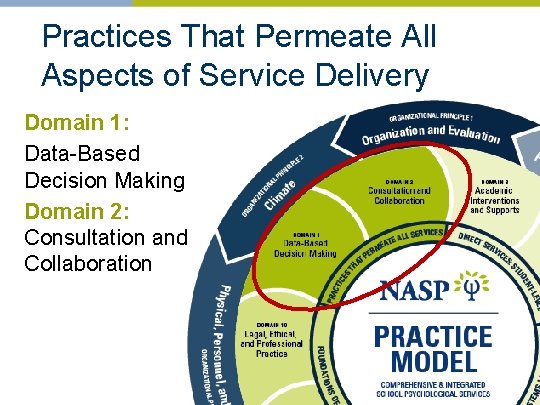
Practices That Permeate All Aspects of Service Delivery Domain 1: Data-Based Decision Making Domain 2: Consultation and Collaboration
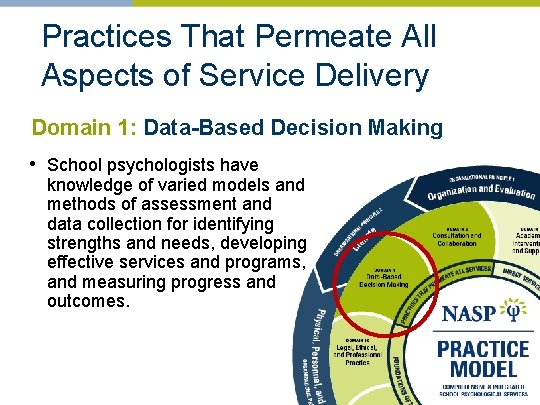
Practices That Permeate All Aspects of Service Delivery Domain 1: Data-Based Decision Making • School psychologists have knowledge of varied models and methods of assessment and data collection for identifying strengths and needs, developing effective services and programs, and measuring progress and outcomes.
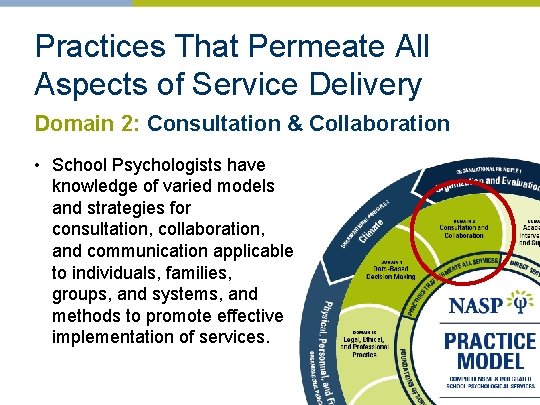
Practices That Permeate All Aspects of Service Delivery Domain 2: Consultation & Collaboration • School Psychologists have knowledge of varied models and strategies for consultation, collaboration, and communication applicable to individuals, families, groups, and systems, and methods to promote effective implementation of services.
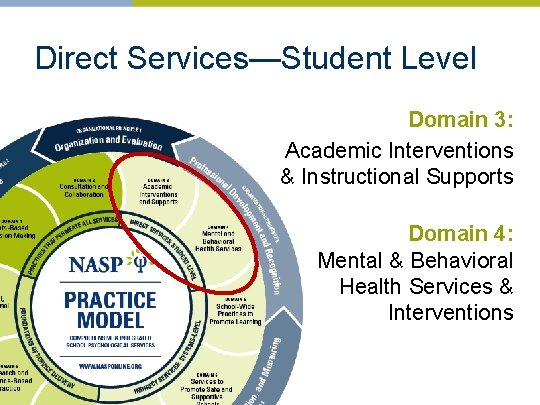
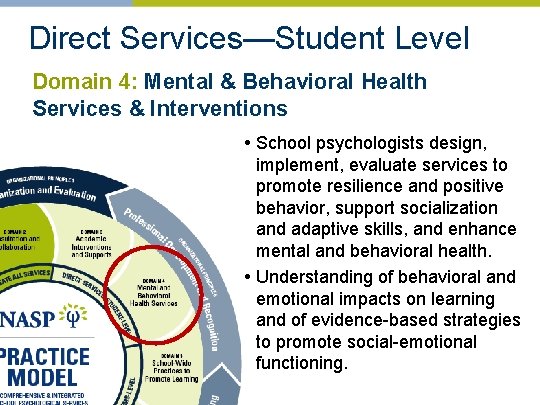
Direct Services—Student Level Domain 3: Academic Interventions & Instructional Supports Domain 4: Mental & Behavioral Health Services & Interventions
Direct Services—Student Level Domain 3: Academic Interventions & Instructional Supports • School psychologists use assessment and data collection methods to implement and evaluate services that support academic skill development. • Requires understanding of biological, cultural, and social influences on academic skills.
Direct Services—Student Level Domain 4: Mental & Behavioral Health Services & Interventions • School psychologists design, implement, evaluate services to promote resilience and positive behavior, support socialization and adaptive skills, and enhance mental and behavioral health. • Understanding of behavioral and emotional impacts on learning and of evidence-based strategies to promote social-emotional functioning.
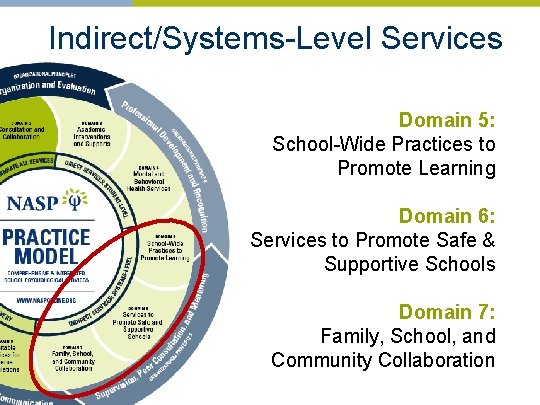
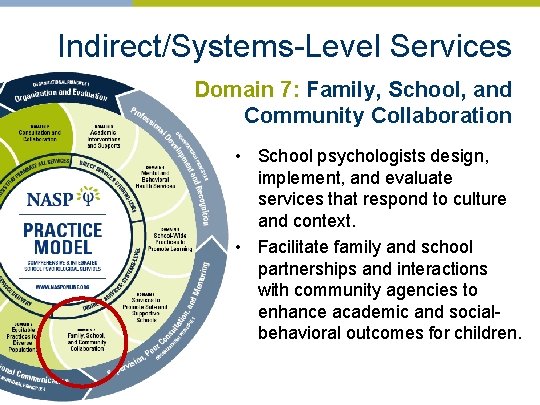
Indirect/Systems-Level Services Domain 5: School-Wide Practices to Promote Learning Domain 6: Services to Promote Safe & Supportive Schools Domain 7: Family, School, and Community Collaboration
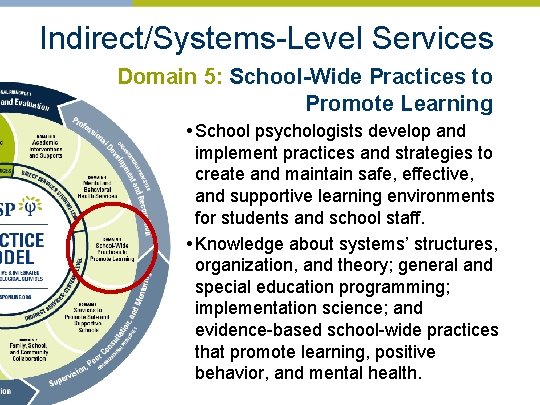
Indirect/Systems-Level Services Domain 5: School-Wide Practices to Promote Learning • School psychologists develop and implement practices and strategies to create and maintain safe, effective, and supportive learning environments for students and school staff. • Knowledge about systems’ structures, organization, and theory; general and special education programming; implementation science; and evidence-based school-wide practices that promote learning, positive behavior, and mental health.
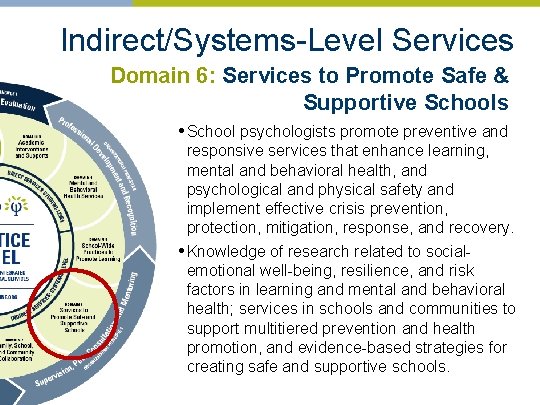
Indirect/Systems-Level Services Domain 6: Services to Promote Safe & Supportive Schools • School psychologists promote preventive and responsive services that enhance learning, mental and behavioral health, and psychological and physical safety and implement effective crisis prevention, protection, mitigation, response, and recovery. • Knowledge of research related to socialemotional well-being, resilience, and risk factors in learning and mental and behavioral health; services in schools and communities to support multitiered prevention and health promotion, and evidence-based strategies for creating safe and supportive schools.
Indirect/Systems-Level Services Domain 7: Family, School, and Community Collaboration • School psychologists design, implement, and evaluate services that respond to culture and context. • Facilitate family and school partnerships and interactions with community agencies to enhance academic and socialbehavioral outcomes for children.
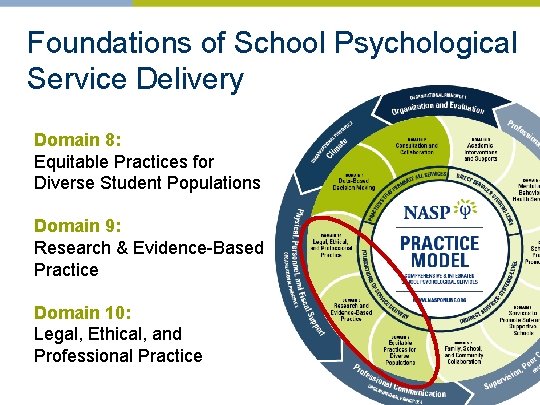
Foundations of School Psychological Service Delivery Domain 8: Equitable Practices for Diverse Student Populations Domain 9: Research & Evidence-Based Practice Domain 10: Legal, Ethical, and Professional Practice
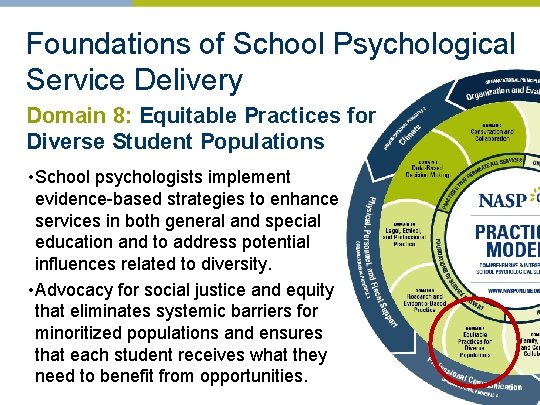
Foundations of School Psychological Service Delivery Domain 8: Equitable Practices for Diverse Student Populations • School psychologists implement evidence-based strategies to enhance services in both general and special education and to address potential influences related to diversity. • Advocacy for social justice and equity that eliminates systemic barriers for minoritized populations and ensures that each student receives what they need to benefit from opportunities.
Foundations of School Psychological Service Delivery Domain 9: Research & Evidence -Based Practice • School psychologists evaluate and apply research as a foundation for service delivery. • Use various techniques and technology resources for data collection, measurement, and analysis to support effective practices at the individual, group, and systems levels.
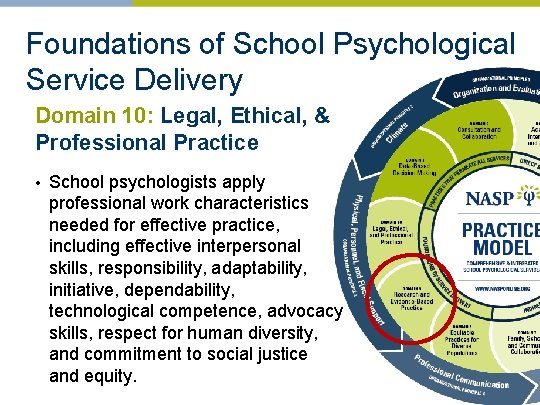
Foundations of School Psychological Service Delivery Domain 10: Legal, Ethical, & Professional Practice • School psychologists apply professional work characteristics needed for effective practice, including effective interpersonal skills, responsibility, adaptability, initiative, dependability, technological competence, advocacy skills, respect for human diversity, and commitment to social justice and equity.
6 Organizational Principles Culture, systems, and conditions that facilitate effective service delivery
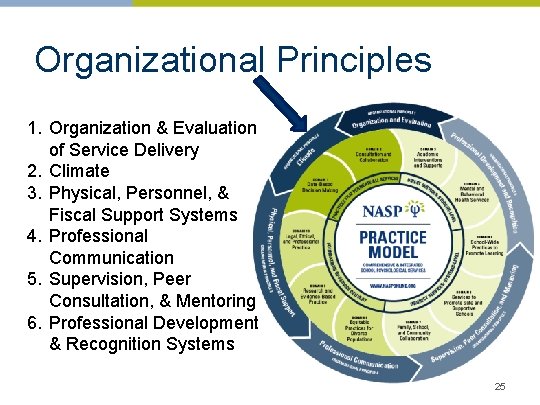
Organizational Principles 1. Organization & Evaluation of Service Delivery 2. Climate 3. Physical, Personnel, & Fiscal Support Systems 4. Professional Communication 5. Supervision, Peer Consultation, & Mentoring 6. Professional Development & Recognition Systems 25
1: 500 Recommended Ratio Sustainable professional capacity to support teachers’ ability to teach and ensure that all students are ready and able to learn
Common Barriers to Implementing the NASP Practice Model • Limited understanding of broad scope of practice • Narrow role defined by district • Poor ratios of school psychologists to students • Critical shortage of school psychologists and positions to fulfill the role • Funding structures
Overcoming Barriers to Implementing the Practice Model Improving the Ratio • Immediately • Communicate benefits of a comprehensive role to school board and district leaders to advocate for positions • Collect/share data with key stakeholders on services delivered, outcomes, and ratio comparisons • Next steps • Collaborate with local universities to develop and enhance practicum or internship programs • Align job description and personnel evaluations with the NASP Practice Model • Long-term • Align pay and benefits packages with the comprehensive training and educational requirements of the field • Consider additional stipends for national certification to attract school psychologists to your district
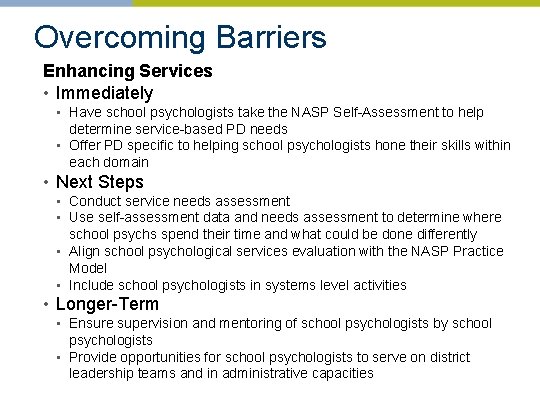
Overcoming Barriers Enhancing Services • Immediately • Have school psychologists take the NASP Self-Assessment to help determine service-based PD needs • Offer PD specific to helping school psychologists hone their skills within each domain • Next Steps • Conduct service needs assessment • Use self-assessment data and needs assessment to determine where school psychs spend their time and what could be done differently • Align school psychological services evaluation with the NASP Practice Model • Include school psychologists in systems level activities • Longer-Term • Ensure supervision and mentoring of school psychologists by school psychologists • Provide opportunities for school psychologists to serve on district leadership teams and in administrative capacities
Excellence in School Psychology Recognition Program Overview
ESPS Recognition Program • • • Recognizing school districts proactively working to implement comprehensive school psychological services. Designed both to support implementation of the organizational principles defined in the NASP Practice Model and to acknowledge the success and progress of districts in meeting them. In second year of program. www. nasponline. org/standards/practice-model/
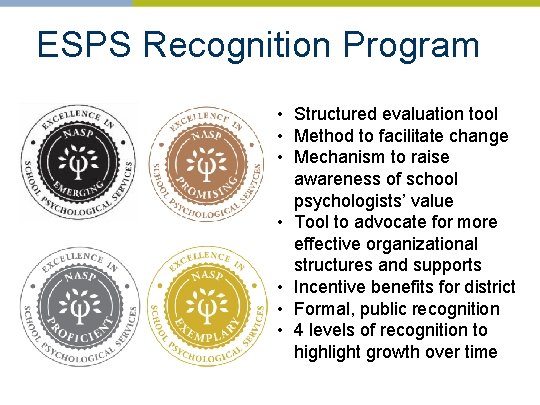
ESPS Recognition Program • Structured evaluation tool • Method to facilitate change • Mechanism to raise awareness of school psychologists’ value • Tool to advocate for more effective organizational structures and supports • Incentive benefits for district • Formal, public recognition • 4 levels of recognition to highlight growth over time
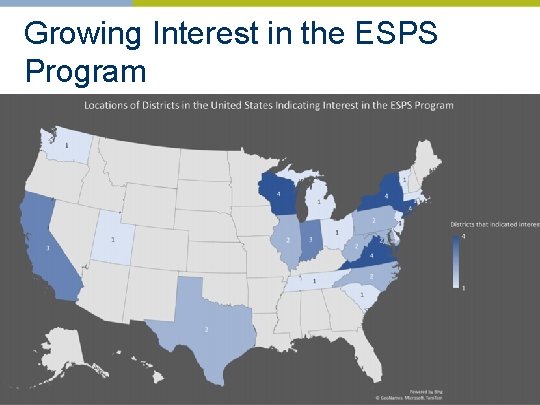
Growing Interest in the ESPS Program
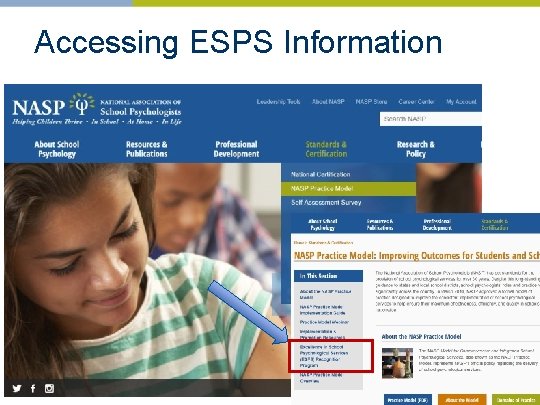
Accessing ESPS Information 34
Questions/Comments
Contact Information • List Primary Presenter – List title, Place of Employment/Organization – List Email • List Secondary Presenter – List title, Place of Employment/Organization – List Email 36