
Improving Safety Procedures in the Gas Stations in


- Slides: 30
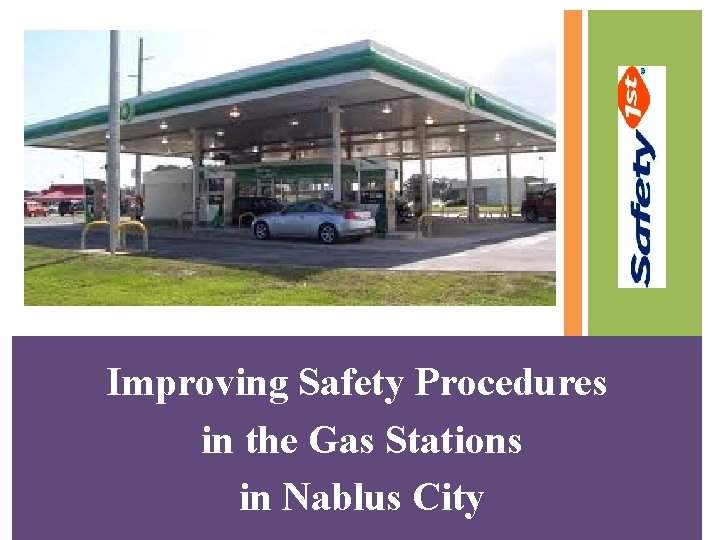
Improving Safety Procedures in the Gas Stations in Nablus City
Study prepared by: Faisal Menawi Waseem Al- Shayeb Mohammad Al-Tamimi Zaid Zrieq Mohammad Foqha Supervisor Dr. Mohammad Othman
� General Information � Rationale of the Study � Objective of the Study � OSHA � Fuel Station Information � Methodology � Authorities Responsible for Licensing Fuel Stations � Analysis � Conclusion
General Introduction Safety is an issue of great importance in all life aspects. Its importance appears in home, street, construction site, factory and even offices. Since human life is the most important and expensive asset everywhere.
Rationale of the Study This study was prepared to evaluate the extent into which the standards of health and occupational safety are applied in fuel stations especially in Nablus governorate which include 27 working fuel stations which offers various kinds of fuel to customers. Objectives of the Study • Define the Palestinian standards and track the authorities involved in the process of licensing fuel station and the unique role for each one • Verify the actual safety condition at fuel stations. • Develop an integrated design for fuel station. • Study the actual status of Al – Tamimi Fuel Station in Huwwara as example to a station not Acceptable to Palestinian standards
Safety Definition safety is defined as “the state Industrial safety Definition Industrial safety is seen as the of being "safe" the condition management of activities of being protected against within a certain industry for the physical, spiritual, financial, purpose of reducing risks and occupational, or other types injuries in a certain or consequences of failure. occupational function.
OSHA Statistical method to characterize accident OSHA stands for Occupational Safety and Health Administration of the United States government. OSHA is responsible for insuring that the workers are provided with a safe working environment.
Goals of Occupational Health and Safety in Industrial Safety The measures of occupational health and safety were set for several important reasons that can be summarized as follows: � Protection of the human factor from injuries due to hazards in the work environment � Maintain and protect the physical component of the work represented by the work facility, machinery, and equipment
� Comply all safety measures that guarantee a safe environment which fulfills the protection of both the human and the physical factors � Occupational health and safety can be used as a scientific approach to promote satisfaction and inner security for workers
1 - Workers health and safety: � To achieve this factor as it’s the most important aspect of life we should select the suitable workers. 2 - Tools and machinery: � As the statics show, 28% of accidents caused by misuse of equipment, to overcome these accidents we should position the machines in their appropriate locations and make periodic maintenance. 3 - Work environment: Its refer to the inner work environment. Protect workers from factors affecting their health or performance �
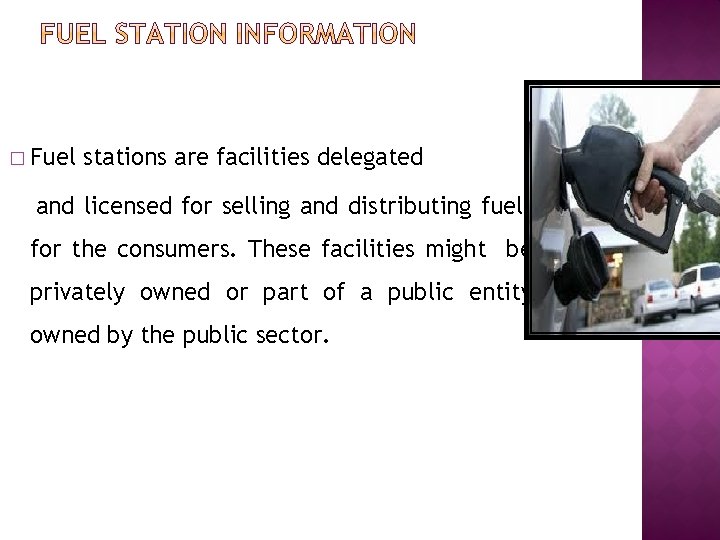
� Fuel stations are facilities delegated and licensed for selling and distributing fuels for the consumers. These facilities might be privately owned or part of a public entity owned by the public sector.
Diesel : is a yellowish or greenish low viscosity fuel made up of a mixture of hydrocarbon products remaining after refining the kerosene. Diesel fuel is more safe compared to gasoline. Kerosene: is similar to diesel fuel in its characteristics although is lighter than diesel and produces more volatile gases when heated. Fuel station substances Gasoline: is a volatile liquid that produces flammable gases even at low temperatures. It is considered a very dangerous and hazardous material if not handled properly. Gasoline is usually colorless.
Effects of fuel on human health � All fuel products may pose a threat to human life if not handled with care � An exposure limit defined by the The Department of Health and Human Services of the United States (DHHS) for present fuels in the air of about one part per million (1 ppm) in a workplace where daily working hours are 8 and weekly working hours are up to 40.
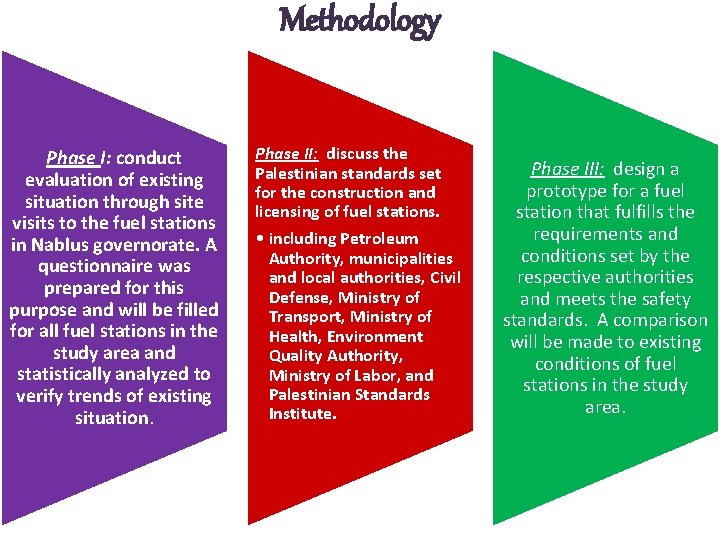
Methodology Phase I: conduct evaluation of existing situation through site visits to the fuel stations in Nablus governorate. A questionnaire was prepared for this purpose and will be filled for all fuel stations in the study area and statistically analyzed to verify trends of existing situation. Phase II: discuss the Palestinian standards set for the construction and licensing of fuel stations. • including Petroleum Authority, municipalities and local authorities, Civil Defense, Ministry of Transport, Ministry of Health, Environment Quality Authority, Ministry of Labor, and Palestinian Standards Institute. Phase III: design a prototype for a fuel station that fulfills the requirements and conditions set by the respective authorities and meets the safety standards. A comparison will be made to existing conditions of fuel stations in the study area.
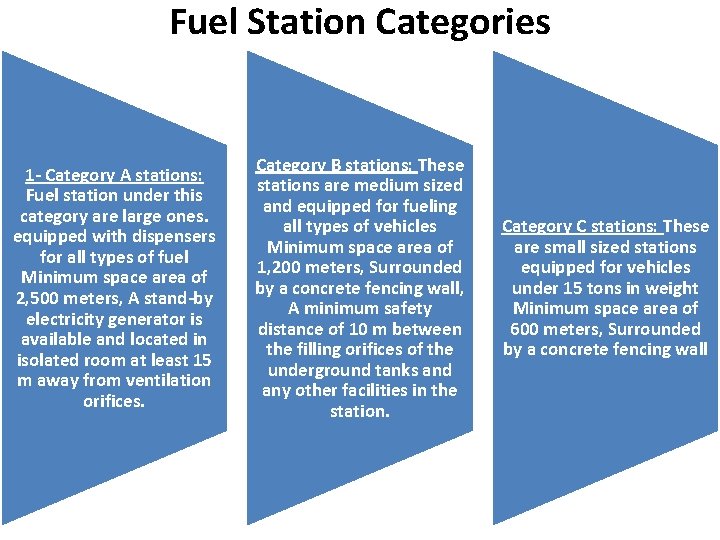
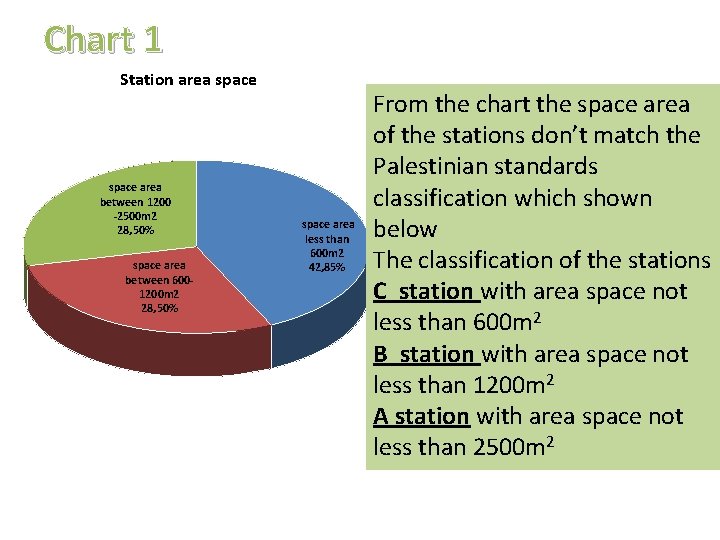
Fuel Station Categories 1 - Category A stations: Fuel station under this category are large ones. equipped with dispensers for all types of fuel Minimum space area of 2, 500 meters, A stand-by electricity generator is available and located in isolated room at least 15 m away from ventilation orifices. Category B stations: These stations are medium sized and equipped for fueling all types of vehicles Minimum space area of 1, 200 meters, Surrounded by a concrete fencing wall, A minimum safety distance of 10 m between the filling orifices of the underground tanks and any other facilities in the station. Category C stations: These are small sized stations equipped for vehicles under 15 tons in weight Minimum space area of 600 meters, Surrounded by a concrete fencing wall
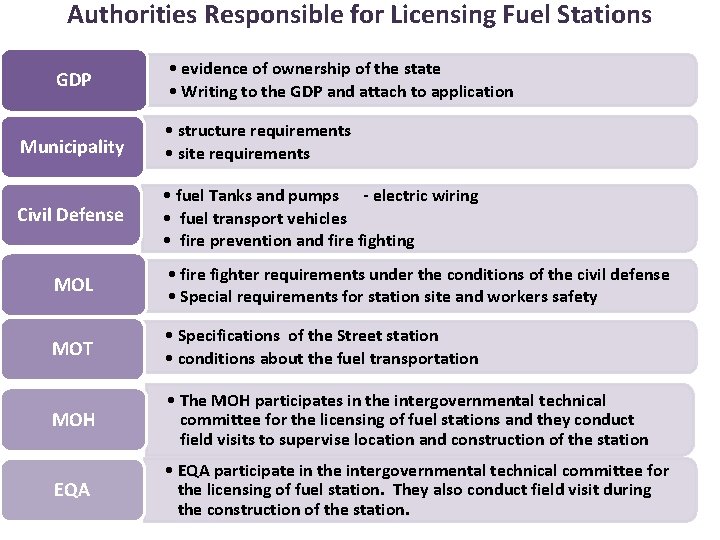
Authorities Responsible for Licensing Fuel Stations GDP • evidence of ownership of the state • Writing to the GDP and attach to application Municipality • structure requirements • site requirements Civil Defense • fuel Tanks and pumps - electric wiring • fuel transport vehicles • fire prevention and fire fighting MOL • fire fighter requirements under the conditions of the civil defense • Special requirements for station site and workers safety MOT • Specifications of the Street station • conditions about the fuel transportation MOH • The MOH participates in the intergovernmental technical committee for the licensing of fuel stations and they conduct field visits to supervise location and construction of the station EQA • EQA participate in the intergovernmental technical committee for the licensing of fuel station. They also conduct field visit during the construction of the station.
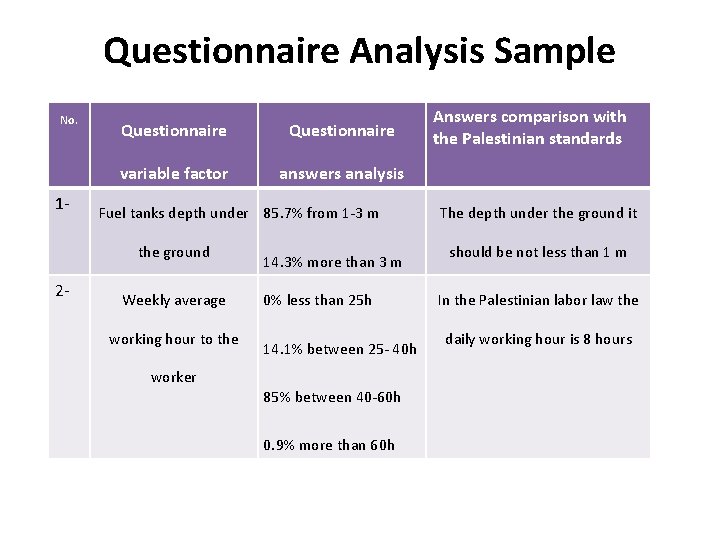
Questionnaire Analysis Sample No. 1 - Questionnaire variable factor answers analysis Fuel tanks depth under 85. 7% from 1 -3 m the ground 2 - Weekly average working hour to the 14. 3% more than 3 m 0% less than 25 h 14. 1% between 25 - 40 h worker 85% between 40 -60 h 0. 9% more than 60 h Answers comparison with the Palestinian standards The depth under the ground it should be not less than 1 m In the Palestinian labor law the daily working hour is 8 hours
Chart 1 Station area space area between 1200 -2500 m 2 28, 50% space area between 6001200 m 2 28, 50% space area less than 600 m 2 42, 85% From the chart the space area of the stations don’t match the Palestinian standards classification which shown below The classification of the stations C station with area space not less than 600 m 2 B station with area space not less than 1200 m 2 A station with area space not less than 2500 m 2
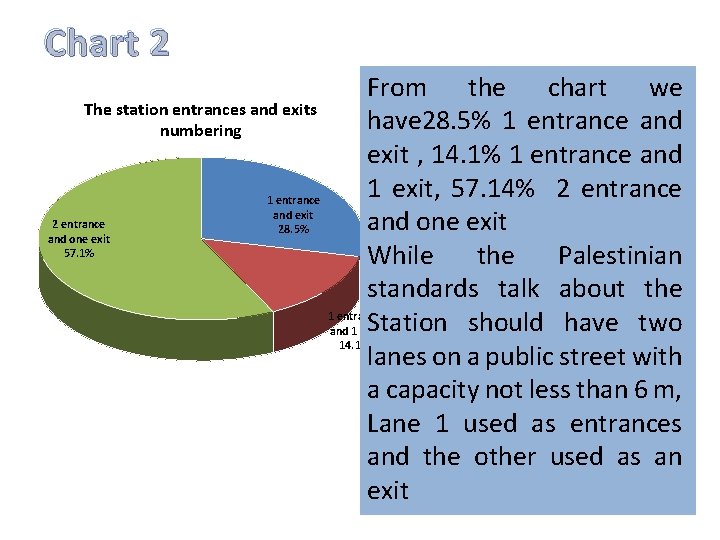
Chart 2 From the chart we The station entrances and exits have 28. 5% 1 entrance and numbering exit , 14. 1% 1 entrance and 1 exit, 57. 14% 2 entrance 1 entrance and exit 2 entrance and one exit 28. 5% and one exit 57. 1% While the Palestinian standards talk about the 1 entrance Station should have two and 1 exit 14. 1% lanes on a public street with a capacity not less than 6 m, Lane 1 used as entrances and the other used as an exit
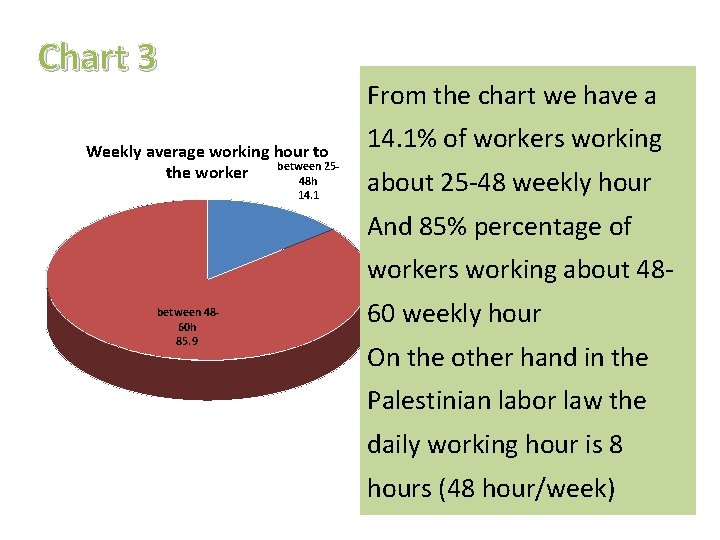
Chart 3 From the chart we have a Weekly average working hour to between 25 the worker 48 h 14. 1% of workers working about 25 -48 weekly hour And 85% percentage of workers working about 48 - between 4860 h 85. 9 60 weekly hour On the other hand in the Palestinian labor law the daily working hour is 8 hours (48 hour/week)
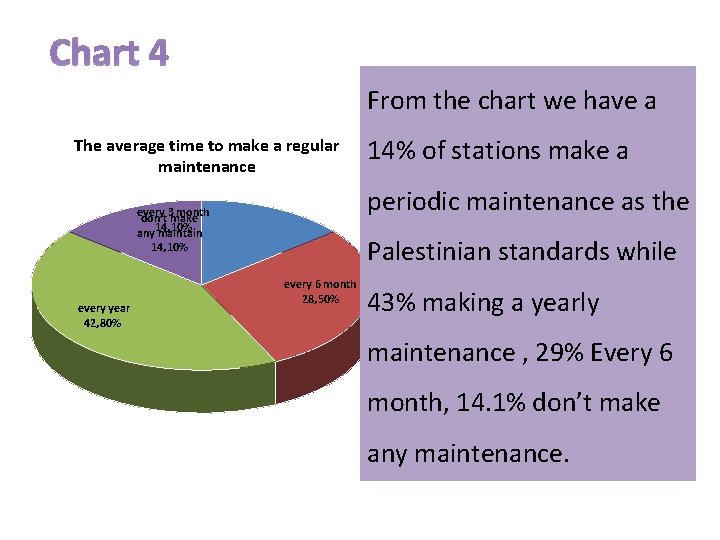
Chart 4 From the chart we have a The average time to make a regular maintenance periodic maintenance as the every month don’t 3 make 14, 10% any maintain Palestinian standards while 14, 10% every year 42, 80% 14% of stations make a every 6 month 28, 50% 43% making a yearly maintenance , 29% Every 6 month, 14. 1% don’t make any maintenance.
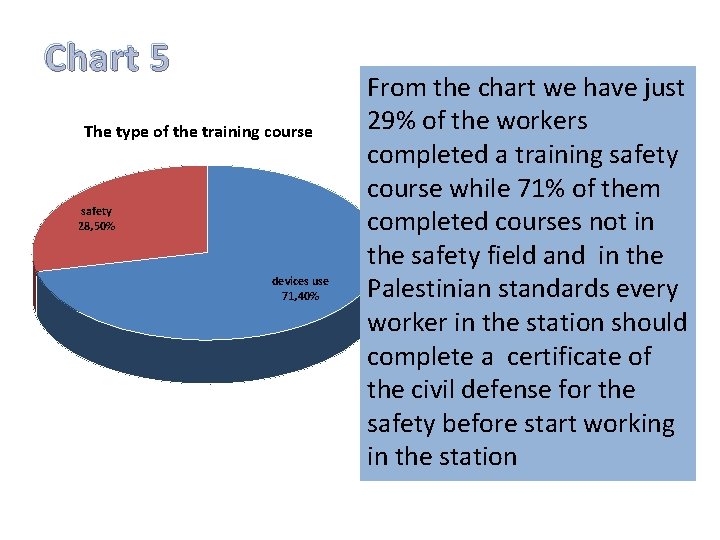
Chart 5 The type of the training course safety 28, 50% devices use 71, 40% From the chart we have just 29% of the workers completed a training safety course while 71% of them completed courses not in the safety field and in the Palestinian standards every worker in the station should complete a certificate of the civil defense for the safety before start working in the station
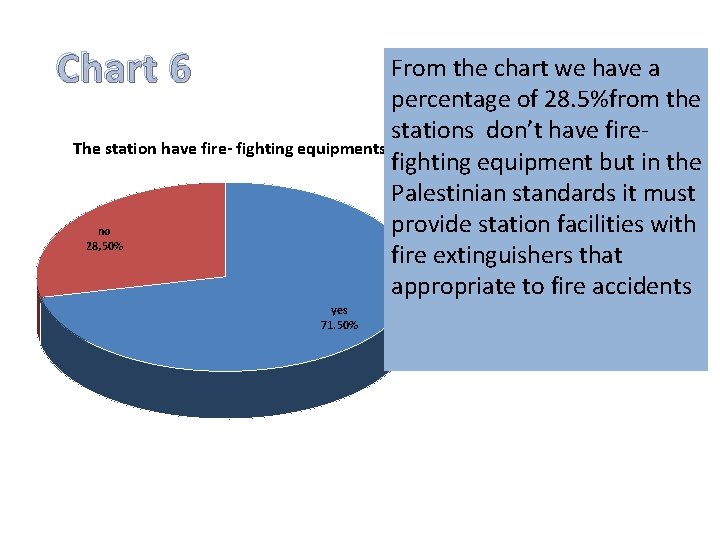
Chart 6 From the chart we have a percentage of 28. 5%from the stations don’t have fire. The station have fire- fighting equipments fighting equipment but in the Palestinian standards it must provide station facilities with no 28, 50% fire extinguishers that appropriate to fire accidents yes 71. 50%
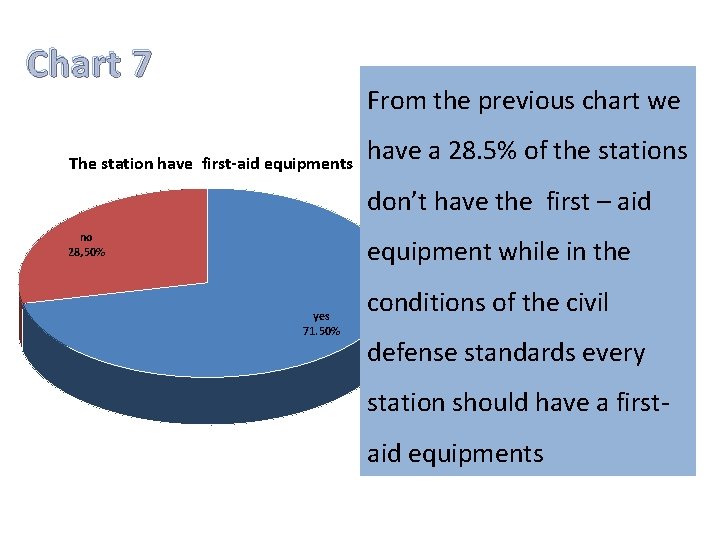
Chart 7 From the previous chart we The station have first-aid equipments have a 28. 5% of the stations don’t have the first – aid no 28, 50% equipment while in the yes 71. 50% conditions of the civil defense standards every station should have a firstaid equipments
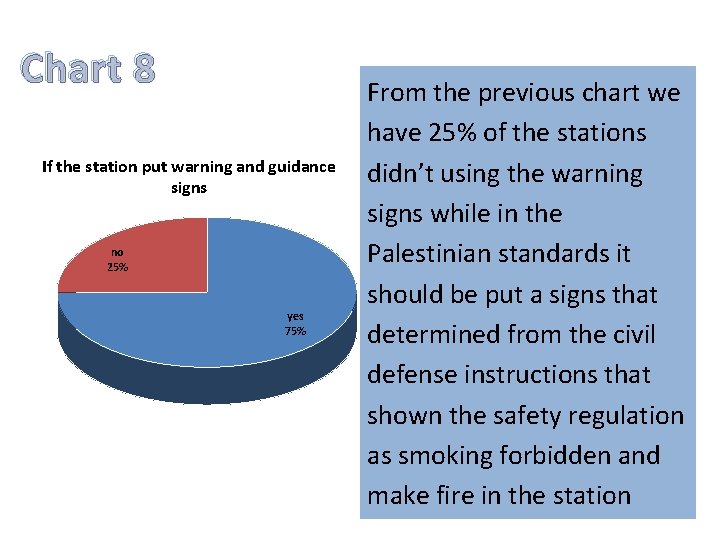
Chart 8 If the station put warning and guidance signs no 25% yes 75% From the previous chart we have 25% of the stations didn’t using the warning signs while in the Palestinian standards it should be put a signs that determined from the civil defense instructions that shown the safety regulation as smoking forbidden and make fire in the station
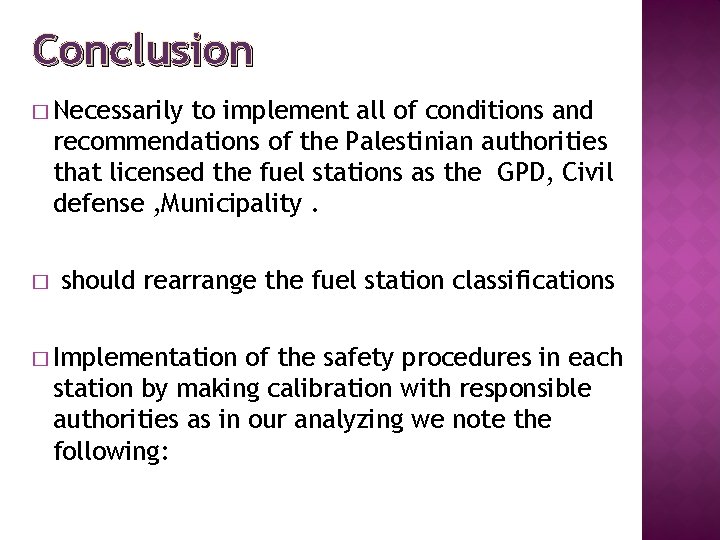
Conclusion � Necessarily to implement all of conditions and recommendations of the Palestinian authorities that licensed the fuel stations as the GPD, Civil defense , Municipality. � should rearrange the fuel station classifications � Implementation of the safety procedures in each station by making calibration with responsible authorities as in our analyzing we note the following:
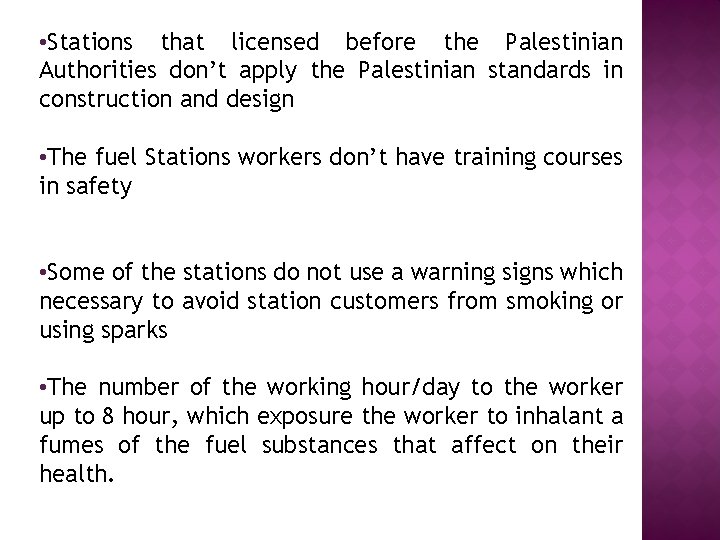
• Stations that licensed before the Palestinian Authorities don’t apply the Palestinian standards in construction and design • The fuel Stations workers don’t have training courses in safety • Some of the stations do not use a warning signs which necessary to avoid station customers from smoking or using sparks • The number of the working hour/day to the worker up to 8 hour, which exposure the worker to inhalant a fumes of the fuel substances that affect on their health.
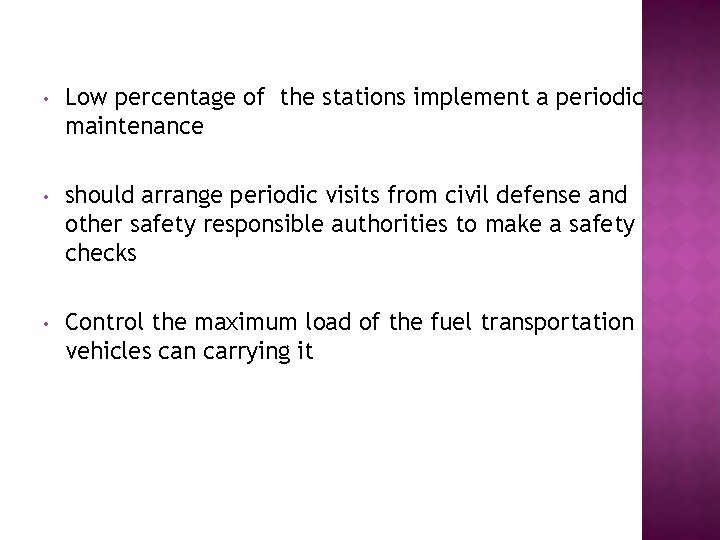
• Low percentage of the stations implement a periodic maintenance • should arrange periodic visits from civil defense and other safety responsible authorities to make a safety checks • Control the maximum load of the fuel transportation vehicles can carrying it
Thanks For Listening