
Improving RFBased DeviceFree Passive Localization In Cluttered Indoor
Improving RF-Based Device-Free Passive Localization In Cluttered Indoor Environments Through Probabilistic Classification Methods Rutgers University WINLAB Chenren Xu Joint work with Bernhard Firner, Yanyong Zhang Richard Howard, Jun Li, Xiaodong Lin
Passive Localization q Motivation q Indoor challenge q Proposed solution q Experimental methodology q Performance evaluation q Conclusion and future work WINLAB 2
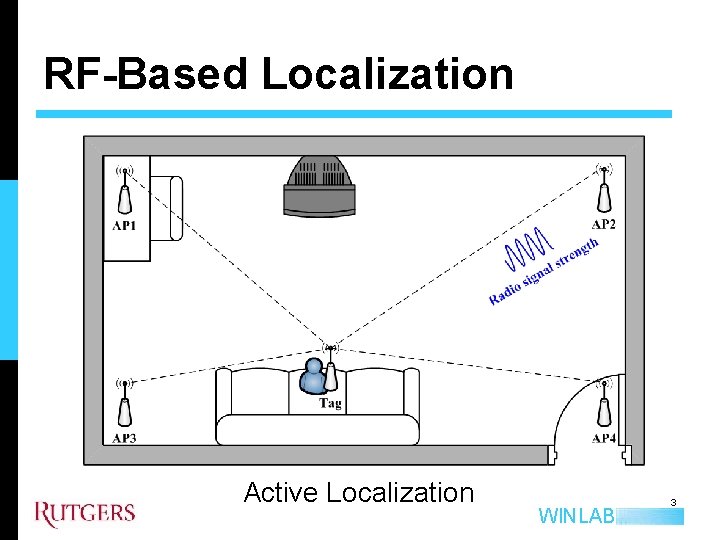
RF-Based Localization Active Localization WINLAB 3
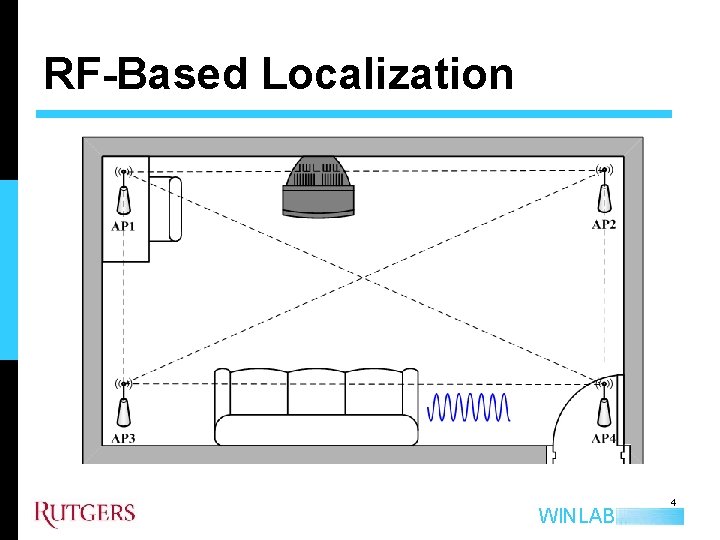
RF-Based Localization WINLAB 4
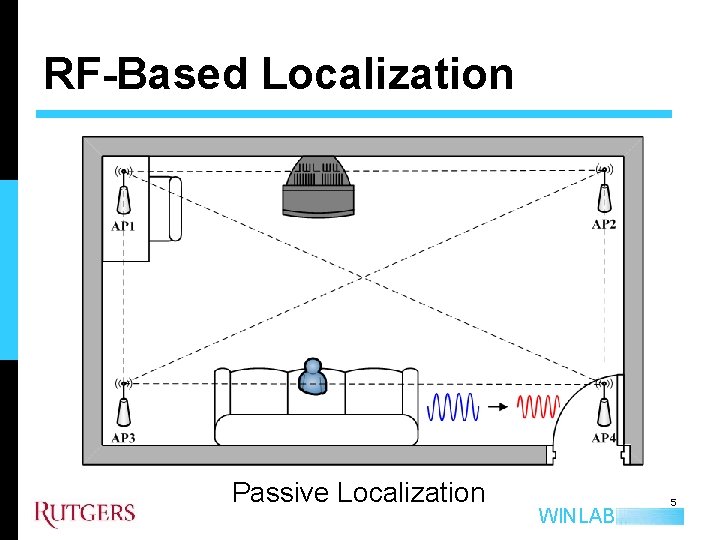
RF-Based Localization Passive Localization WINLAB 5
Passive Localization q Motivation q Indoor challenge q Proposed solution q Experimental methodology q Performance evaluation q Conclusion and future work WINLAB 6
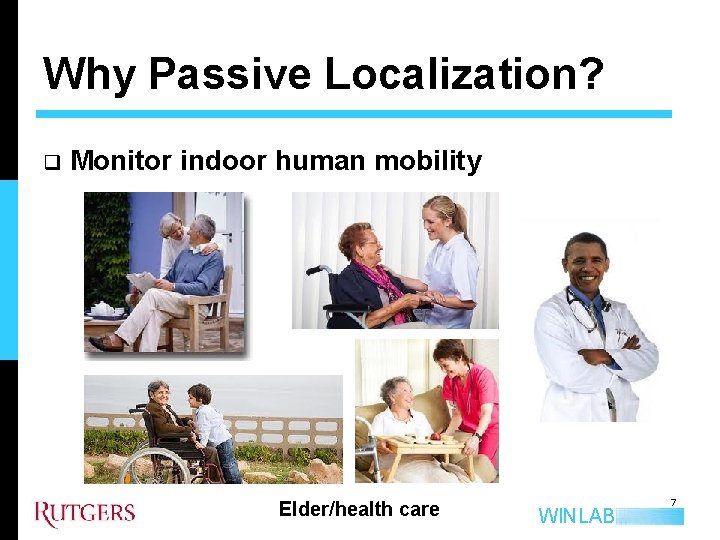
Why Passive Localization? q Monitor indoor human mobility Elder/health care WINLAB 7
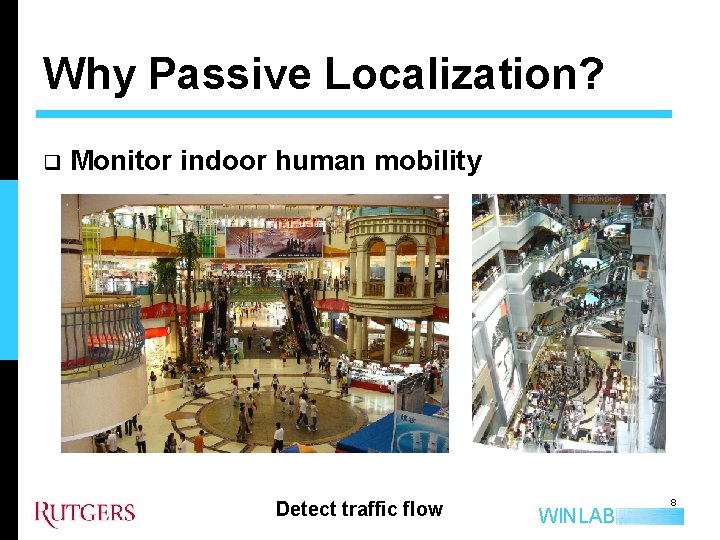
Why Passive Localization? q Monitor indoor human mobility Detect traffic flow WINLAB 8
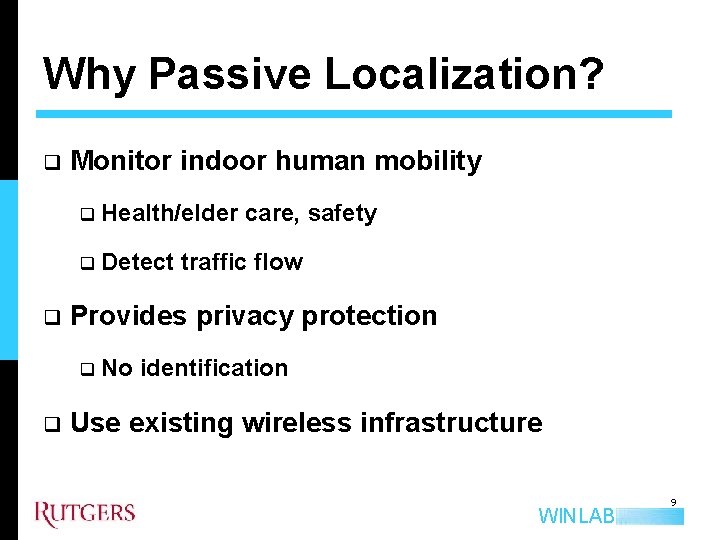
Why Passive Localization? q q Monitor indoor human mobility q Health/elder care, safety q Detect traffic flow Provides privacy protection q q No identification Use existing wireless infrastructure WINLAB 9
Passive Localization q Motivation q Indoor challenge q Proposed solution q Experimental methodology q Performance evaluation q Conclusion and future work WINLAB 10
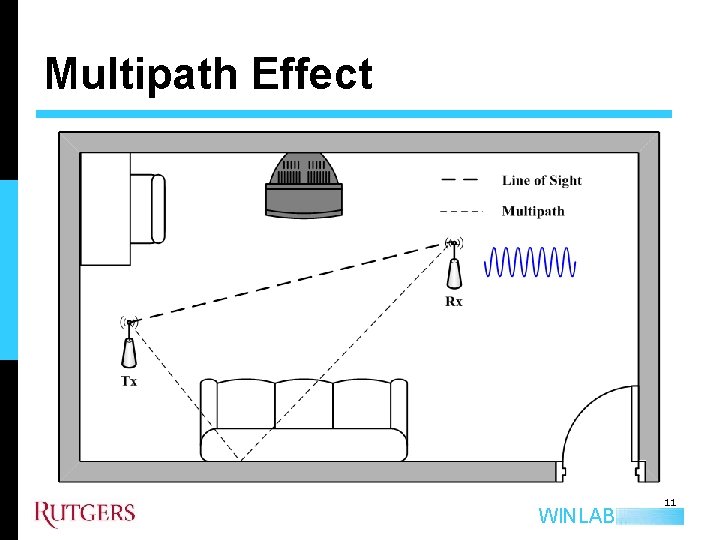
Multipath Effect WINLAB 11
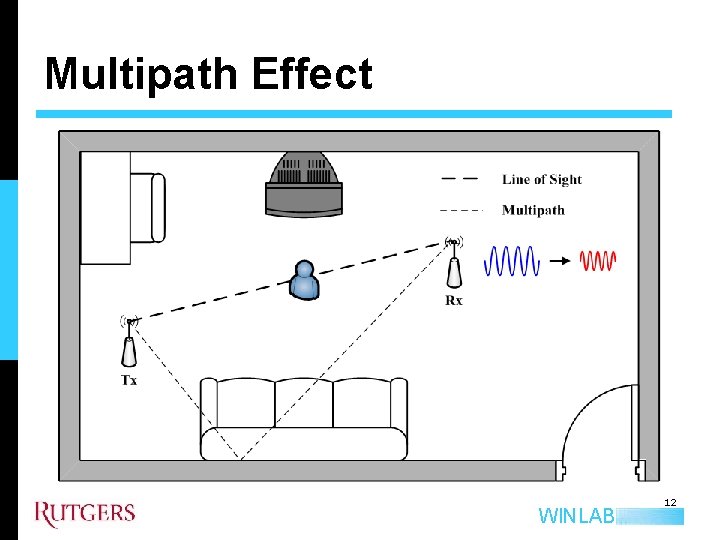
Multipath Effect WINLAB 12
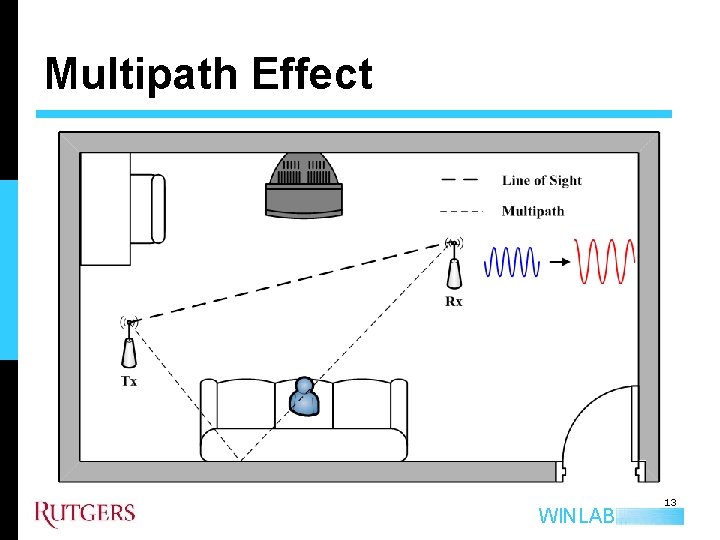
Multipath Effect WINLAB 13
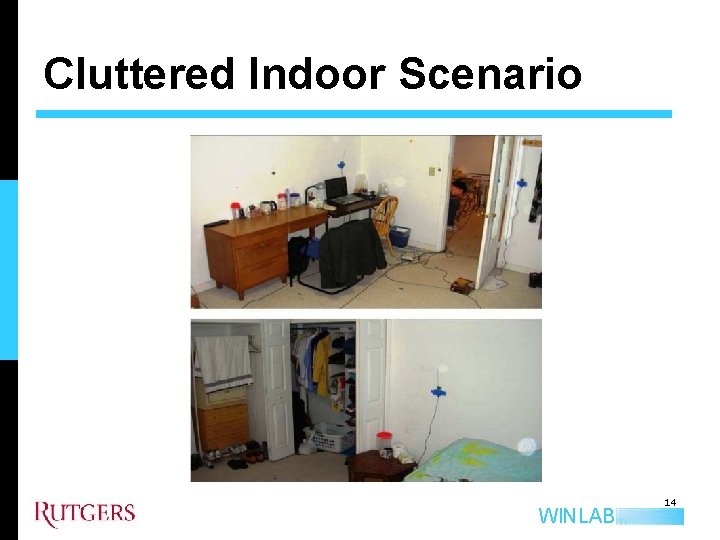
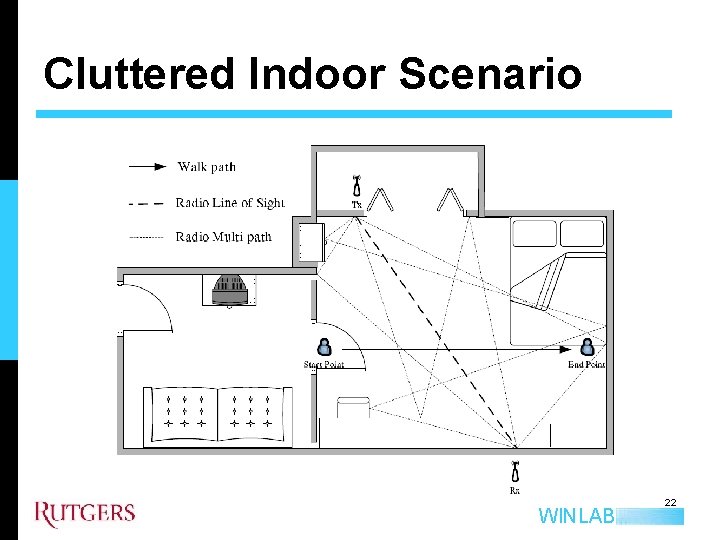
Cluttered Indoor Scenario WINLAB 14
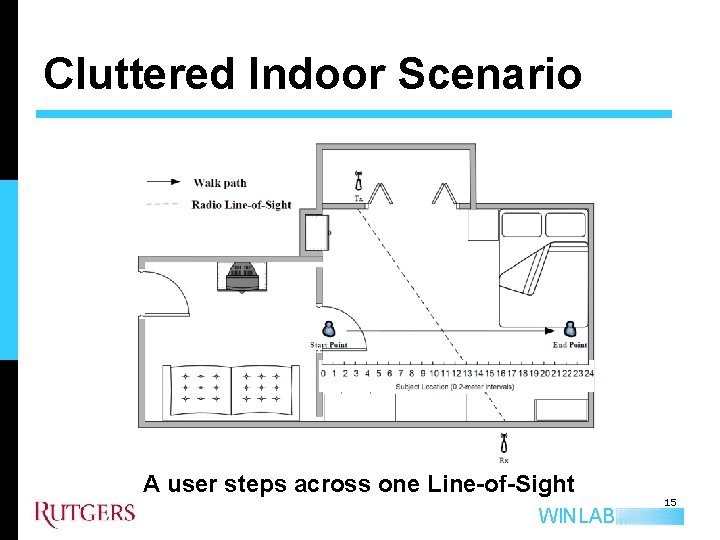
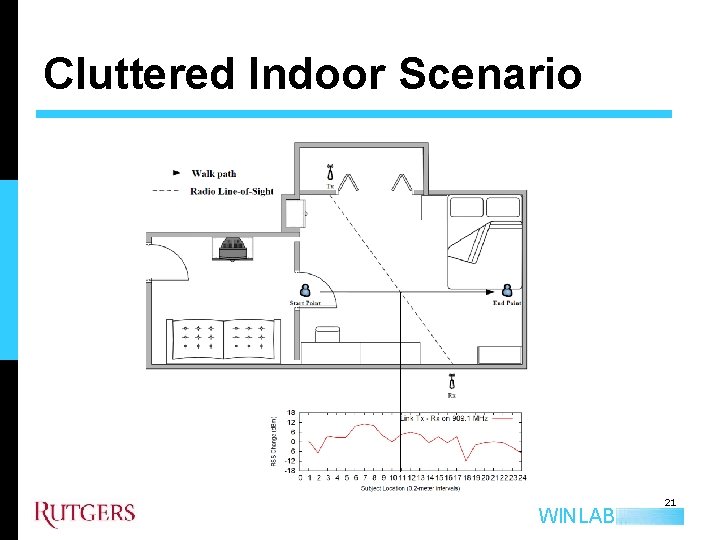
Cluttered Indoor Scenario A user steps across one Line-of-Sight WINLAB 15
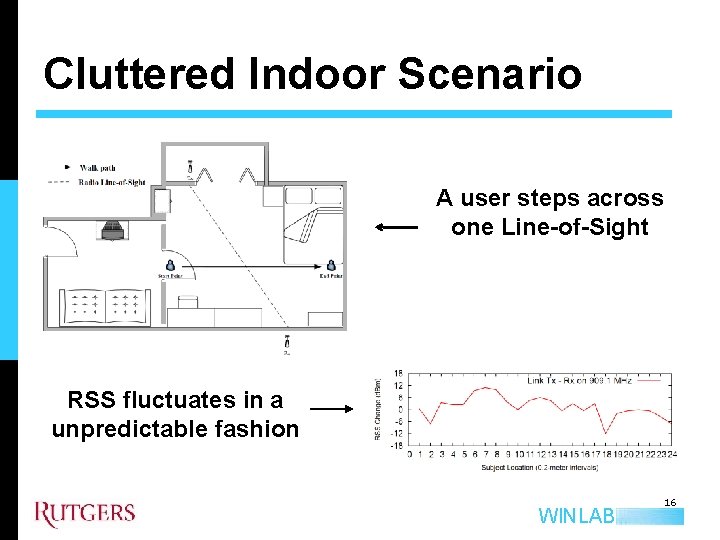
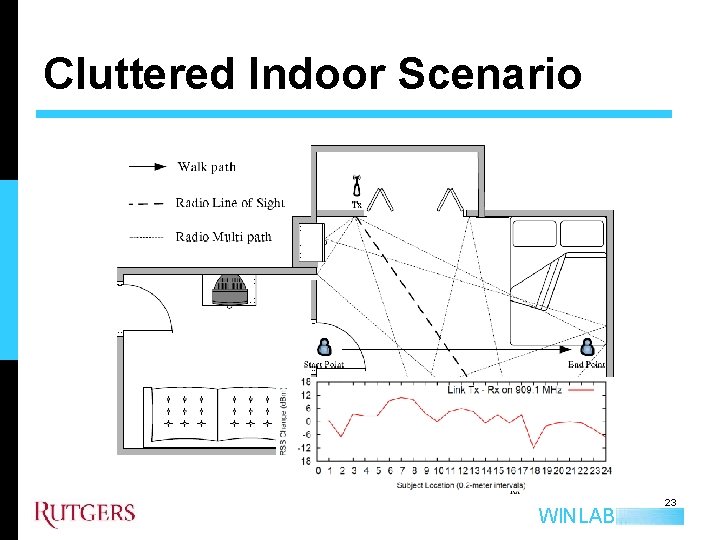
Cluttered Indoor Scenario A user steps across one Line-of-Sight RSS fluctuates in a unpredictable fashion WINLAB 16
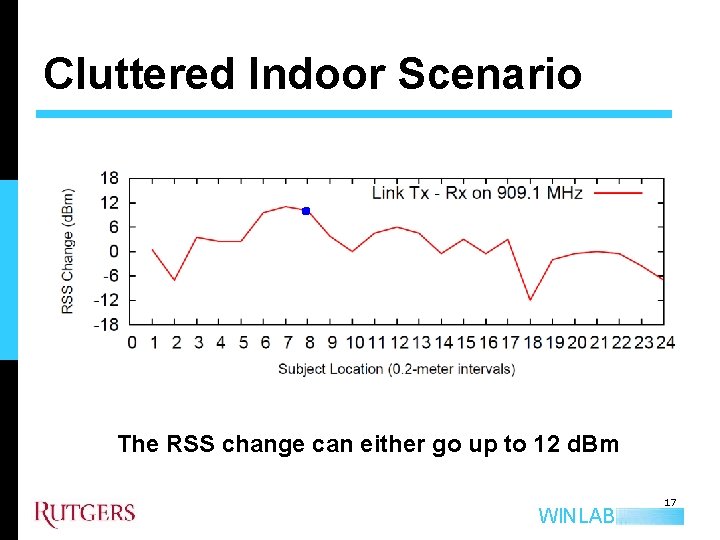
Cluttered Indoor Scenario The RSS change can either go up to 12 d. Bm WINLAB 17

Cluttered Indoor Scenario Or go down to -12 d. Bm WINLAB 18
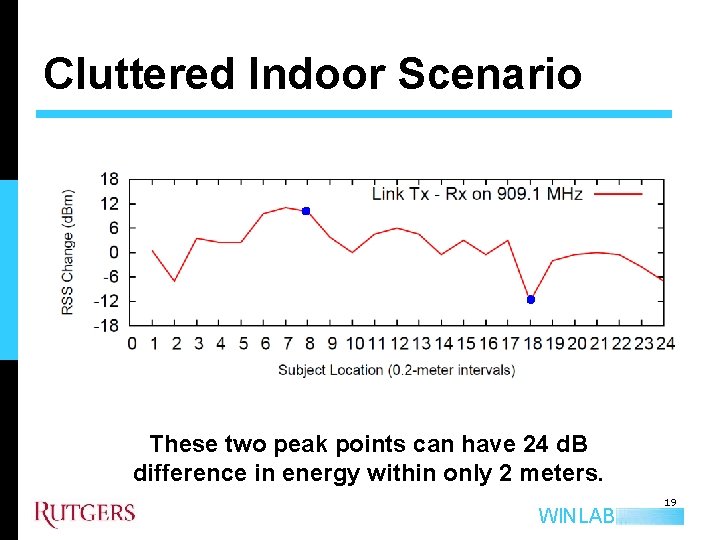
Cluttered Indoor Scenario These two peak points can have 24 d. B difference in energy within only 2 meters. WINLAB 19
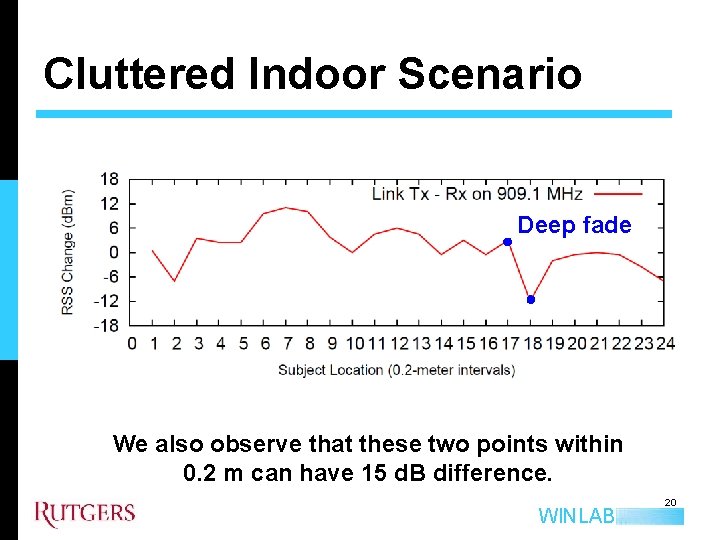
Cluttered Indoor Scenario Deep fade We also observe that these two points within 0. 2 m can have 15 d. B difference. WINLAB 20
Cluttered Indoor Scenario WINLAB 21
Cluttered Indoor Scenario WINLAB 22
Cluttered Indoor Scenario WINLAB 23
Passive Localization q Motivation q Indoor challenge q Proposed solution q Experimental methodology q Performance evaluation q Conclusion and future work WINLAB 24
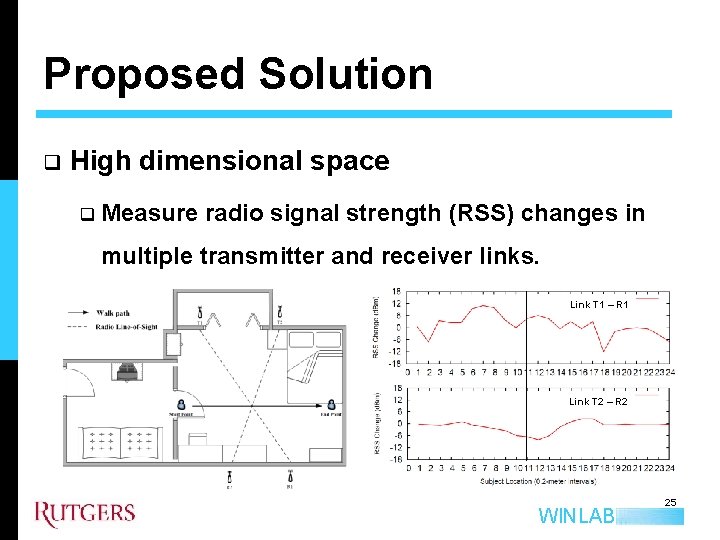
Proposed Solution q High dimensional space q Measure radio signal strength (RSS) changes in multiple transmitter and receiver links. Link T 1 – R 1 Link T 2 – R 2 WINLAB 25
Proposed Solution q High dimensional space q Cell-based localization q Flexible precision q Classification approach WINLAB 26
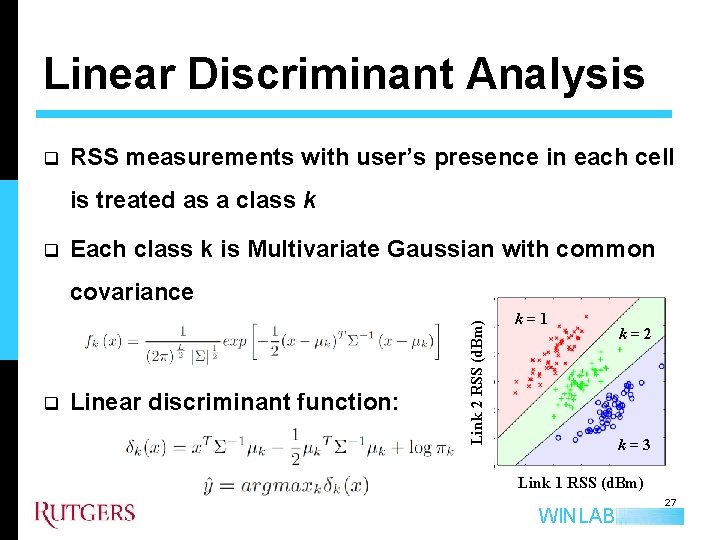
Linear Discriminant Analysis q RSS measurements with user’s presence in each cell is treated as a class k q Each class k is Multivariate Gaussian with common q Linear discriminant function: Link 2 RSS (d. Bm) covariance k=1 k=2 k=3 Link 1 RSS (d. Bm) WINLAB 27
Proposed Solution q High dimensional space q Cell-based localization q Lower radio frequency q Smooth the spatial variation WINLAB 28
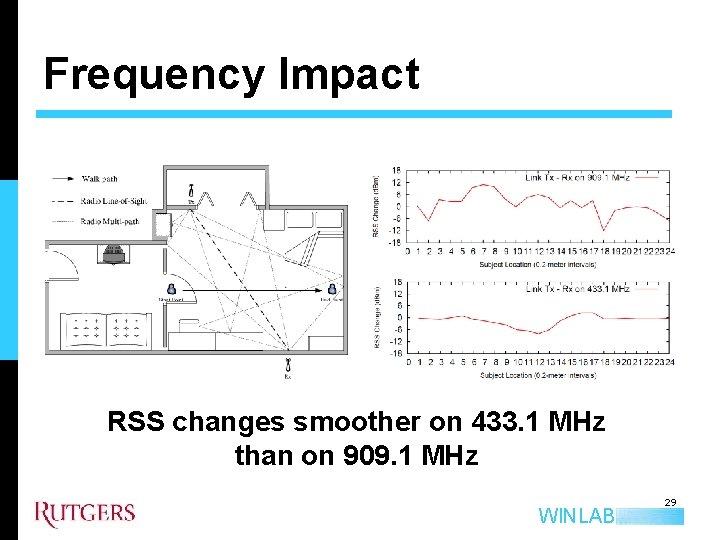
Frequency Impact RSS changes smoother on 433. 1 MHz than on 909. 1 MHz WINLAB 29
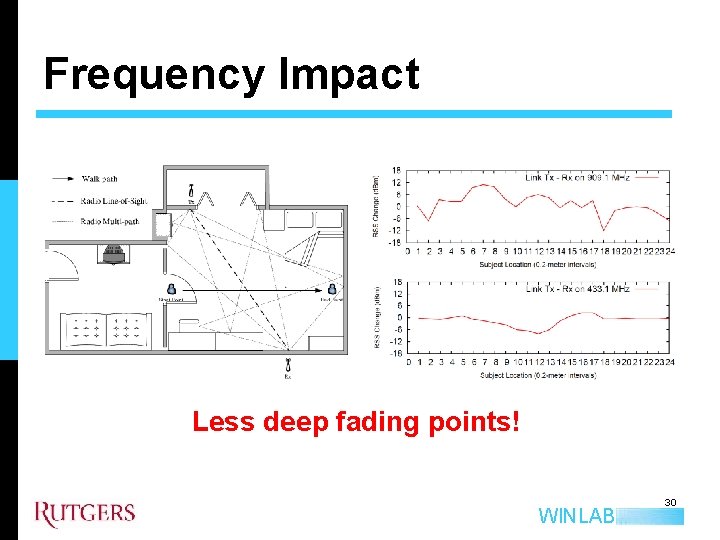
Frequency Impact Less deep fading points! WINLAB 30
Proposed Solution q High dimensional space q q Cell-based localization q q Find features with fewer deep fading points Average the deep fading effect Lower radio frequency q Reduce the deep fading points Mitigate the error caused by the multipath effect! WINLAB 31
Passive Localization q Motivation q Indoor challenge q Proposed solution q Experimental methodology q Performance evaluation q Conclusion and future work WINLAB 32
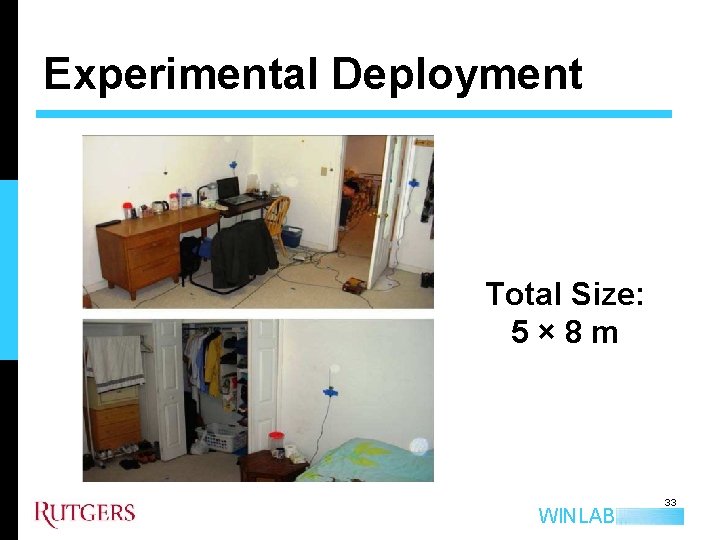
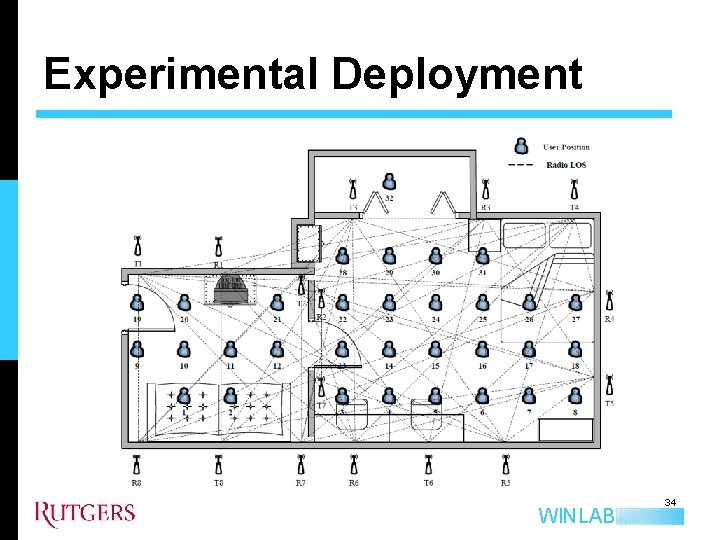
Experimental Deployment Total Size: 5× 8 m WINLAB 33
Experimental Deployment WINLAB 34
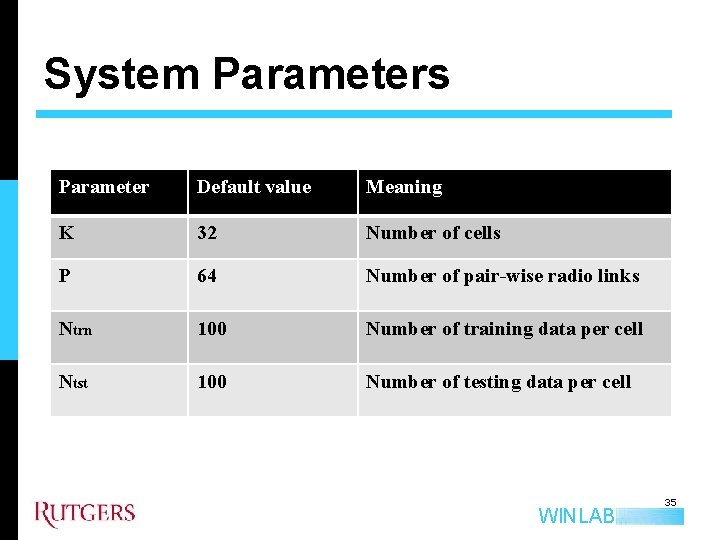
System Parameters Parameter Default value Meaning K 32 Number of cells P 64 Number of pair-wise radio links Ntrn 100 Number of training data per cell Ntst 100 Number of testing data per cell WINLAB 35
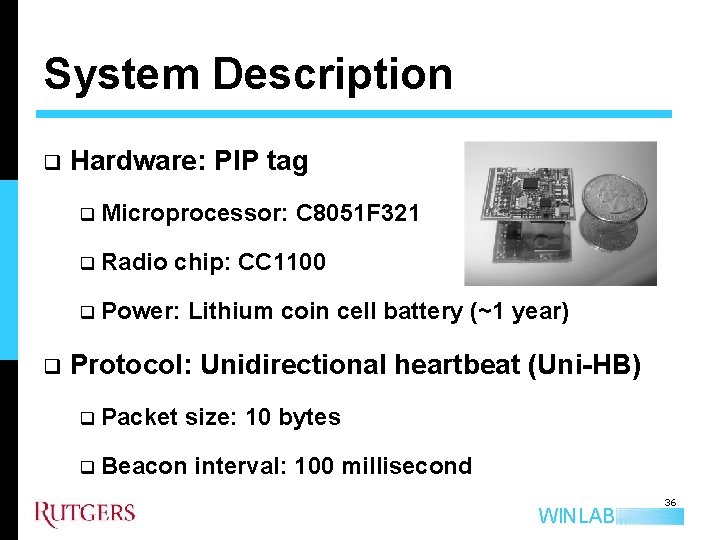
System Description q q Hardware: PIP tag q Microprocessor: C 8051 F 321 q Radio chip: CC 1100 q Power: Lithium coin cell battery (~1 year) Protocol: Unidirectional heartbeat (Uni-HB) q Packet size: 10 bytes q Beacon interval: 100 millisecond WINLAB 36
Training Methodology q q Case A: stand still at the each cell center q Measurement only involves center of the cell q Ignore the deep fade points Case B: random walk within each cell q Measurement includes all the space q Average the multi-path effects Training only takes 15 mins! WINLAB 37
Passive Localization q Motivation q Indoor challenge q Proposed solution q Experimental methodology q Performance evaluation q Conclusion and future work WINLAB 38
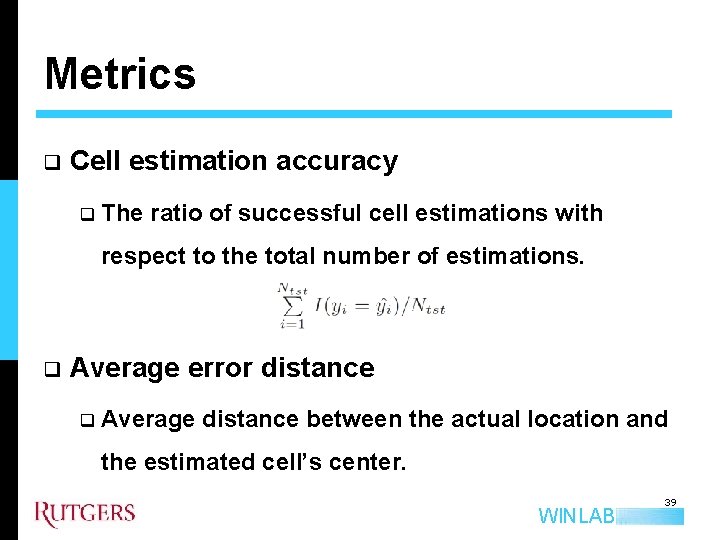
Metrics q Cell estimation accuracy q The ratio of successful cell estimations with respect to the total number of estimations. q Average error distance q Average distance between the actual location and the estimated cell’s center. WINLAB 39
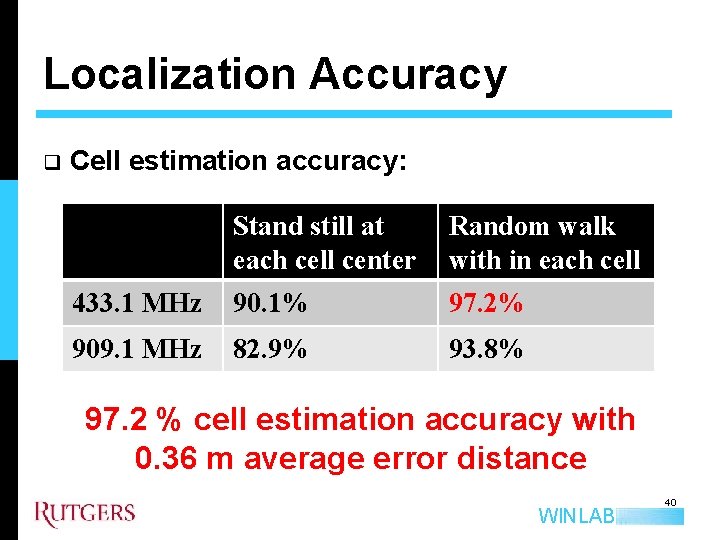
Localization Accuracy q Cell estimation accuracy: Stand still at each cell center Random walk with in each cell 433. 1 MHz 90. 1% 97. 2% 909. 1 MHz 82. 9% 93. 8% 97. 2 % cell estimation accuracy with 0. 36 m average error distance WINLAB 40
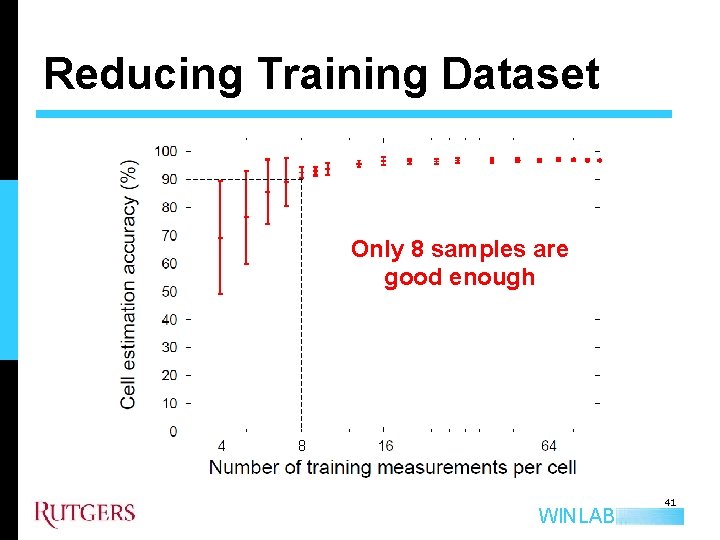
Reducing Training Dataset Only 8 samples are good enough 8 100 WINLAB 41
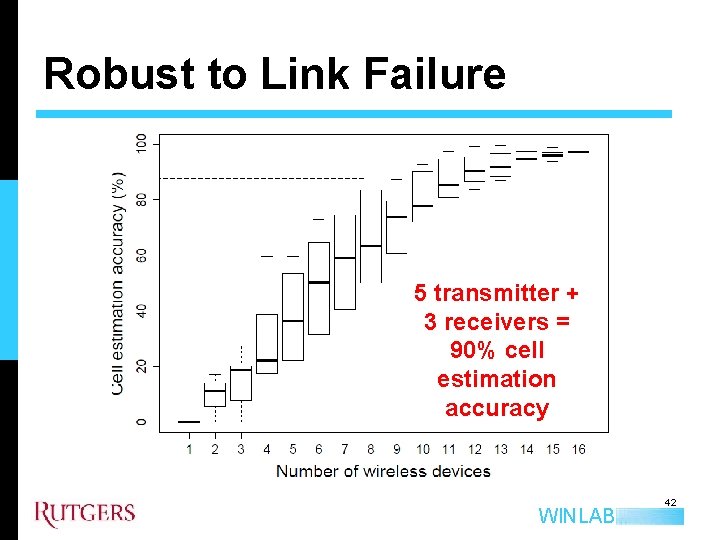
Robust to Link Failure 5 transmitter + 3 receivers = 90% cell estimation accuracy WINLAB 42
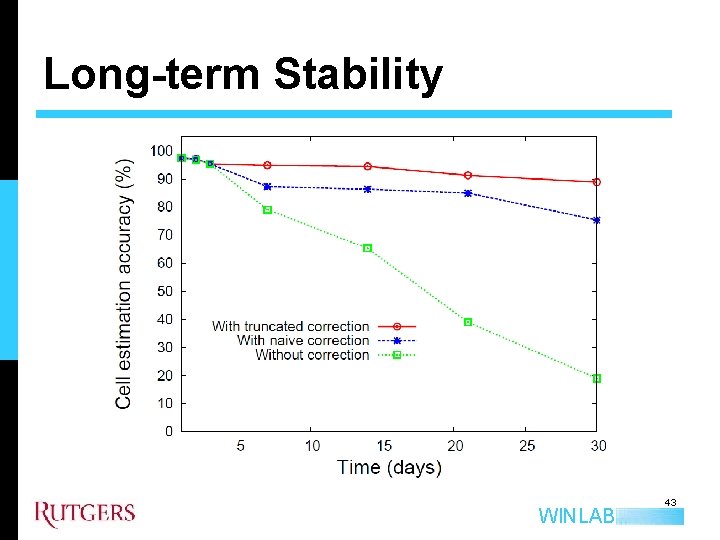
Long-term Stability WINLAB 43
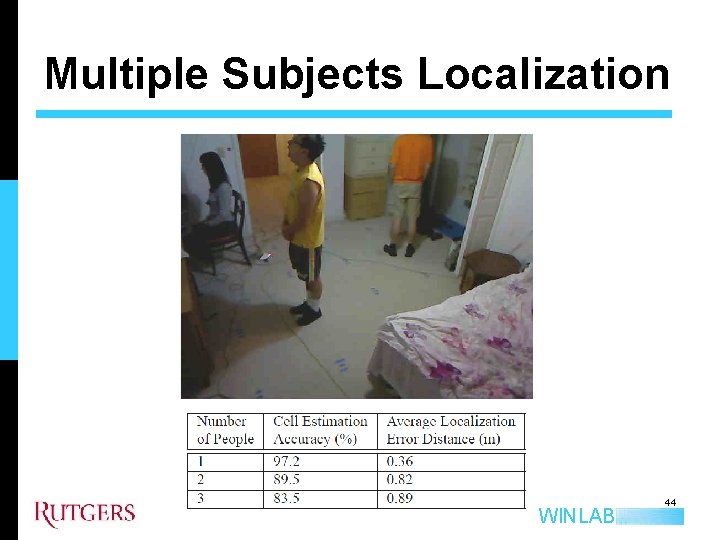
Multiple Subjects Localization WINLAB 44
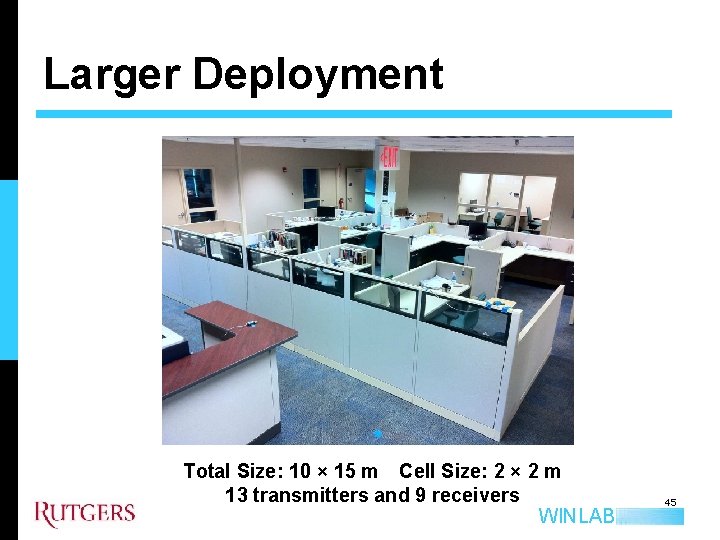
Larger Deployment Total Size: 10 × 15 m Cell Size: 2 × 2 m 13 transmitters and 9 receivers WINLAB 45
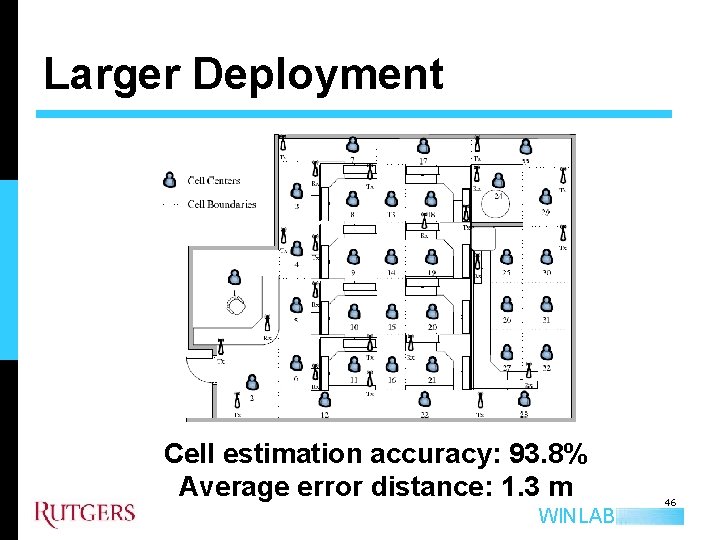
Larger Deployment Cell estimation accuracy: 93. 8% Average error distance: 1. 3 m WINLAB 46
Passive Localization q Motivation q Indoor challenge q Proposed solution q Experimental methodology q Performance evaluation q Conclusion and future work WINLAB 47
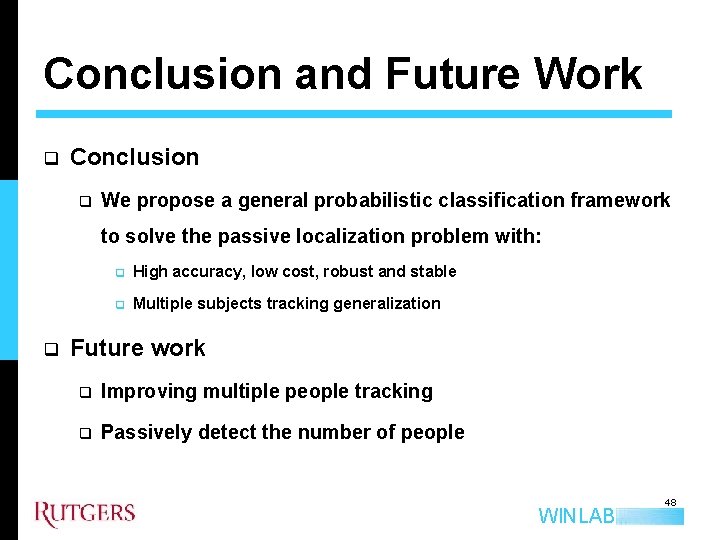
Conclusion and Future Work q Conclusion q We propose a general probabilistic classification framework to solve the passive localization problem with: q q High accuracy, low cost, robust and stable q Multiple subjects tracking generalization Future work q Improving multiple people tracking q Passively detect the number of people WINLAB 48

Q&A Thank you WINLAB 49
- Slides: 49