
Improving Reservoir Characterization of KarstModified Reservoirs with 3
- Slides: 18
Improving Reservoir Characterization of Karst-Modified Reservoirs with 3 -D Geometric Seismic Attributes Susan E. Nissen 1, E. Charlotte Sullivan 2, Kurt J. Marfurt 3, and Timothy R. Carr 4 1 Consultant, 2 Pacific 3 College Mc. Louth, KS Northwest National Labs, Richland, WA of Earth and Energy, University of Oklahoma, Norman, OK 4 Department of Geology and Geography, West Virginia University, Morgantown, WV
Outline • Characteristics of karst-modified reservoirs • Multi-trace geometric seismic attributes • Seismic-based examples of • Collapse structures • Polygonal features • Oriented lineaments • Interpretation workflow for karst-modified reservoirs • Conclusions
Karst Modified Reservoirs • Carbonate reservoirs • Rocks modified by dissolution during subaerial exposure • May also have hydrothermal and tectonic overprints
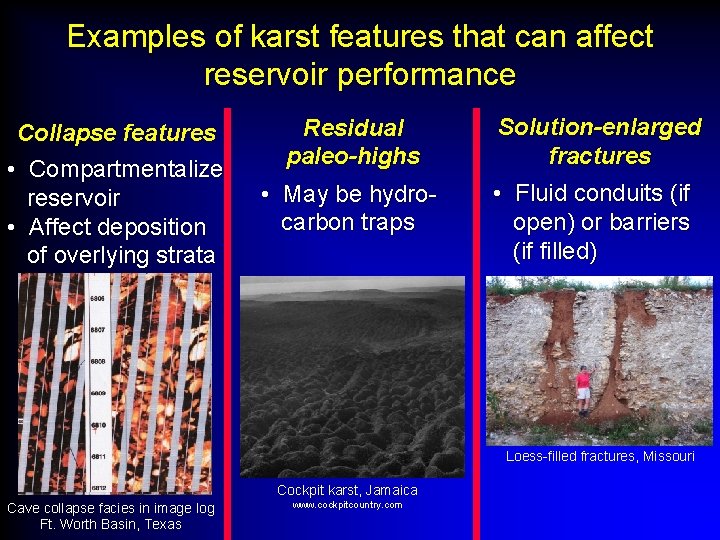
Examples of karst features that can affect reservoir performance Collapse features • Compartmentalize reservoir • Affect deposition of overlying strata Residual paleo-highs • May be hydrocarbon traps Solution-enlarged fractures • Fluid conduits (if open) or barriers (if filled) Loess-filled fractures, Missouri Cockpit karst, Jamaica Cave collapse facies in image log Ft. Worth Basin, Texas www. cockpitcountry. com
Interpretation of Karst Features • Well data alone is insufficient for identifying the spatial extent and distribution of local karst features. • Karst features with substantial vertical relief can be readily identified using 3 -D seismic. • Critical features relating to reservoir character are often subtle and not readily detected using standard 3 -D seismic interpretation methods. • Multi-trace geometric seismic attributes can help!
Multi-Trace Geometric Seismic Attributes • Calculated using multiple input seismic traces and a small vertical analysis window • The analysis "box" moves throughout the entire data volume => attributes can be output as a 3 D volume • Provide quantitative information about lateral variations in the seismic data
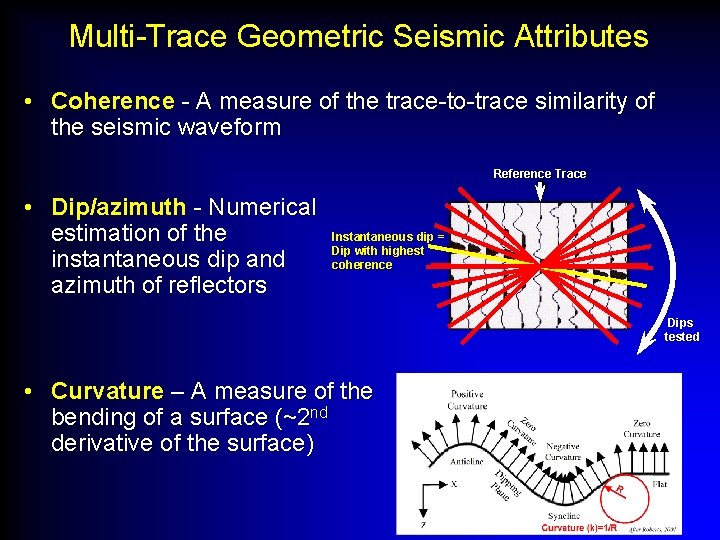
Multi-Trace Geometric Seismic Attributes • Coherence - A measure of the trace-to-trace similarity of the seismic waveform Reference Trace • Dip/azimuth - Numerical estimation of the instantaneous dip and azimuth of reflectors Instantaneous dip = Dip with highest coherence Dips tested • Curvature – A measure of the bending of a surface (~2 nd derivative of the surface)
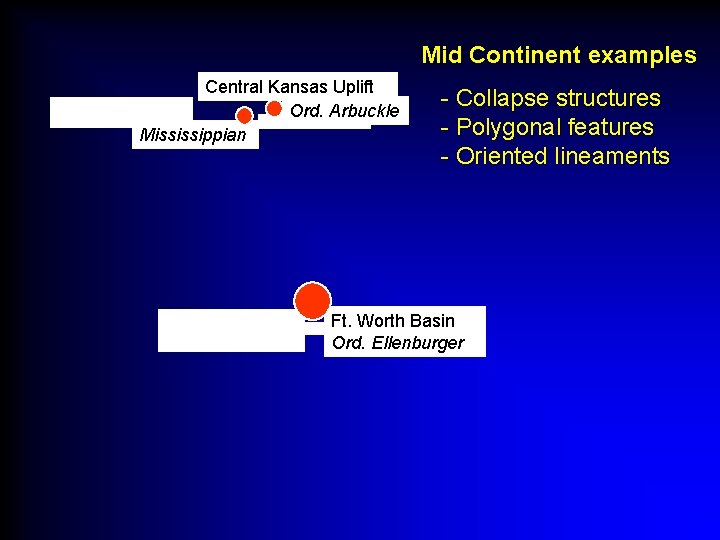
Mid Continent examples Central Kansas Uplift Ord. Arbuckle Mississippian - Collapse structures - Polygonal features - Oriented lineaments Ft. Worth Basin Ord. Ellenburger
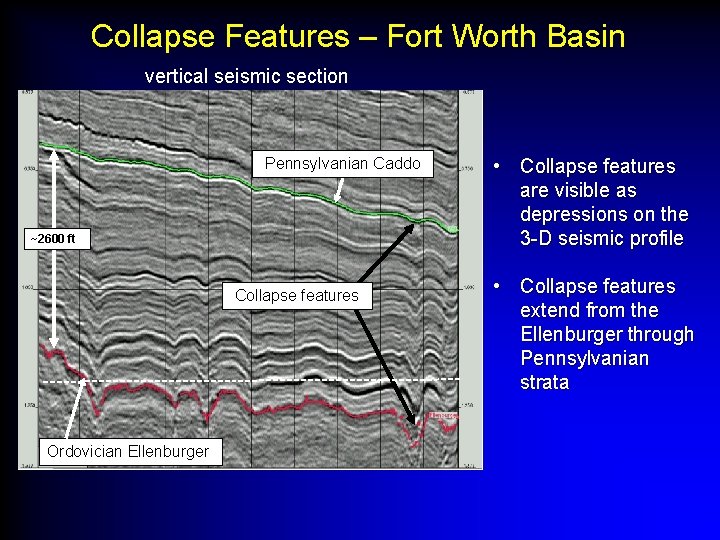
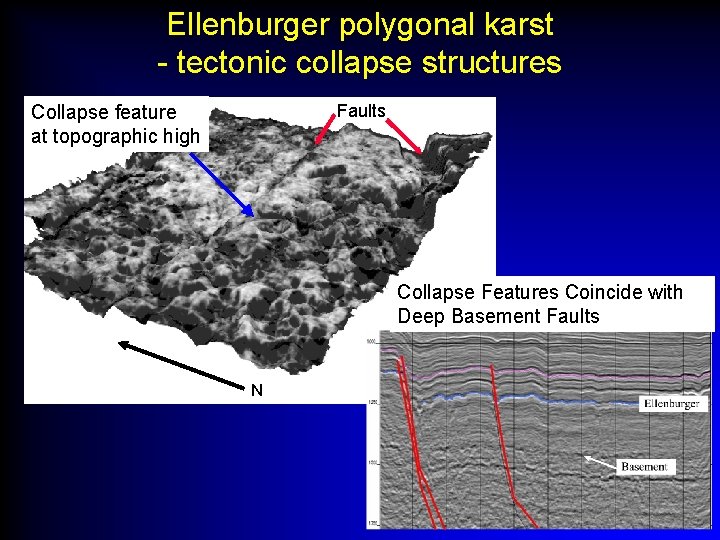
Collapse Features – Fort Worth Basin vertical seismic section Pennsylvanian Caddo ~2600 ft Collapse features Ordovician Ellenburger • Collapse features are visible as depressions on the 3 -D seismic profile • Collapse features extend from the Ellenburger through Pennsylvanian strata
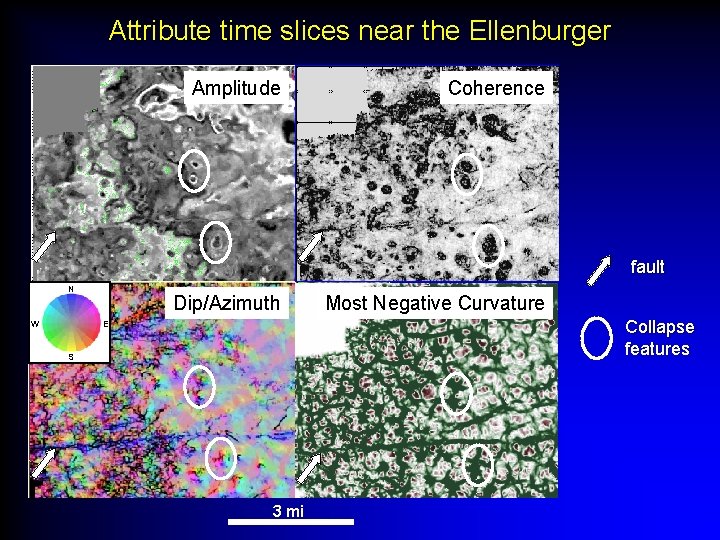
Attribute time slices near the Ellenburger Amplitude Coherence fault N W Dip/Azimuth Most Negative Curvature Collapse features E S 3 mi
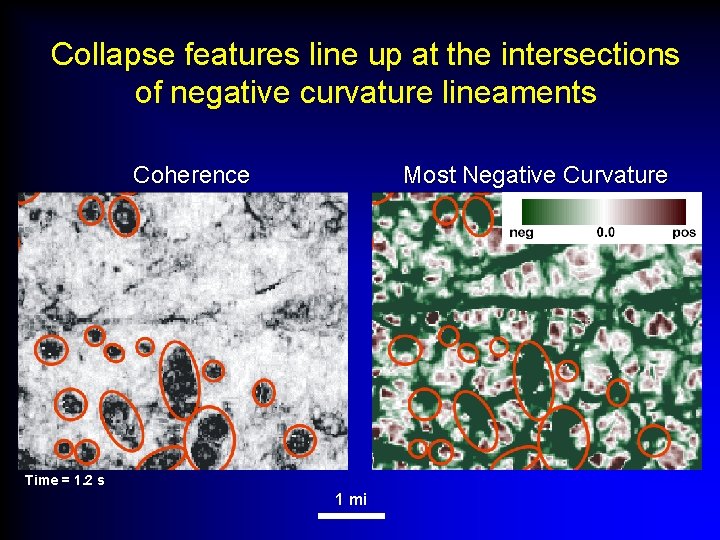
Collapse features line up at the intersections of negative curvature lineaments Coherence Most Negative Curvature Time = 1. 2 s 1 mi
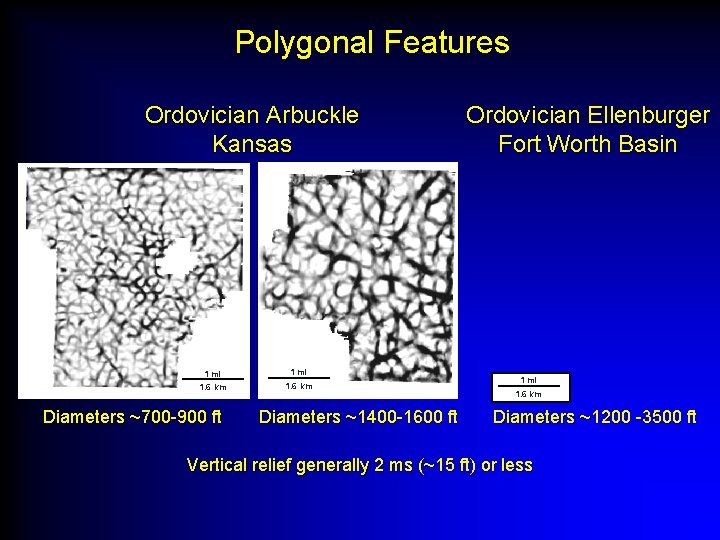
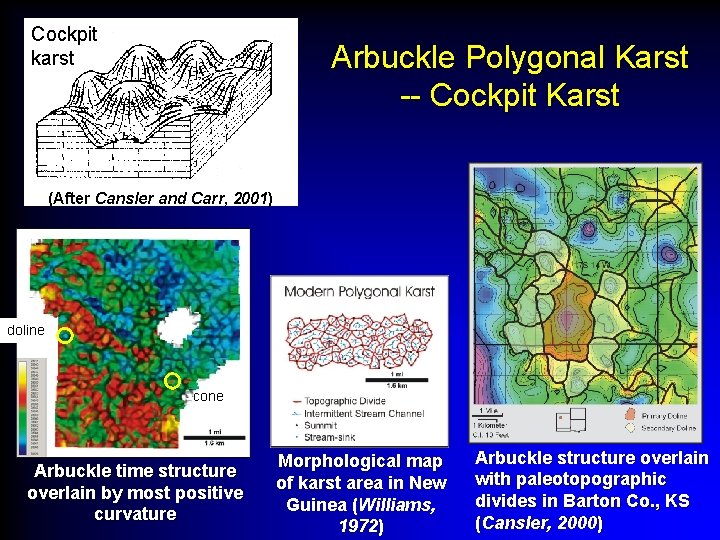
Polygonal Features Ordovician Arbuckle Kansas 1 mi 1. 6 km Diameters ~700 -900 ft Diameters ~1400 -1600 ft Ordovician Ellenburger Fort Worth Basin 1 mi 1. 6 km Diameters ~1200 -3500 ft Vertical relief generally 2 ms (~15 ft) or less
Cockpits karst Arbuckle Polygonal Karst -- Cockpit Karst (After Cansler and Carr, 2001) doline cone Arbuckle time structure overlain by most positive curvature Morphological map of karst area in New Guinea (Williams, 1972) Arbuckle structure overlain with paleotopographic divides in Barton Co. , KS (Cansler, 2000)
Ellenburger polygonal karst - tectonic collapse structures Faults Collapse feature at topographic high Collapse Features Coincide with Deep Basement Faults N
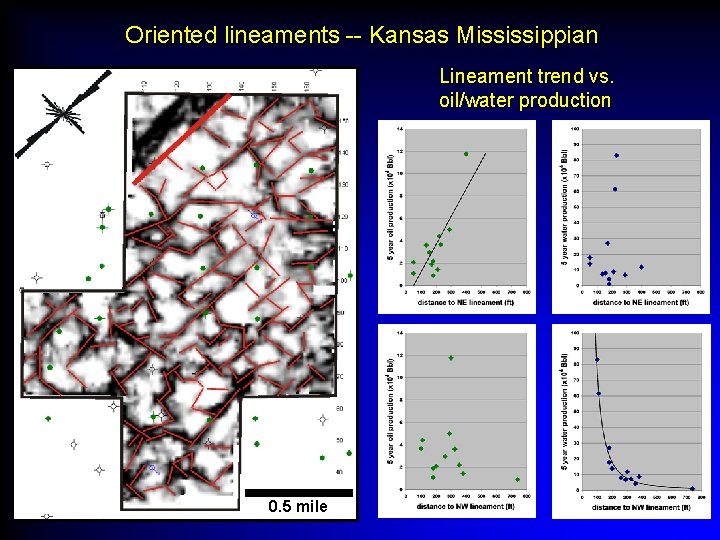
Oriented lineaments -- Kansas Mississippian Lineament trend vs. oil/water production 0. 5 mile
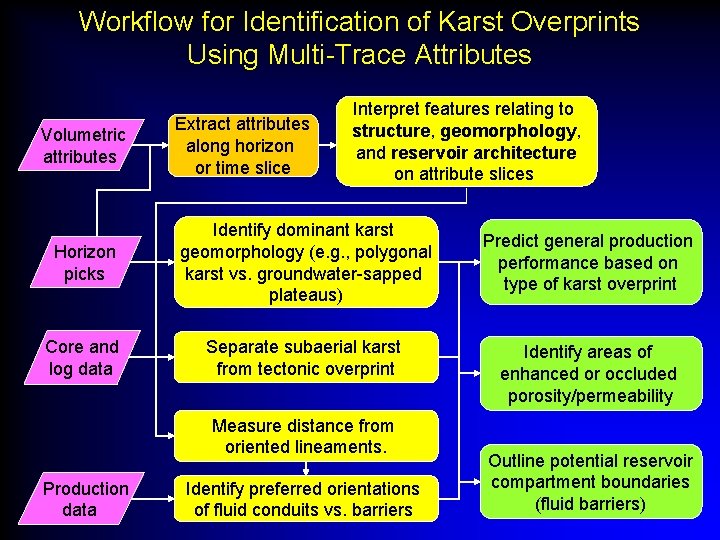
Workflow for Identification of Karst Overprints Using Multi-Trace Attributes Volumetric attributes Extract attributes along horizon or time slice Interpret features relating to structure, geomorphology, and reservoir architecture on attribute slices Horizon picks Identify dominant karst geomorphology (e. g. , polygonal karst vs. groundwater-sapped plateaus) Core and log data Separate subaerial karst from tectonic overprint Measure distance from oriented lineaments. Production data Identify preferred orientations of fluid conduits vs. barriers Predict general production performance based on type of karst overprint Identify areas of enhanced or occluded porosity/permeability Outline potential reservoir compartment boundaries (fluid barriers)
Conclusions • Coherence, dip/azimuth, and curvature extractions are valuable for establishing seismic geomorphology • Different attributes reveal different details about karst features • A workflow utilizing multi-trace attributes, along with geologic and production information, can improve characterization of karst-modified carbonate reservoirs
Acknowledgements l l l Devon Energy Grand Mesa Operating Company John O. Farmer, Inc. Murfin Drilling Company IHS - geo. PLUS Corporation Seismic Micro-Technology, Inc. U. S. Department of Energy Petroleum Research Fund State of Texas ATP Kansas Geological Survey, University of Kansas University of Houston