
Improving Real Estate Assessment Center REAC Inspections National

- Slides: 21
Improving Real Estate Assessment Center (REAC) Inspections: National Standards for the Physical Inspection of Real Estate (NSPIRE) May 20, 2019
Overview • “The Problem” • Inspection Task Force • Current protocol efforts • The NSPIRE model • NSPIRE demonstration 2
The Problem While a significant majority of HUD and HUD-assisted properties are safe and in a quality condition, a new inspection model is needed to expediently address properties that are not. Issues include: • Inspections do not always identify the extent of health and safety conditions affecting residents • Properties can pass inspection even with poor unit conditions • Scoring model no longer aligns with expectations about housing quality • Some owners preparing for inspections, rather than performing maintenance year-round 3
Inspection Task Force Mission • Conduct a wholesale reexamination of REAC inspections • Place the greatest emphasis on eliminating health and safety hazards • Ensure owners adopt sound maintenance practices year-round 4
2 -Track Approach • Track 1 – Immediate Changes to the Current System ü 14 Day Inspection Notification üEliminating Reverse Auction Program üCarbon Monoxide Detectors üMeasuring Wall Moisture • Track 2 – Complete Review and Overhaul of the Inspection Process 5
Track 1: 14 Calendar Day Inspection Notification • Achieves a more accurate picture of how the property is being maintained year-round • Reduces significant costs spent for inspection preparation and promotes reinvestment into the property year-round • General Concept • Property notified 14 calendar days before the inspection • Unless state or local law requires a longer resident notification window • If property cancels, the score will be a zero • One additional reinspection within 7 calendar days; otherwise, score held at zero • Notice Released Feb 22, 2019; Effective March 25, 2019 • https: //www. hud. gov/sites/dfiles/PIH/documents/PIH-2019 -02. pdf 6
Track 1: Reverse Auction Program Contract Replacement HUD is replacing the Reverse Auction Contract method in 2 steps: • Demonstration • All Inspections 7
Track 1: Carbon Monoxide (CO) Detectors HUD issued a notice on April 18, 2019 stating: PIH Inspector Notice 2019 -06; Housing Notice 2019 -05; OLHCHH 2019 -01 • As required by the state or local law, code or other regulation, owners, managers and agents of HUD-assisted housing must have operational CO detectors. • HUD strongly encourages those located in areas that do not require CO detectors, to have operational CO detectors in buildings/units with fuelfired appliances or connected garages. On March 25, 2019, REAC issued an Inspector memo to determine the prevalence of CO detection systems at HUD properties subject to UPCS inspection. 8
Track 1: Measuring Wall Moisture • Federal Inspectors are using infrared cameras and moisture meters to test wall moisture at a limited number of properties. • HUD is asking for specific feedback on the methods used to measure wall moisture. 9
Track 2: Goals of NSPIRE Demonstration • Ensure families are living in decent and safe housing • Enhance accuracy through: • Better identification of substandard properties • Increased objectivity and defensibility of inspections • Streamlined inspection processes 10
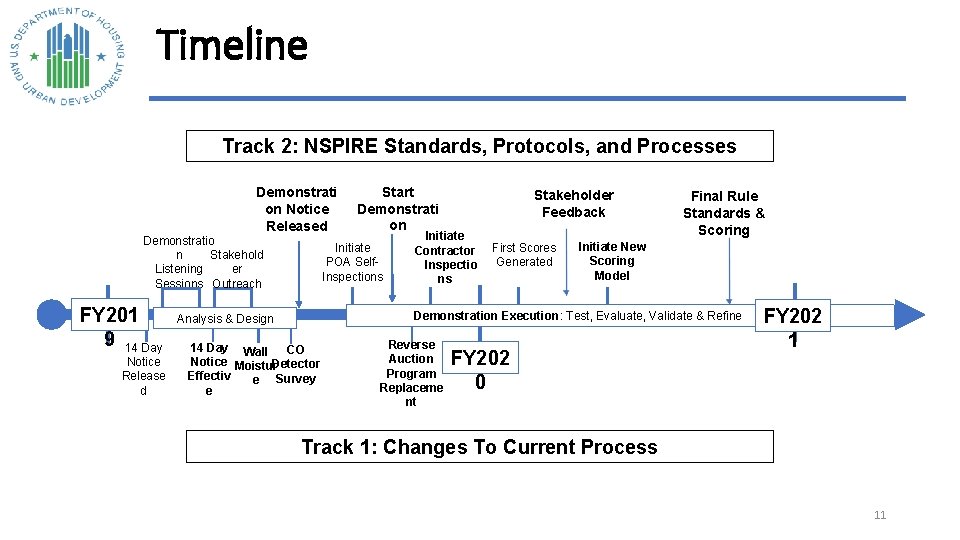
Timeline Track 2: NSPIRE Standards, Protocols, and Processes Demonstrati on Notice Released Demonstratio n Stakehold Listening er Sessions Outreach FY 201 9 14 Day Notice Release d Start Demonstrati on Initiate POA Self. Inspections Stakeholder Feedback Initiate Contractor Inspectio ns First Scores Generated Final Rule Standards & Scoring Initiate New Scoring Model Demonstration Execution: Test, Evaluate, Validate & Refine Analysis & Design 14 Day Wall CO Notice Moistur. Detector Effectiv e Survey e Reverse Auction Program Replaceme nt FY 202 0 FY 202 1 Track 1: Changes To Current Process 11
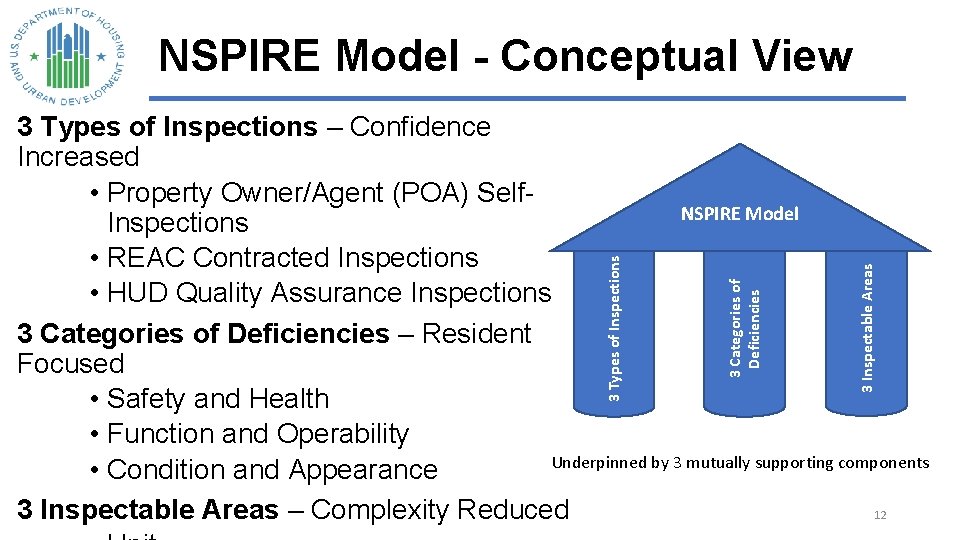
NSPIRE Model - Conceptual View 3 Inspectable Areas 3 Categories of Deficiencies 3 Types of Inspections – Confidence Increased • Property Owner/Agent (POA) Self. NSPIRE Model Inspections • REAC Contracted Inspections • HUD Quality Assurance Inspections 3 Categories of Deficiencies – Resident Focused • Safety and Health • Function and Operability Underpinned by 3 mutually supporting components • Condition and Appearance 3 Inspectable Areas – Complexity Reduced 12
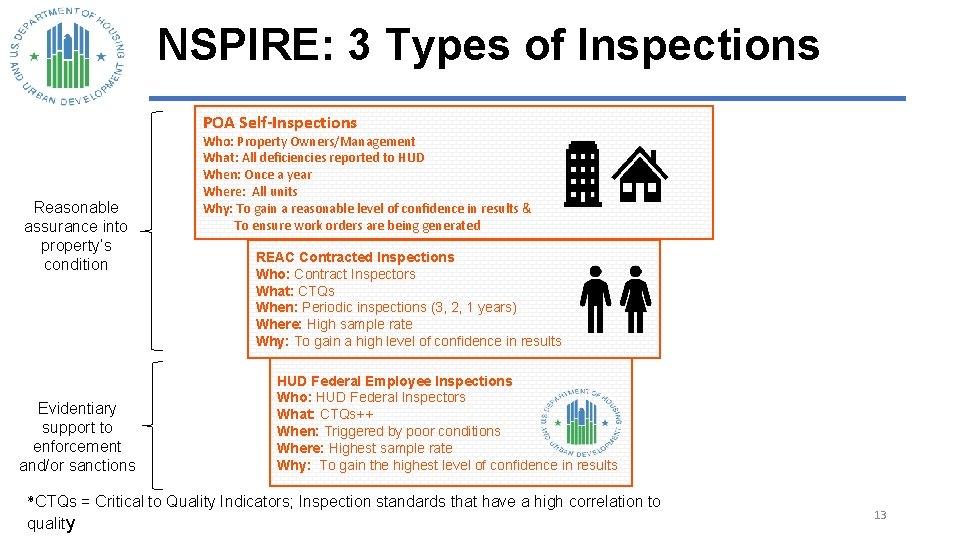
NSPIRE: 3 Types of Inspections POA Self-Inspections Reasonable assurance into property’s condition Evidentiary support to enforcement and/or sanctions Who: Property Owners/Management What: All deficiencies reported to HUD When: Once a year Where: All units Why: To gain a reasonable level of confidence in results & To ensure work orders are being generated REAC Contracted Inspections Who: Contract Inspectors What: CTQs When: Periodic inspections (3, 2, 1 years) Where: High sample rate Why: To gain a high level of confidence in results HUD Federal Employee Inspections Who: HUD Federal Inspectors What: CTQs++ When: Triggered by poor conditions Where: Highest sample rate Why: To gain the highest level of confidence in results *CTQs = Critical to Quality Indicators; Inspection standards that have a high correlation to quality 13
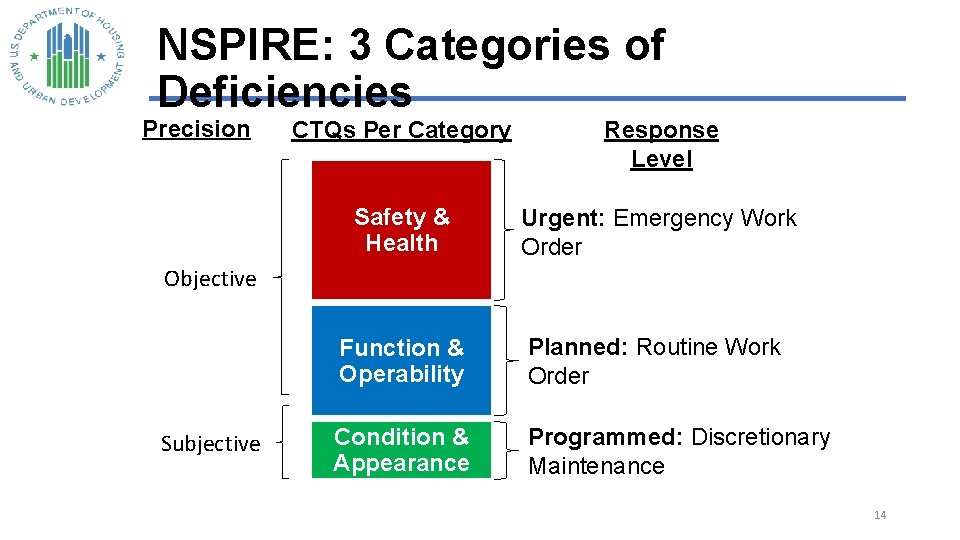
NSPIRE: 3 Categories of Deficiencies Precision CTQs Per Category Response Level Safety & Health Urgent: Emergency Work Order Function & Operability Planned: Routine Work Order Condition & Appearance Programmed: Discretionary Maintenance Objective Subjective 14
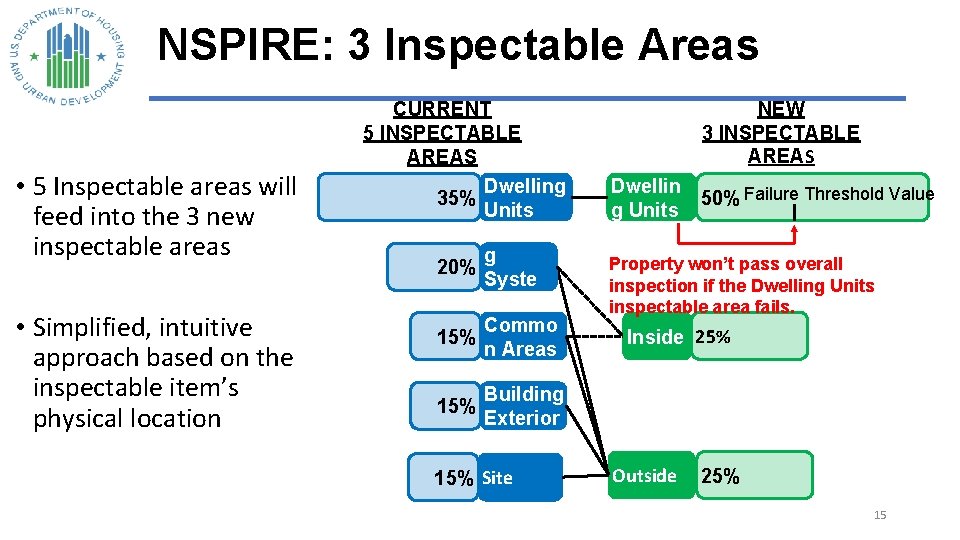
NSPIRE: 3 Inspectable Areas • 5 Inspectable areas will feed into the 3 new inspectable areas • Simplified, intuitive approach based on the inspectable item’s physical location CURRENT 5 INSPECTABLE AREAS Dwelling 35% Units Buildin g 20% Syste ms Commo 15% n Areas 15% NEW 3 INSPECTABLE AREAS Dwellin 50% Failure Threshold Value g Units Property won’t pass overall inspection if the Dwelling Units inspectable area fails. Inside 25% Building Exterior 15% Site Outside 25% 15
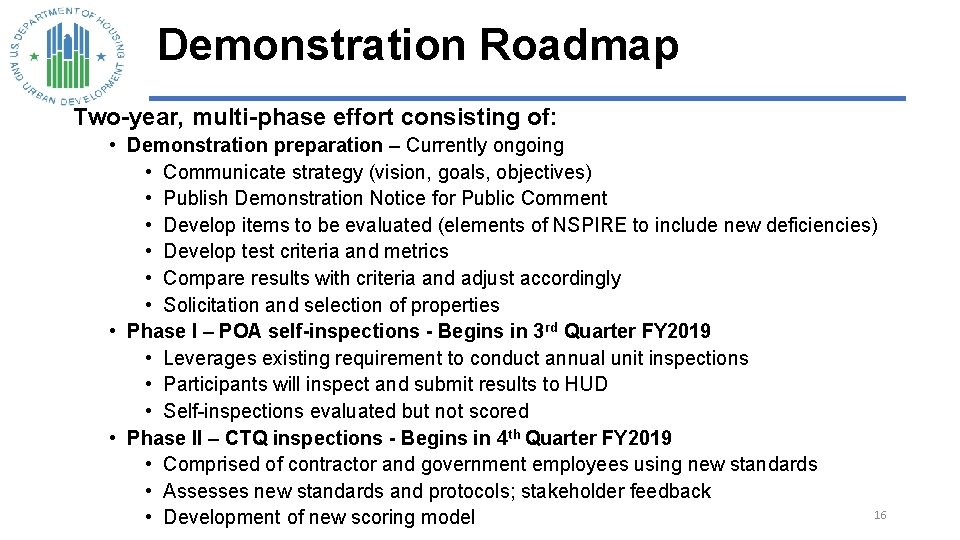
Demonstration Roadmap Two-year, multi-phase effort consisting of: • Demonstration preparation – Currently ongoing • Communicate strategy (vision, goals, objectives) • Publish Demonstration Notice for Public Comment • Develop items to be evaluated (elements of NSPIRE to include new deficiencies) • Develop test criteria and metrics • Compare results with criteria and adjust accordingly • Solicitation and selection of properties • Phase I – POA self-inspections - Begins in 3 rd Quarter FY 2019 • Leverages existing requirement to conduct annual unit inspections • Participants will inspect and submit results to HUD • Self-inspections evaluated but not scored • Phase II – CTQ inspections - Begins in 4 th Quarter FY 2019 • Comprised of contractor and government employees using new standards • Assesses new standards and protocols; stakeholder feedback 16 • Development of new scoring model
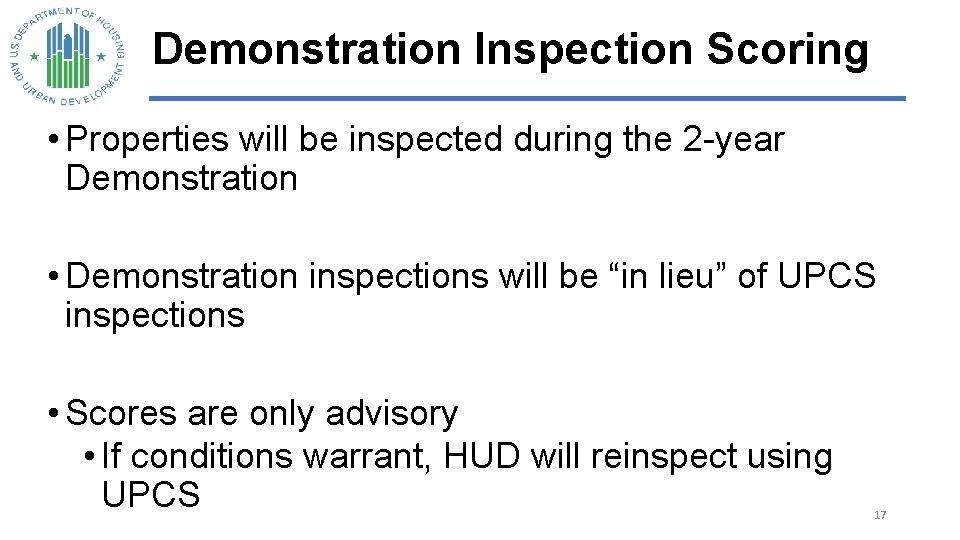
Demonstration Inspection Scoring • Properties will be inspected during the 2 -year Demonstration • Demonstration inspections will be “in lieu” of UPCS inspections • Scores are only advisory • If conditions warrant, HUD will reinspect using UPCS 17
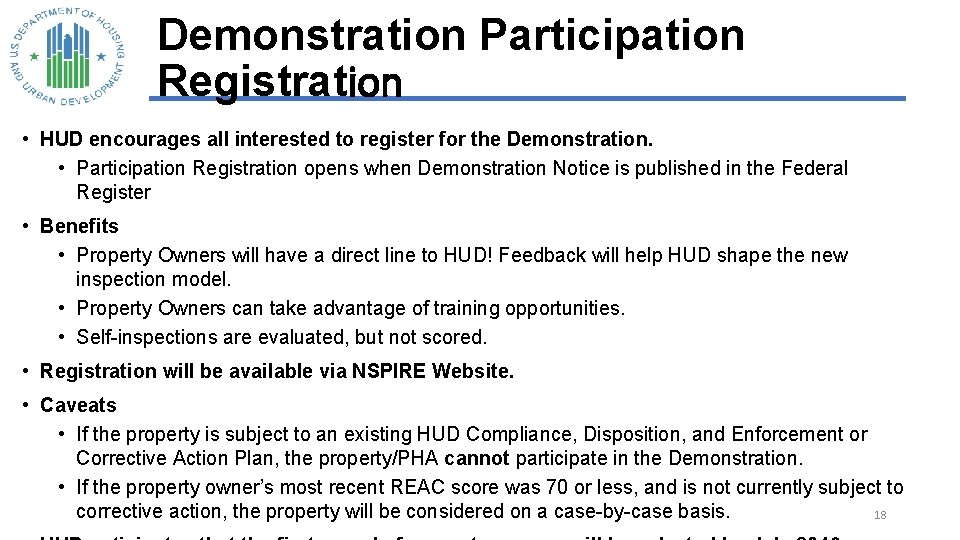
Demonstration Participation Registration • HUD encourages all interested to register for the Demonstration. • Participation Registration opens when Demonstration Notice is published in the Federal Register • Benefits • Property Owners will have a direct line to HUD! Feedback will help HUD shape the new inspection model. • Property Owners can take advantage of training opportunities. • Self-inspections are evaluated, but not scored. • Registration will be available via NSPIRE Website. • Caveats • If the property is subject to an existing HUD Compliance, Disposition, and Enforcement or Corrective Action Plan, the property/PHA cannot participate in the Demonstration. • If the property owner’s most recent REAC score was 70 or less, and is not currently subject to corrective action, the property will be considered on a case-by-case basis. 18
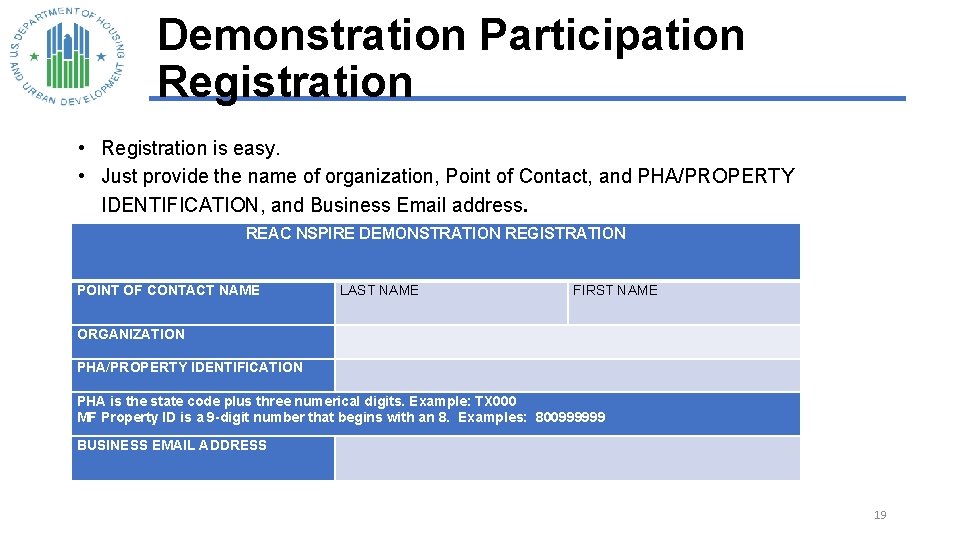
Demonstration Participation Registration • Registration is easy. • Just provide the name of organization, Point of Contact, and PHA/PROPERTY IDENTIFICATION, and Business Email address. REAC NSPIRE DEMONSTRATION REGISTRATION POINT OF CONTACT NAME LAST NAME FIRST NAME ORGANIZATION PHA/PROPERTY IDENTIFICATION PHA is the state code plus three numerical digits. Example: TX 000 MF Property ID is a 9 -digit number that begins with an 8. Examples: 800999999 BUSINESS EMAIL ADDRESS 19
Summary • Improvements to protect families and ensure the inspection results reflect the property’s true physical condition • Improvements will be tested during a 2 -year demonstration • Feedback will be collected from stakeholders through listening sessions and other methods of outreach • Demonstration expected beginning Q 3 FY 19 • Demonstration Participant Registration will be on NSPIRE website 20
Your feedback… Questions & Comments NSPIRE@hud. gov or Search on “HUD NSPIRE” 21