
Improving Qo S of Vo IP over Wireless
- Slides: 26
Improving Qo. S of Vo. IP over Wireless Networks (IQ-VW) Mona Habib & Nirmala Bulusu CS 522 – 12/09/2002
Agenda n Voice over IP (Vo. IP): Why? n Vo. IP Protocols: H. 323 and SIP n Quality of Service (Qo. S) n Wireless Networks n Testbed Configuration n Testing Scenarios n Qo. S Test Results n Comments 2
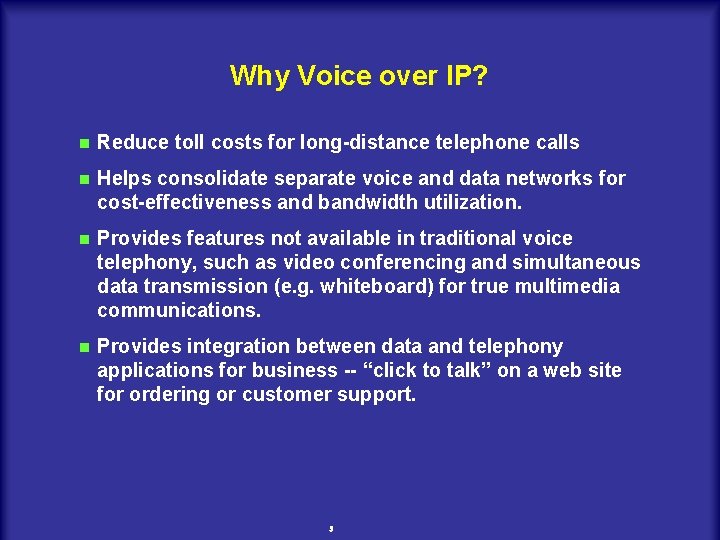
Why Voice over IP? n Reduce toll costs for long-distance telephone calls n Helps consolidate separate voice and data networks for cost-effectiveness and bandwidth utilization. n Provides features not available in traditional voice telephony, such as video conferencing and simultaneous data transmission (e. g. whiteboard) for true multimedia communications. n Provides integration between data and telephony applications for business -- “click to talk” on a web site for ordering or customer support. 3
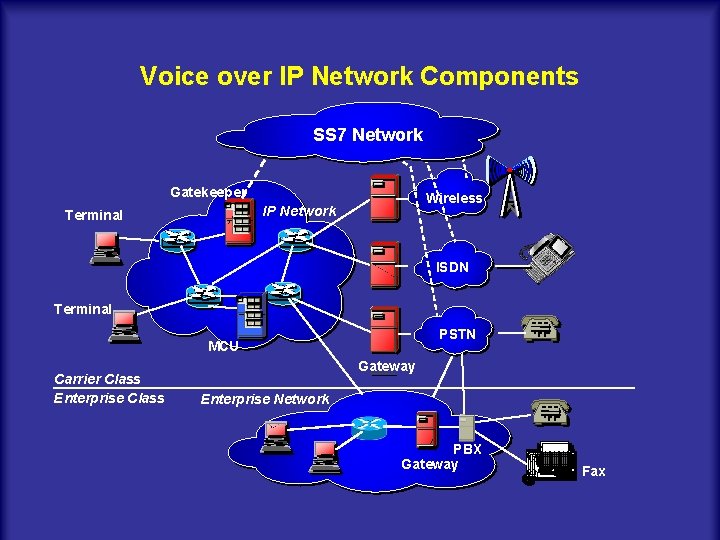
Voice over IP Network Components SS 7 Network Gatekeeper Wireless IP Network Terminal ISDN Terminal PSTN MCU Carrier Class Enterprise Class Gateway Enterprise Network PBX Gateway Fax
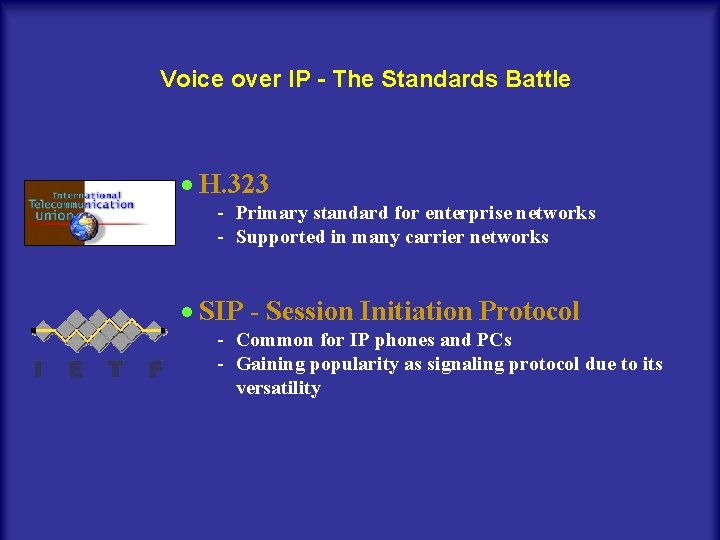
Voice over IP - The Standards Battle · H. 323 - Primary standard for enterprise networks - Supported in many carrier networks · SIP - Session Initiation Protocol - Common for IP phones and PCs - Gaining popularity as signaling protocol due to its versatility
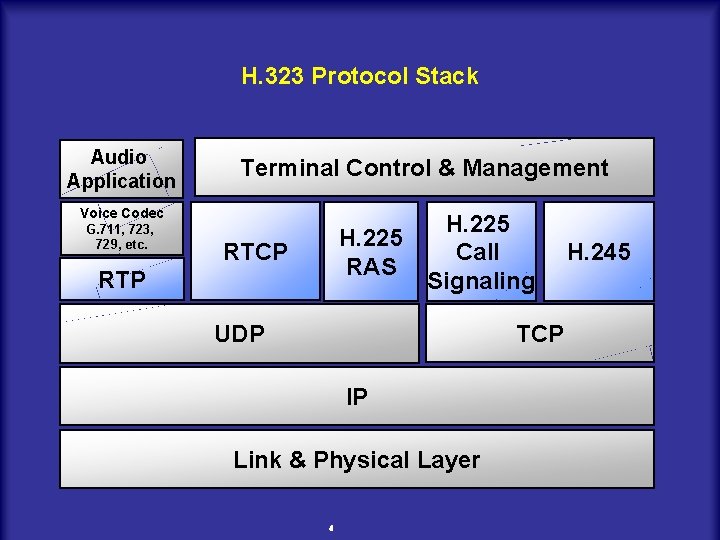
H. 323 Protocol Stack Audio Application Terminal Control & Management Voice Codec G. 711, 723, 729, etc. H. 225 RAS RTCP RTP H. 225 Call Signaling TCP UDP IP Link & Physical Layer 6 H. 245
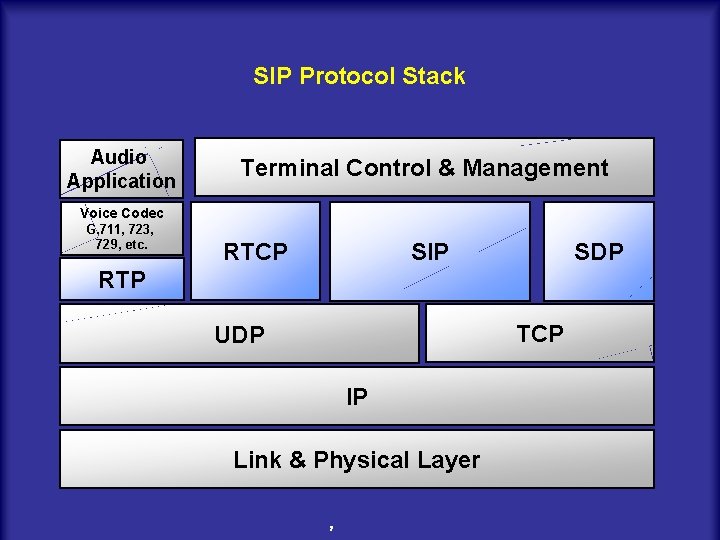
SIP Protocol Stack Audio Application Terminal Control & Management Voice Codec G. 711, 723, 729, etc. RTCP SIP SDP RTP TCP UDP IP Link & Physical Layer 7
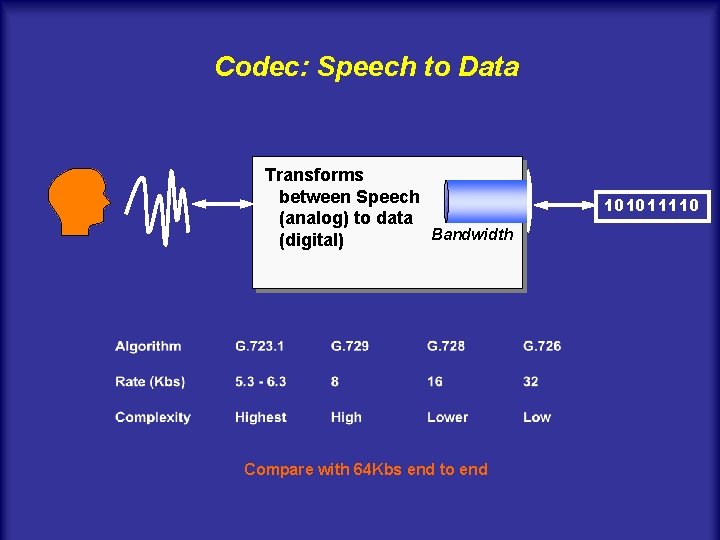
Codec: Speech to Data Transforms between Speech (analog) to data Bandwidth (digital) Compare with 64 Kbs end to end 101011110
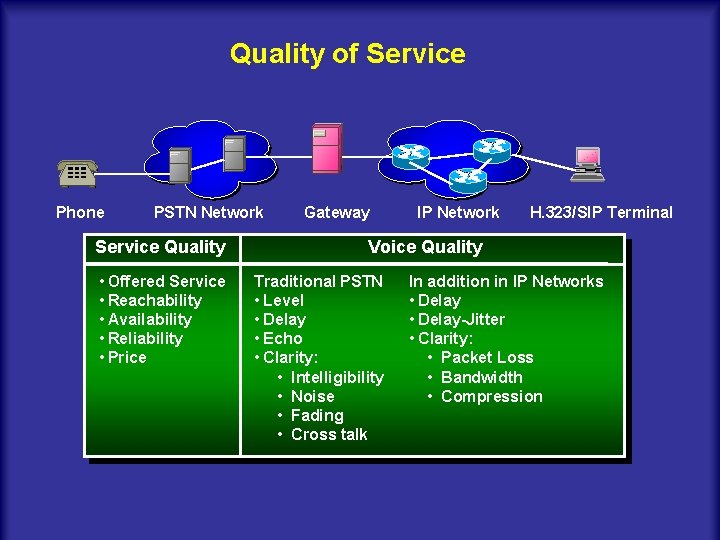
Quality of Service Phone PSTN Network Service Quality • Offered Service • Reachability • Availability • Reliability • Price Gateway IP Network H. 323/SIP Terminal Voice Quality Traditional PSTN • Level • Delay • Echo • Clarity: • Intelligibility • Noise • Fading • Cross talk In addition in IP Networks • Delay-Jitter • Clarity: • Packet Loss • Bandwidth • Compression
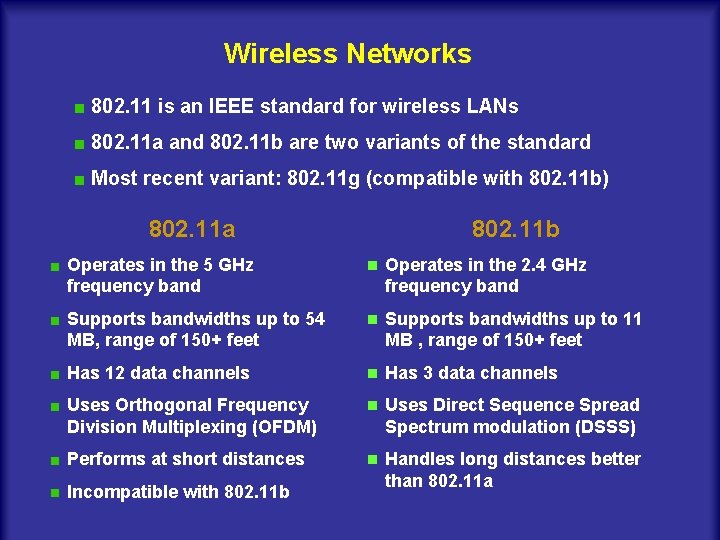
Wireless Networks 802. 11 is an IEEE standard for wireless LANs 802. 11 a and 802. 11 b are two variants of the standard Most recent variant: 802. 11 g (compatible with 802. 11 b) 802. 11 a 802. 11 b Operates in the 5 GHz frequency band n Operates in the 2. 4 GHz frequency band Supports bandwidths up to 54 MB, range of 150+ feet n Supports bandwidths up to 11 MB , range of 150+ feet Has 12 data channels n Has 3 data channels Uses Orthogonal Frequency Division Multiplexing (OFDM) n Uses Direct Sequence Spread Spectrum modulation (DSSS) Performs at short distances n Handles long distances better than 802. 11 a Incompatible with 802. 11 b
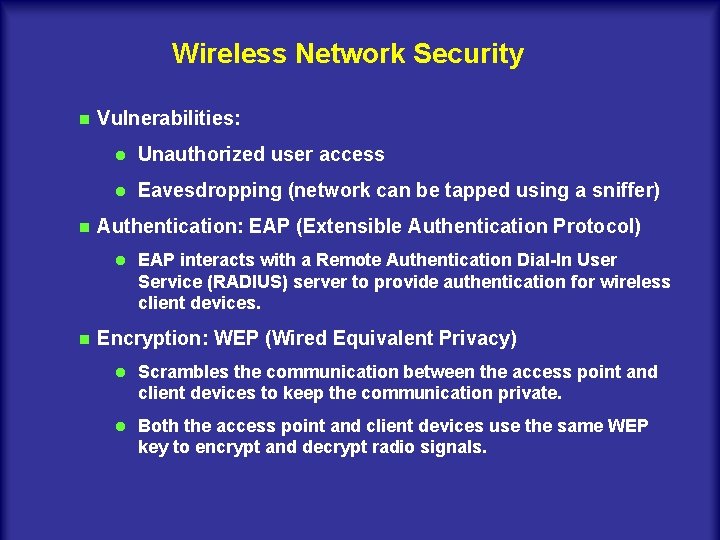
Wireless Network Security n n Vulnerabilities: l Unauthorized user access l Eavesdropping (network can be tapped using a sniffer) Authentication: EAP (Extensible Authentication Protocol) l n EAP interacts with a Remote Authentication Dial-In User Service (RADIUS) server to provide authentication for wireless client devices. Encryption: WEP (Wired Equivalent Privacy) l Scrambles the communication between the access point and client devices to keep the communication private. l Both the access point and client devices use the same WEP key to encrypt and decrypt radio signals.
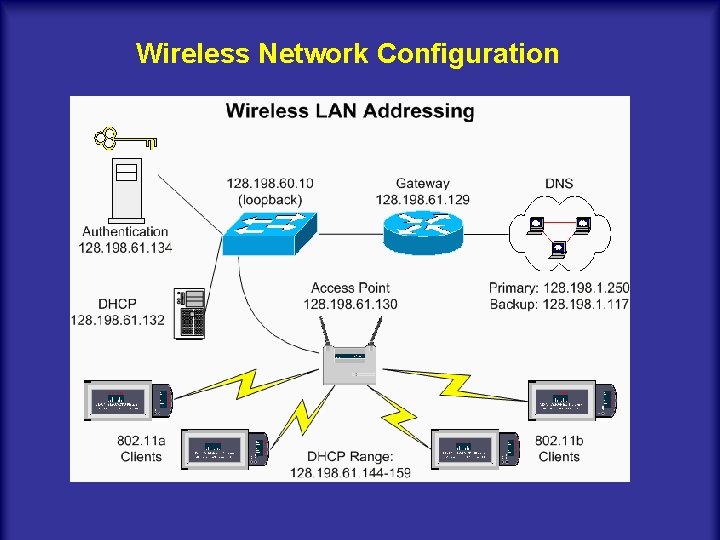
Wireless Network Configuration
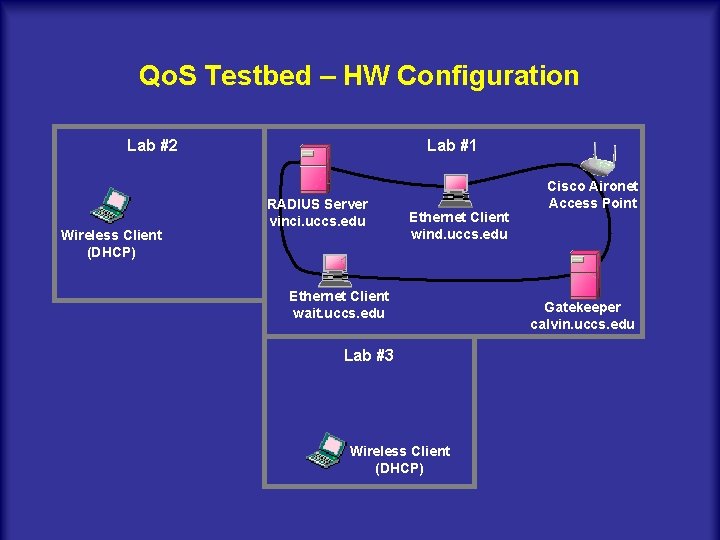
Qo. S Testbed – HW Configuration Lab #2 Wireless Client (DHCP) Lab #1 RADIUS Server vinci. uccs. edu Ethernet Client wind. uccs. edu Ethernet Client wait. uccs. edu Lab #3 Wireless Client (DHCP) Cisco Aironet Access Point Gatekeeper calvin. uccs. edu
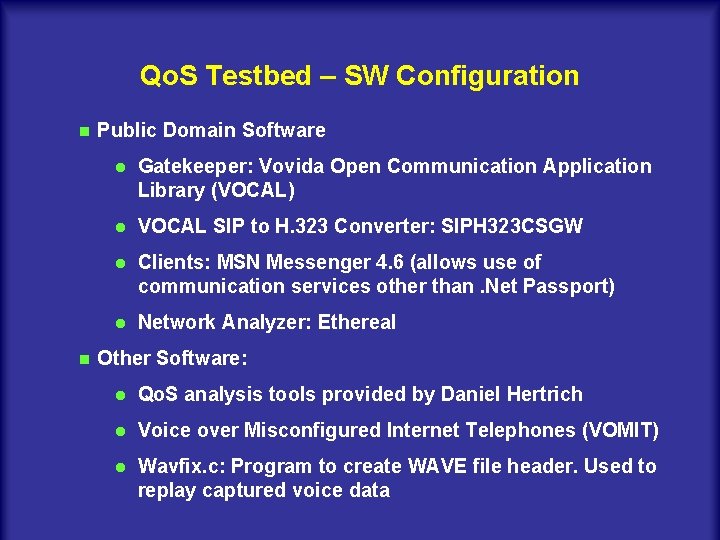
Qo. S Testbed – SW Configuration n n Public Domain Software l Gatekeeper: Vovida Open Communication Application Library (VOCAL) l VOCAL SIP to H. 323 Converter: SIPH 323 CSGW l Clients: MSN Messenger 4. 6 (allows use of communication services other than. Net Passport) l Network Analyzer: Ethereal Other Software: l Qo. S analysis tools provided by Daniel Hertrich l Voice over Misconfigured Internet Telephones (VOMIT) l Wavfix. c: Program to create WAVE file header. Used to replay captured voice data
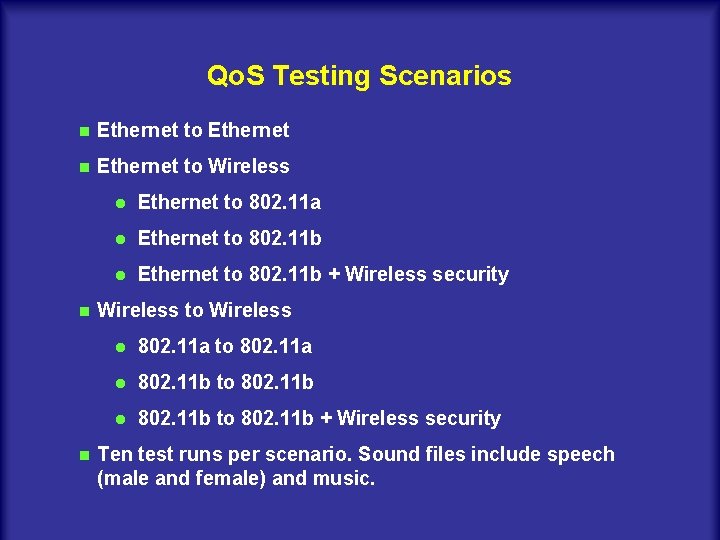
Qo. S Testing Scenarios n Ethernet to Ethernet n Ethernet to Wireless n n l Ethernet to 802. 11 a l Ethernet to 802. 11 b + Wireless security Wireless to Wireless l 802. 11 a to 802. 11 a l 802. 11 b to 802. 11 b + Wireless security Ten test runs per scenario. Sound files include speech (male and female) and music.
Qo. S Test Results Sample Inter-packet Delay Graph
Qo. S Test Results Sample Jitter Time Graph
Qo. S Test Results: Average Jitter per Call Ethernet to Wireless (802. 11 a vs. 802. 11 b) Distance from AP ~15 -20 ft. Excellent signal strength with both 802. 11 a and 802. 11 b. 802. 11 a performed better than 802. 11 b.
Qo. S Test Results: Average Jitter per Call Ethernet to Wireless (with and without WEP) More research/testing needed to validate these results. Tests performed on different days (maybe different network load).
Qo. S Test Results: Average Jitter per Call Wireless to Wireless (802. 11 a vs. 802. 11 b) Each client’s distance from AP ~15 -20 ft. Peer-to-peer ~30 -40 ft. Poor signal strength for 802. 11 a, excellent for 802. 11 b.
Qo. S Test Results: Average Jitter per Call Wireless to Wireless (with and without WEP) No significant difference in results. Need to investigate further to check at which point packets are captured by Winpcap.
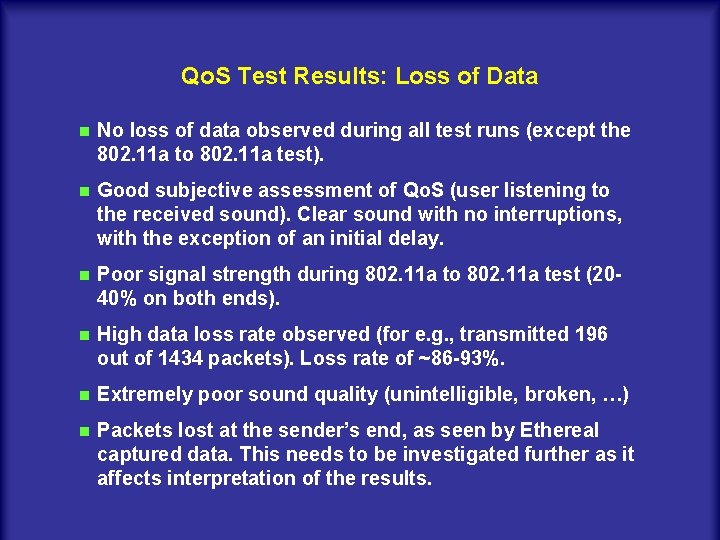
Qo. S Test Results: Loss of Data n No loss of data observed during all test runs (except the 802. 11 a to 802. 11 a test). n Good subjective assessment of Qo. S (user listening to the received sound). Clear sound with no interruptions, with the exception of an initial delay. n Poor signal strength during 802. 11 a to 802. 11 a test (2040% on both ends). n High data loss rate observed (for e. g. , transmitted 196 out of 1434 packets). Loss rate of ~86 -93%. n Extremely poor sound quality (unintelligible, broken, …) n Packets lost at the sender’s end, as seen by Ethereal captured data. This needs to be investigated further as it affects interpretation of the results.
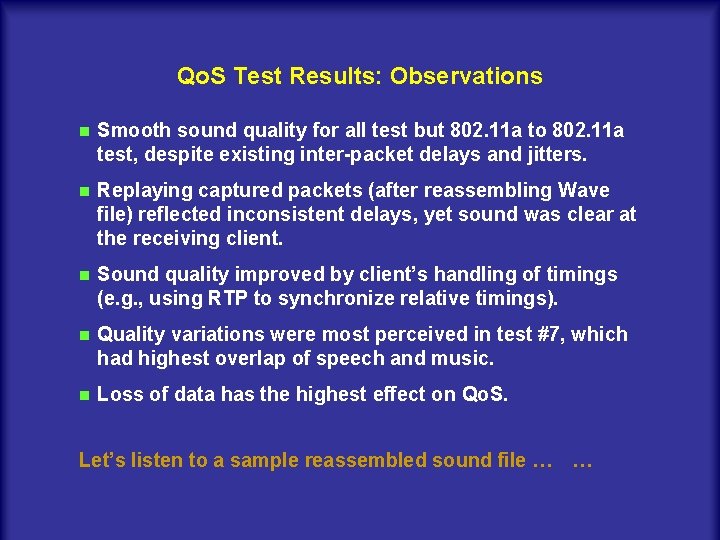
Qo. S Test Results: Observations n Smooth sound quality for all test but 802. 11 a to 802. 11 a test, despite existing inter-packet delays and jitters. n Replaying captured packets (after reassembling Wave file) reflected inconsistent delays, yet sound was clear at the receiving client. n Sound quality improved by client’s handling of timings (e. g. , using RTP to synchronize relative timings). n Quality variations were most perceived in test #7, which had highest overlap of speech and music. n Loss of data has the highest effect on Qo. S. Let’s listen to a sample reassembled sound file … …
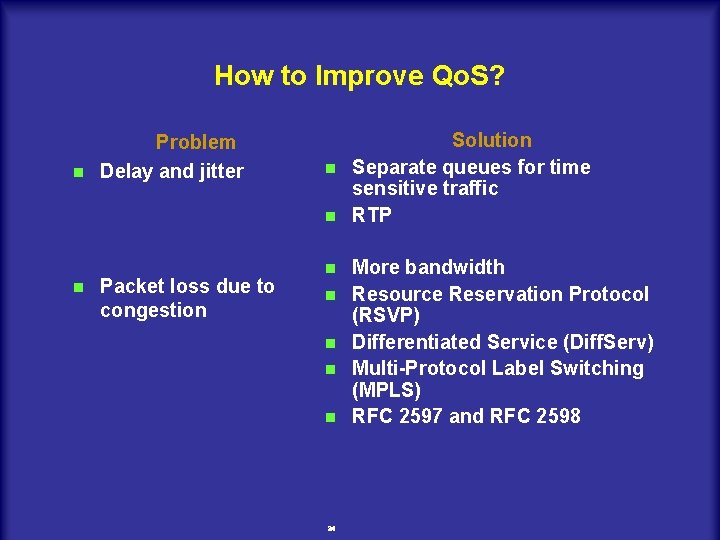
How to Improve Qo. S? Problem n Delay and jitter n Packet loss due to congestion Solution n Separate queues for time sensitive traffic n RTP n n n 24 More bandwidth Resource Reservation Protocol (RSVP) Differentiated Service (Diff. Serv) Multi-Protocol Label Switching (MPLS) RFC 2597 and RFC 2598
Future Research/Tests n n n Inject background traffic Synchronize time on all testbed components and calculate initial connection delay Evaluate the effect of using different codecs PC-to-Phone quality testing Evaluate wireless network performance at different distances from the access point Evaluate wireless network performance using multiple access points with overlapping coverage Assess compatibility of 802. 11 variants Evaluate existing Qo. S solutions (e. g. , RSVP) Evaluate Qo. S of Vo. IP using H. 323 clients Detect transmission sampling rate for replay based on timestamps of the captured packets Evaluate Qo. S of Vo. IP using a PDA client (might require porting a SIP client to a PDA) 25
References n n n n Collins, Daniel (2001). Carrier Grade Voice over IP, Mc. Graw-Hill. Ferguson, Paul and Geoff Huston (1998). Quality of Service, Wiley Computer Publishing. Douskalis, Bill (2000). IP Telephony: The Integration of Robust Vo. IP Services, Prentice Hall PTR. Keey, David G. , Cullen Jennings, and Luan Dang (2002). Practical Vo. IP using VOCAL, O’Reilly Network. Gast, Matthew (2002). 802. 11 Wireless Networks: The Definitive Guide, O’Reilly Network. Hertrich, Daniel et al. (2001). “Evaluating Qo. S for Voice over IP in Wireless LANs”, Technical Report, Telecommunication Networks Group. Useful links: Vo. IP-WLAN-Qo. S Useful Links 26