
IMPROVING PROJECT OUTCOMES THROUGH OPERATIONAL RELIABILITY A CONCEPTUAL
軟體專案管理報告 IMPROVING PROJECT OUTCOMES THROUGH OPERATIONAL RELIABILITY: A CONCEPTUAL MODEL Summarized from. : Sullivan, J. and Beach, R. , 2010, International Journal of Project Management, 28, p. 765 -775. 951606 范雅筑 951644 李源裕 951623 江小琪 951703 洪嘉昌 951632 陳葦芸 951736 陳啟天 951645 王俐尹 951751 李洹宇 951626 王佩婷 951758 謝孟樸

INTRODUCTI ON 951645 王俐尹
INTRODUCTION Management information system (IS) projects have been studied for many years, and numerous recommendations have been made to improve performance. ERP systems are highly integrated, complex, crossfunctional systems, which support business processes across an entire organisation.
INTRODUCTION(CON. ) High reliability organisations (HRO) operate in environments where the potential for disaster is high, the pressure to meet expectations is persistent and the consequences for failure are publicly visible.
INTRODUCTION(CON. ) That projects can also be considered as ‘‘particular kinds of organisations” (ibid) reinforces our view that these ‘project-based organisations’ might benefit from an improved understanding of how high operational reliability is achieved.

INTRODUCTION(CON. ) The aims of this phase were to: (a) provide theoretical foundations for researching the factors that contribute to operational reliability in IS project environments.
INTRODUCTION(CON. ) (b) develop a framework to facilitate a comparative analysis of organisational activities and the synthesis of empirical data gathered in subsequent stages of the research. (c) extend knowledge of those organisational characteristics that contribute to successful project outcomes/reliable operational performance.
HIGH RELIABILITY ORGANISATIONS 951644 李源裕
HIGH RELIABILITY ORGANISATIONS Some organisations have been very successful in the implementation of complex systems HRO is capable of developing and/or applying sophisticated technologies HRO is the way that these organisations deal with failure and recovery
HOW HRO WORK high reliability is possible and that organizations possess attributes that can enhance reliability design reward systems to recognize the costs of failure
ATTRIBUTES The HRO places a higher priority on reliability than any other objective It places a high priority on effective performance and avoiding disasters through processes of collective learning
CHARACTERIZATION high technical competence high performance and oversight a propensity to constantly search for improvements
CHARACTERIZATION (CONT. ) operate under high pressure use incentives and share expectations to enhance reliability maintain hazard-driven operational flexibility to ensure safety promote a culture of reliability avoid cost effective trade-offs and trial and error learning
HRO MATRIX using a two dimensional matrix technological risk Reliability
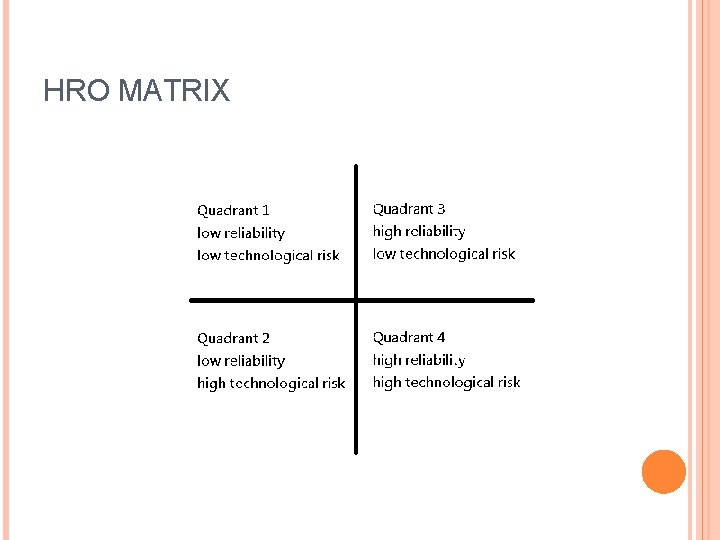
HRO MATRIX
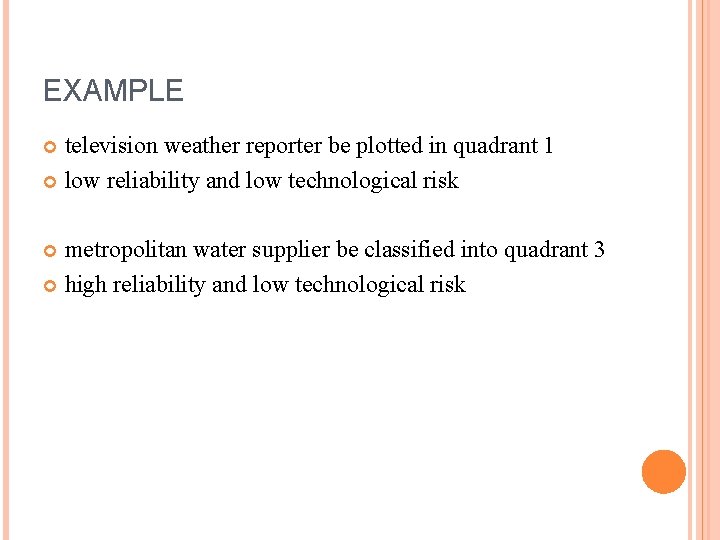
EXAMPLE television weather reporter be plotted in quadrant 1 low reliability and low technological risk metropolitan water supplier be classified into quadrant 3 high reliability and low technological risk
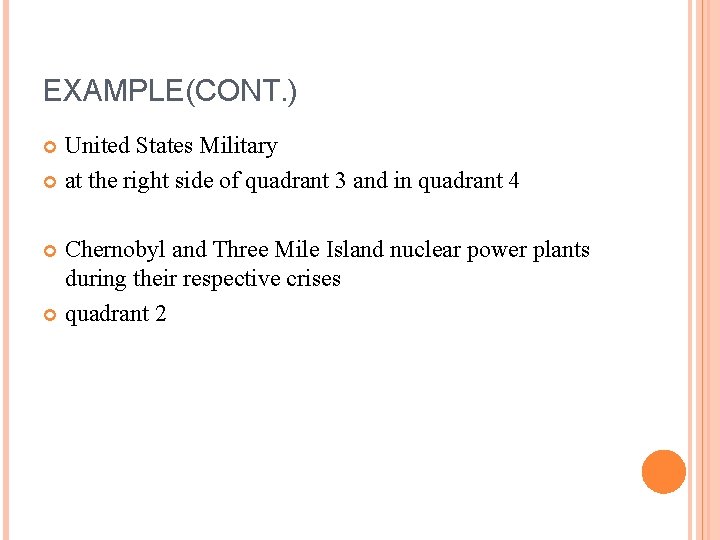
EXAMPLE(CONT. ) United States Military at the right side of quadrant 3 and in quadrant 4 Chernobyl and Three Mile Island nuclear power plants during their respective crises quadrant 2
FRAMEWORK profit-seeking organisations might place a different emphasis on reliability compared to non-profit organisations service organisations (high consumer contact) may avoid technological risk in preference for proven technologies compared to manufacturers
RISK 951626 王佩婷
PRIMARY RISKS FACED BY THE HRO The primary risks faced by the HRO are those that : may result in significant property damage or loss of life those associated with failure to meet the expectations of stakeholders for safe and effective performance
So they refer to these as operational and stakeholder risks
OPERATIONAL RISK FACTORS Grabowski and Roberts have suggested that HRO risk factors involve ‘‘high consequence. ” In extreme cases, they include uncertain or hazardous operating environments, ‘‘a situation that invokes a sense of dread”
OPERATIONAL RISK FACTORS (CONT. ) Risk factors exist in other forms such as introducing new technology where failure to properly manage the technology might threaten the value of the company stock or drain resources from more profitable ventures
OPERATIONAL RISK FACTORS (CONT. ) human activities : false assumptions about reality or the effects of political activity when small anomalies evolve into significant problems risk factors can arise as effects of a ‘‘disaster incubation period”
OPERATIONAL RISK FACTORS (CONT. ) Risk factors can be categorized into three groups: 1. known risk 2. imagined risk 3. unknown risk
STAKEHOLDER EXPECTATIONS An organisation’s stakeholders include its managers, employees, regulatory and political entities and, increasingly, the general public and consumers Stakeholder influence on project outcomes is well known and strategies to influence the behavioural characteristics of individuals to mitigate the effects in ‘‘sensitive projects” have been presented
STAKEHOLDER EXPECTATIONS (CONT. ) The HRO requires a ‘‘high level of goal congruence and a shared sense of duty to the collective purpose” Aboard US Navy aircraft carriers, each individual is expected to perform assigned tasks reliably as well as monitoring the larger picture
STAKEHOLDER EXPECTATIONS (CONT. ) In these organisations, the expectations of individuals are so high that an organisational culture develops surrounding those expectations. This is in stark contrast to the non-HRO where failure to meet expectations rarely invokes the same degree of anxiety from stakeholders. The consequences of failure are related to stakeholder expectations in that failure to meet minor expectations will result in minimal consequences whilst major failures will result in more severe consequences.

CAPABILITY 951623 江小琪
CAPABILITY • • Capability can be defined in terms of resources and competences. The HRO places a higher priority on the adequacy of these resources. Competences include proprietary process knowledge, unique skills and experiences. The HRO must have significant reserves of these competences to adequately address the hazards of their environment.
RESOURCES • • Reliability to be equal or greater in importance to efficiency and maintaining adequate resources is a prerequisite of reliability. Grabowski and Roberts suggest: – • Over time large scale systems can become degraded. Higher operational costs than conventional organizations.
RESOURCES (CONT. ) Perrow drives toward efficiency (cost reduction or increased profitability) increased the danger in complex systems. Roberts in large scale HRO environments where resource requirements can be significant.
RESOURCES (CONT. ) The HRO also has a heightened awareness of investments in safety. Many organizations understand that ‘‘expenditure on safety is a good investment. ” But the HRO is characterized by an operational ethos in which reliability rivals efficiency. The cost of an accident far outweighs the cost of preventive measures.
COMPETENCE FACTORS Competences include the skills, procedures, knowledge and experience of an organization’s members. These factors are difficult to quantify and tend to fluctuate over time. In times of crisis, exceptional competence is often credited with averting disaster.
COMPETENCE FACTORS (CONT. ) To attain ‘high reliability’ high levels of competence are necessary but even organizations with plentiful resources will occasionally experience system failure. In essence, it is the competence factors that prevent disaster, not resources alone.
COMPETENCE FACTORS (CONT. ) How these competences are nurtured and deployed within the organization will impact on the effectiveness of the system. The matrix structure, frequently associated with projectbased organizations, can be particularly useful in overcoming problems that are inter-functional in nature.
COMPETENCE FACTORS SAPIENTIAL AUTHORITY They also provide competence and confidence building opportunities for individuals that can lead to the creation of sapiential authority. Sapiential authority knowledge and expertise • maturity (life knowledge) rather than hierarchical position (structural or positional authority • To be particularly useful when events become critical.
DISAGREEMENT As previously mentioned, there is some disagreement as to whether all failures can be completely prevented in complex systems. Perrow’s “Normal Accident Theory” accidents in complex technological systems must be expected, that eventually enough circumstances will align themselves and failure will follow.
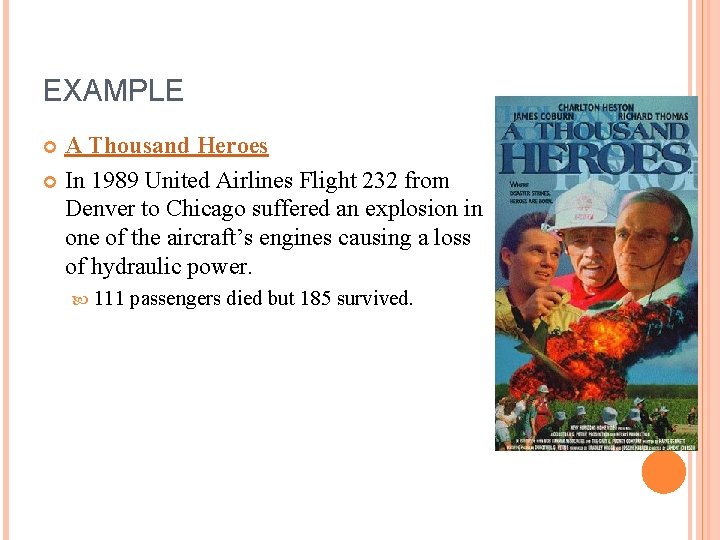
EXAMPLE A Thousand Heroes In 1989 United Airlines Flight 232 from Denver to Chicago suffered an explosion in one of the aircraft’s engines causing a loss of hydraulic power. 111 passengers died but 185 survived.
CAPABILITY TO MITIGATE RISK & THE CONCEPTUAL MODEL 951736 陳啟天
5. CAPABILITY TO MITIGATE RISK some organisations must carry excess capability to mitigate exceptional operational risks. lower capability is required by those whose perceived risk and consequences of failure are lower. the HRO must ‘‘avoid errors or failure because the potential cost is unacceptable to society”
6. THE CONCEPTUAL MODEL Organisations that reliably manage complex systems maintain a balance between those factors that represent a threat to the system and those that mitigate them. HRO is able to consistently achieve this balance over long periods of time.

6. THE CONCEPTUAL MODEL A conceptual appear to facilitate high operational reliability.
ABOUT THIS MODEL Five interacting forces: expectations, risk factors, resources, competence factors, and consequences.
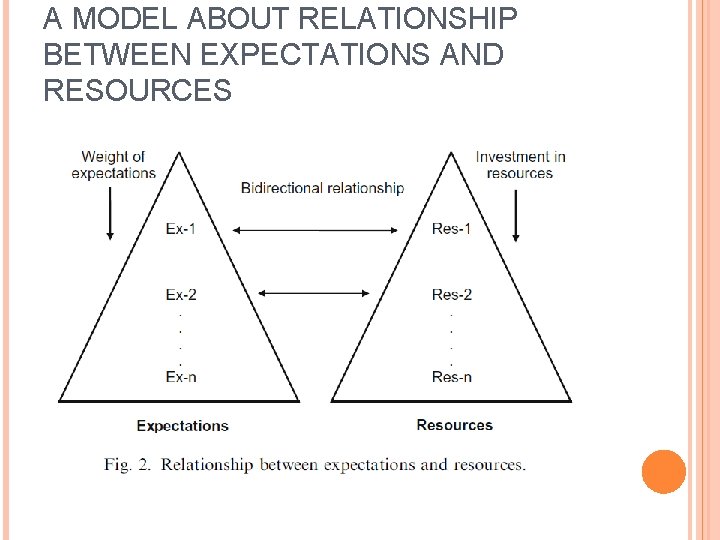
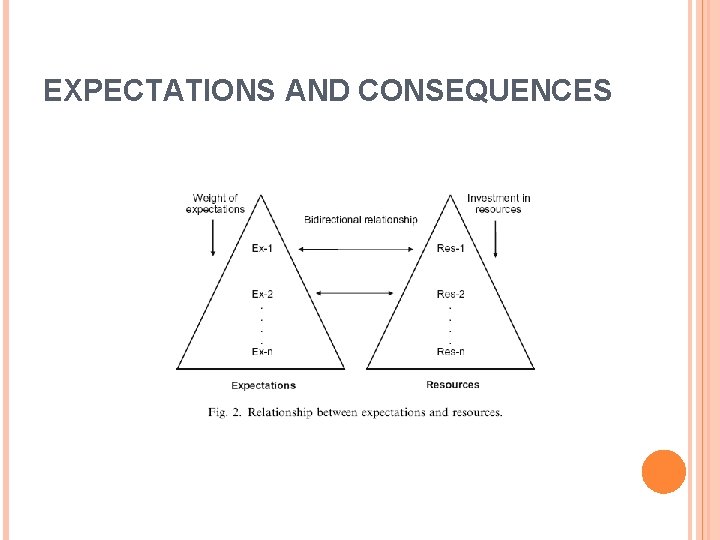
6. 1 RESOURCE AND EXPECTATIONS adequate resources are essential to support complex systems in the HRO. cutting back resources and emphasising efficiency is detrimental to reliability.
A MODEL ABOUT RELATIONSHIP BETWEEN EXPECTATIONS AND RESOURCES The bidirectional nature of this relationship is represented in the model as dotted lines. whilst the variable relative strength (or weakness) of these components is represented as triangles.
A MODEL ABOUT RELATIONSHIP BETWEEN EXPECTATIONS AND RESOURCES

THE CONCEPTUAL MODEL 951758 謝孟樸
THE CONCEPTUAL MODEL Five factors Resource、Expectation、Consequence、 Competence factor、Risk Relationship Resource and expectations Expectations and consequences Consequences and competence factors Competence factors and risks
EXPECTATIONS AND CONSEQUENCES Factors of Influence consequence Resources are reduced Ability insufficiency External political influences Environment opposition
EXPECTATIONS AND CONSEQUENCES
EXPECTATIONS AND CONSEQUENCES Direct proportion - Weight of expectations increase, Weight of consequence increase Fear ( Fears of the consequences of not meeting expectations ) Inverse proportion - Weight of expectations decrease, Weight of consequence increase Security ( Security of flies )
CONSEQUENCES AND COMPETENCE FACTORS Unbalance Consequences System’s failure Develop slowly lead to new procedures
CONSEQUENCES AND COMPETENCE FACTORS HRO’s mechanism Learn from mistakes Avoid repetitions Have exceptional organisational learning capability
COMPETENCE FACTORS AND RISKS Factors of increases risk Exceed development ability Exceed Design limit Exhibited groupthink Exist political pressure Less competent

COLUMBIA DISASTER 951606 范雅筑
ORIGIN OF CLUMBIA DISASTER On February 1, 2003, the space shuttle Columbia disintegrated on re-entry into the earth’s atmosphere, killing all seven astronauts.
CAUSES FOR THE DISASTER l Technical causes for the disaster Ø l A piece of protective foam strikes the leading edge of the wing on lift-off. Administrative and organizational contributors. Ø Ø Unknown risk : NASA unaware that a foam strike could cause catastrophic damage to the shuttle. Knowledge management : With staffing levels of the Shuttle program declining NASA had no plan in place for retaining the knowledge of key personnel.
ERRORS OF THE SHUTTLE PROGRAM (1) Unrealistic expectations held by Congress. Ø NASA had also failed to imagined risks and the possibility of unknown risks that would have led to contingency plans. Areas of capability were insufficient. Ø the mishandling of the foam strike
ERRORS OF THE SHUTTLE PROGRAM(2) The operational program was perceived to be a ‘‘mature and reliable system. ” Ø caused the focus of the program to be erroneously transitioned from development to operational Years of inadequate funding Ø forced NASA to ‘‘ do more with less. ”
RECOMMENDATIONS FOR A NEW MODE Be more efficient Ø Ø reduce costs Management with considerably less NASA oversight. • Outsourcing Ø an obvious thing to do because the risks were believed to be known and under control. Consolidate shuttle operations under a single-business entity. Ø even the eventual privatization of the Space Shuttle Program.
DIFFICULTIES IN INTERNAL ORGANIZATION The organization culture of the 1960 s was resistant to change and rigidly hierarchical. Greater expectations to accommodate special interest projects without corresponding increases in resources. There are many shortcomings of the organization and requiring remedial action. Organizational learning at NASA.
NORTHEAST BLACKOUT 951632 陳葦芸
NORTHEAST BLACKOUT On August 14, 2003 Midwest and Northeast United States as well as Ontario, Canada Eastlake 5 came into contact with overgrown trees and shut down.
NORTHEAST BLACKOUT(2) Some areas were without power for as long as four days, and parts of Ontario endured rolling blackouts for over a week It cost the United States and Canada billions of dollars in lost commerce
NORTHEAST BLACKOUT(3) NERC( The North American Electric Reliability Council) , a nongovernment agency, and its ten subordinate Regional Reliability Councils (RRCs) are responsible for the voluntary operating and planning standards that promote reliability within the power grid. NERC does not have authority to enforce compliance for the standards that promote reliability within the power grid.
MAINTAINING A HIGH DEGREE OF RELIABILITY WITH A SYSTEM NEED Requires skilled operators complex computer and communications systems careful planning and design
FIRSTENERGY’S PROBLEMS First. Energy—a company that caused the blackout. First. Energy’s substandard power generation and transmission capability had been in place for a long time before the blackout The absence of any legally binding authority for enforcement contributed to non-compliance.
FIRSTENERGY’S PROBLEMS(2) inadequate training an inability to acquire and understand information concerning the status of the power grid weakening infrastructure ineffective policies and procedures
CONCLUSION failure was inevitable, but it was preventable. The most obvious problem was a lack of accountability. Without consequences for non-compliance, the organizational learning relationship is ineffective.
CONCLUSION(2) the model explains why an increased risk of power grid deterioration combined with stagnant, or possibly atrophying competence would lead to disaster.
CONCLUSIO N 951751 李洹宇
HOW TO IMPLEMENT AND OPERATE A SYSTEM SUCCESSFUL p HRO oganizational characteristics p Tranfer to non-HRO
FACILITATE THE STUDY 1 p the literature relating to the HRO p the organisational characteristics p the environmental factors p Example: a failed examination
FACILITATE THE STUDY 2 p immediate & practical using p monitoring & measuring p it might be a long time
MORE EFFECTIVE APPROACH p the magnitude of the failure ( the one-off nature of projects & the critical role information systems) p identify any potential weaknesses early p researchers and project management professionals evaluate

LIMITATIONS 951703 洪嘉昌
LIMITATIONS OF THE STUDY The above research has focussed on organisations in the United States. in other countries and industries, the possibility that national culture may influence the utility of the model should not be ignored.
EXAMPLE Milliken and Mellahi have an underpinning assumption: The HRO can be transferred to other, less critical environments. For example, organisations operating in less critical environments to the HRO or under different cultural conditions may not have the ability or volition to learn from their experiences or change behaviours.
SHOULD KNOW BEFORE STUDY THE MODEL The interrelationship between risk and capability is complex and multi-dimensional, it is not a simple two dimensional phenomenon like the conceptual model.
SHOULD KNOW BEFORE STUDY THE MODEL(CONT. ) Basic factors of the conceptual model: Resource, Expectation, Consequence, Competence factors and Risk factors. Others factor in the real world: Strategy, Country, Culture, Politics, Social, …. etc.
THE VALUE OF THE MODEL The model does show the state, at a point in time, of the factors that enhance capability and allow risk to emerge. The value of the model is therefore in its ability to provide a means of conceptualizing the dynamic relationships between the factors. Example of relationships in the model: Consequences and competence factors Competence factors and risks factors

THANK YOU FOR YOUR ATTENTION!
- Slides: 83