
Improving Preventive Care in Your Practice Without Burden
Improving Preventive Care in Your Practice Without Burden Edward Curry, MD, FAAP Judith Shaw, Ed. D, MPH, RN, FAAP Session I 2051 : 2016 NCE 10/23/2016
Agenda Introduction & Background Big Winners for Implementation Cases 1 & 2 q Maternal Depression q Autism Screening Cases 3 & 4 q Oral Health q Parental Strengths Resources 2
Faculty Disclosure: Judith Shaw In the past 12 months, I have no relevant financial relationships with the manufacturer(s) of any commercial product(s) and/or provider(s) of commercial services discussed in this CME activity. I do not intend to discuss an unapproved/investigative use of a commercial product/device in my presentation. I am one of the editors of the Bright Futures: Guidelines for Health Supervision of Infants, Children, and Adolescent, 3 rd Edition. I acknowledge that today’s activity is certified for CME credit and thus cannot be promotional. I will give a balanced presentation about well child care using the best available evidence to support my conclusions and recommendations. 3
Faculty Disclosure: Edward Curry In the past 12 months, I do not have any Financial Disclosures I do not intend to discuss an unapproved/investigative use of a commercial product/device in my presentation. 4
Changes in Practice Participants will be able to: q Plan to implement the Bright Futures/AAP Guidelines for children and adolescents q Use pediatrician-tested strategies and Bright Futures tools to improve the quality of preventive services delivered in their clinical setting 5
Bright Futures …is a set of principles, strategies and tools that are theory - based, evidence - driven, and systems - oriented, that can be used to improve the health and well-being of all children through culturally appropriate interventions that address the current and emerging health promotion needs at the family, clinical practice, community, health system and policy levels. 6
Affordable Care Act: Section 2713 …requires all health plans to cover, with no cost-sharing “with respect to infants, children, and adolescents, evidence-informed preventive care and screenings provided for in the comprehensive guidelines supported by the Health Resources and Services Administration, ” the services are outlined in Bright Futures: Guidelines for Health Supervision of Infants, Children, and Adolescents, 3 rd Edition (Hagan J, Shaw JS, Duncan PM eds. ) 7

Periodicity Schedule Available at: https: //www. aap. org/periodicityschedule 8
Bright Futures is the health promotion/disease prevention part of the medical home At the heart of the medical home is the relationship between the clinician and the family or youth 9
Making the Most of the Guidelines q The Bright Futures Guidelines provide the background all the details. q The question is: § How can you incorporate all that into a typical office visit? q Use the Guidelines along with other Bright Futures materials q Therapeutic relationship is still the key 10
Overview of Changes & Important Topics Bright Futures Guidelines, 4 th Edition (pending) Part 1: Health Promotion Themes § 12 chapters highlighting key health promotion themes § New themes in development: Social determinants of health; Media use, Children with Special Health Care Needs Part 2: Health Supervision Visits § § § • • Rationale and evidence for screening recommendations 32 age-specific visits (including prenatal visit) 5 health supervision priorities for each visit Designed to focus visit on most important issues for child that age Includes: social determinants of health, health risks, developmental issues, positive reinforcement

Bright Futures Guidelines, 4 th Edition • Child Healthy Development • Family Support • Mental Health and Emotional Well. Being • Nutritional Health • Physical Activity • Healthy Weight • Promoting Lifelong Health for Families and Communities • • Oral Healthy Sexuality Safety and Injury Prevention Community Relationships and Resources • Promoting the Healthy and Safe Use of Social Media • Children and Youth with Special Health Care Needs
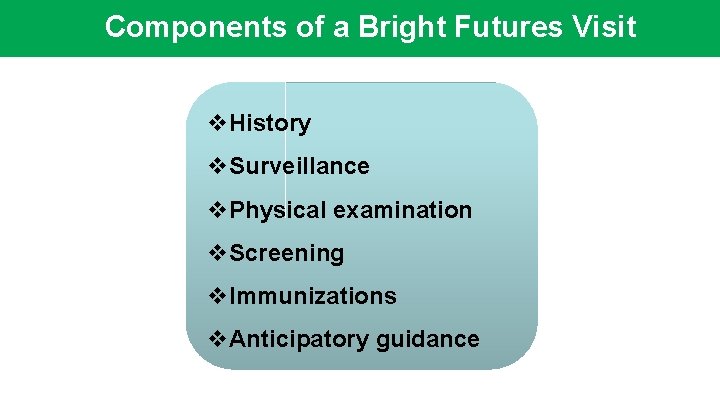
Components of a Bright Futures Visit v. History v. Surveillance v. Physical examination v. Screening v. Immunizations v. Anticipatory guidance
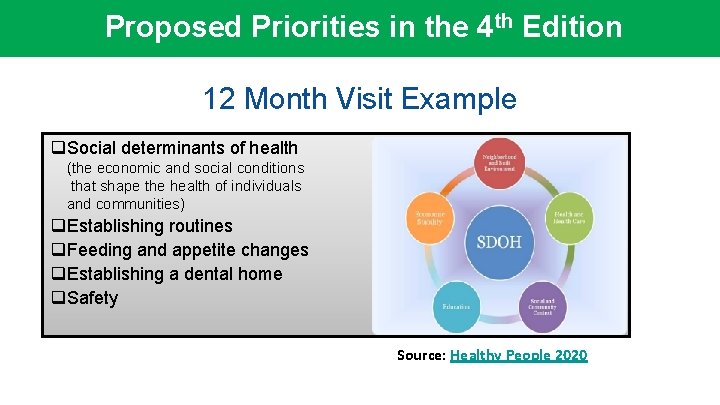
Proposed Priorities in the 4 th Edition 12 Month Visit Example q. Social determinants of health (the economic and social conditions that shape the health of individuals and communities) q. Establishing routines q. Feeding and appetite changes q. Establishing a dental home q. Safety Source: Healthy People 2020
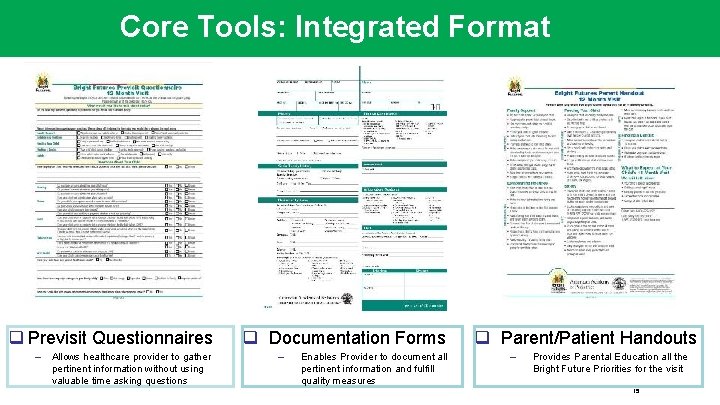
Core Tools: Integrated Format q Previsit Questionnaires – Allows healthcare provider to gather pertinent information without using valuable time asking questions q Documentation Forms – Enables Provider to document all pertinent information and fulfill quality measures q Parent/Patient Handouts – Provides Parental Education all the Bright Future Priorities for the visit 15
Tool & Resource Kit q The Bright Futures Tool and Resource Kit also contains supplementary materials: § Additional Parent/Patient Handouts § Developmental, behavioral, and psychosocial screening and assessment tools § Practice management tools for preventive care § Information on community resources q All of Bright Futures developed materials are in the public domain brightfutures. aap. org/materials-and-tools/tool-and-resource-kit/Pages/default. aspx
Implementing Bright Futures into Daily Practice How it gets done in your practice setting in partnership with your patients and parents You and your team are the experts 17
Implementing Bright Futures into Daily Practice Can it be done? YES 18
Implementing Bright Futures New Approaches q National AAP Preventive Services Implementation Project (Jan–Oct 2011) § Pediatricians, family physicians, nurse practitioners, physician assistants, nurses and office staff § Rural, urban and suburban practices and clinics, as well as community health centers and the Indian Health Service q Partner with Health Plan and Medicaid QI activities § For example: CHIPRA Demo Projects 19
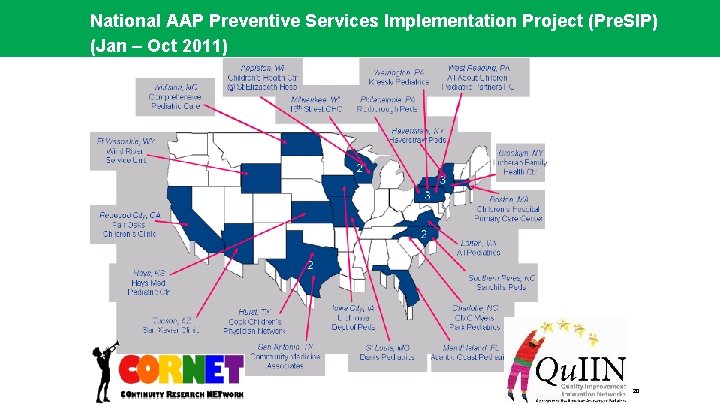
National AAP Preventive Services Implementation Project (Pre. SIP) (Jan – Oct 2011) 20
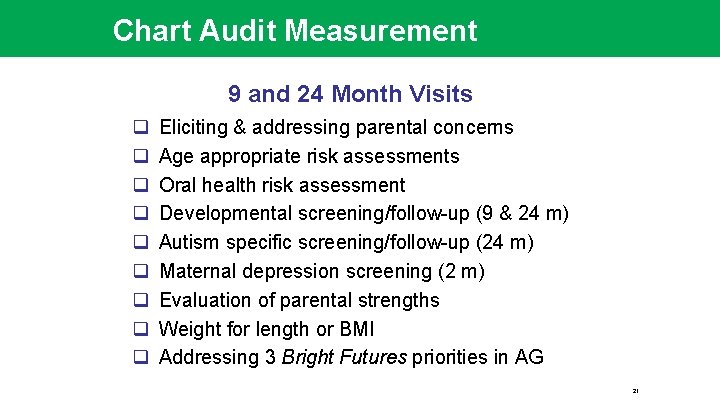
Chart Audit Measurement 9 and 24 Month Visits q q q q q Eliciting & addressing parental concerns Age appropriate risk assessments Oral health risk assessment Developmental screening/follow-up (9 & 24 m) Autism specific screening/follow-up (24 m) Maternal depression screening (2 m) Evaluation of parental strengths Weight for length or BMI Addressing 3 Bright Futures priorities in AG 21
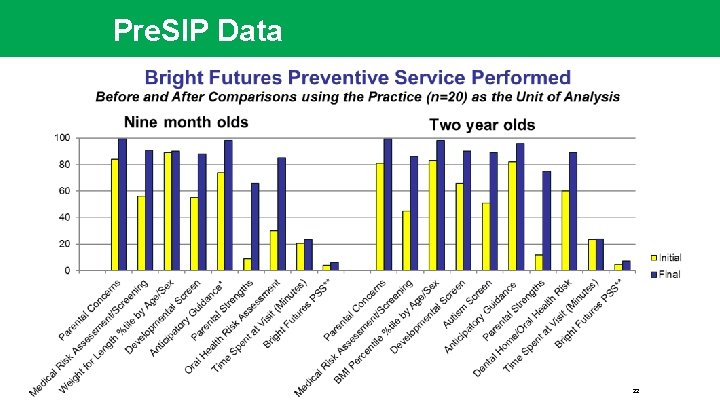
Pre. SIP Data 22
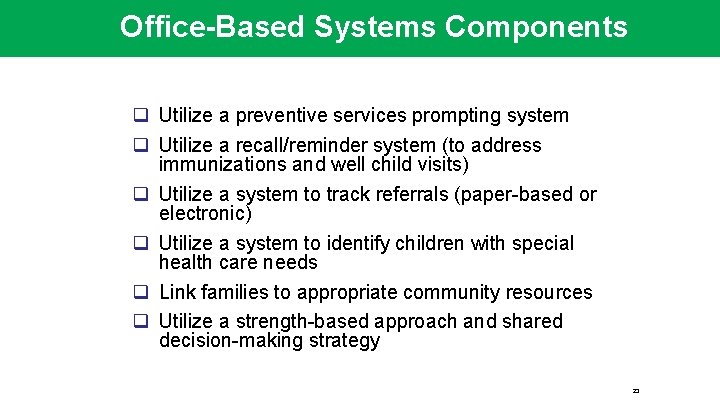
Office-Based Systems Components q Utilize a preventive services prompting system q Utilize a recall/reminder system (to address immunizations and well child visits) q Utilize a system to track referrals (paper-based or electronic) q Utilize a system to identify children with special health care needs q Link families to appropriate community resources q Utilize a strength-based approach and shared decision-making strategy 23
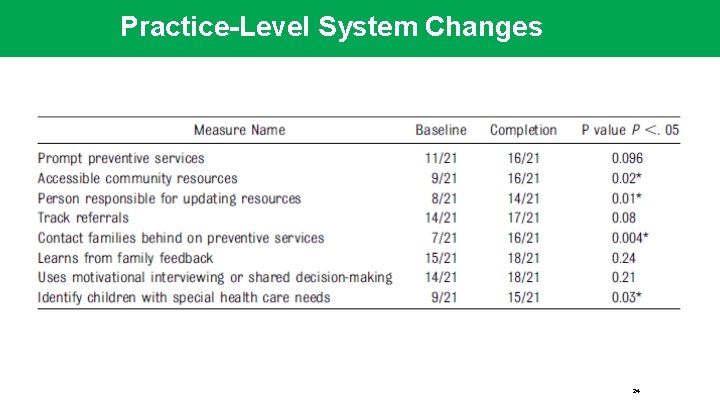
Practice-Level System Changes 24
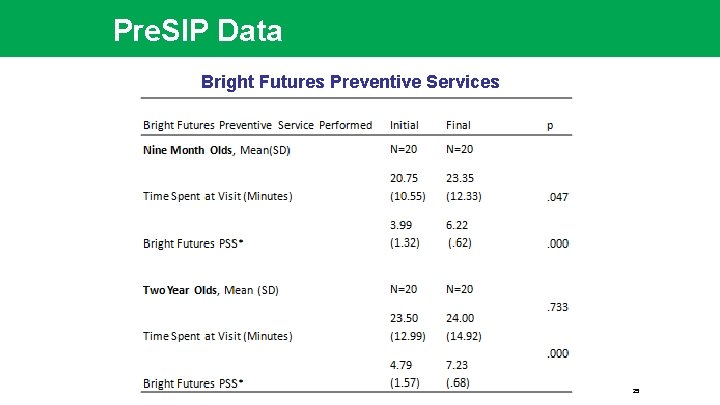
Pre. SIP Data Bright Futures Preventive Services 25
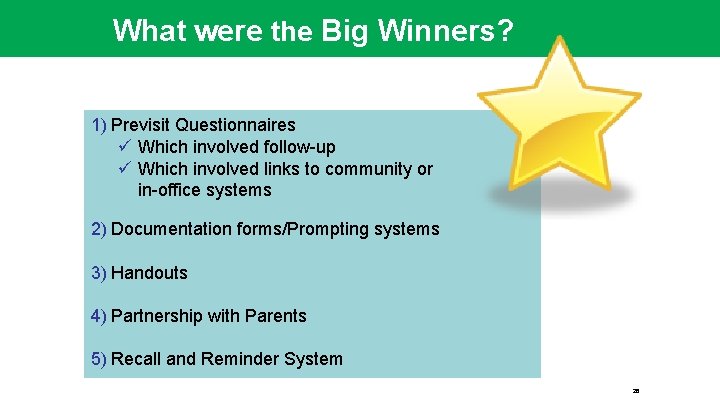
What were the Big Winners? 1) Previsit Questionnaires ü Which involved follow-up ü Which involved links to community or in-office systems 2) Documentation forms/Prompting systems 3) Handouts 4) Partnership with Parents 5) Recall and Reminder System 26
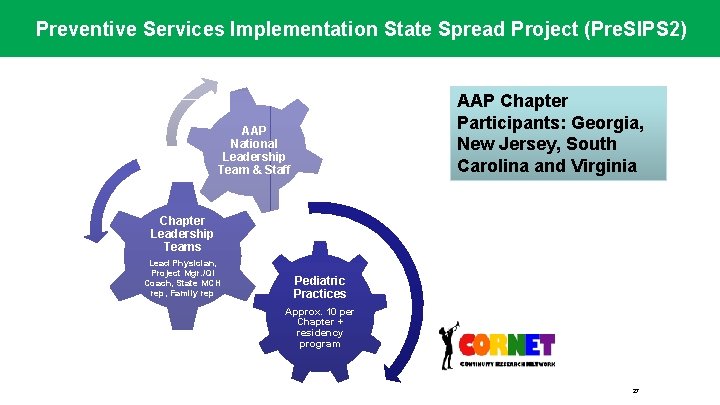
Preventive Services Implementation State Spread Project (Pre. SIPS 2) AAP Chapter Participants: Georgia, New Jersey, South Carolina and Virginia AAP National Leadership Team & Staff Chapter Leadership Teams Lead Physician, Project Mgr. /QI Coach, State MCH rep, Family rep Pediatric Practices Approx. 10 per Chapter + residency program 27
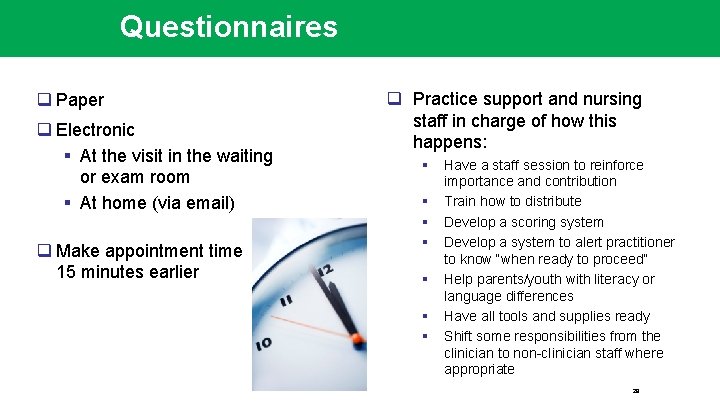
Questionnaires q Paper q Electronic § At the visit in the waiting or exam room § At home (via email) q Make appointment time 15 minutes earlier q Practice support and nursing staff in charge of how this happens: § § § § Have a staff session to reinforce importance and contribution Train how to distribute Develop a scoring system Develop a system to alert practitioner to know “when ready to proceed” Help parents/youth with literacy or language differences Have all tools and supplies ready Shift some responsibilities from the clinician to non-clinician staff where appropriate 28
Questionnaires cont. What can you get from a Bright Futures Previsit Questionnaire? q. Maternal depression screening q. Medical risk screening § TB, Lead, Anemia, STIs, Cholesterol § Vision and Hearing § If possible, practice staff can perform or set up q“Parental/youth concerns and questions” for this visit q. Oral health risk assessment § Dental home/fluoride H 2 O q. Developmental surveillance for young children q. Strength/developmental surveillance for school aged children & adolescents 29
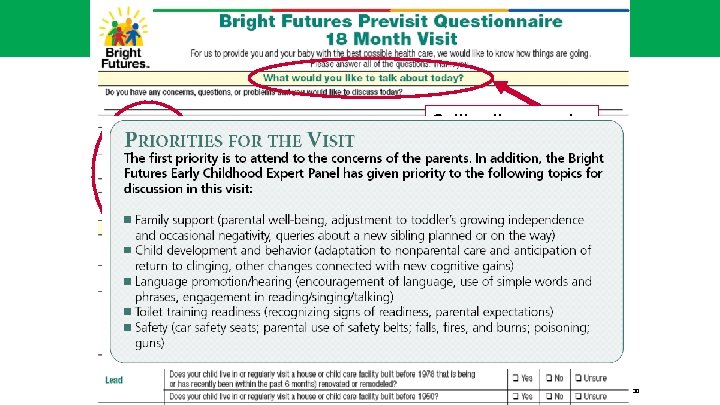
Setting the agenda PRIORITIES Family support Child development and behavior Language promotion/hearing Toilet training readiness Safety 30
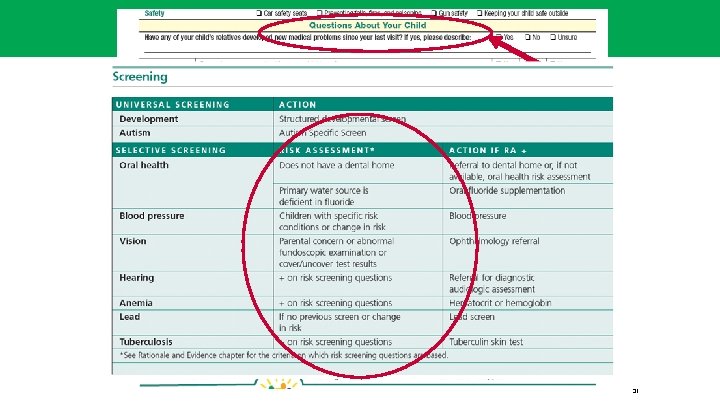
Medical Screening 31
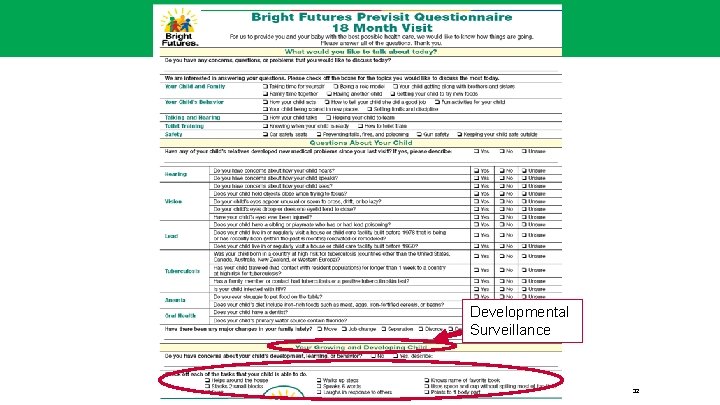
Developmental Surveillance 32
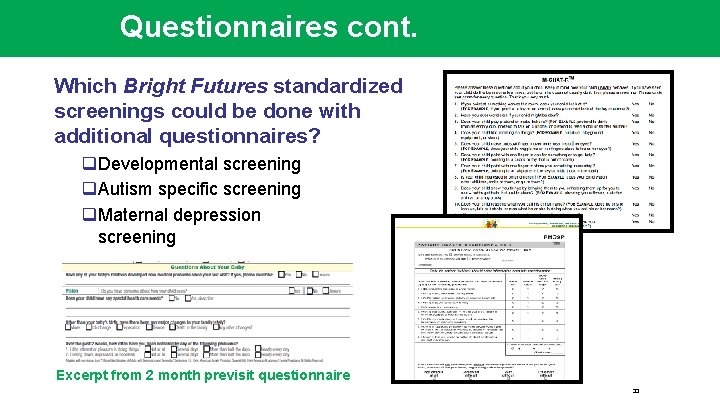
Questionnaires cont. Which Bright Futures standardized screenings could be done with additional questionnaires? q. Developmental screening q. Autism specific screening q. Maternal depression screening Excerpt from 2 month previsit questionnaire 33
What’s Left? q Further history including identification of parental strengths § Additional visit questionnaire with questions in each of the five visit priority areas q BMI q Physical exam q Answering questions, addressing concerns and anticipatory guidance about five priority topics q If a change needs to be considered, use a shared decision-making approach q Immunizations 34
Final Questionnaire Tips from Practices q Include tools in the EHR q Include pass/fail categories for MCHAT in EHR q Include secondary screens for use if screen is positive q Staple screening tools to Previsit Questionnaires so the entire previsit packet is provided to parents 35

Case Studies 1 & 2 36
Case Study 1: Maternal Depression : Mia q 28 -year-old married mother of two q College educated q Currently a high school math teacher, but considering staying at home q On 3 month parental leave q Husband is computer consultant and travels once a week for job q She is well-liked at school and has friends from school and book club q With her first child she had a relatively easy adjustment and has a good child care situation 37
Case Study 1: Maternal Depression cont. q. Embarrassed that she is having so much trouble q. Mia is at home and feels like should be able to do this IF WE DO SCREENING WHAT SCREENING TOOL 38
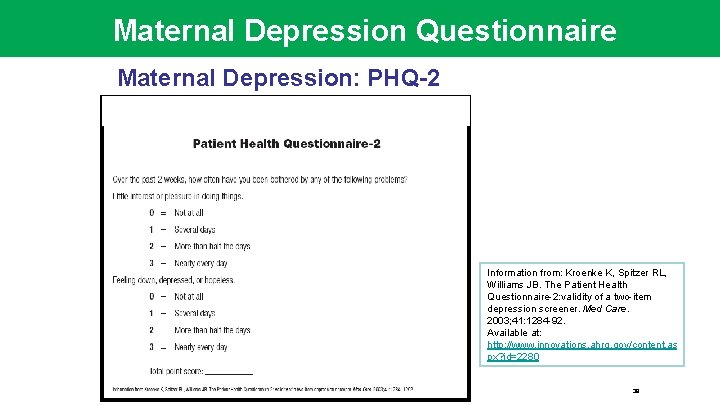
Maternal Depression Questionnaire Maternal Depression: PHQ-2 Information from: Kroenke K, Spitzer RL, Williams JB. The Patient Health Questionnaire-2: validity of a two-item depression screener. Med Care. 2003; 41: 1284 -92. Available at: http: //www. innovations. ahrq. gov/content. as px? id=2280 39
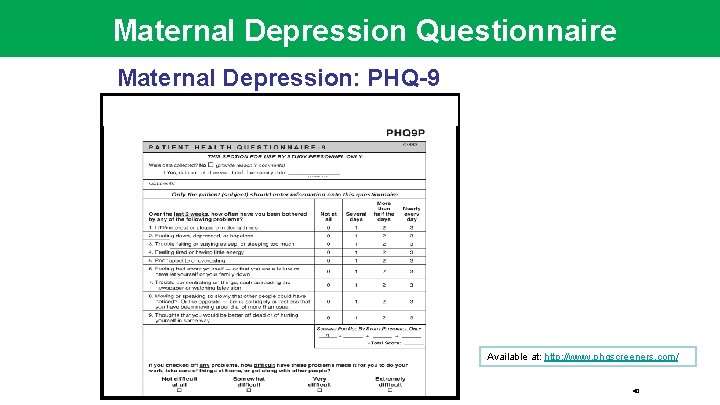
Maternal Depression Questionnaire Maternal Depression: PHQ-9 Available at: http: //www. phqscreeners. com/ 40
Case Study 2: Autism Jason q 24 -month-old who is only speaking 2 to 3 words. Most of his speech is jibberish. He also has prolonged temper tantrums lasting 15 to 20 minutes q Mother brought her concerns to her previous pediatrician at 18 months. She was told boy’s usually talk later and temper tantrums are normal 41
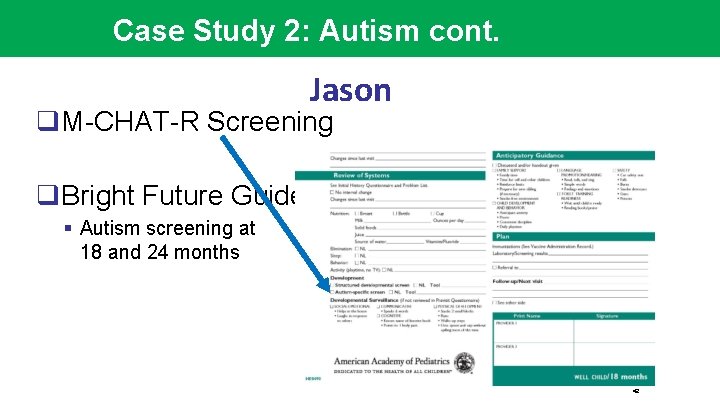
Case Study 2: Autism cont. Jason q. M-CHAT-R Screening q. Bright Future Guidelines § Autism screening at 18 and 24 months 42

Case Study 2: Autism cont. M-CHAT-R Screening (excerpt) For more information on autism screening tools, go to: mchatscreen. com/ 43
Establishing a Workflow!!! 44
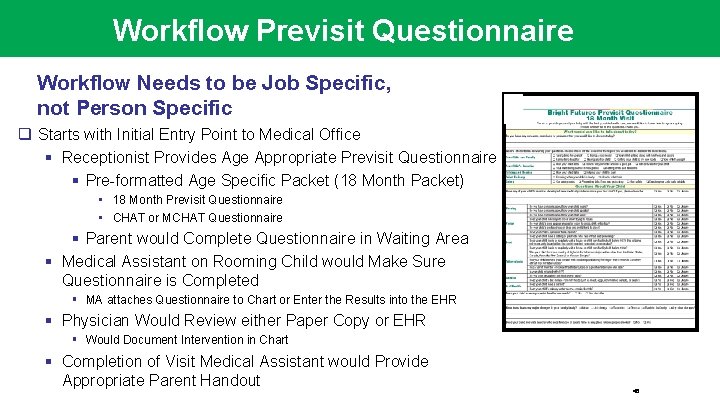
Workflow Previsit Questionnaire Workflow Needs to be Job Specific, not Person Specific q Starts with Initial Entry Point to Medical Office § Receptionist Provides Age Appropriate Previsit Questionnaire § Pre-formatted Age Specific Packet (18 Month Packet) • 18 Month Previsit Questionnaire • CHAT or MCHAT Questionnaire § Parent would Complete Questionnaire in Waiting Area § Medical Assistant on Rooming Child would Make Sure Questionnaire is Completed § MA attaches Questionnaire to Chart or Enter the Results into the EHR § Physician Would Review either Paper Copy or EHR § Would Document Intervention in Chart § Completion of Visit Medical Assistant would Provide Appropriate Parent Handout 45
Workflow: Autism Screening Workflow q Physician reviews both Questionnaire and confirms red flag results § If child fails two items, physician initiates referral q Referral tracking is referred to staff member to follow-up § Regional Center Referral § Referral to Developmental Pediatrician 46
Workflow Screening Questionnaire Follow-up of Red Flag Results q Maternal Depression Screening § If PHQ-2 Done, then Need to Do PHQ-9 § If Positive, then: • Low Risk Referral to Community Resources • Moderate Risk Social Worker or MFT • Emergency Mental Health Evaluation • Autism Screening q Autism Screening § Administer M-CHAT-R § If Positive, Set Follow-up Process 47
Questionnaires How do I address a positive screening response? q Maternal depression § Referral to OB/nurse midwife, primary care or mental health professional (set up ahead of time) § Co-located/employed mental health practitioner in the practice § Referral to a mental health professional q Adolescent mental health issues § More practitioner education and experience § Telephone, telemedicine and email support systems q Developmental screening § Have a developmental behavioral specialist come to practice once a month to see kids with positive screens 48
Community Linkage Tips from the Practices q Systems measure § Do you have someone in your office or clinic who is in charge of liaisons with community organizations and updates to accessible list of community resources for parents? q Hire a care coordinator, or use current staff with skills in this area q Use community liaisons in the practice to handle referrals, communicate with specialists, and coordinate services/resources for families q Consider hosting “mixers” with potential referral sources in the community to establish relationships q If you have set it up, everything related to a difficult situation goes better 49
Billing & Coding Billing and Coding for Questionnaires q When standardized developmental screening tools are administer, scored, and interpreted as part of preventive service visit each screening can be individually coded q. Appropriate CPT code: 96110 50

Case Studies 3 & 4 51
Case Study 3: Oral Health Fernando q Fernando is a 9 -month-old baby who comes in with Maria, his mother, and grandmother for his checkup q Maria has no concerns, but does wonder if he should be feeding himself q His parents both work § They work opposite shifts so that one often can be there with the baby § They have arranged to always have all day Sunday together as a family q His grandmother often has him for dinner and breakfast to cover the overlap times and takes special care to prepare his food and feed him § He eats table food, some baby food at mealtime and breast milk 4 x a day § She has utilized the WIC supplements for breast feeding moms 52
Case Study 3: Oral Health cont. q Maria enjoys his happy disposition and his calling out when she comes home from work q She is also pleased that he is growing so well on her breast milk and can feed himself the bottle. On his oral health risk assessment… q Maria and her mother have many dental caries and have been unable to access dental care q Fernando takes bottles in his crib at least twice a day 53
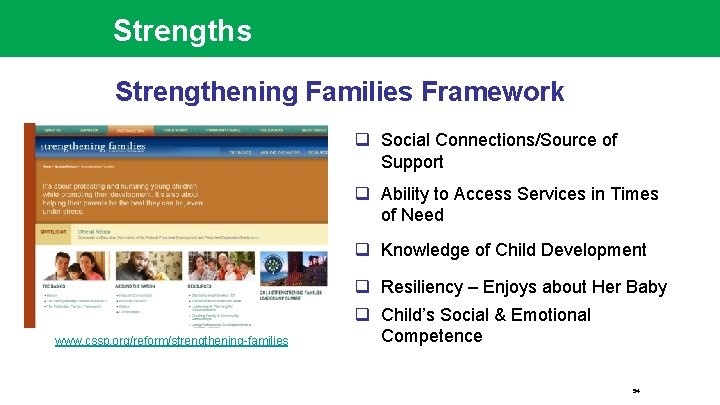
Strengths Strengthening Families Framework q Social Connections/Source of Support q Ability to Access Services in Times of Need q Knowledge of Child Development q Resiliency – Enjoys about Her Baby www. cssp. org/reform/strengthening-families q Child’s Social & Emotional Competence 54
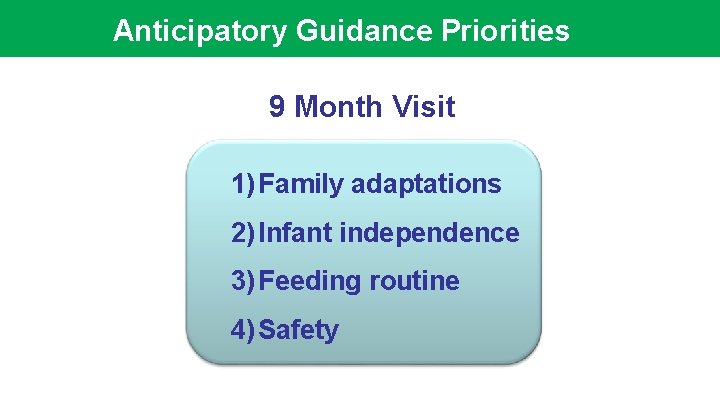
Anticipatory Guidance Priorities 9 Month Visit 1) Family adaptations 2) Infant independence 3) Feeding routine 4) Safety
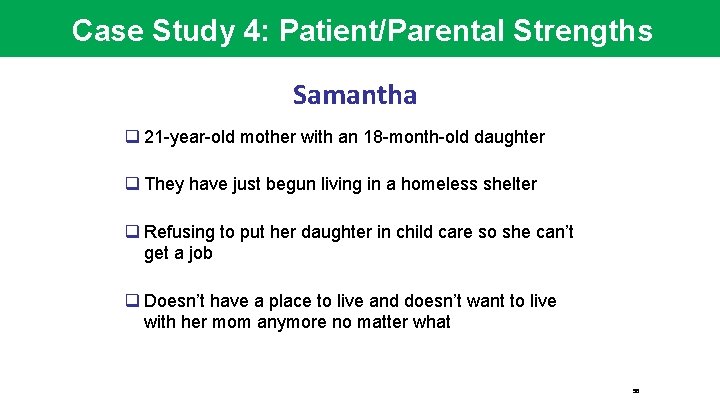
Case Study 4: Patient/Parental Strengths Samantha q 21 -year-old mother with an 18 -month-old daughter q They have just begun living in a homeless shelter q Refusing to put her daughter in child care so she can’t get a job q Doesn’t have a place to live and doesn’t want to live with her mom anymore no matter what 56
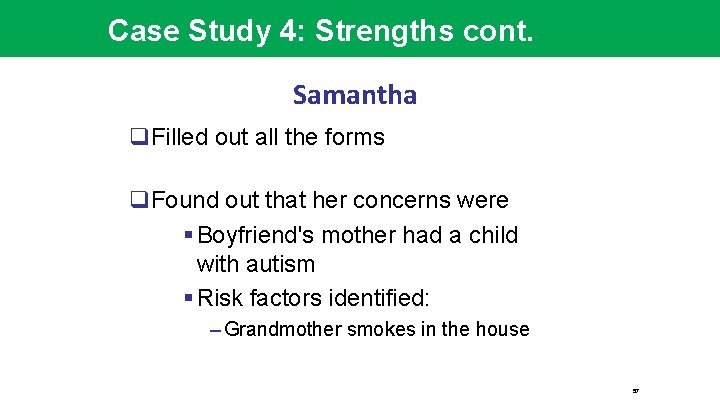
Case Study 4: Strengths cont. Samantha q. Filled out all the forms q. Found out that her concerns were § Boyfriend's mother had a child with autism § Risk factors identified: – Grandmother smokes in the house 57
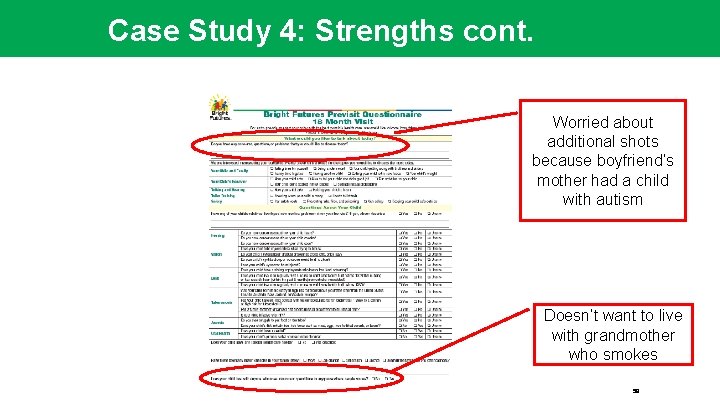
Case Study 4: Strengths cont. Worried about additional shots because boyfriend’s mother had a child with autism Doesn’t want to live with grandmother who smokes 58
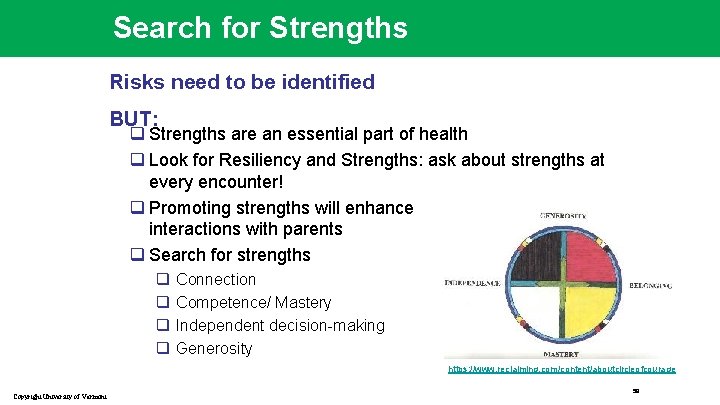
Search for Strengths Risks need to be identified BUT: q Strengths are an essential part of health q Look for Resiliency and Strengths: ask about strengths at every encounter! q Promoting strengths will enhance interactions with parents q Search for strengths q q Connection Competence/ Mastery Independent decision-making Generosity https: //www. reclaiming. com/content/aboutcircleofcourage Copyright University of Vermont 59
Case Study 4: Strengths cont. Identified Parental Strengths q Has a partner who has been with her and Samantha for 6 months – lives with his parents q Wants to have her daughter grow up always feeling safe and smoke-free q Helps out at the shelter with reading – went to the library to get the books q Finished her GED, works as a waitress, never interacted with an agency before 60
Anticipatory Guidance Priorities 18 Month Visit 1) Family support 2) Child development & behavior 3) Language promotion/hearing 4) Toilet training readiness 5) Safety
Tips on Strengths from the Practices q If you see a parent doing something great, point it out q Provide positive feedback during the visit q Instead of telling the parent they “should” do something, offer that they “could” do something q Share your own experiences as a parent (if applicable) q Ask the parents about their role as a parent, how they differ from their own parents, what they like to do with their child q Take an interest in the parents q Recognize the strength of extended family and offer strategies to assist 62
Pediatric Preventive Coding Resource Bright Futures and Preventive Medicine Coding Fact Sheet This resource contains comprehensive listings of codes that may not be used by your practice on a regular basis. We recommend that you identify the codes most relevant to your practice and include those on your encounter form/billing sheet. 63
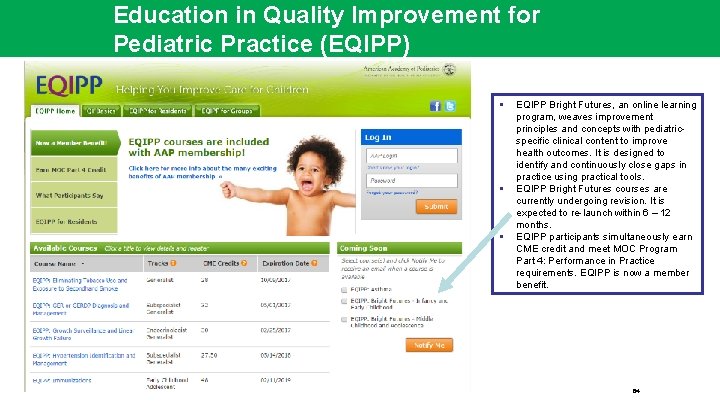
Education in Quality Improvement for Pediatric Practice (EQIPP) § § § EQIPP Bright Futures, an online learning program, weaves improvement principles and concepts with pediatricspecific clinical content to improve health outcomes. It is designed to identify and continuously close gaps in practice using practical tools. EQIPP Bright Futures courses are currently undergoing revision. It is expected to re-launch within 6 – 12 months. EQIPP participants simultaneously earn CME credit and meet MOC Program Part 4: Performance in Practice requirements. EQIPP is now a member benefit. 64
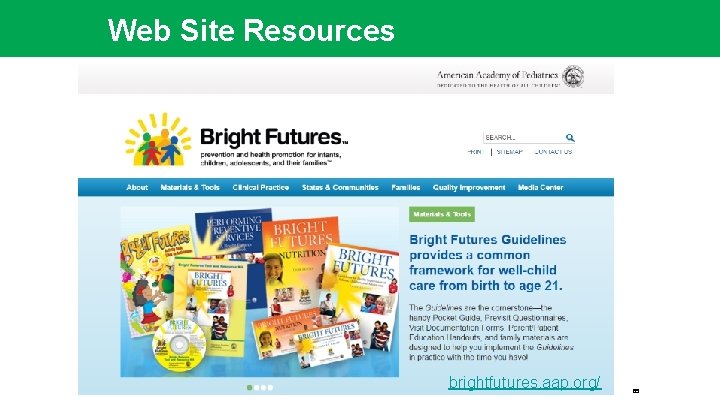
Web Site Resources brightfutures. aap. org/ 65
Resources: Parent/Family q healthychildren. org § § General information related to child health and/or more specific guidance on parenting issues Information on AAP policies, guidelines, publications, and other child health resources Tips & tools www. healthychildren. org q Brightfutures. aap. org § § Patient/Parent handouts in the Bright Futures Tool & Resource kit Family Resources Web page Virginia Department of Health educational videos brightfutures. aap. org/ q Healthy Child Care America § § Promotes cognitive, social and physical development of children in early education and child care Supports the needs of health professionals interested in promoting healthy and safe early education and child care programs Resource library (for health care and early education & child care professionals) www. healthychildcare. org/bfutures. html q Bright Futures Family Pocket Guide § § § Developed by the National Family Voices Project IMPACT with input from the Bright Futures National Center Easy-to-use book designed to help families support health and wellness for their children at every age (in English and Spanish) www. fv-impact. org 66
Changes in Practice: Recap Participants will be able to: q Plan to implement the Bright Futures/AAP Guidelines for children and adolescents q Use pediatrician-tested strategies and Bright Futures tools to improve the quality of preventive services delivered in their clinical setting § § § Previsit questionnaires Documentation forms Handouts Office systems changes Strength-based approach 67
Questions & Answers 68
![References q American Academy of Pediatrics. Bright Futures Tool and Resource Kit [CD-ROM]. Duncan](http://slidetodoc.com/presentation_image/48fe2a0fdb551a81199dc1d7584d4ffb/image-69.jpg "References q American Academy of Pediatrics. Bright Futures Tool and Resource Kit [CD-ROM]. Duncan")
References q American Academy of Pediatrics. Bright Futures Tool and Resource Kit [CD-ROM]. Duncan PM, Shaw JS, Gottesman MM, Swanson J, Hagan JF, Pirretti AE, eds. Elk Grove Village, IL: American Academy of Pediatrics; 2010. q Duncan P, Pirretti A, Earls MF, Stratbucker W, Healy JA, Shaw JS, Kairys S. Improving delivery of Bright Futures preventive services at the 9 - and 24 -month well child visit. Pediatrics. 2015. q Hagan JF, Shaw JS, Duncan PM, eds: 2008, Bright Futures: Guidelines for Health Supervision of Infants, Children and Adolescents. Third Edition. Elk Grove Village, IL: American Academy of Pediatrics. 69
Contact Information American Academy of Pediatrics Bright Futures National Center Jane Bassewitz, MA Manager, Bright Futures National Center 847 -434 -7781 Kathy Janies Manager, Bright Futures Implementation 847 -434 -7785 E-mail brightfutures@aap. org Web site brightfutures. aap. org
- Slides: 70