
Improving Predictive Models with Machine Learning Big Data
Improving Predictive Models with Machine Learning & Big Data 2015 NJ/DV HIMSS Fall Conference © Spectra. Medix, 2015. The contents of this presentation are confidential and cannot be copied without prior written permission from Spectra. Medix.
Learning Objectives 1. Predictive Modeling in Healthcare - Why Predict? 2. Use Cases: Existing Predictive Modeling Techniques a. Reducing Preventable Readmissions b. Population Health Management 3. Improving Healthcare Predictive Models with Machine Learning and Big Data 4. Integrating Machine Learning and Big Data into Predictive Models 5. Use Cases: Enhanced Predictive Modeling a. Reducing Preventable Readmissions b. Population Health Management © Spectra. Medix, 2015. The contents of this presentation are confidential and cannot be copied without prior written permission from Spectra. Medix. 2

Predictive Modeling: Why Predict? Predictive Modeling helps institutions anticipate risks and better prepare, organize and align resources to tackle those risks. Predict Plan Predict future Plan on how to act to intervene risk for events of interest Measure effectiveness of prediction and intervention P erform Deploy plan to intervene © Spectra. Medix, 2015. The contents of this presentation are confidential and cannot be copied without prior written permission from Spectra. Medix. 3
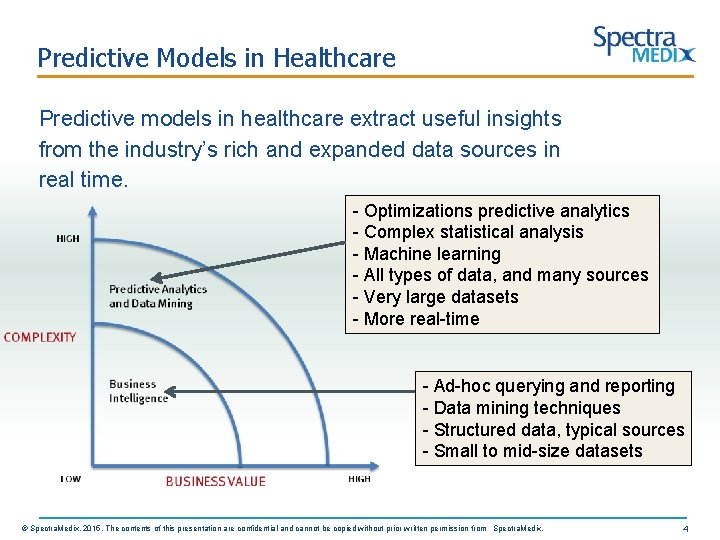
Predictive Models in Healthcare Predictive models in healthcare extract useful insights from the industry’s rich and expanded data sources in real time. - Optimizations predictive analytics - Complex statistical analysis - Machine learning - All types of data, and many sources - Very large datasets - More real-time - Ad-hoc querying and reporting - Data mining techniques - Structured data, typical sources - Small to mid-size datasets © Spectra. Medix, 2015. The contents of this presentation are confidential and cannot be copied without prior written permission from Spectra. Medix. 4
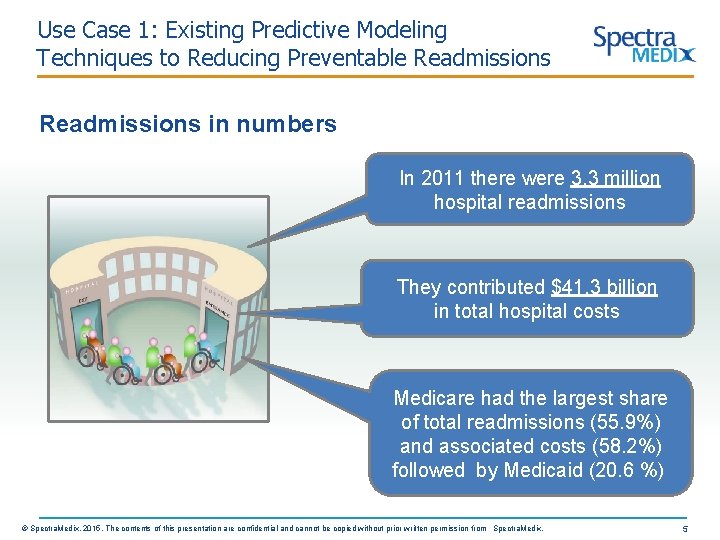
Use Case 1: Existing Predictive Modeling Techniques to Reducing Preventable Readmissions in numbers In 2011 there were 3. 3 million hospital readmissions They contributed $41. 3 billion in total hospital costs Medicare had the largest share of total readmissions (55. 9%) and associated costs (58. 2%) followed by Medicaid (20. 6 %) © Spectra. Medix, 2015. The contents of this presentation are confidential and cannot be copied without prior written permission from Spectra. Medix. 5

Use Case 1: Existing Predictive Modeling Techniques to Reducing Preventable Readmissions LACE 1. How it works • L=Length of Stay (LOS) • A= Acuity • C= Co-morbidities based on the “Charlson Comorbidity Index” • E= Previous emergency room visits 2. Challenges a. Info from the LACE model is generally delivered too late to have an impact – when patient is already moving to discharge b. LACE has moderate predictive power c. LACE alone does not provide actionable insights © Spectra. Medix, 2015. The contents of this presentation are confidential and cannot be copied without prior written permission from Spectra. Medix. 6
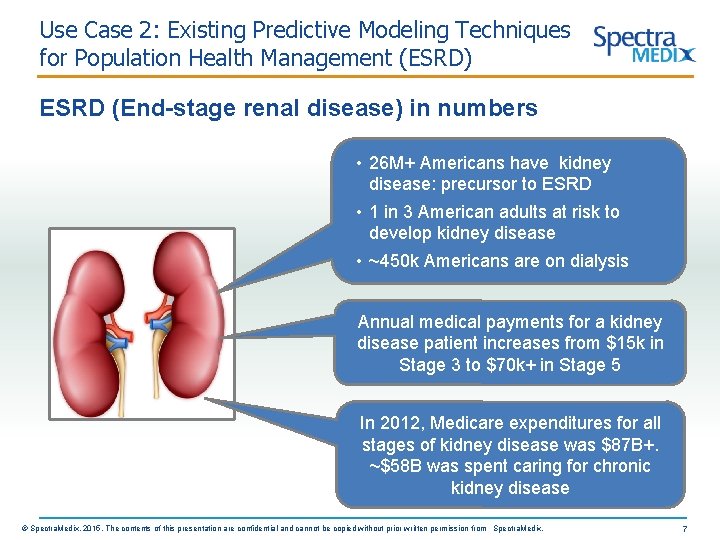
Use Case 2: Existing Predictive Modeling Techniques for Population Health Management (ESRD) ESRD (End-stage renal disease) in numbers • 26 M+ Americans have kidney disease: precursor to ESRD • 1 in 3 American adults at risk to develop kidney disease • ~450 k Americans are on dialysis Annual medical payments for a kidney disease patient increases from $15 k in Stage 3 to $70 k+ in Stage 5 In 2012, Medicare expenditures for all stages of kidney disease was $87 B+. ~$58 B was spent caring for chronic kidney disease © Spectra. Medix, 2015. The contents of this presentation are confidential and cannot be copied without prior written permission from Spectra. Medix. 7
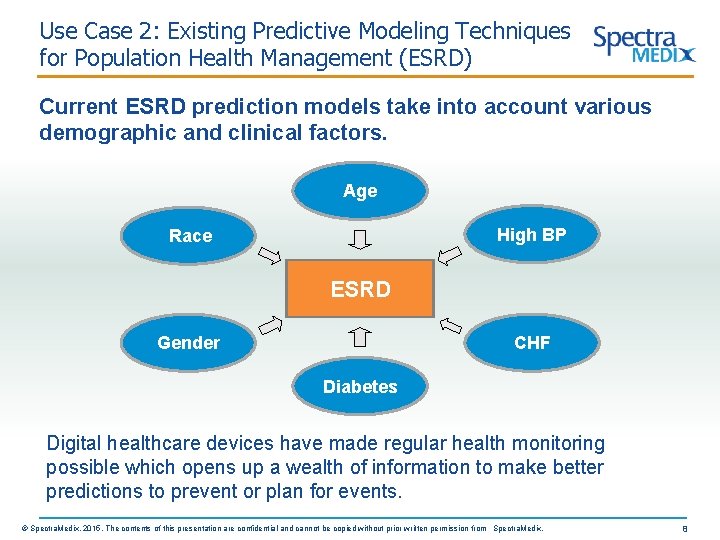
Use Case 2: Existing Predictive Modeling Techniques for Population Health Management (ESRD) Current ESRD prediction models take into account various demographic and clinical factors. Age High BP Race ESRD Gender CHF Diabetes Digital healthcare devices have made regular health monitoring possible which opens up a wealth of information to make better predictions to prevent or plan for events. © Spectra. Medix, 2015. The contents of this presentation are confidential and cannot be copied without prior written permission from Spectra. Medix. 8
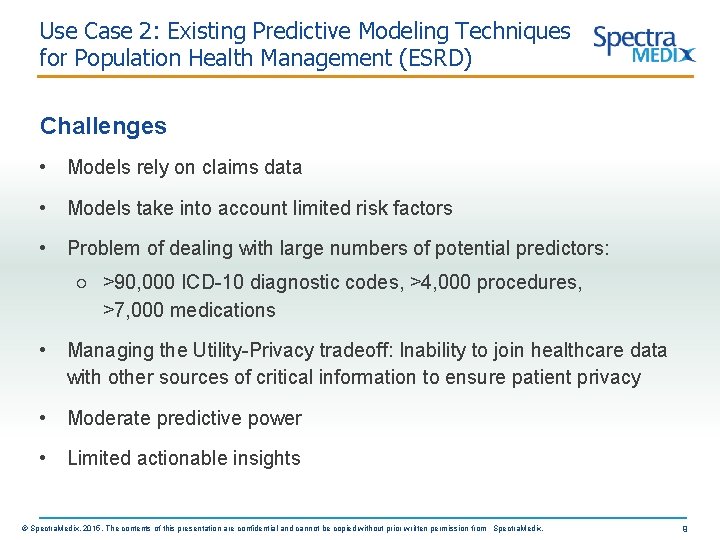
Use Case 2: Existing Predictive Modeling Techniques for Population Health Management (ESRD) Challenges • Models rely on claims data • Models take into account limited risk factors • Problem of dealing with large numbers of potential predictors: ○ >90, 000 ICD-10 diagnostic codes, >4, 000 procedures, >7, 000 medications • Managing the Utility-Privacy tradeoff: Inability to join healthcare data with other sources of critical information to ensure patient privacy • Moderate predictive power • Limited actionable insights © Spectra. Medix, 2015. The contents of this presentation are confidential and cannot be copied without prior written permission from Spectra. Medix. 9
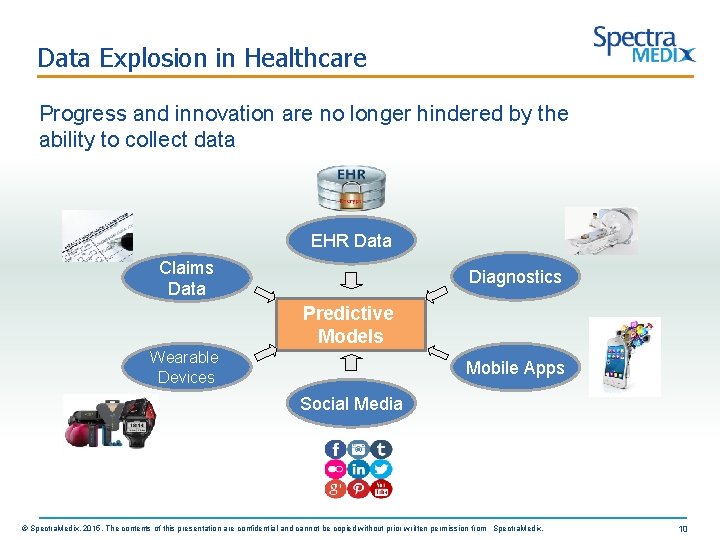
Data Explosion in Healthcare Progress and innovation are no longer hindered by the ability to collect data EHR Data Claims Data Diagnostics Predictive Models Wearable Devices Mobile Apps Social Media © Spectra. Medix, 2015. The contents of this presentation are confidential and cannot be copied without prior written permission from Spectra. Medix. 10
Improving Healthcare Predictive Models with Machine Learning and Big Data • The next generation of predictive models incorporate real time data, text mining, machine learning and big data • Use real-time data to make results relevant and timely • They make predictive models actionable • Improve accuracy - prescriptive and customizable analytics based on the needs of the hospital • More generalizable across patient sub populations • Easier to implement – machine learning makes them automated © Spectra. Medix, 2015. The contents of this presentation are confidential and cannot be copied without prior written permission from Spectra. Medix. 11
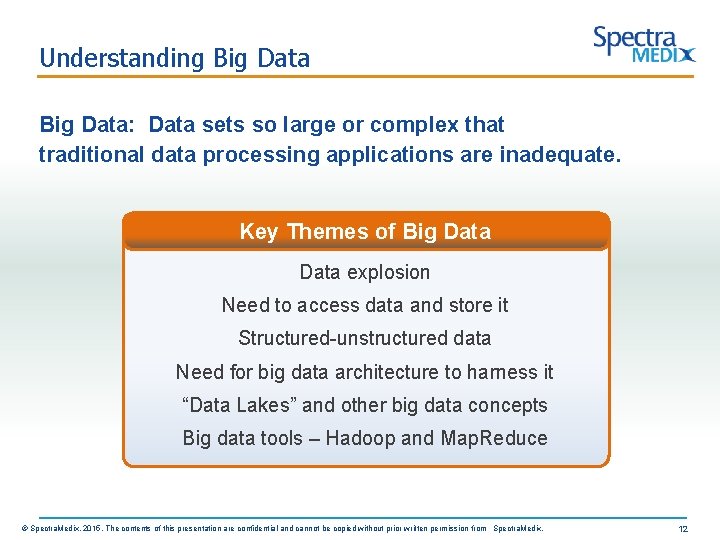
Understanding Big Data: Data sets so large or complex that traditional data processing applications are inadequate. Key Themes of Big Data explosion Need to access data and store it Structured-unstructured data Need for big data architecture to harness it “Data Lakes” and other big data concepts Big data tools – Hadoop and Map. Reduce © Spectra. Medix, 2015. The contents of this presentation are confidential and cannot be copied without prior written permission from Spectra. Medix. 12
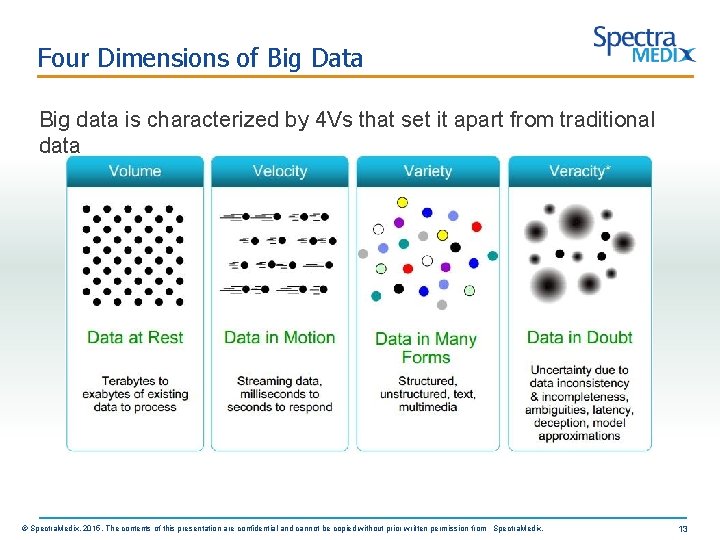
Four Dimensions of Big Data Big data is characterized by 4 Vs that set it apart from traditional data © Spectra. Medix, 2015. The contents of this presentation are confidential and cannot be copied without prior written permission from Spectra. Medix. 13
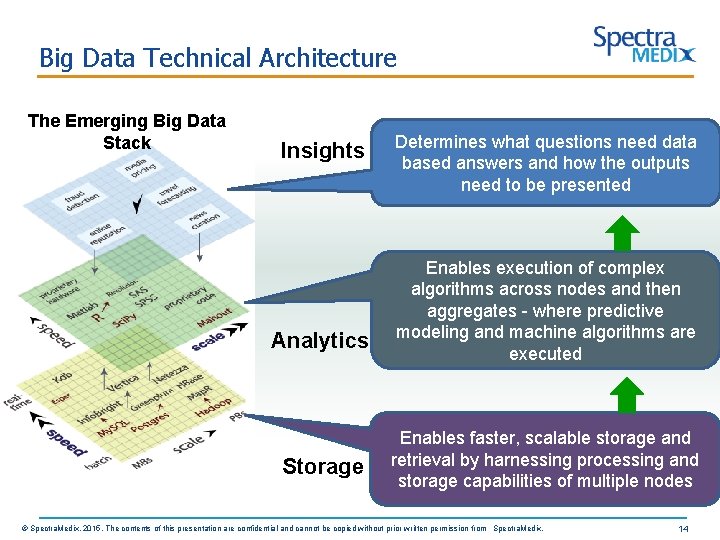
Big Data Technical Architecture The Emerging Big Data Stack Insights Analytics Storage Determines what questions need data based answers and how the outputs need to be presented Enables execution of complex algorithms across nodes and then aggregates - where predictive modeling and machine algorithms are executed Enables faster, scalable storage and retrieval by harnessing processing and storage capabilities of multiple nodes © Spectra. Medix, 2015. The contents of this presentation are confidential and cannot be copied without prior written permission from Spectra. Medix. 14
Machine Learning to the Rescue! Increased computing power and advancement in computer science have resulted in the development of sophisticated machine learning algorithms that enable intelligent mining of the big data. Machine Learning uses Big Data to Improve the Performance of Predictive Models © Spectra. Medix, 2015. The contents of this presentation are confidential and cannot be copied without prior written permission from Spectra. Medix. 15
Why Machine Learning? Machine Learning enables us to generate meaningful insights from Big Data to drive business more effectively • Relationships and correlations hidden within large amounts of data can be discovered using Machine Learning • Amount of knowledge available about certain tasks might be too large for explicit encoding by humans • New knowledge about tasks is constantly being discovered. It is inefficient and difficult to continuously re-design systems “by hand” • Environments change over time © Spectra. Medix, 2015. The contents of this presentation are confidential and cannot be copied without prior written permission from Spectra. Medix. 16
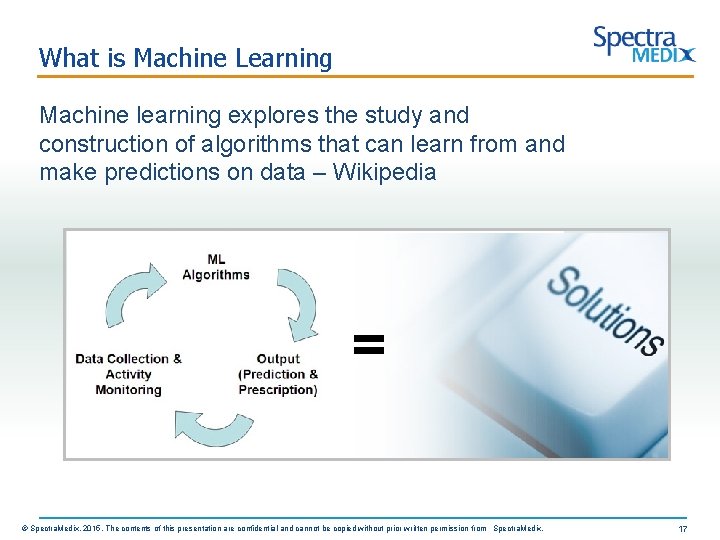
What is Machine Learning Machine learning explores the study and construction of algorithms that can learn from and make predictions on data – Wikipedia = © Spectra. Medix, 2015. The contents of this presentation are confidential and cannot be copied without prior written permission from Spectra. Medix. 17
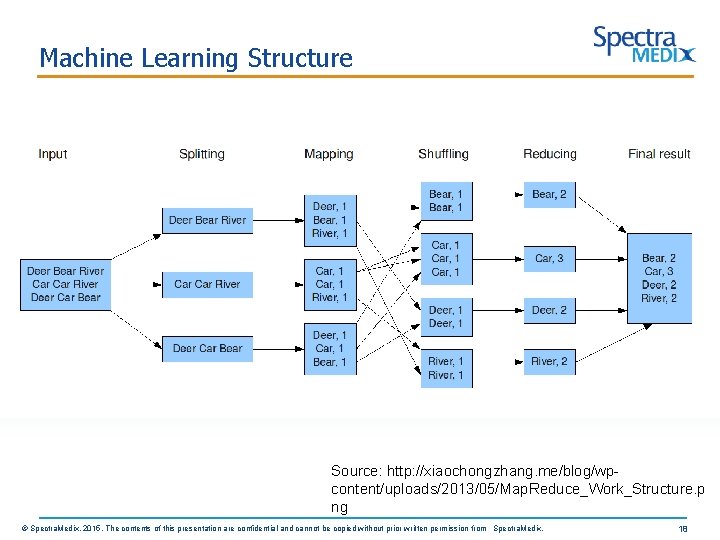
Machine Learning Structure Source: http: //xiaochongzhang. me/blog/wpcontent/uploads/2013/05/Map. Reduce_Work_Structure. p ng © Spectra. Medix, 2015. The contents of this presentation are confidential and cannot be copied without prior written permission from Spectra. Medix. 18
Use Case 1 A: Enhanced Predictive Modeling to Identify Patients at High Risk for Readmissions © Spectra. Medix, 2015. The contents of this presentation are confidential and cannot be copied without prior written permission from Spectra. Medix. 19
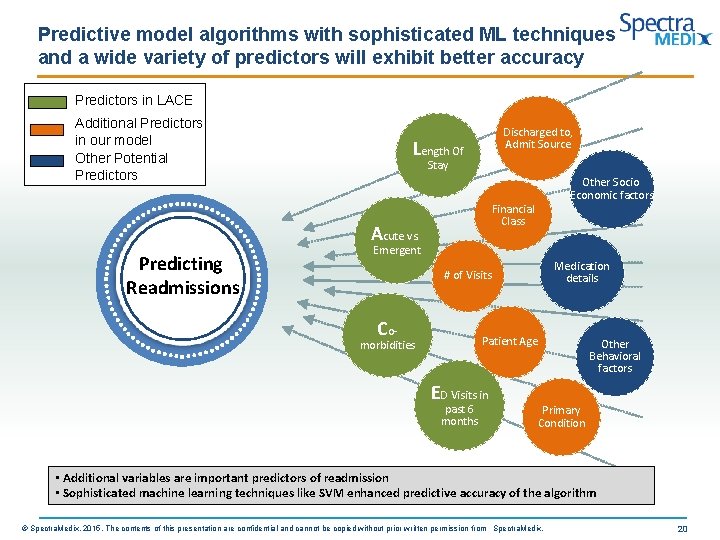
Predictive model algorithms with sophisticated ML techniques and a wide variety of predictors will exhibit better accuracy Predictors in LACE Additional Predictors in our model Other Potential Predictors Discharged to, Admit Source Length Of Stay Financial Class Acute vs. Predicting Readmissions Other Socio Economic factors Emergent Medication details # of Visits Co- Patient Age morbidities ED Visits in past 6 months Other Behavioral factors Primary Condition • Additional variables are important predictors of readmission • Sophisticated machine learning techniques like SVM enhanced predictive accuracy of the algorithm © Spectra. Medix, 2015. The contents of this presentation are confidential and cannot be copied without prior written permission from Spectra. Medix. 20
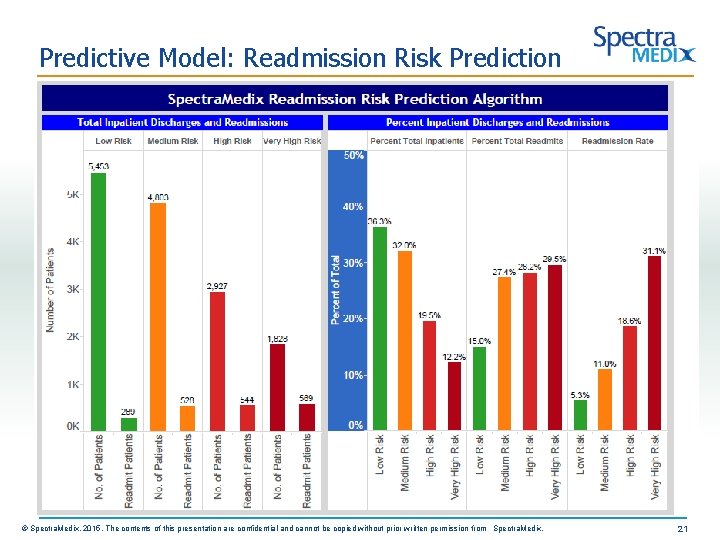
Predictive Model: Readmission Risk Prediction © Spectra. Medix, 2015. The contents of this presentation are confidential and cannot be copied without prior written permission from Spectra. Medix. 21
Use Case 2 a: Enhanced Predictive Modeling to Predict ESRD in Elderly Patients © Spectra. Medix, 2015. The contents of this presentation are confidential and cannot be copied without prior written permission from Spectra. Medix. 22
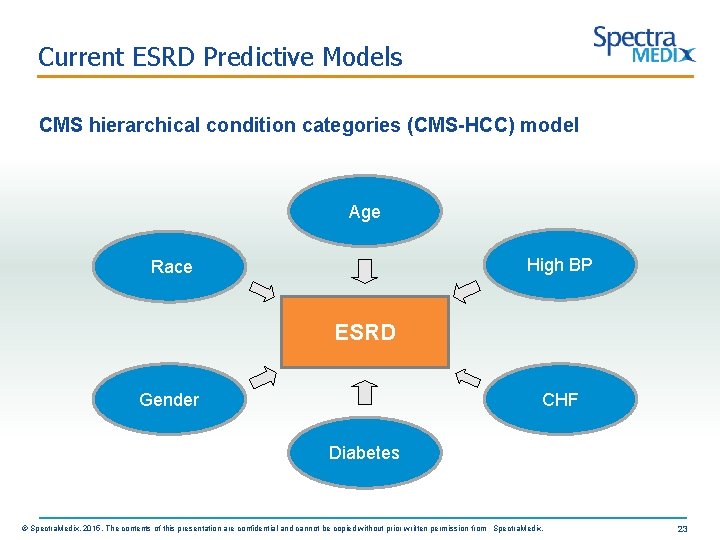
Current ESRD Predictive Models CMS hierarchical condition categories (CMS-HCC) model Age High BP Race ESRD Gender CHF Diabetes © Spectra. Medix, 2015. The contents of this presentation are confidential and cannot be copied without prior written permission from Spectra. Medix. 23
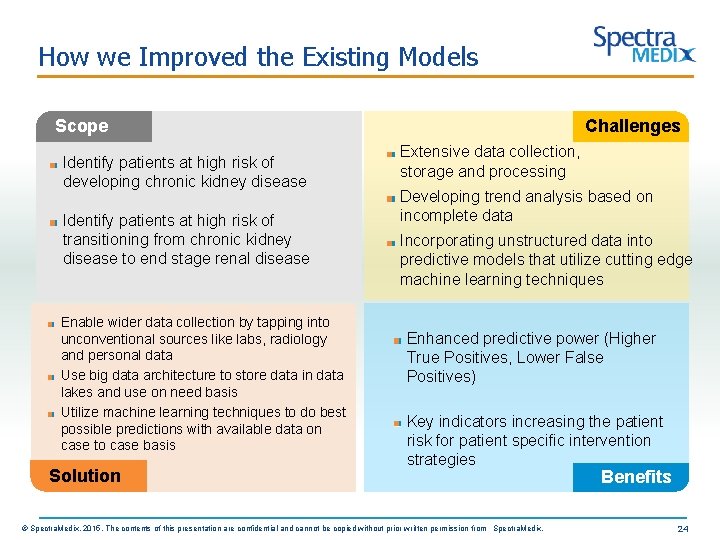
How we Improved the Existing Models Scope Identify patients at high risk of developing chronic kidney disease Identify patients at high risk of transitioning from chronic kidney disease to end stage renal disease Enable wider data collection by tapping into unconventional sources like labs, radiology and personal data Use big data architecture to store data in data lakes and use on need basis Utilize machine learning techniques to do best possible predictions with available data on case to case basis Solution Challenges Extensive data collection, storage and processing Developing trend analysis based on incomplete data Incorporating unstructured data into predictive models that utilize cutting edge machine learning techniques Enhanced predictive power (Higher True Positives, Lower False Positives) Key indicators increasing the patient risk for patient specific intervention strategies © Spectra. Medix, 2015. The contents of this presentation are confidential and cannot be copied without prior written permission from Spectra. Medix. Benefits 24
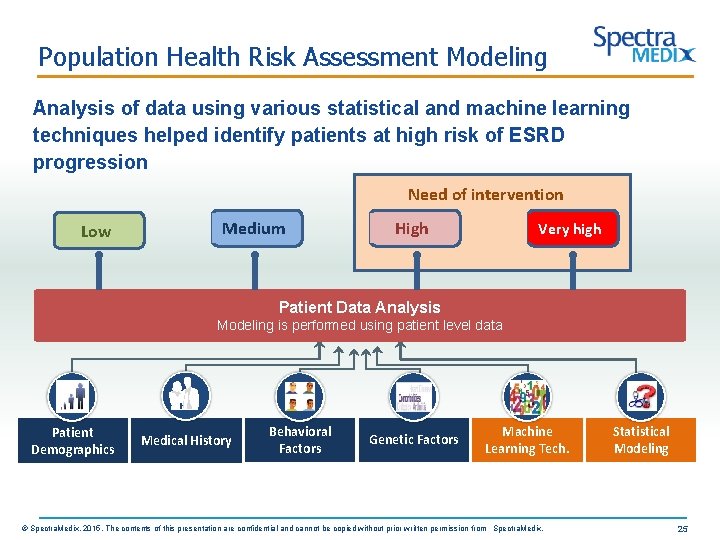
Population Health Risk Assessment Modeling Analysis of data using various statistical and machine learning techniques helped identify patients at high risk of ESRD progression Need of intervention Low Medium High Very high Patient Data Analysis Modeling is performed using patient level data Patient Demographics Medical History Behavioral Factors Genetic Factors Machine Learning Tech. © Spectra. Medix, 2015. The contents of this presentation are confidential and cannot be copied without prior written permission from Spectra. Medix. Statistical Modeling 25
Questions? © Spectra. Medix, 2015. The contents of this presentation are confidential and cannot be copied without prior written permission from Spectra. Medix. 26
Presenter Contact Information Raj Lakhanpal, MD CEO, Spectra. Medix 609 -336 -7733, x 301 (office) 609 -865 -3244 (cell) Raj. Lakhanpal@Spectra. Medixcom Indranil Ganguly Vice President & CIO JFK Health 732 -321 -7702 IGanguly@JFKHealth. org © Spectra. Medix, 2015. The contents of this presentation are confidential and cannot be copied without prior written permission from Spectra. Medix. 27
- Slides: 27