
IMPROVING PEER RELATIONSHIPS IN CHILDREN WITH AUTISM SPECTRUM


- Slides: 12
IMPROVING PEER RELATIONSHIPS IN CHILDREN WITH AUTISM SPECTRUM DISORDER Heather Bounds
How can teachers and specialists improve typically developing peers’ (TYPs) attitudes towards children with autism spectrum disorder (ASD)?
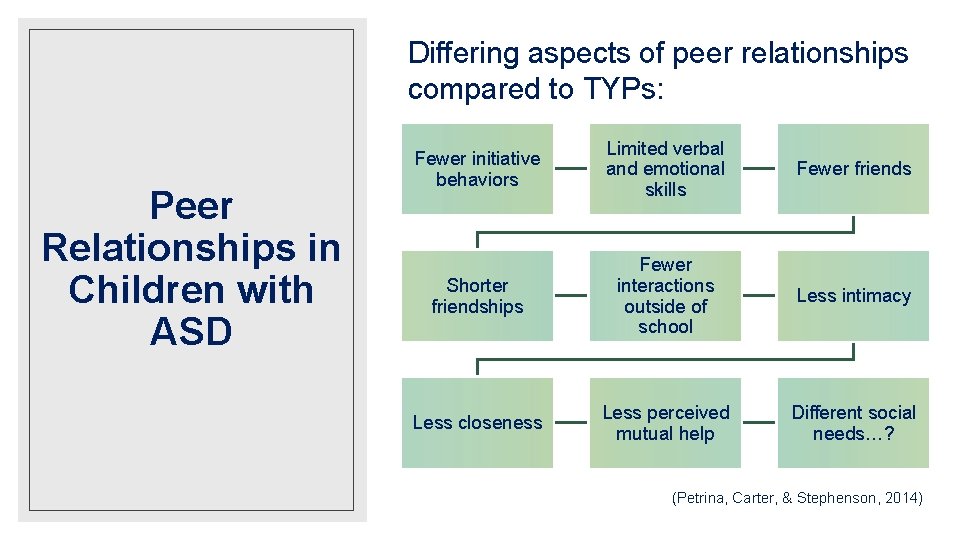
Differing aspects of peer relationships compared to TYPs: Peer Relationships in Children with ASD Fewer initiative behaviors Limited verbal and emotional skills Fewer friends Shorter friendships Fewer interactions outside of school Less intimacy Less closeness Less perceived mutual help Different social needs…? (Petrina, Carter, & Stephenson, 2014)
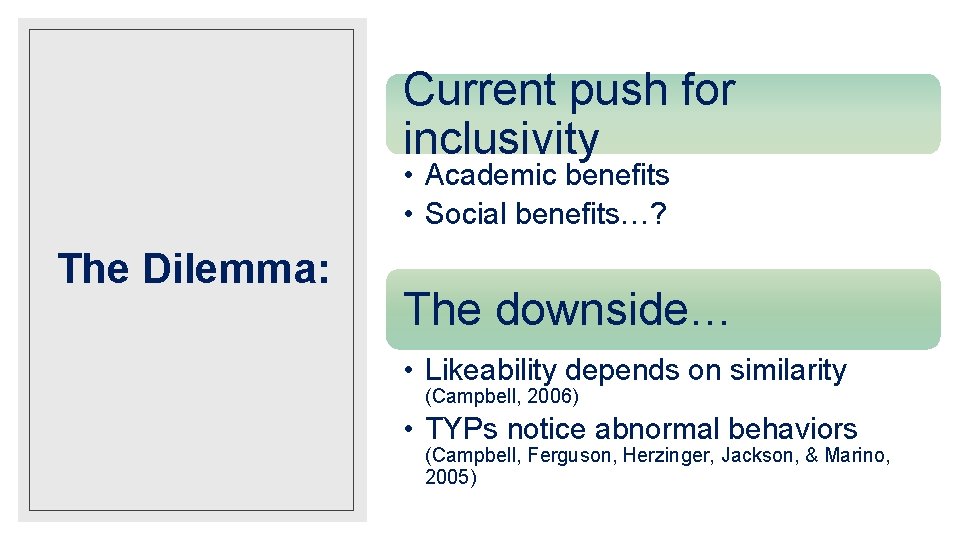
Current push for inclusivity • Academic benefits • Social benefits…? The Dilemma: The downside… • Likeability depends on similarity (Campbell, 2006) • TYPs notice abnormal behaviors (Campbell, Ferguson, Herzinger, Jackson, & Marino, 2005)
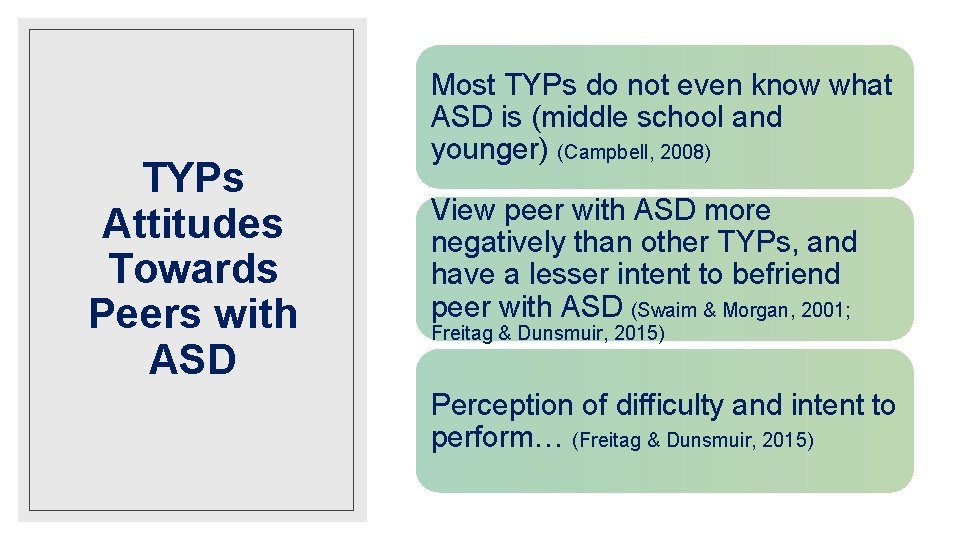
TYPs Attitudes Towards Peers with ASD Most TYPs do not even know what ASD is (middle school and younger) (Campbell, 2008) View peer with ASD more negatively than other TYPs, and have a lesser intent to befriend peer with ASD (Swaim & Morgan, 2001; Freitag & Dunsmuir, 2015) Perception of difficulty and intent to perform… (Freitag & Dunsmuir, 2015)
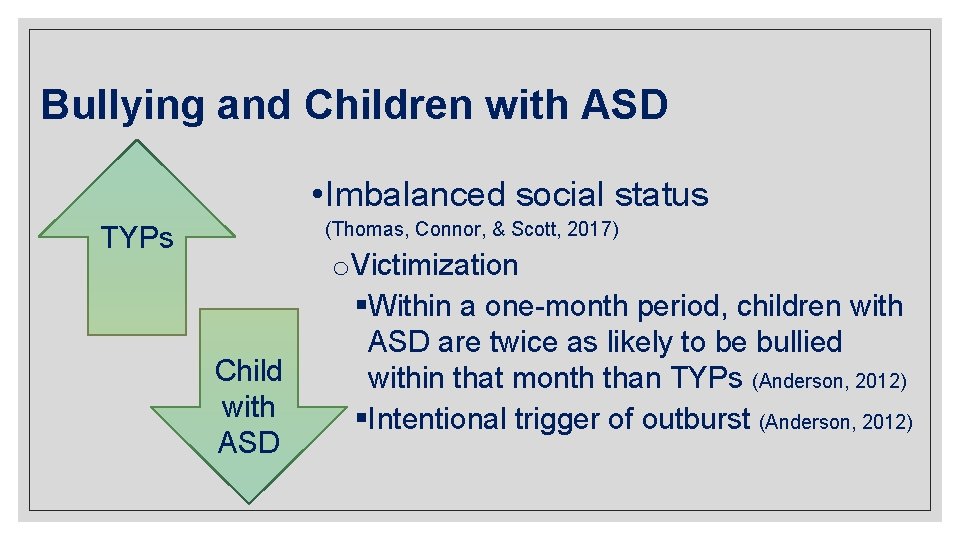
Bullying and Children with ASD • Imbalanced social status (Thomas, Connor, & Scott, 2017) TYPs Child with ASD o. Victimization §Within a one-month period, children with ASD are twice as likely to be bullied within that month than TYPs (Anderson, 2012) §Intentional trigger of outburst (Anderson, 2012)
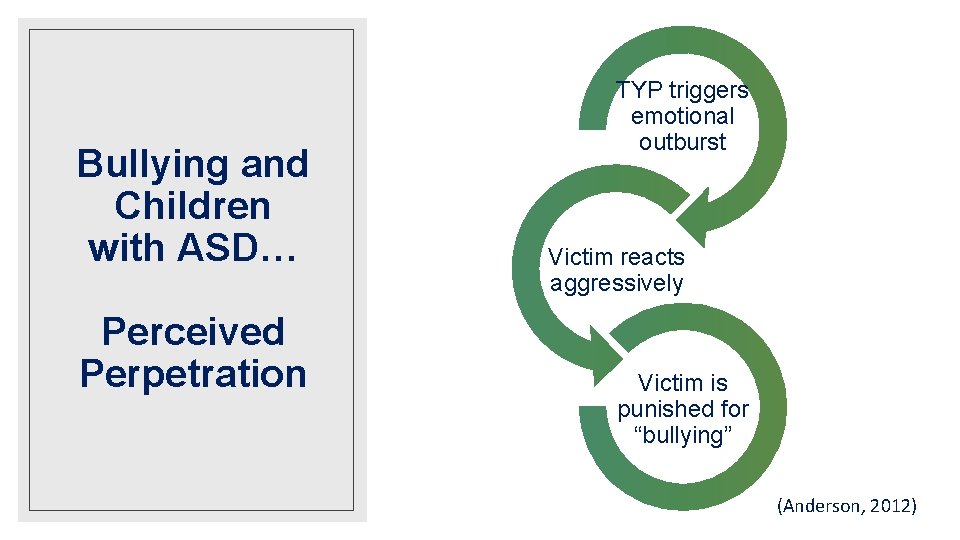
Bullying and Children with ASD… Perceived Perpetration TYP triggers emotional outburst Victim reacts aggressively Victim is punished for “bullying” (Anderson, 2012)
Unsuccessful Attempts… • Informational Interventions ◦ Vignette videos of “new peers” ◦ No change in attitude, but altered assignment of blame (Campbell, 2006) TYP Peer with ASD + Explanation
• Focus on TYPs A Ray of Hope ◦ Open conversational interventions (Gus, 2000) ◦ Provide action plans (Rex, Charlop, & Spector, 2018)
Moving Forward… • Complexities in research… ◦ Balance between internal and external validity • Responsibilities for teachers and specialists ◦ Open communication ◦ Action Plans
References Anderson, C. (2012). IAN research report bullying and children with ASD. IAN Community Scientific Liaison Kennedy Krieger Institute. Campbell, J. M. (2006). Changing Children’s Attitudes Toward Autism: A Process of Persuasive Communication. Journal of Developmental and Physical Disabilities, 18(3), 251– 272. Campbell, J. M. (2008). Brief report: Reliability and validity of the Shared Activities Questionnaire as a measure of middle school students’ attitudes toward autism. Journal of Autism and Developmental Disorders, 38(8), 1598– 1604. Campbell, J. M. , Ferguson, J. E. , Herzinger, C. V. , Jackson, J. N. , & Marino, C. (2005). Peers’ attitudes toward autism differ across sociometric groups: An exploratory investigation. Journal of Developmental and Physical Disabilities, 17(3), 281– 298. Freitag, S. , & Dunsmuir, S. (2015). The inclusion of children with ASD: Using the Theory of Planned Behaviour as a theoretical framework to explore peer attitudes. International Journal of Disability, Development and Education, 62(4), 405 -421. Gus, L. (2000). Autism: Promoting peer understanding. Educational Psychology in Practice, 16(4), 461– 468. Petrina, N. , Carter, M. , & Stephenson, J. (2014). The nature of friendship in children with autism spectrum disorders: A systematic review. Research in Autism Spectrum Disorders, 8(2), 111– 126. Rex, C. , Charlop, M. H. , & Spector, V. (2018). Using video modeling as an anti-bullying intervention for children with autism spectrum disorder. Journal of Autism and Developmental Disorders, 48(8), 2701– 2713. Swaim, K. F. , & Morgan, S. B. (2001). Children’s attitudes and behavioral intentions toward a peer with autistic behaviors: Does a brief educational intervention have an effect? Journal of Autism and Developmental Disorders, 31(2), 195– 205. Thomas, H. J. , Connor, J. P. , & Scott, J. G. (2018). Why do children and adolescents bully their peers? A critical review of key theoretical frameworks. Social Psychiatry and Psychiatric Epidemiology: The International Journal for Research in Social and Genetic Epidemiology and Mental Health Services , 53(5), 437– 451.
ANY QUESTIONS?