
Improving Outdoor Air Quality Around Schools Christine Slocum
- Slides: 23
Improving Outdoor Air Quality Around Schools Christine Slocum, MPH student Walden University PUBH 6165 Instructor: Robert Marino Fall 2010
Learning Outcomes �Define components of outdoor air pollution near schools �Explain the impact of poor air quality �Compare the current programs available �Explain what else can be done to improve the air quality around our schools
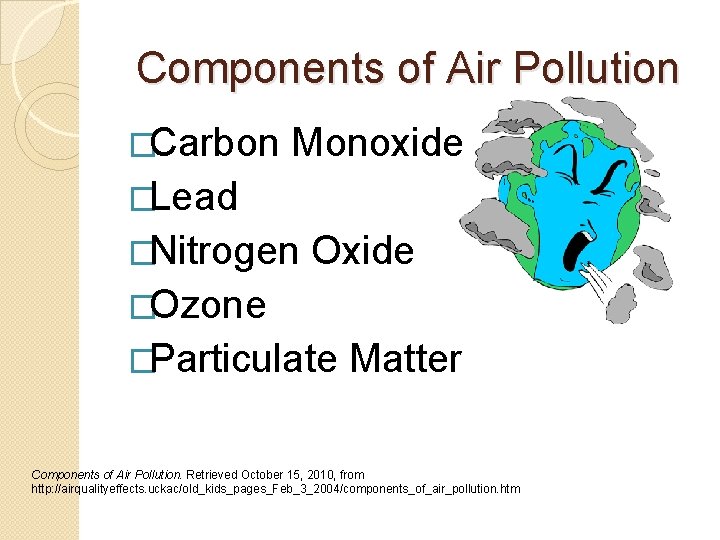
Components of Air Pollution �Carbon Monoxide �Lead �Nitrogen Oxide �Ozone �Particulate Matter Components of Air Pollution. Retrieved October 15, 2010, from http: //airqualityeffects. uckac/old_kids_pages_Feb_3_2004/components_of_air_pollution. htm
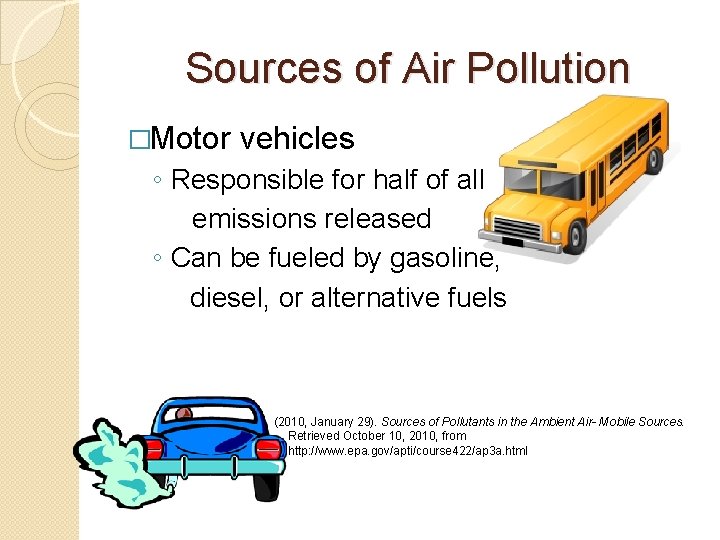
Sources of Air Pollution �Motor vehicles ◦ Responsible for half of all emissions released ◦ Can be fueled by gasoline, diesel, or alternative fuels (2010, January 29). Sources of Pollutants in the Ambient Air- Mobile Sources. Retrieved October 10, 2010, from http: //www. epa. gov/apti/course 422/ap 3 a. html
Why Should We Be Concerned? �School buses drive more than 4 billion miles each year � 24 million American children ride school buses daily �On average these children spend an hour and a half each day on the school bus (2008, March 11). Clean School Bus USA. Retrieved October 10, 2010, from http: //www. epa. gov/cleanschoolbus/index. htm
Why Should We Be Concerned? �Diesel exhaust ◦ Can cause lung damage and respiratory problems ◦ Exacerbate asthma and existing allergies ◦ Especially harmful to children because they breathe 50% more air per pound of body weight ◦ Long term exposure can increase the risk of lung cancer (2008, March 11). Clean School Bus USA. Retrieved October 10, 2010, from http: //www. epa. gov/cleanschoolbus/index. htm
Health Effects of Poor Air Quality �Irritation to eyes, nose, and throat �Lightheadedness �Heartburn �Headache �Weakness, numbness and tingling extremities �Chest tightness �Wheezing �Vomiting of Occupational Safety, & Health Bureau Montana Department of Labor & Industry. Diesel Exhaust Health Hazards. Retrieved October 15, 2010, from erd. dli. mt. gov/safetyhealth/brochures/dieselexhaust. pdf
Existing Programs �Clean �The School Bus USA Clean Air Schools Program
Clean School Bus USA � 3 Ways to reduce public school bus emissions ◦ Anti-idling strategies ◦ Engine retrofit and clean fuels ◦ Bus replacement ◦ (2008, March 11). Clean School Bus USA. Retrieved October 10, 2010, from http: //www. epa. gov/cleanscoolbus/index. htm
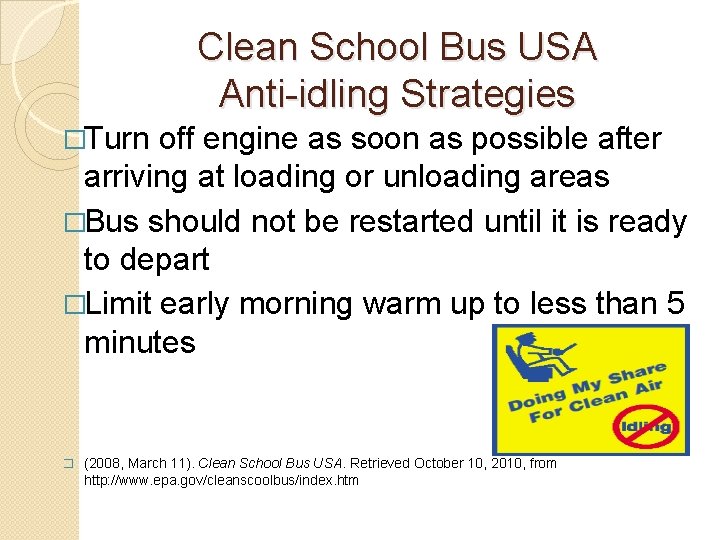
Clean School Bus USA Anti-idling Strategies �Turn off engine as soon as possible after arriving at loading or unloading areas �Bus should not be restarted until it is ready to depart �Limit early morning warm up to less than 5 minutes � (2008, March 11). Clean School Bus USA. Retrieved October 10, 2010, from http: //www. epa. gov/cleanscoolbus/index. htm
Clean School Bus USA Retrofit and Clean Fuel Strategies �Pollution Control Devices ◦ Diesel Oxidation Catalysts- uses chemical process to break down exhaust pollutants into less harmful components ◦ Diesel Particulate Matter Filters-ceramic devices that collect particulate matter ◦ (2007, November 21). Clean School Bus USA Retrofit. Retrieved October 24, 2010, from http: //www. epa. gov/cleanschoolbus/retrofit. htm#cleaner
Clean School Bus USA Retrofit and Clean Fuel Strategies �Cleaner Fuels ◦ Ultra-Low Sulfur Diesel (ULSD)- improves performance of particulate matter filter ◦ Biodiesel- reduces particulate matter, carbon monoxide ◦ Emulsified Diesel- reduces particulate matter and smog-causing Nitrogen oxide (NOx) ◦ (2007, November 21). Clean School Bus USA Retrofit. Retrieved October 24, 2010, from http: //www. epa. gov/cleanschoolbus/retrofit. htm#cleaner
Clean School Bus USA Bus Replacement �Older buses are not equipped with today’s pollution control or safety features �There are over 75, 000 pre 1990 buses still on the road that carry 3 million children to school (2010, June 23). Clean School Bus USA Replacing Old School Buses. Retrieved October 23, 2010, from http: //www. epa. gov/cleanschoolbus/replacement. htm
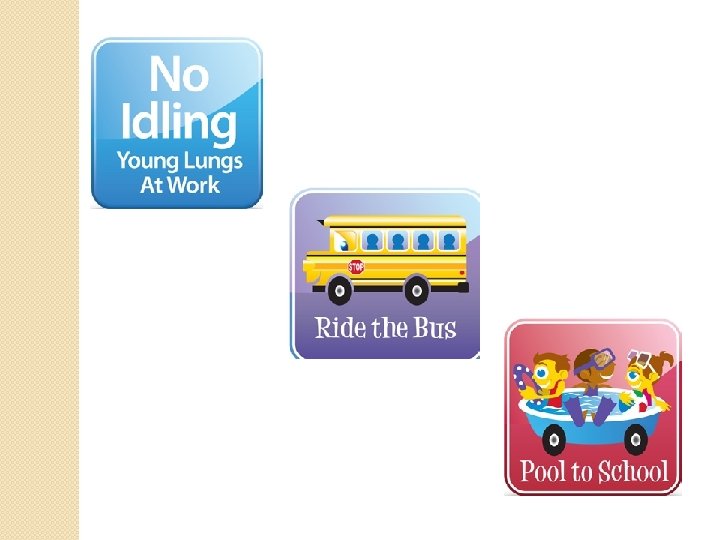
The Clean Air Clean Schools Program � 3 components of program ◦ No idling program ◦ Ride the bus! For clean air ◦ Pool to school Make Your Child's School a Clean Air School. Retrieved October 23, 2010, from http: //www. cleanaircampaign. org/Take_Action/Make-Your-Child-s-School-a-Clean-Air-School
The Clean Air Clean Schools Program �No Idling Program ◦ Encourages bus drivers and parent drivers to turn off engines when dropping off or waiting for students ◦ Make Your Child's School a Clean Air School. Retrieved October 23, 2010, from http: //www. cleanaircampaign. org/Take_Action/Make-Your-Child-s-School-a-Clean-Air. School
The Clean Air Clean Schools Program �Ride the bus! For clean air �Designed to get more student on buses and out of cars that contribute to traffic around school ground � Make Your Child's School a Clean Air School. Retrieved October 23, 2010, from http: //www. cleanaircampaign. org/Take_Action/Make-Your-Child-s-School-a-Clean-Air-School
The Clean Air Clean Schools Program �Pool to school �Promote car pooling to reduce traffic and reduce pollution � Make Your Child's School a Clean Air School. Retrieved October 23, 2010, from http: //www. cleanaircampaign. org/Take_Action/Make-Your-Child-s-School-a-Clean-Air-School
What Can We Do In Our School District? �Utilize the EPA, state, and local agencies to monitor outdoor air around schools for toxic air pollutants �Establish partnerships with school officials, bus drivers, parents, and students to improve the air quality around our schools
What Can We Do In Our School District? �Establish idle reduction policies ◦ Minimize time children spend outside when buses are arriving/departing ◦ If possible shorten commute times ◦ Deploy cleanest buses on longest routes ◦ Limit idling of delivery vehicles on school grounds ◦ Provide space inside school where drivers can wait on cold days �Develop educational programs for students of all ages about air pollution
References � � � � (2007, November 21). Clean School Bus USA Retrofit. Retrieved October 24, 2010, from http: //www. epa. gov/cleanschoolbus/retrofit. htm#cleaner (2008, March 11). Clean School Bus USA. Retrieved October 10, 2010, from http: //www. epa. gov/cleanschoolbus/index. htm (2010, January 29). Sources of Pollutants in the Ambient Air- Mobile Sources. Retrieved October 10, 2010, from http: //www. epa. gov/apti/course 422/ap 3 a. html (2010, June 23). Clean School Bus USA Replacing Old School Buses. Retrieved October 23, 2010, from http: //www. epa. gov/cleanschoolbus/replacement. htm Components of Air Pollution. Retrieved October 15, 2010, from http: //airqualityeffects. uckac/old_kids_pages_Feb_3_2004/components_o f_air_pollution. htm Make Your Child's School a Clean Air School. Retrieved October 23, 2010, from http: //www. cleanaircampaign. org/Take_Action/Make-Your. Child-s-School-a-Clean-Air-School Occupational Safety, & Health Bureau Montana Department of Labor & Industry. Diesel Exhaust Health Hazards. Retrieved October 15, 2010, from erd. dli. mt. gov/safetyhealth/brochures/dieselexhaust. pdf
Sources for Further Information �http: //www. epa. gov/cleanschoolbus/in dex. htm �http: //www. cleanaircampaign. org/Take -Action/Make-Your-Child-s-School-a. Clean-Air-School
Questions