
Improving Nurse SelfEfficacy in Trauma Care with Simulation
- Slides: 1
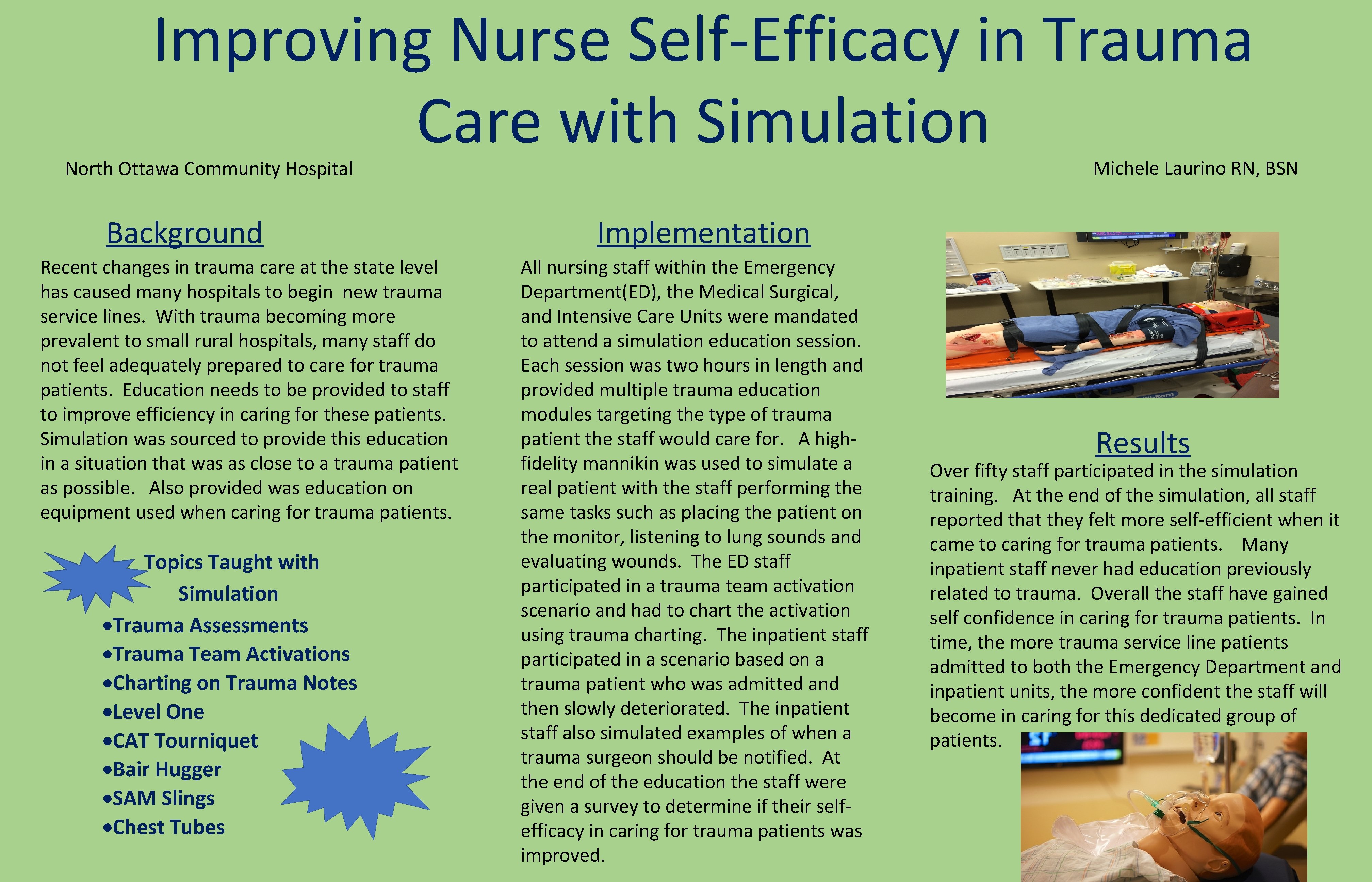
Improving Nurse Self-Efficacy in Trauma Care with Simulation Michele Laurino RN, BSN North Ottawa Community Hospital Background Recent changes in trauma care at the state level has caused many hospitals to begin new trauma service lines. With trauma becoming more prevalent to small rural hospitals, many staff do not feel adequately prepared to care for trauma patients. Education needs to be provided to staff to improve efficiency in caring for these patients. Simulation was sourced to provide this education in a situation that was as close to a trauma patient as possible. Also provided was education on equipment used when caring for trauma patients. Topics Taught with Simulation Trauma Assessments Trauma Team Activations Charting on Trauma Notes Level One CAT Tourniquet Bair Hugger SAM Slings Chest Tubes Implementation All nursing staff within the Emergency Department(ED), the Medical Surgical, and Intensive Care Units were mandated to attend a simulation education session. Each session was two hours in length and provided multiple trauma education modules targeting the type of trauma patient the staff would care for. A highfidelity mannikin was used to simulate a real patient with the staff performing the same tasks such as placing the patient on the monitor, listening to lung sounds and evaluating wounds. The ED staff participated in a trauma team activation scenario and had to chart the activation using trauma charting. The inpatient staff participated in a scenario based on a trauma patient who was admitted and then slowly deteriorated. The inpatient staff also simulated examples of when a trauma surgeon should be notified. At the end of the education the staff were given a survey to determine if their selfefficacy in caring for trauma patients was improved. Results Over fifty staff participated in the simulation training. At the end of the simulation, all staff reported that they felt more self-efficient when it came to caring for trauma patients. Many inpatient staff never had education previously related to trauma. Overall the staff have gained self confidence in caring for trauma patients. In time, the more trauma service line patients admitted to both the Emergency Department and inpatient units, the more confident the staff will become in caring for this dedicated group of patients.