
Improving Machine Translation Quality with Automatic Named Entity
- Slides: 31
Improving Machine Translation Quality with Automatic Named Entity Recognition Bogdan Babych Anthony Hartley Centre for Translation Studies University of Leeds, UK Department of Computer Science University of Sheffield, UK Centre for Translation Studies University of Leeds, UK bogdan@comp. leeds. ac. uk a. hartley@leeds. ac. uk
Overview • Problems of Named Entities (NEs) for MT • Experiment set-up – Segmentation of the MT output – Scoring scheme • Results of the experiment • Discussion – Improving MT with IE techniques • Conclusions and future work
Problems of NEs for MT • NEs are the weak point for many MT systems • Distinct linguistic properties of proper nouns and different translation strategies for NE • “NE internal” errors: – Proper / common noun disambiguation errors – Errors in morphosyntactic categories of NEs • “NE external” errors in the context of NEs: – Word sense disambiguation errors – Errors in morphosyntactic features in NE context – Segmentation errors
Translation strategies for NEs • Language-dependent strategies – Eastern Slavonic languages: person names are transcribed with Cyrillic characters • Strategies dependent on a type of NE – [Newmark, 1982: 70 -83]: organisation names are often left untranslated – Languages with Cyrillic writing system: organisation names are often left in original Roman orthography • E. g. : 4 articles on international economy from BBC Russian site: Roman-script NEs cover 6% of the total 1000 tokens
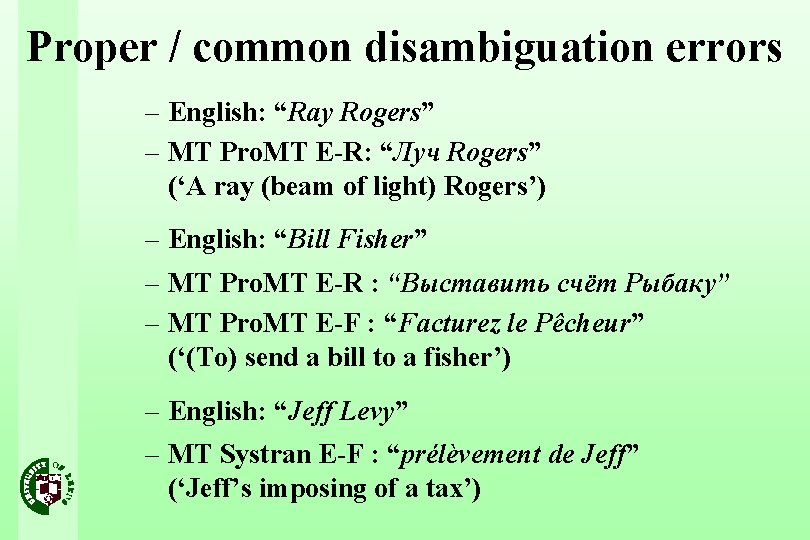
Proper / common disambiguation errors – English: “Ray Rogers” – MT Pro. MT E-R: “Луч Rogers” (‘A ray (beam of light) Rogers’) – English: “Bill Fisher” – MT Pro. MT E-R : “Выставить счёт Рыбаку” – MT Pro. MT E-F : “Facturez le Pêcheur” (‘(To) send a bill to a fisher’) – English: “Jeff Levy” – MT Systran E-F : “prélèvement de Jeff” (‘Jeff’s imposing of a tax’)
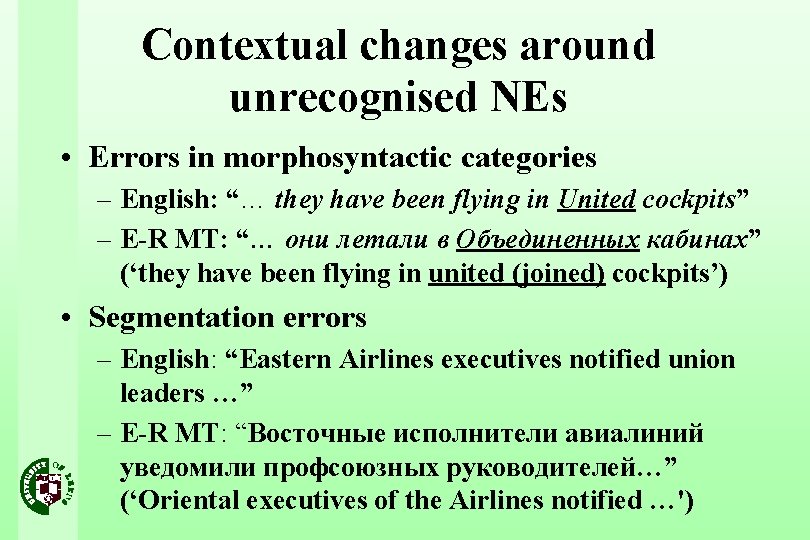
Contextual changes around unrecognised NEs • Errors in morphosyntactic categories – English: “… they have been flying in United cockpits” – E-R MT: “… они летали в Объединенных кабинах” (‘they have been flying in united (joined) cockpits’) • Segmentation errors – English: “Eastern Airlines executives notified union leaders …” – E-R MT: “Восточные исполнители авиалиний уведомили профсоюзных руководителей…” (‘Oriental executives of the Airlines notified …')
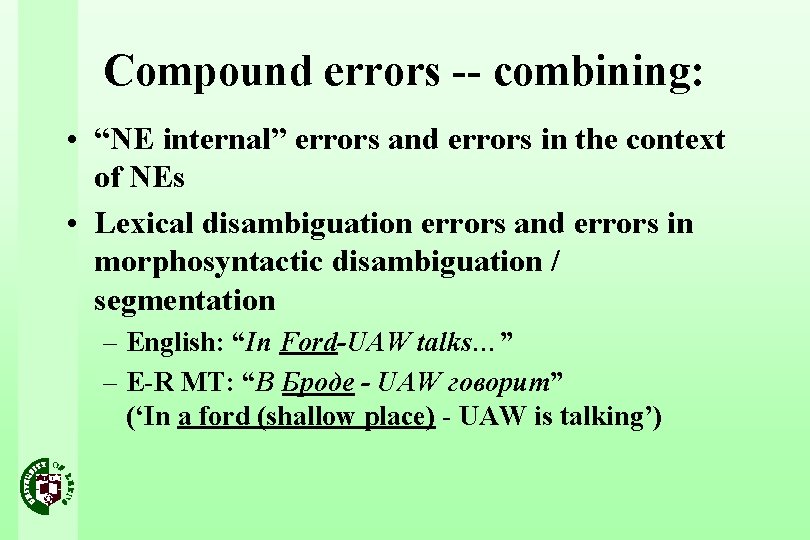
Compound errors -- combining: • “NE internal” errors and errors in the context of NEs • Lexical disambiguation errors and errors in morphosyntactic disambiguation / segmentation – English: “In Ford-UAW talks…” – E-R MT: “В Броде - UAW говорит” (‘In a ford (shallow place) - UAW is talking’)
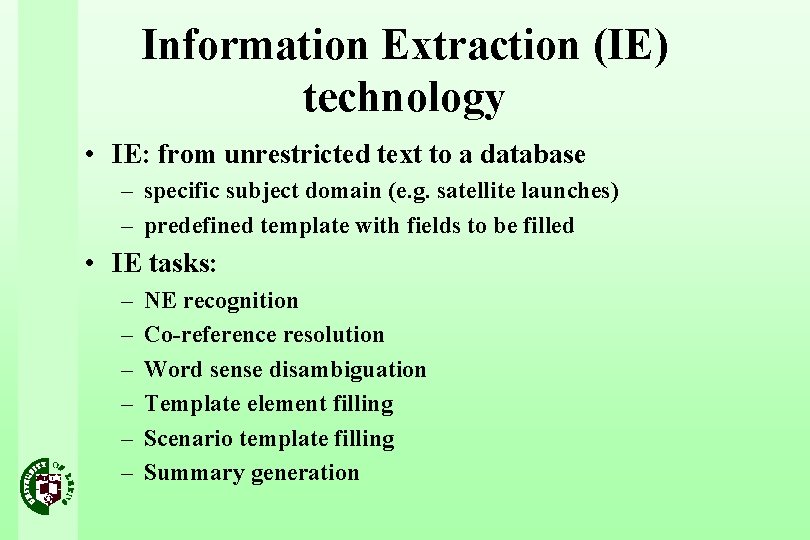
Information Extraction (IE) technology • IE: from unrestricted text to a database – specific subject domain (e. g. satellite launches) – predefined template with fields to be filled • IE tasks: – – – NE recognition Co-reference resolution Word sense disambiguation Template element filling Scenario template filling Summary generation
NE recognition in IE • NE recognition is specifically addressed and benchmarked (DARPA MUC 6 & MUC 7 competitions) • Manually annotated “gold standard” available • Highly accurate – leading IE systems achieve F-score 80 -90% – performance is higher and less dependent on a subject domain (compared to Scenario Template Filling) • Available under GPL: NE recognition module ANNIE in Sheffield’s GATE system
Using NE recognition for MT • GATE-ANNIE system allows automatic annotation of NEs in English texts • MT systems accept Do-Not-Translate (DNT) lists – acceptable translation strategy for many organisation names in certain language pairs • Suggestion: if NE recognition is more accurate for IE systems, then general MT quality will improve (compared to the baseline performance) – NE-Internal changes are predictable (DNT strategy) – Changes in the context of NEs are more interesting and more difficult to predict
Experiment set-up • Purpose: evaluating morphosyntactic changes in the context of NEs after DNT-processing • Corpus: – 30 texts (news articles) from MUC 6 evaluation set (11, 975 tokens, 510 NE occurrences, 174 NE types) – GATE “responses” -- NE recognition output file generated by GATE-1 for MUC 6 competition (Precision - 84%; Recall - 94%; F-measure - 89. 06%) • MT systems: – E-R Pro. MT 98; E-F Pro. MT 2001; E-F Systran 2000
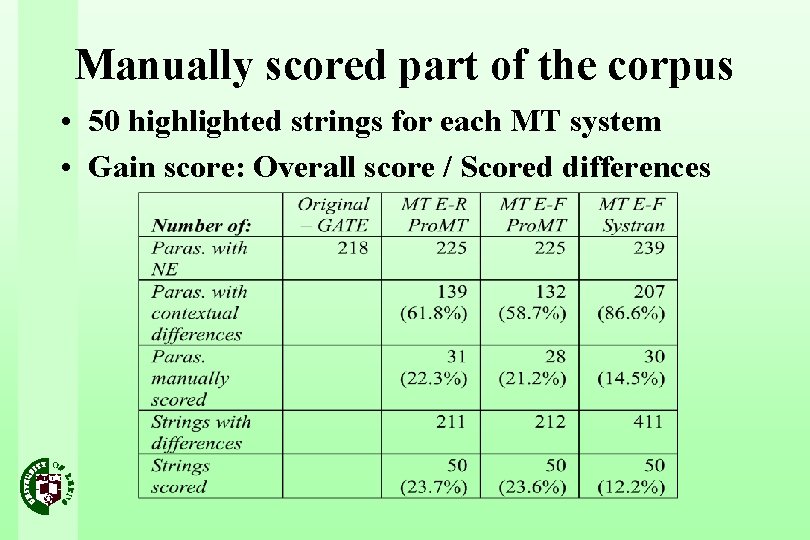
Experiment set-up (contd. ) • Stage 1: Automatic generation of DNT lists from GATE-1 annotation • Stage 2: Generating translations for 3 systems – Baseline translation (without a DNT list) – DNT-processed translation • Stage 3: Automatic segmentation of translations into NE-internal and NE-external zones • Stage 4: Manual scoring of NE-external differences
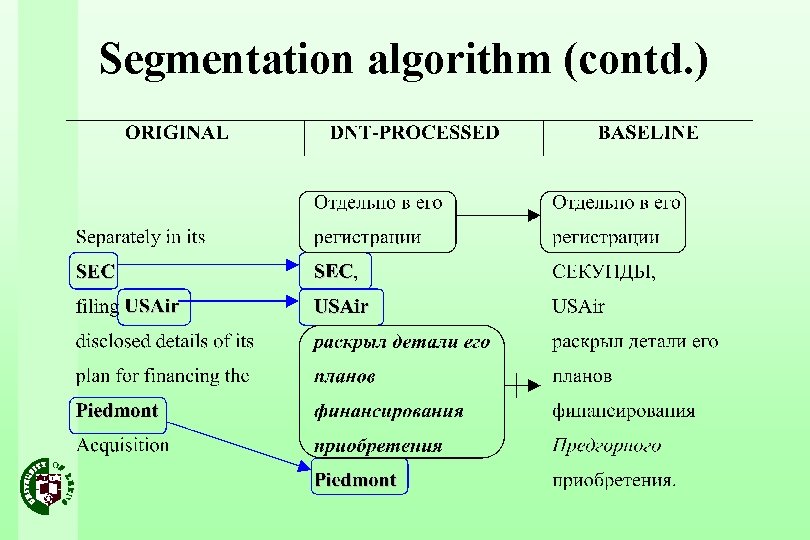
Segmentation algorithm • Annotated NEs in the English original are looked up in the DNT-processed translation • Strings between found NEs are then looked up in the baseline translation • If a string is not found, it is highlighted (signaling a difference in the context of the NE) – Result: NE-internal and NE-external zones in the baseline translation are separated – NE-external differences are highlighted – No complex alignment
Segmentation algorithm (contd. )
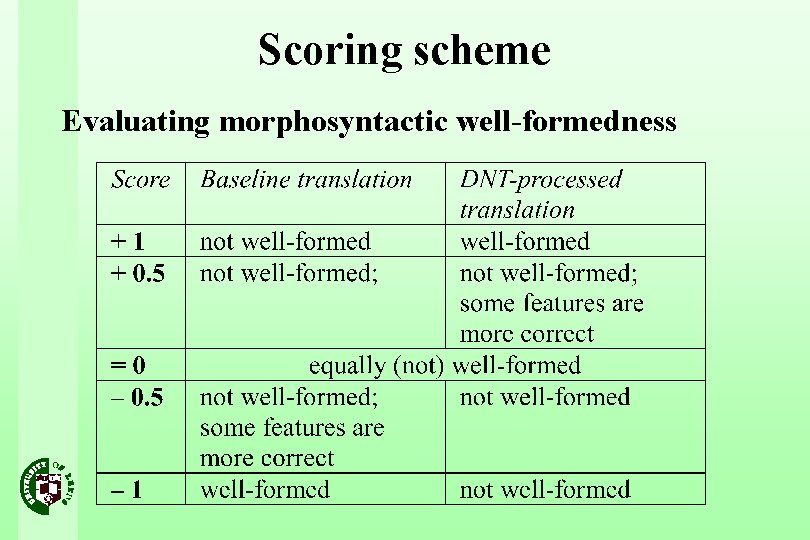
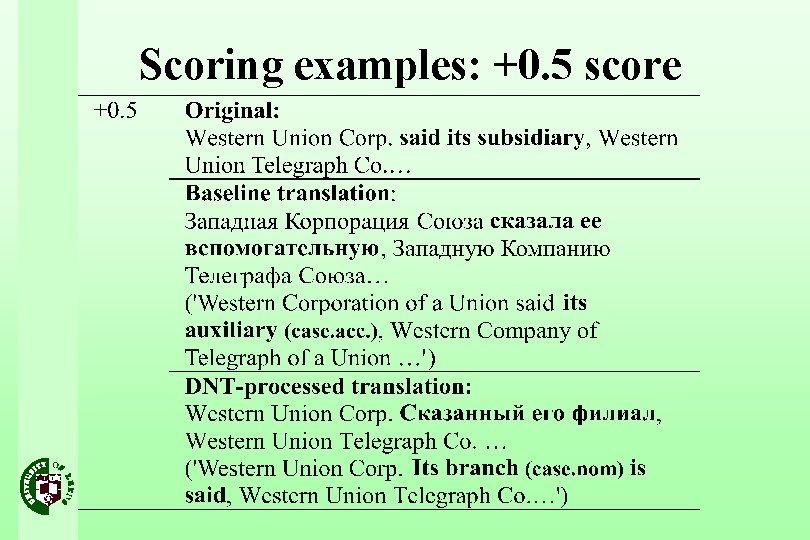
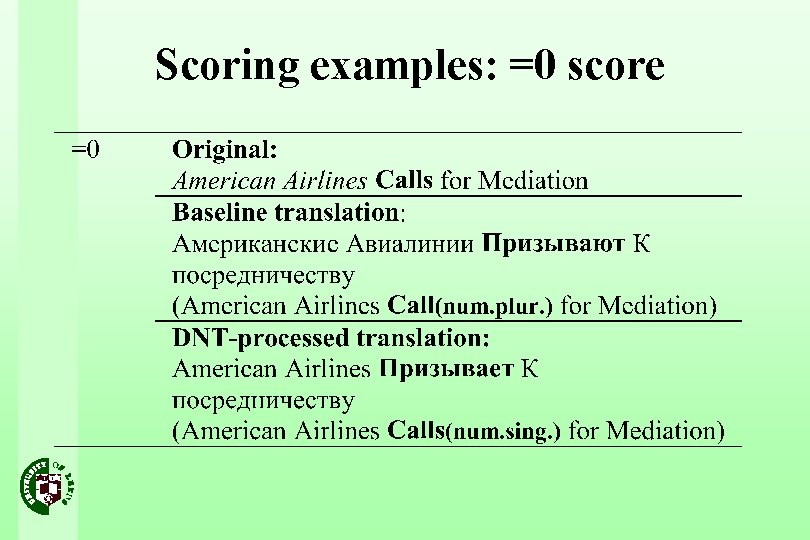
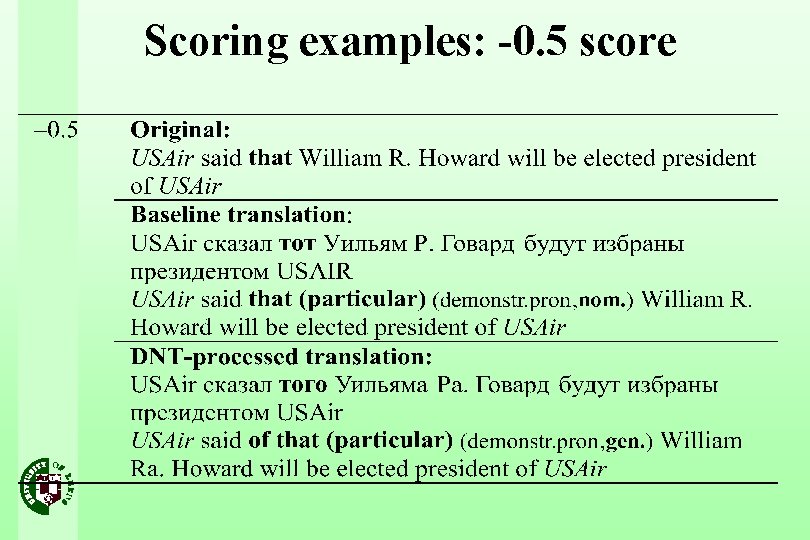
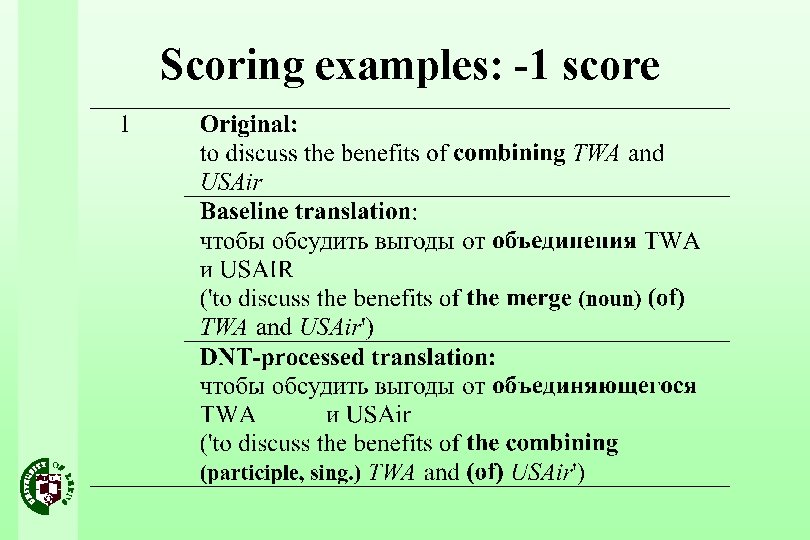
Scoring scheme Evaluating morphosyntactic well-formedness
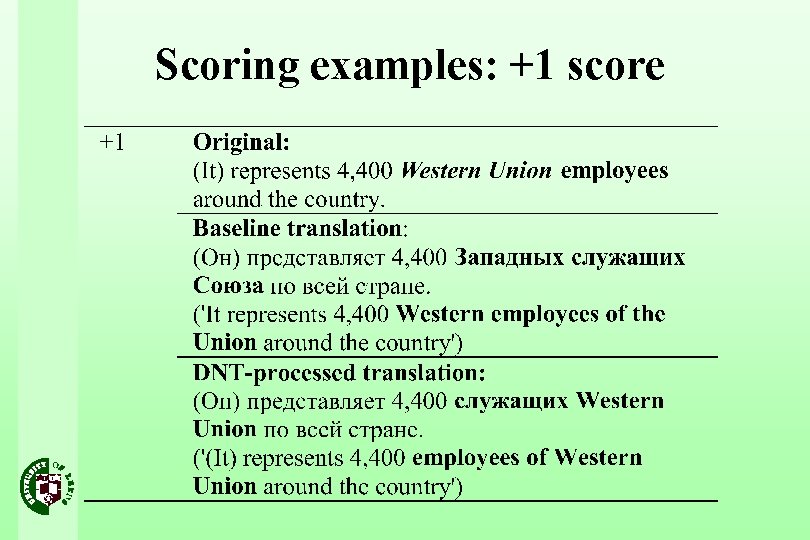
Scoring examples: +1 score
Scoring examples: +0. 5 score
Scoring examples: =0 score
Scoring examples: -0. 5 score
Scoring examples: -1 score
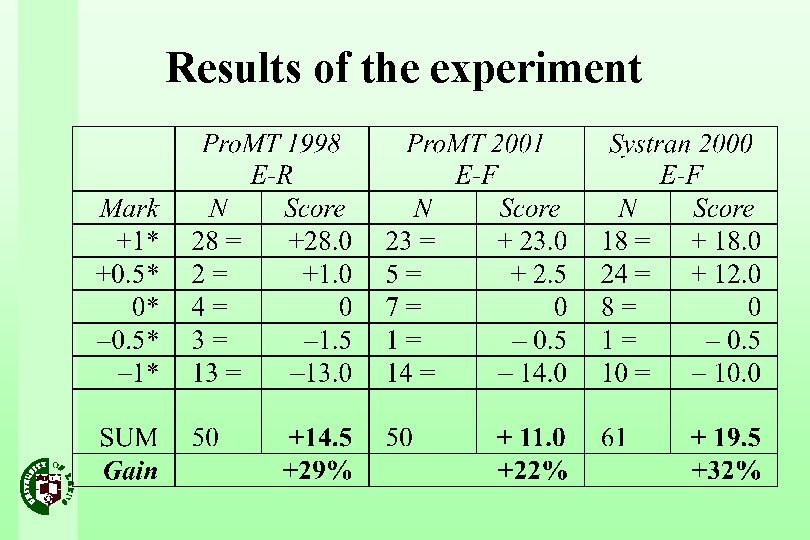
Manually scored part of the corpus • 50 highlighted strings for each MT system • Gain score: Overall score / Scored differences
Results of the experiment
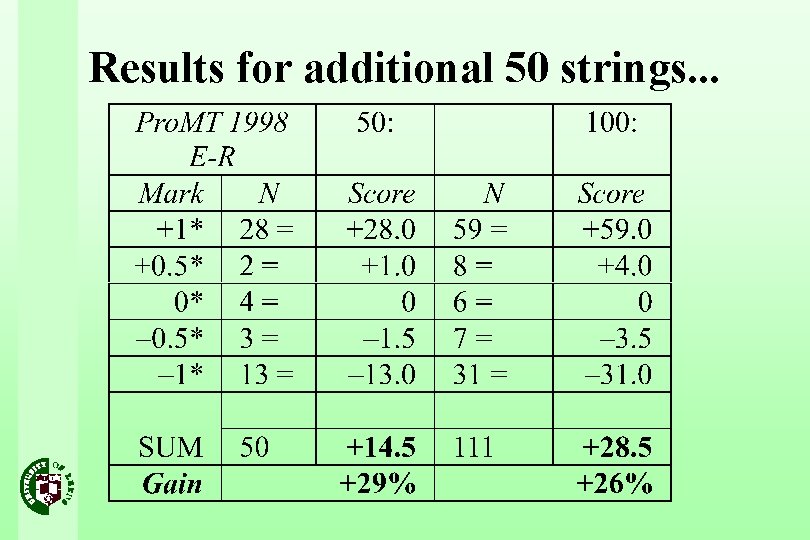
Results for additional 50 strings. . .
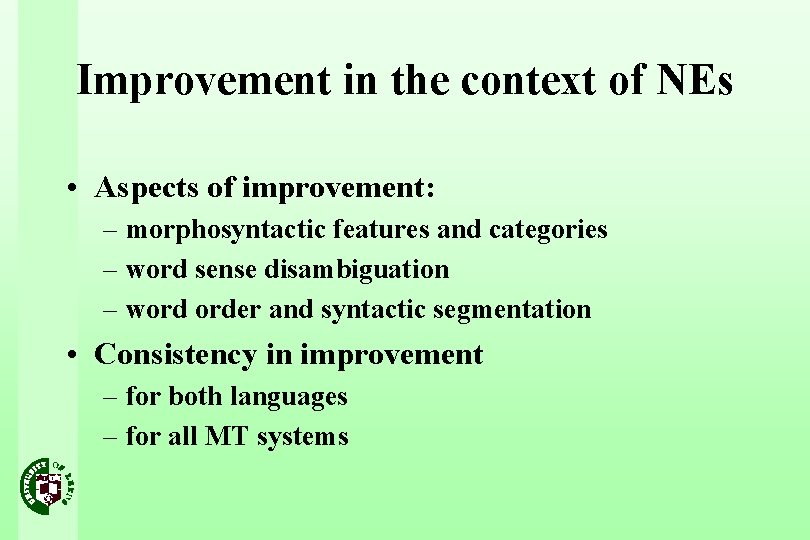
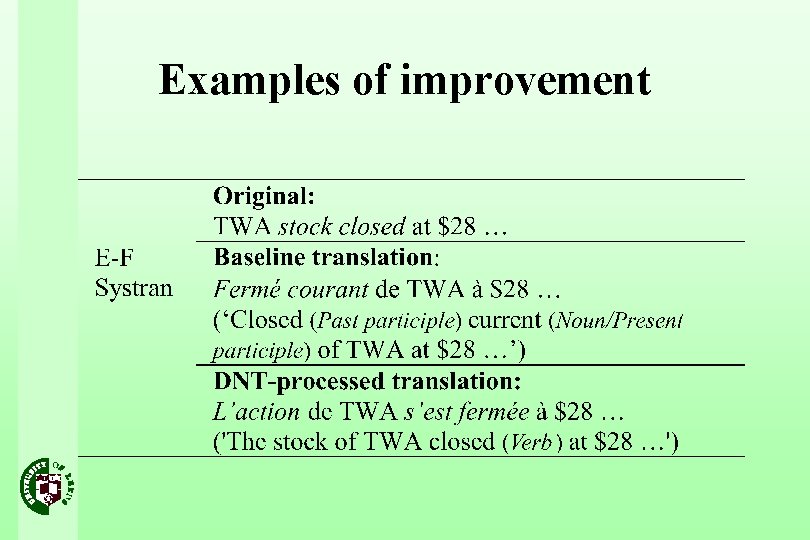
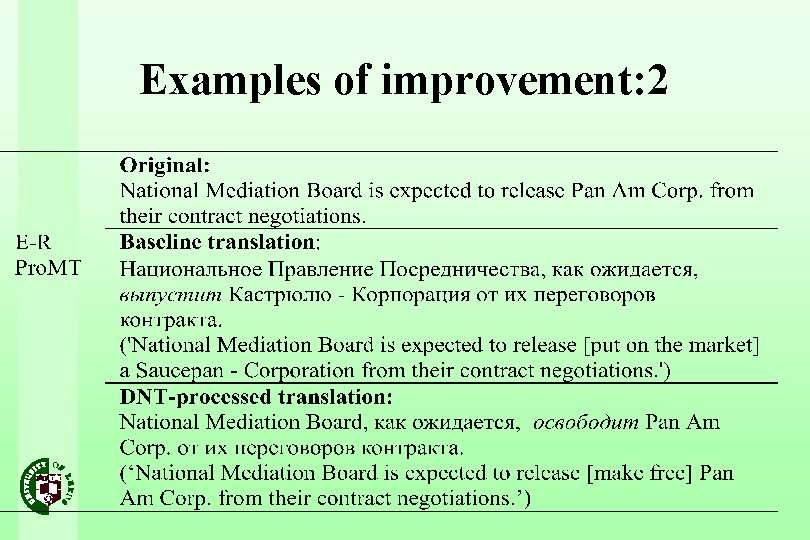
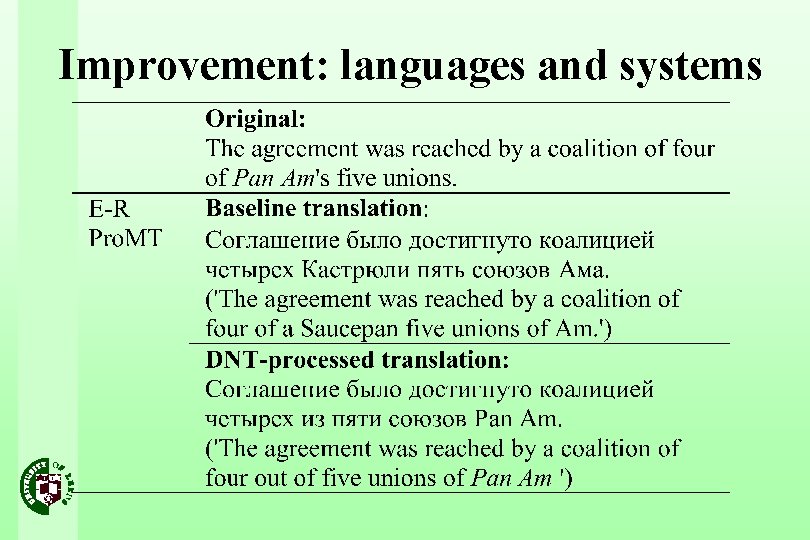
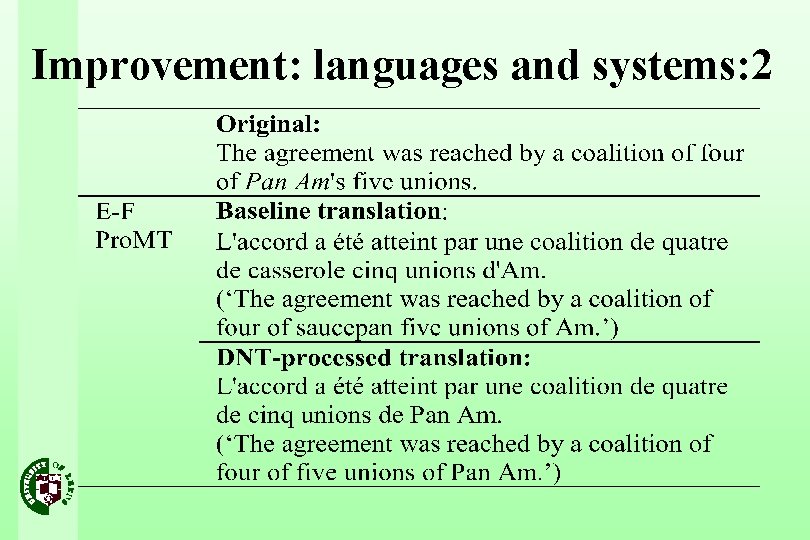
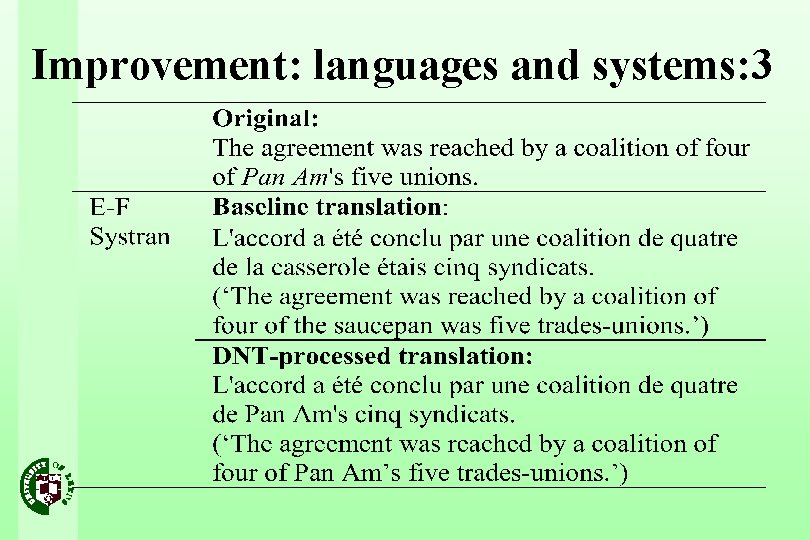
Improvement in the context of NEs • Aspects of improvement: – morphosyntactic features and categories – word sense disambiguation – word order and syntactic segmentation • Consistency in improvement – for both languages – for all MT systems
Examples of improvement
Examples of improvement: 2
Improvement: languages and systems
Improvement: languages and systems: 2
Improvement: languages and systems: 3
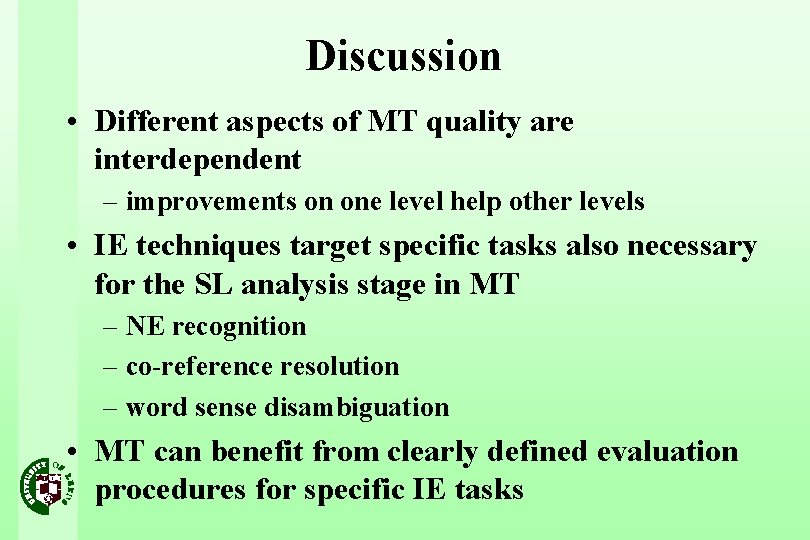
Discussion • Different aspects of MT quality are interdependent – improvements on one level help other levels • IE techniques target specific tasks also necessary for the SL analysis stage in MT – NE recognition – co-reference resolution – word sense disambiguation • MT can benefit from clearly defined evaluation procedures for specific IE tasks
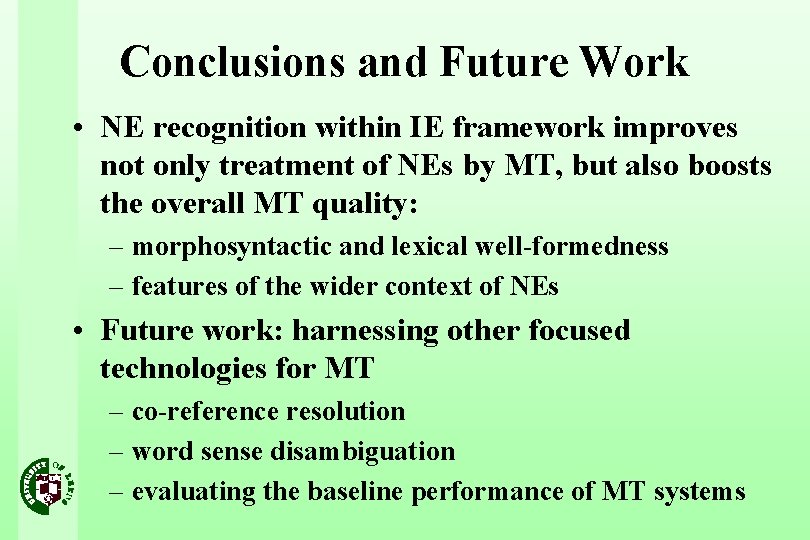
Conclusions and Future Work • NE recognition within IE framework improves not only treatment of NEs by MT, but also boosts the overall MT quality: – morphosyntactic and lexical well-formedness – features of the wider context of NEs • Future work: harnessing other focused technologies for MT – co-reference resolution – word sense disambiguation – evaluating the baseline performance of MT systems