
Improving Interprofessional Communication Skills with Standardized Patient Simulations
- Slides: 22
Improving Interprofessional Communication Skills with Standardized Patient Simulations Emma Kientz, MS, APRN-CNS, CNE Site Coordinator - Tulsa Assistant Professor of Nursing University of Oklahoma Fran and Earl Ziegler College of Nursing March 2016
Disclosures The presenter has no relevant financial relationships with any commercial interests to disclose No disclosures 2
Acknowledgements John Carlson, MS John Gaudet MPH Julie Miller-Cribbs MSW, PHD Dr. Sarah Passmore Dr. James Tomasek Jeana Wilcox Ph. D, RN, CNS, CNE 3
Train in Silos, Work as Teams How are health care professionals supposed to make the transition? 4
Problem and Significance • If Interprofessional collaboration is a goal of health care provider training, one must understand effective methods of training that results in collaborative professionals. • Author review of 35 articles • Only 5 involved actual or simulated clinical experiences 5
Research Question Do attitudes and perceptions of communication and teamwork of an interprofessional team change following exposure to an interprofessional learning experience? 6
Sample • 110 Health Professions Students • Medicine (35) • Nursing (43) • Social Work (32) 7
Specific Aims • Specific Aim 1: To compare change in attitudes toward working in health care teams pre- and post- simulated interprofessional standardized patient encounter. • Hypothesis 1 a: There will be improved attitudes 8 toward working in health care teams following participation in a simulated interprofessional standardized patient encounter. • Hypothesis 1 b: The attitude changes will vary depending on the future profession of the students involved.
Specific Aims • Specific Aim 2: To compare readiness for interprofessional learning pre- and postsimulated interprofessional standardized patient encounter. • Hypothesis 2 a: There will be improved readiness for 9 interprofessional learning following participation in a simulated interprofessional standardized patient encounter. • Hypothesis 2 b: The readiness for interprofessional learning will vary depending on the future profession of the students involved.
Project Description • Students from three professional groups were brought together for a half-day seminar and interprofessional simulation • Consent forms and Pre surveys for attitudes and readiness for working in Interprofessional teams were administered • Introduction to Oklahoma child abuse reporting laws • Interprofessional standardized patient simulation • Post surveys and debriefing 10 Baker, C. , Pulling, R. , Mc. Graw, R, Dagone, J, Hopkins-Rosel, D. (2008). Simulation in interprofesional education for patient centered collaborative care. Journal of Advanced Nursing 64(4) 372 -379.
Surveys • ATHCT: Attitudes Toward Health Care Teams Scale • 20 item tool with 6 point scale • Cronbach’s alpha =. 87* • RIPLS: Readiness for Interprofessional Learning Scale • 19 item tool with 5 point scale • Cronbach’s alpha =. 90* 11 * Chronbach's alpha as reported in literature
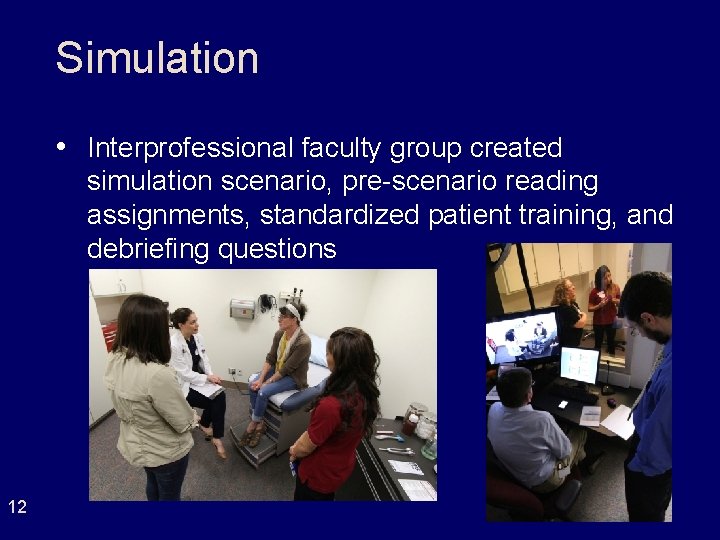
Simulation • Interprofessional faculty group created simulation scenario, pre-scenario reading assignments, standardized patient training, and debriefing questions 12
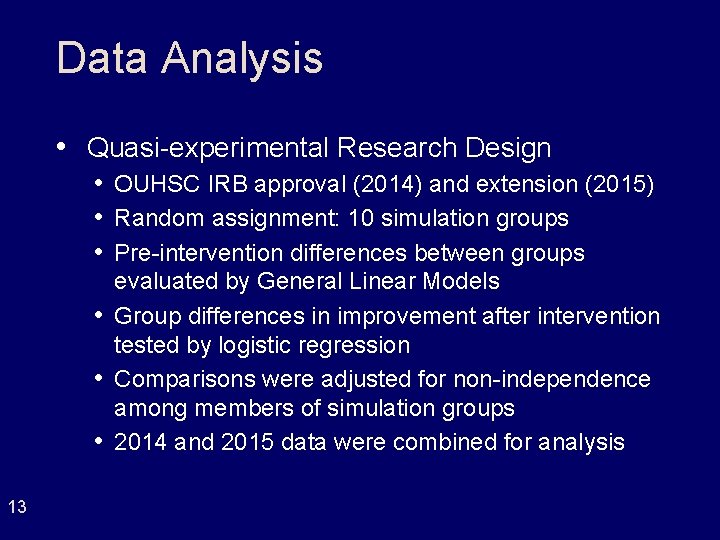
Data Analysis • Quasi-experimental Research Design • OUHSC IRB approval (2014) and extension (2015) • Random assignment: 10 simulation groups • Pre-intervention differences between groups evaluated by General Linear Models • Group differences in improvement after intervention tested by logistic regression • Comparisons were adjusted for non-independence among members of simulation groups • 2014 and 2015 data were combined for analysis 13
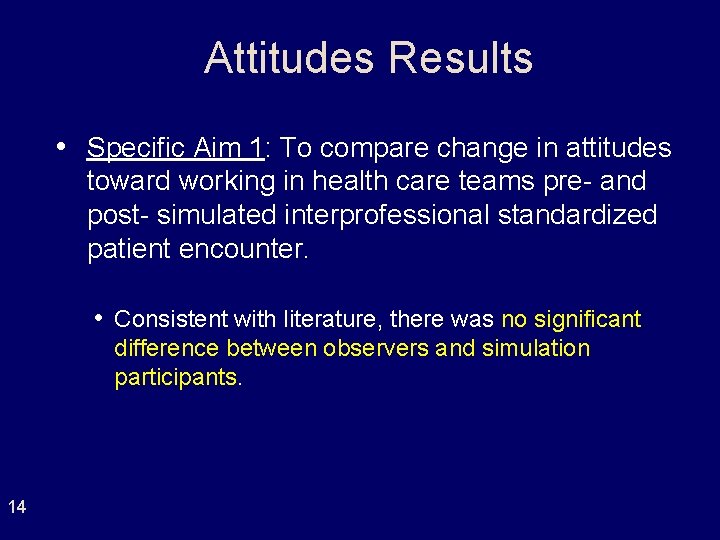
Attitudes Results • Specific Aim 1: To compare change in attitudes toward working in health care teams pre- and post- simulated interprofessional standardized patient encounter. • Consistent with literature, there was no significant difference between observers and simulation participants. 14
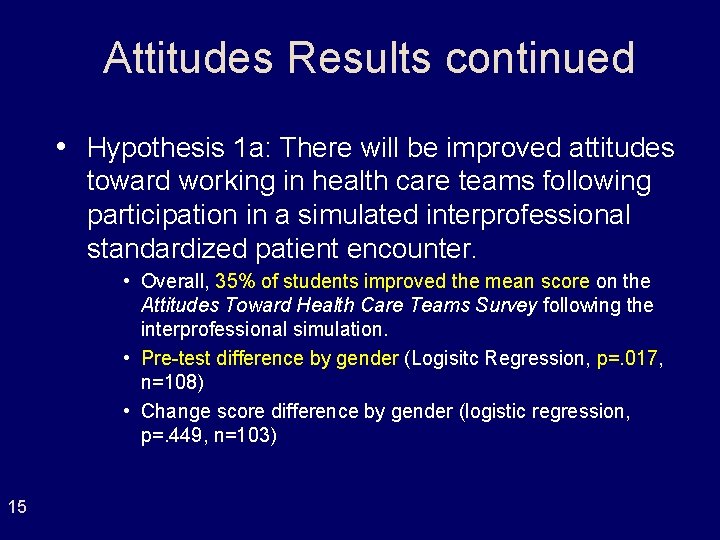
Attitudes Results continued • Hypothesis 1 a: There will be improved attitudes toward working in health care teams following participation in a simulated interprofessional standardized patient encounter. • Overall, 35% of students improved the mean score on the Attitudes Toward Health Care Teams Survey following the interprofessional simulation. • Pre-test difference by gender (Logisitc Regression, p=. 017, n=108) • Change score difference by gender (logistic regression, p=. 449, n=103) 15
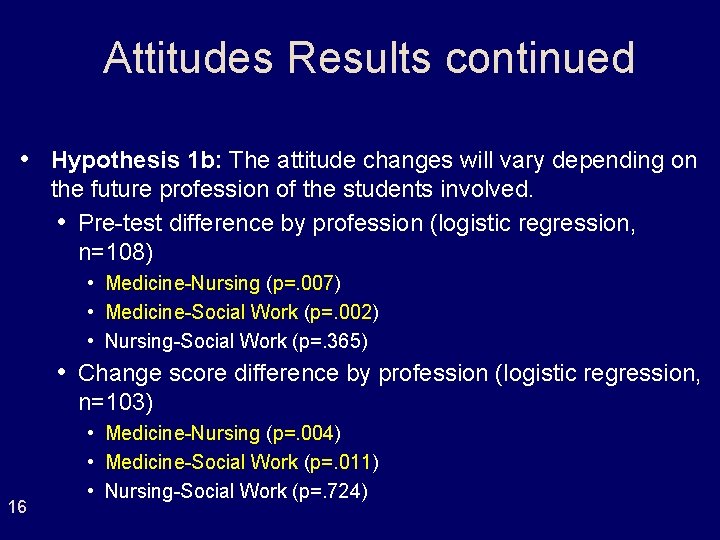
Attitudes Results continued • Hypothesis 1 b: The attitude changes will vary depending on the future profession of the students involved. • Pre-test difference by profession (logistic regression, n=108) • Medicine-Nursing (p=. 007) • Medicine-Social Work (p=. 002) • Nursing-Social Work (p=. 365) • Change score difference by profession (logistic regression, n=103) 16 • Medicine-Nursing (p=. 004) • Medicine-Social Work (p=. 011) • Nursing-Social Work (p=. 724)
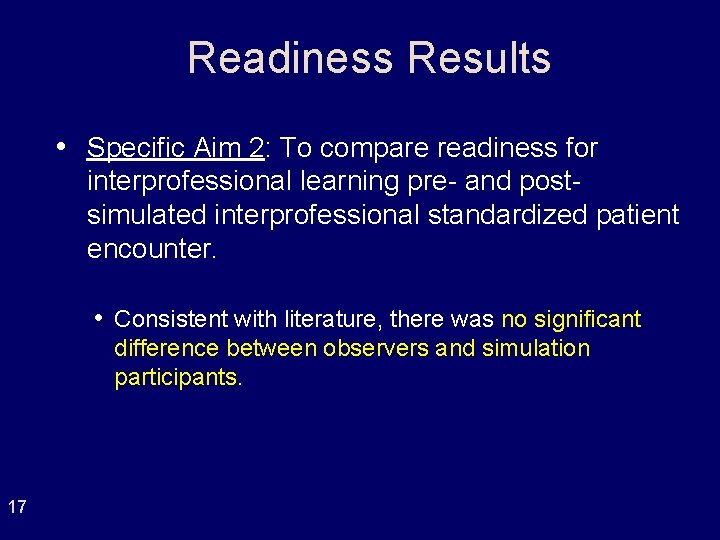
Readiness Results • Specific Aim 2: To compare readiness for interprofessional learning pre- and postsimulated interprofessional standardized patient encounter. • Consistent with literature, there was no significant difference between observers and simulation participants. 17
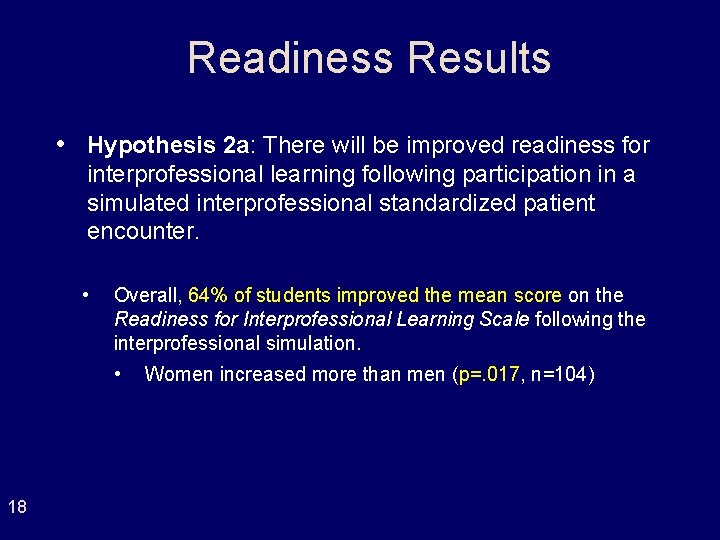
Readiness Results • Hypothesis 2 a: There will be improved readiness for interprofessional learning following participation in a simulated interprofessional standardized patient encounter. • Overall, 64% of students improved the mean score on the Readiness for Interprofessional Learning Scale following the interprofessional simulation. • 18 Women increased more than men (p=. 017, n=104)
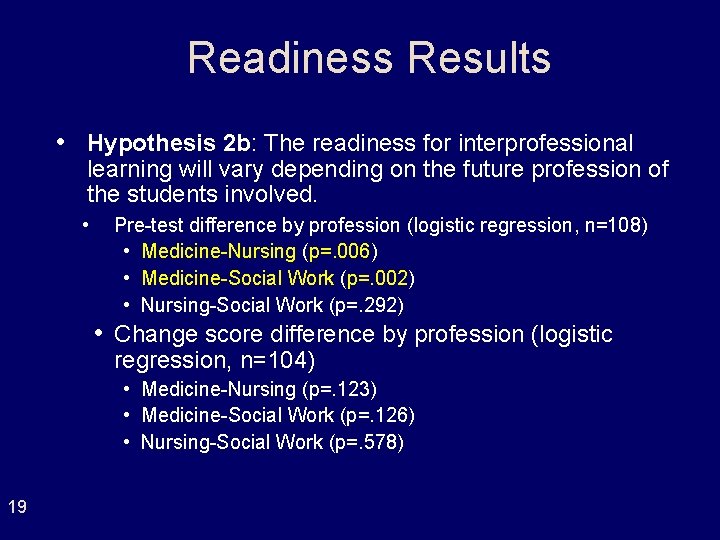
Readiness Results • Hypothesis 2 b: The readiness for interprofessional learning will vary depending on the future profession of the students involved. • Pre-test difference by profession (logistic regression, n=108) • Medicine-Nursing (p=. 006) • Medicine-Social Work (p=. 002) • Nursing-Social Work (p=. 292) • Change score difference by profession (logistic regression, n=104) • Medicine-Nursing (p=. 123) • Medicine-Social Work (p=. 126) • Nursing-Social Work (p=. 578) 19
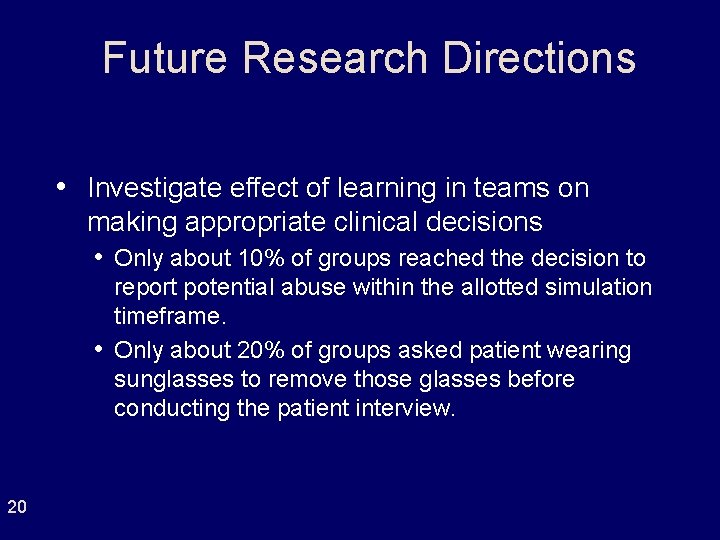
Future Research Directions • Investigate effect of learning in teams on making appropriate clinical decisions • Only about 10% of groups reached the decision to report potential abuse within the allotted simulation timeframe. • Only about 20% of groups asked patient wearing sunglasses to remove those glasses before conducting the patient interview. 20
Questions?
References • Baker, C. , Pulling, R. , Mc. Graw, R, Dagone, J, Hopkins-Rosel, D. (2008). Simulation in interprofesional education for patient centered collaborative care. Journal of Advanced Nursing 64(4) 372 -379. • Hall, P. (2005). Interprofessional Teamwork: Professional cultures as barriers. Journal of Interprofessional Care, (May), 188 -196. • Heinemann, G. , Schmitt, H. , Farrell, M. & Brallier, S. (1999). Development of an Attitudes Toward Health Care Teams Scale. Evaluation and the Health Professions, March 22(1), 123 -142. • Lidskog, M. , Lofmark, A. & Ahlstrom, G. (2008). Learning 22 About Each Other: Students’ conceptions before and after interprofessional education on a training ward. Journal of