
Improving Human Anatomy and Physiology Grades with Electronic


- Slides: 3
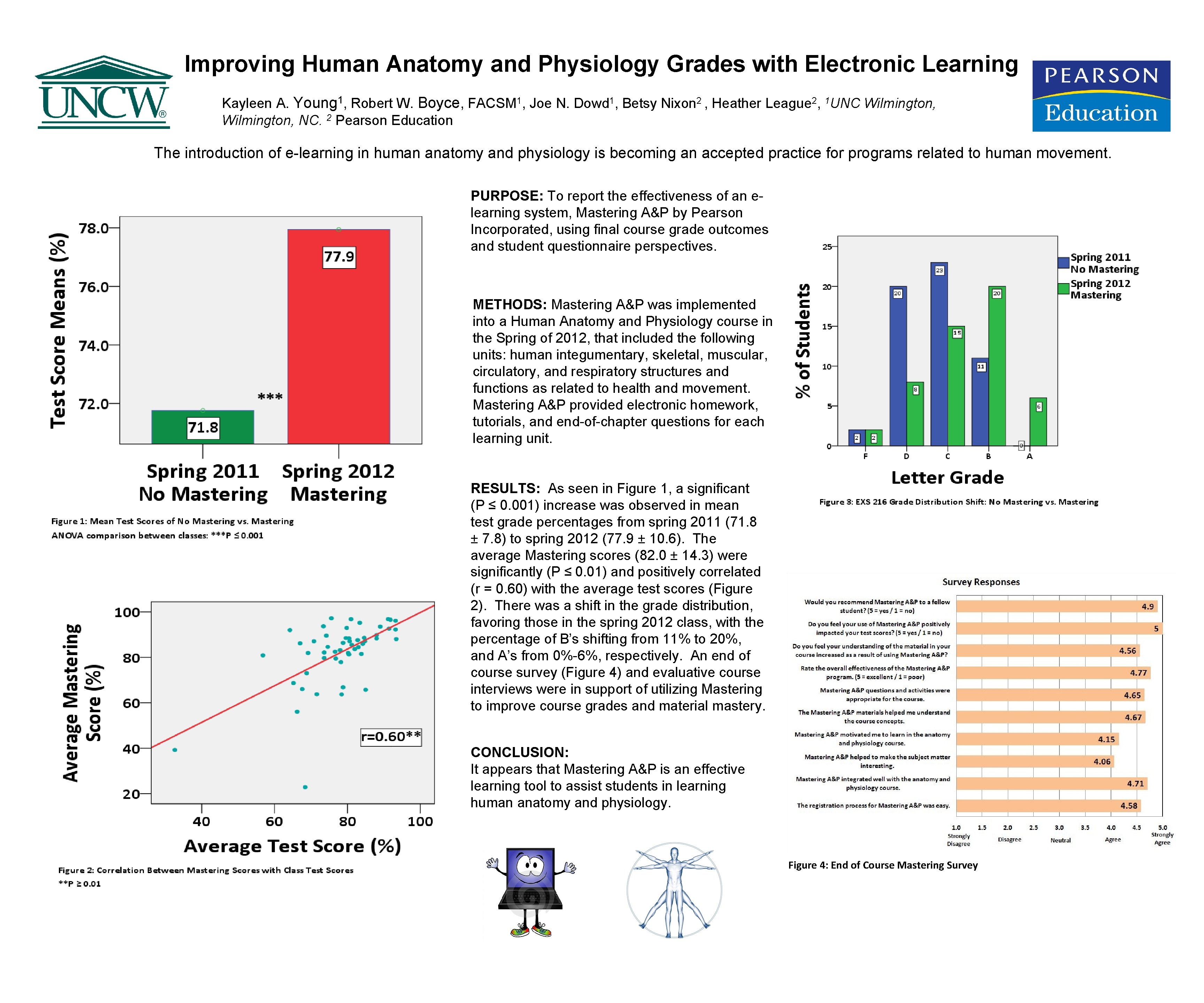
Improving Human Anatomy and Physiology Grades with Electronic Learning Kayleen A. Young 1, Robert W. Boyce, FACSM 1, Joe N. Dowd 1, Betsy Nixon 2 , Heather League 2, 1 UNC Wilmington, NC. 2 Pearson Education The introduction of e-learning in human anatomy and physiology is becoming an accepted practice for programs related to human movement. PURPOSE: To report the effectiveness of an elearning system, Mastering A&P by Pearson Incorporated, using final course grade outcomes and student questionnaire perspectives. METHODS: Mastering A&P was implemented into a Human Anatomy and Physiology course in the Spring of 2012, that included the following units: human integumentary, skeletal, muscular, circulatory, and respiratory structures and functions as related to health and movement. Mastering A&P provided electronic homework, tutorials, and end-of-chapter questions for each learning unit. RESULTS: As seen in Figure 1, a significant (P ≤ 0. 001) increase was observed in mean test grade percentages from spring 2011 (71. 8 ± 7. 8) to spring 2012 (77. 9 ± 10. 6). The average Mastering scores (82. 0 ± 14. 3) were significantly (P ≤ 0. 01) and positively correlated (r = 0. 60) with the average test scores (Figure 2). There was a shift in the grade distribution, favoring those in the spring 2012 class, with the percentage of B’s shifting from 11% to 20%, and A’s from 0%-6%, respectively. An end of course survey (Figure 4) and evaluative course interviews were in support of utilizing Mastering to improve course grades and material mastery. CONCLUSION: It appears that Mastering A&P is an effective learning tool to assist students in learning human anatomy and physiology. Figure 4: End of Course Mastering Survey