
Improving health by boosting active mobility Sandra Wegener
Improving health by boosting active mobility Sandra Wegener (BOKU), Ilonka Horvath (GÖG), Esther Anaya (ICL), Mark Nieuwenhuijsen (CREAL), Luc Int Panis (VITO), Thomas Götschi (UZH), Tina Uhlmann (BOKU) on behalf of the PASTA* consortium WALK 21 VIENNA 2015, STEPPING AHEAD XVI International Conference on Walking and Liveable Communities 20 – 23 October 2015 *This project has received funding from the European Union’s Seventh Programme for Research, Technological Development and Demonstration under Grant Agreement No. 602604 -2. The sole responsibility for the content of this webpage lies with the authors. It does not necessarily reflect the opinion of the European Union. The European Commission is not responsible for any use that may be made of the information contained therein.
Walking and Cycling for Health … Health: • Physical inactivity is the fourth leading risk factor for death worldwide • Only 1/3 of the European population is estimated to meet the minimum recommended (by the WHO) levels of physical activity Transport: • • On average we spend 80 minutes per day in transit Approx. 50% of all trips are shorter than 5 km ► High potential for active mobility (walking, cycling, PT) www. pastaproject. eu |2
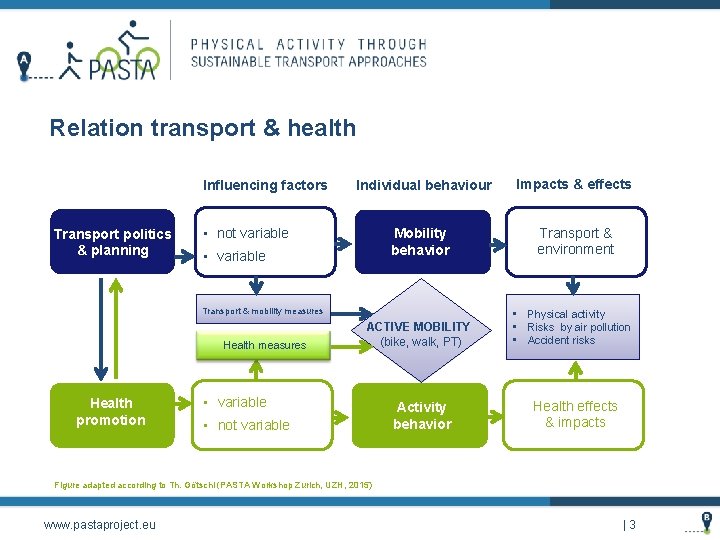
Relation transport & health Influencing factors Transport politics & planning Individual behaviour Impacts & effects Mobility behavior Transport & environment ACTIVE MOBILITY (bike, walk, PT) • Physical activity • Risks by air pollution • Accident risks Activity behavior Health effects & impacts • not variable • variable Transport & mobility measures Health promotion • variable • not variable Figure adapted according to Th. Götschi (PASTA Workshop Zurich, UZH, 2015) www. pastaproject. eu |3
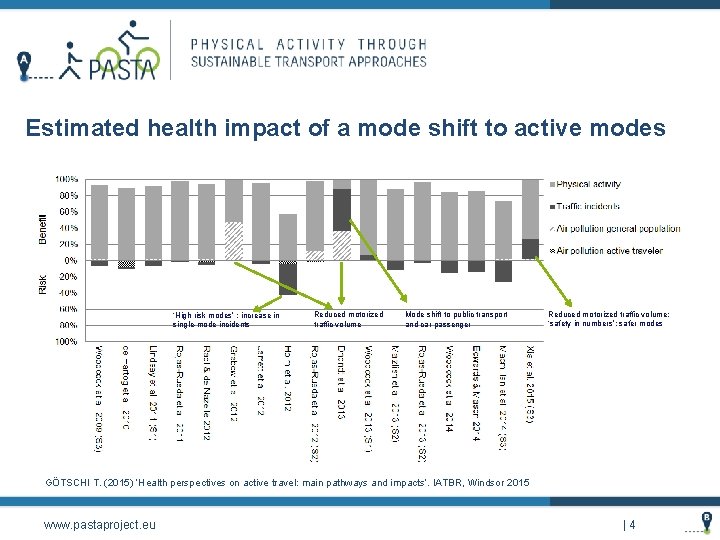
Estimated health impact of a mode shift to active modes ‘High risk modes’ ; increase in single-mode incidents Reduced motorized traffic volume Mode shift to public transport and car passenger Reduced motorized traffic volume; ‘safety in numbers’; safer modes GÖTSCHI T. (2015) ‘Health perspectives on active travel: main pathways and impacts’. IATBR, Windsor 2015 www. pastaproject. eu |4
PASTA project (www. pastaproject. eu) … focus is on systematic promotion of active mobility (AM) as an innovative approach to integrate physical activity into individuals’ everyday lives. Overall objectives: • • to promote, assess and analyse active mobility; to reduce sedentary behavior; to integrate physical activity as part of our daily routine; to link health and transport. www. pastaproject. eu |5
PASTA approach: Transport & health research 7 Case Study Cities Workshops & Interviews Key stakeholders from cities: transport & health Policies, strategies, challenges, barriers, factors of success www. pastaproject. eu Longitudinal survey Good practice examples & General public (2, 000 each city) Improved HEAT Mobility diary, physical activity, accidents, air pollution. Outcome for the cities (politicians, planners, stakeholders) |6
PASTA longitudinal study … … investigating how active mobility contributes to physical activity. … web-based survey (beginning of 2015 – autumn 2016) … in seven European cities (2, 000 participants per city) investigating: a. the key determinants of active mobility behavior b. how active mobility relates to physical activity c. effectiveness of measures to promote active mobility https: //survey. pastaproject. eu/ www. pastaproject. eu |7
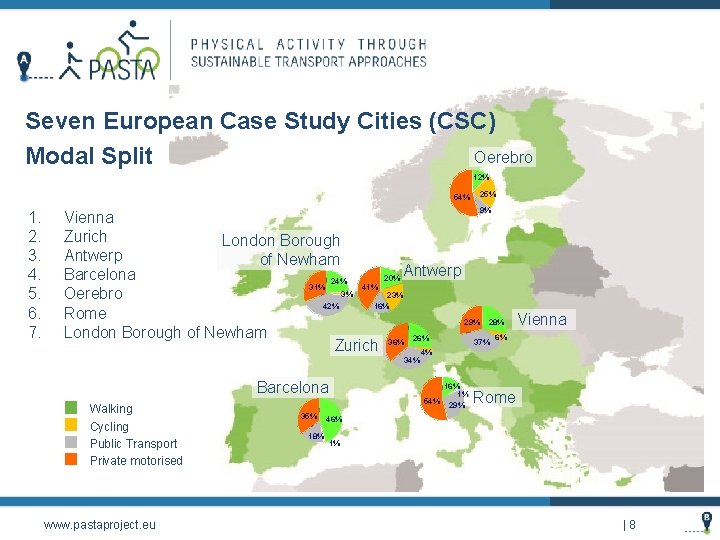
Seven European Case Study Cities (CSC) Oerebro Modal Split 12% 54% 1. 2. 3. 4. 5. 6. 7. 25% 9% Vienna Zurich London Borough Antwerp of Newham Antwerp Barcelona 20% 24% 31% 41% 3% 23% Oerebro 42% 16% Rome 29% 28% Vienna London Borough of Newham 6% 26% 37% Zurich 36% 4% 34% Barcelona Walking Cycling Public Transport Private motorised www. pastaproject. eu 35% 18% 54% 16% 1% 29% Rome 46% 1% |8
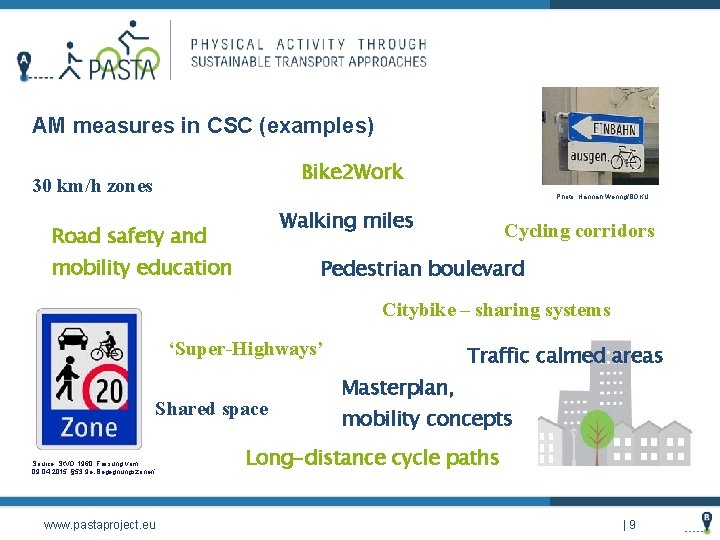
AM measures in CSC (examples) Bike 2 Work 30 km/h zones Photo: Hannah Wenng/BOKU Walking miles Road safety and mobility education Cycling corridors Pedestrian boulevard Citybike – sharing systems ‘Super-Highways’ Shared space Source: St. VO 1960, Fassung vom 09. 04. 2015; § 53 9 e ‚Begegnungszonen‘ www. pastaproject. eu Traffic calmed areas Masterplan, mobility concepts Long-distance cycle paths |9
Urban development plan 2025 Vienna Technical Mobility Concept Targets 2025 • 80% Active travel (PT, walking, cycling) 20% Car traffic „The Viennese should have the opportunity to preferably walk, cycle or go by PT, in order to reach the target that in 2025 80% of all trips are covered by sustainable modes. “ • 30 min active mobile everyday for a healthier lifestyle „The Viennese should use their daily trips to get healthier. In 2025 one third of all city residents should travel at least 30 min by bike or on foot – and what is more: safely with decreasing number of accidents. “ • 20% less energy for transportation „The Viennese should consume a minimum of energy for travelling. That means that in 2025 20% less energy will be spent for transport. “ http: //www. wien. gv. at/stadtentwicklung/strategien/step 2025/fachkonzepte/mobilitaet/ www. pastaproject. eu | 10
Health targets (Austrian Ministry for Health, 2012) Target 8: Promoting healthy and safe physical activity in daily life by building a livable environment National action plan for physical activity (Ministry for National Defence and Sports, Austrian Ministry for Health, 2013) Target 13: To raise the share of active mobility among the citizens • … raise the share of cyclists to 10% of all daily trips till 2025; • … raise the share of pedestrians significantly; • … provide attractive infrastructure for walking and cycling; • … polish up the image of active mobility. www. pastaproject. eu | 11
HEAT – Health economic assessment tool for walking and cycling* If x people cycle a distance of y kilometres on most days, what is the economic value of the health benefits that occur as a result of the reduction in mortality due to their physical activity? www. heatwalkingcycling. org * Cavill N. , Kahlmeier S. , Rutter H. , Racioppi F. , Oja P. (2008). Methodological Guideance on the economic appraisal of health effects related to walking and cycling: Summary. Economic assessment of transport infrastructure and policies. WHO www. pastaproject. eu | 12
Challenges in cities • Walking and cycling policies versus policies favoring car traffic • Transport planning – more public space for pedestrians and cyclists • Culture of walking and cycling – public awareness and communication • ‘Health in transport policies’ … to link transport and health on the policy level www. pastaproject. eu | 13
Information and contact: Website: www. pastaproject. eu Twitter: @EUPASTA Newsletter: sign up by visiting our website E-mail: info@pastaproject. eu www. pastaproject. eu | 14
Sandra Wegener Dipl. -Ing. Dr. Institute for Transport Studies University of Natural Resources and Life Sciences, Vienna (BOKU) A-1190 Vienna, Peter-Jordan-Straße 82 Tel. +43 -1 / 47654 -5305 Fax +43 -1 / 47654 -5344 teampasta@boku. ac. at
- Slides: 15