
IMPROVING EFFICIENCY IN PUBLIC PROCUREMENT KENYA H K
IMPROVING EFFICIENCY IN PUBLIC PROCUREMENT - KENYA H. K. Kirungu Manager, Policy & Research Public Procurement Oversight Authority, Kenya
OUTLINE Areas of Inefficiency Over-pricing RFQ Transactions Procurement Capacity Procurement Appeals Pre-qualification Adverts Common-User Items Self-Monitoring Culture

OUTLINE Areas of Inefficiency Procurement Planning Over-Pricing Transaction Frequency Procurement Capacity E-Procurement Framework Common User Items Self-Monitoring Culture Administrative & Judicial Reviews Conclusion
q Lack Procurement planning q Over-Pricing of Common User Items q Over-use of the RFQ Method q Inadequate Procurement Capacity q Manual Procurement System q Decentralized Procurement of Common User Items q Lack of Self-Monitoring Culture q Frivolous appeals q Long judicial review process 4
q q It is commonly known that “failure to plan is planning to fail” Though procurement planning is legal requirement, lack of it is still a major cause of inefficiencies It has lead to: § End-of year artificial emergency procurements § Failure to absorb allocated funds § Application of inappropriate procurement methods § Circumvention of legal & regulatory procedures PPOA is forestalling this challenge by: § Issuance of mandatory procurement planning Circular § Enhanced surveillance through procurement assessments and reviews.
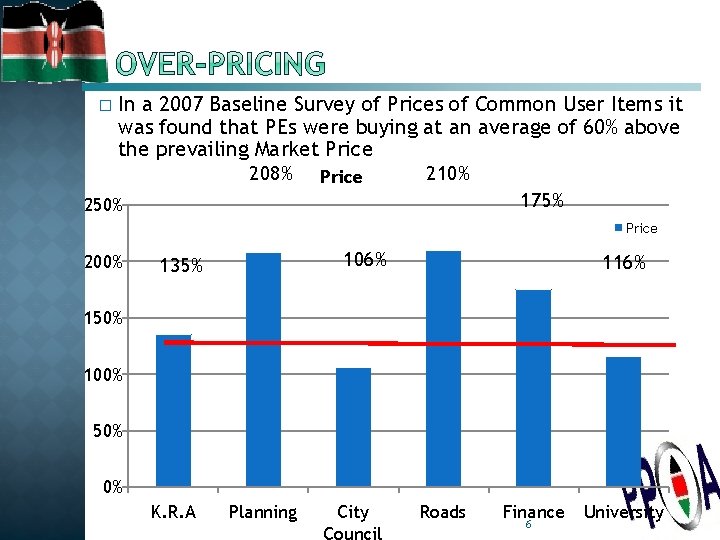
In a 2007 Baseline Survey of Prices of Common User Items it was found that PEs were buying at an average of 60% above the prevailing Market Price 208% Price 210% 175% 250% � Price 200% 106% 135% 116% 150% 100% 50% 0% K. R. A Planning City Roads Finance 6 University
q PPOA developed a Price Reference Guide that is updated from time to Time q In the subsequent Impact Assessment of application of Price Reference Guide prices reduced to an average of 20% above the market price q The Guide is used as a benchmark for investigations by: § § § KACC/E&ACC KENAO Parliament 7
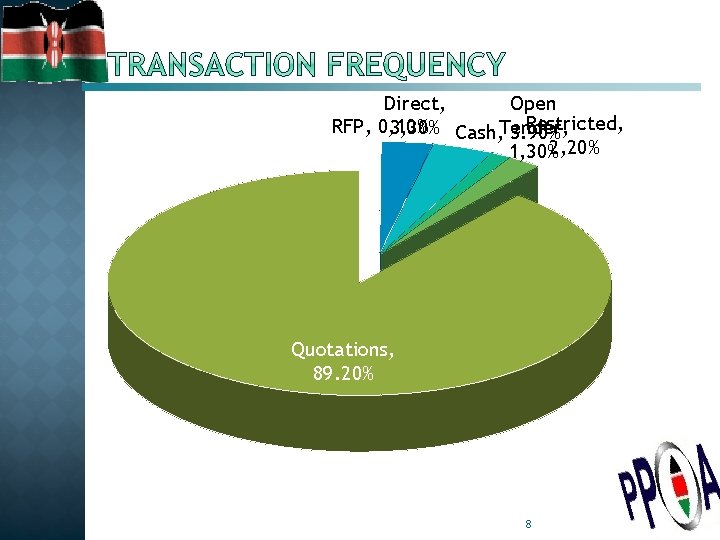
Direct, Open Restricted, RFP, 0, 10% 3, 30% Cash, Tender, 3. 90% 2, 20% 1, 30% Quotations, 89. 20% 8
� Over-reliance of the RFQ Method depicted inefficient use of procurement unit’s time � PPOA issued Framework Contract Guidelines � Allows PEs to arrange indefinite quantity and delivery contracts 9
q Capacity in Public Procurement for all stakeholders must be developed such as: q. Policy makers q. Regulators q. Procuring entities q. Suppliers/Providers q Since 2007 PPOA has conducted several capacity building initiatives: qdeveloped a capacity building strategy qtrained at least 10, 000 persons/organizations qsponsored PG-degrees courses for professionals qsetting up of a professional body 10
� Manual systems are a source of major inefficiencies in regulation and operations of the function. � PPOA has/is addressing this situation by: � Developed � Dedicated an e-procurement Strategy tenders portal for e-adverts and publication of contract awards � Developed Statement of Work for e-procurement software � Attempted procurement of e-procurement software but contract curtailed by an on-going court process � As an alternative identified the “Procure To Pay” module in the IFMIS Re-engineering framework of the Mo. F � EOI for procurement of “Procure to Pay” software is underway � The re-engineering process targets elimination of all redundant steps in the function.
� Inefficiencies in procurement of common user items was inexperienced in � The noted inefficiencies were duplication of newspaper advertisement costs. � PPOA targets centralization of tender adverts by clustering them in the following sectors: �Health �Districts �Local Authorities �Education � Modernization of the Government shop
PPOA introduced the IPPMT Tool with 4 main Objectives: q To To § § q q inculcate self-monitoring culture in PEs improve performance of procurement units. structure PPOA’s M&E requirements. improve compliance with the Procurement Law The tool uses 21 selected indicators within the procurement cycle Indicators to be monitored among others, include: § § § Procurement planning Bidding process Evaluation process Awarding process Contract management
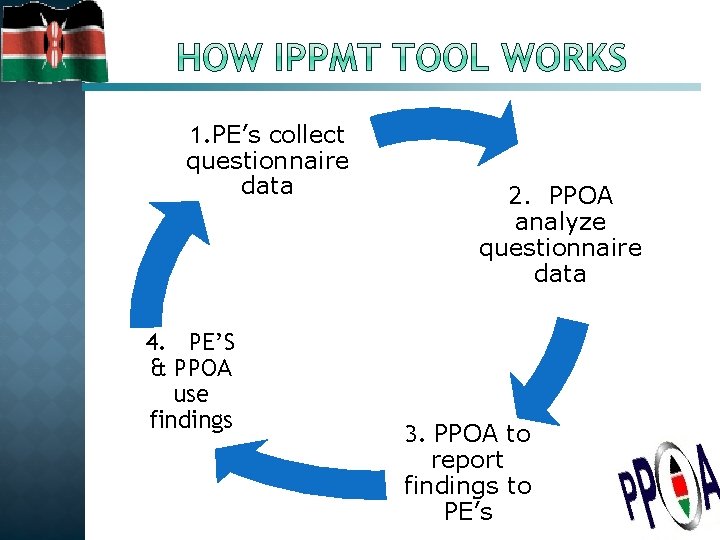
1. PE’s collect questionnaire data 4. PE’S & PPOA use findings 2. PPOA analyze questionnaire data 3. PPOA to report findings to PE’s
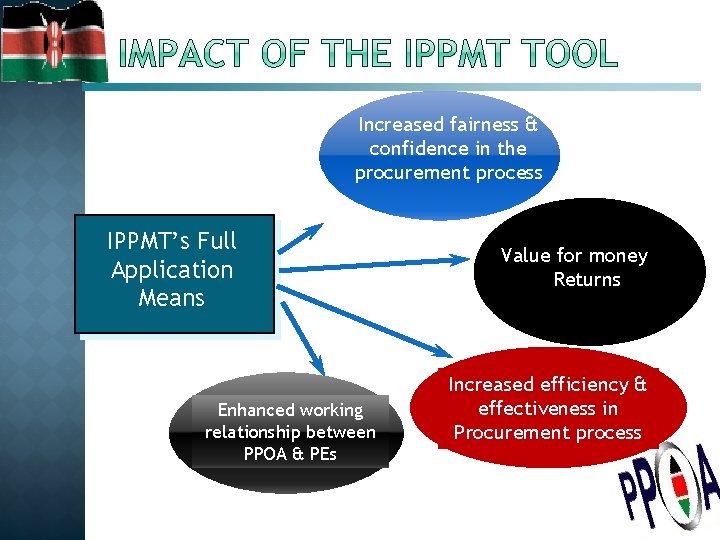
Increased fairness & confidence in the procurement process IPPMT’s Full Application Means Enhanced working relationship between PPOA & PEs Value for money Returns Increased efficiency & effectiveness in Procurement process
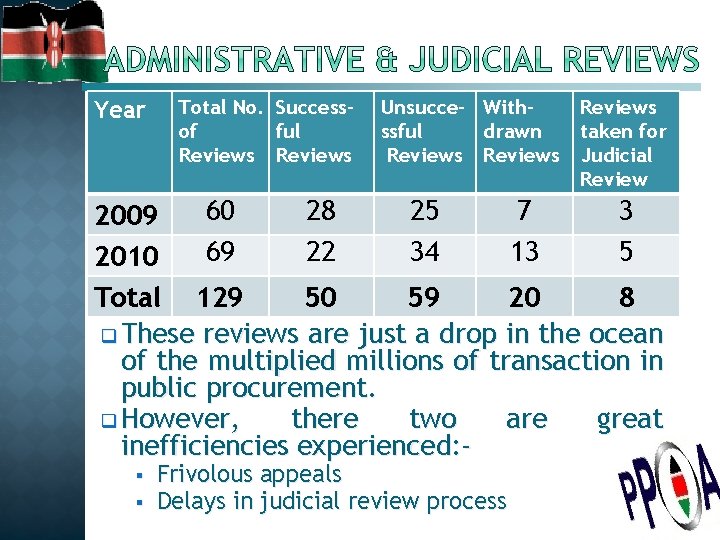
Year Total No. Successof ful Reviews Unsucce- Withssful drawn Reviews taken for Judicial Review 60 28 25 7 3 2009 69 22 34 13 5 2010 Total 129 50 59 20 8 q These reviews are just a drop in the ocean of the multiplied millions of transaction in public procurement. q However, there two are great inefficiencies experienced: § § Frivolous appeals Delays in judicial review process
� Commissioned a study on dealing with frivolous appeals in 2011. � Study proposed amendments to the Law to forestall challenge including short term measures � Held discussion with judges in their 2010 Annual Colloquium to acquire understanding of perishable nature of procurement transactions & proposed: �Expedition of cases �Creation of special procurement courts
q Kenya is committed to improving efficiency in the public procurement system at every opportunity for the purpose of enhancing: § § § Accountability in decision-making structures. Responsiveness to citizens of the country. Professionalism to improve performance. Transparency in the procedures and policies. Appeal rights to redress meritorious grievances of suppliers. 18

Asante Sana Webale Nnyo Murakoze ! 19
- Slides: 19