
Improving DRAM Performance by Parallelizing Refreshes with Accesses
Improving DRAM Performance by Parallelizing Refreshes with Accesses Kevin Chang Donghyuk Lee, Zeshan Chishti, Alaa Alameldeen, Chris Wilkerson, Yoongu Kim, Onur Mutlu
Executive Summary • DRAM refresh interferes with memory accesses – Degrades system performance and energy efficiency – Becomes exacerbated as DRAM density increases • Goal: Serve memory accesses in parallel with refreshes to reduce refresh interference on demand requests • Our mechanisms: – 1. Enable more parallelization between refreshes and accesses across different banks with new per-bank refresh scheduling algorithms – 2. Enable serving accesses concurrently with refreshes in the same bank by exploiting DRAM subarrays • Improve system performance and energy efficiency for a wide variety of different workloads and DRAM densities – 20. 2% and 9. 0% for 8 -core systems using 32 Gb DRAM – Very close to the ideal scheme without refreshes 2

Outline • • Motivation and Key Ideas DRAM and Refresh Background Our Mechanisms Results 3
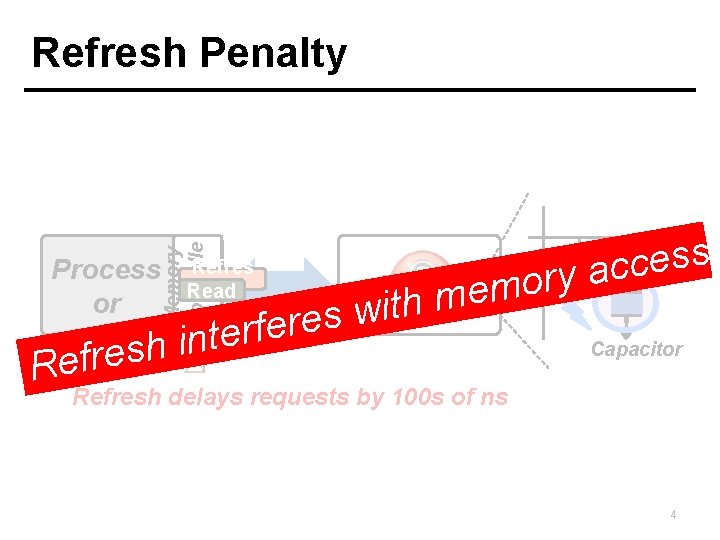
Refresh Penalty Memory Controlle r e s s e c Process c a y DRAM emor m or Data h t i w s e r e f r e t n i Capacitor h s Refres Read h Access transistor Refresh delays requests by 100 s of ns 4

Existing Refresh Modes All-bank refresh in commodity DRAM (DDRx) Time Bank 7 … Refresh Bank 1 Bank 0 Per-bank refresh allows accesses to Per-bank refresh in mobile DRAM (LPDDRx) other banks while a bank is refreshing Round-robin order Time Bank 7 … Bank 1 Bank 0 5 …
Shortcomings of Per-Bank Refresh • Problem 1: Refreshes to different banks are scheduled in a strict round-robin order – The static ordering is hardwired into DRAM chips – Refreshes busy banks with many queued requests when other banks are idle • Key idea: Schedule per-bank refreshes to idle banks opportunistically in a dynamic order 6

Shortcomings of Per-Bank Refresh • Problem 2: Banks that are being refreshed cannot concurrently serve memory requests Delayed by refresh Per-Bank Refresh R D Time Bank 0 7
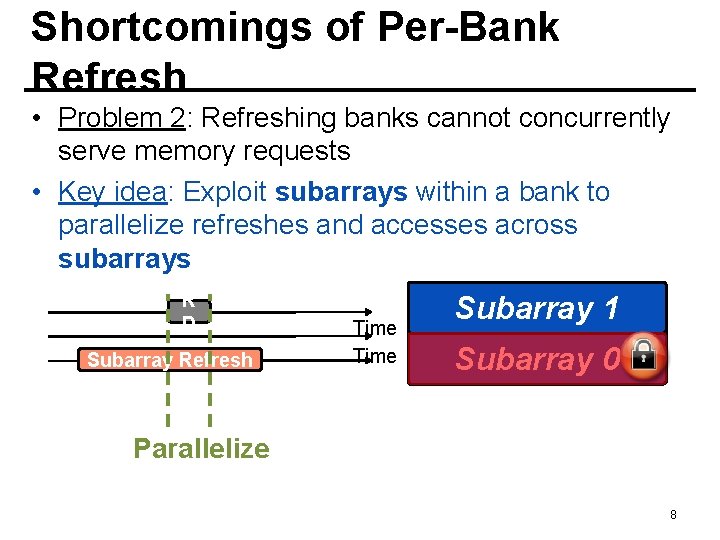
Shortcomings of Per-Bank Refresh • Problem 2: Refreshing banks cannot concurrently serve memory requests • Key idea: Exploit subarrays within a bank to parallelize refreshes and accesses across subarrays R D Subarray Refresh Time Subarray 1 Bank 0 Subarray 0 Parallelize 8
Outline • • Motivation and Key Ideas DRAM and Refresh Background Our Mechanisms Results 9
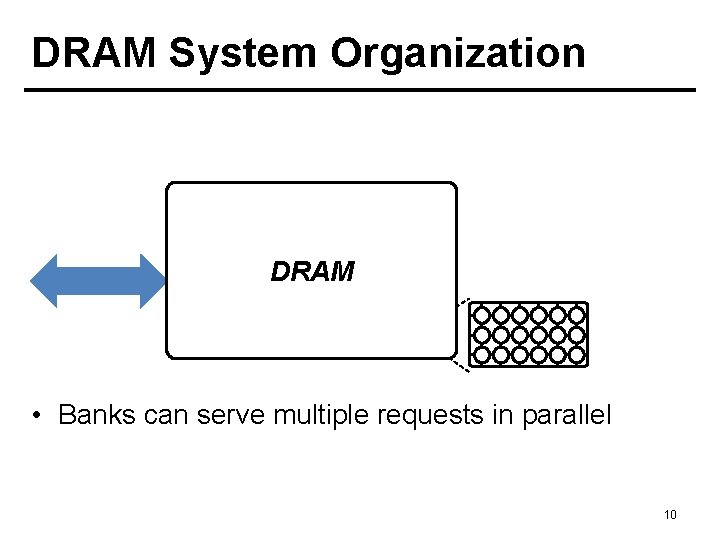
DRAM System Organization … Rank 1 Rank Bank 07 Rank 1 DRAM Bank 1 Bank 0 • Banks can serve multiple requests in parallel 10

DRAM Refresh Frequency • DRAM standard requires memory controllers to send periodic refreshes to DRAM t. Ref. Latency (t. RFC): Varies based on DRAM chip density (e. g. , 350 ns Read/Write: roughly 50 ns Timeline t. Ref. Period (t. REFI): Remains constant 11
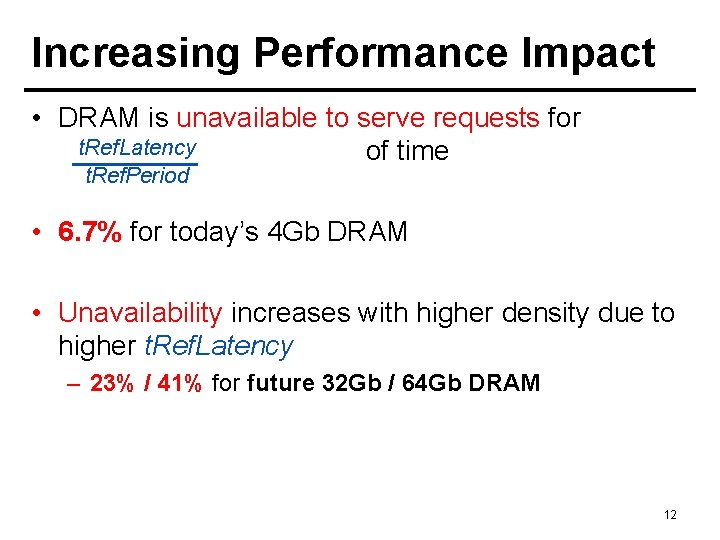
Increasing Performance Impact • DRAM is unavailable to serve requests for t. Ref. Latency of time t. Ref. Period • 6. 7% for today’s 4 Gb DRAM • Unavailability increases with higher density due to higher t. Ref. Latency – 23% / 41% for future 32 Gb / 64 Gb DRAM 12
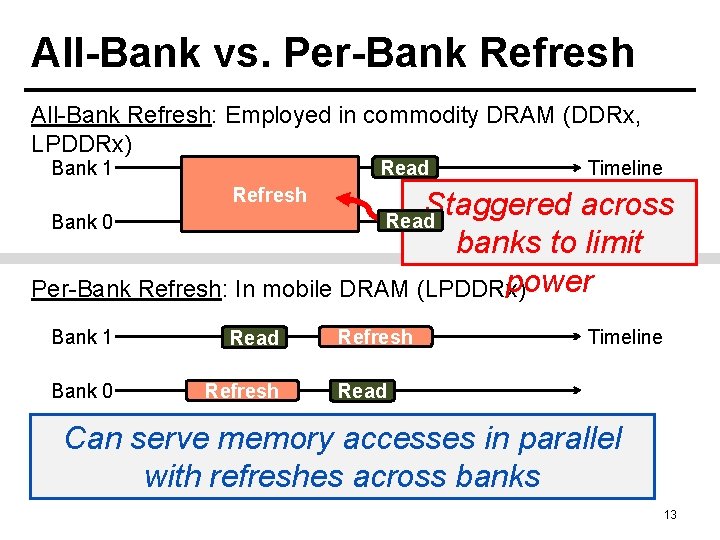
All-Bank vs. Per-Bank Refresh All-Bank Refresh: Employed in commodity DRAM (DDRx, LPDDRx) Bank 1 Refresh Read Timeline Staggered across Bank 0 banks to limit power Per-Bank Refresh: In mobile DRAM (LPDDRx) Bank 1 Read Bank 0 Refresh Read Refresh Timeline Read • Shorter t. Ref. Latency than that of all-bank refresh Can serve memory accesses in parallel • More frequent refreshes (shorter t. Ref. Period) with refreshes across banks 13

Shortcomings of Per-Bank Refresh • 1) Per-bank refreshes are strictly scheduled in round-robin order (as fixed by DRAM’s internal logic) • 2) A refreshing bank cannot serve memory accesses Goal: Enable more parallelization between refreshes and accesses using practical mechanisms 14
Outline • Motivation and Key Ideas • DRAM and Refresh Background • Our Mechanisms – 1. Dynamic Access-Refresh Parallelization (DARP) – 2. Subarray Access-Refresh Parallelization (SARP) • Results 15
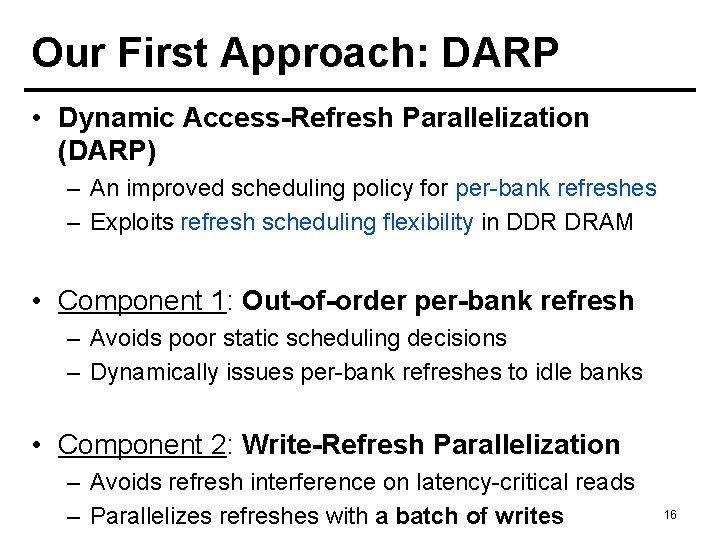
Our First Approach: DARP • Dynamic Access-Refresh Parallelization (DARP) – An improved scheduling policy for per-bank refreshes – Exploits refresh scheduling flexibility in DDR DRAM • Component 1: Out-of-order per-bank refresh – Avoids poor static scheduling decisions – Dynamically issues per-bank refreshes to idle banks • Component 2: Write-Refresh Parallelization – Avoids refresh interference on latency-critical reads – Parallelizes refreshes with a batch of writes 16
1) Out-of-Order Per-Bank Refresh • Dynamic scheduling policy that prioritizes refreshes to idle banks • Memory controllers decide which bank to refresh 17
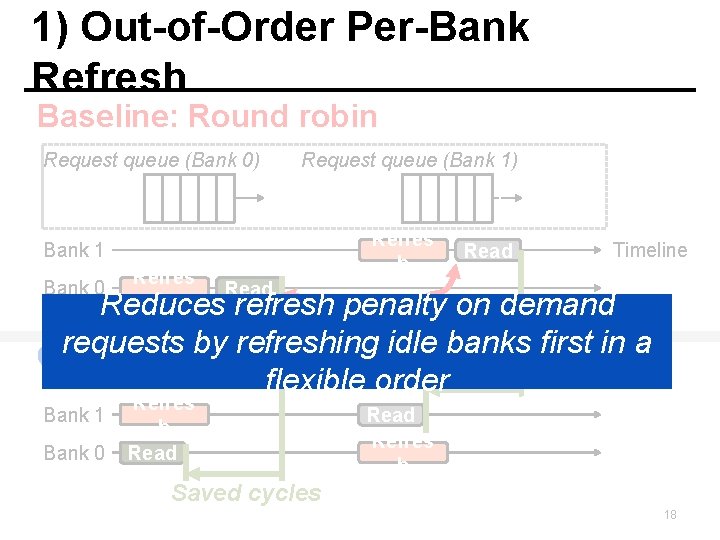
1) Out-of-Order Per-Bank Refresh Baseline: Round robin Refres h Bank 1 Bank 0 Refres h Rea d Request queue (Bank 1) Rea d Request queue (Bank 0) Read Timeline Read Reduces refresh penalty Delayedon by demand refresh requests by refreshing idle banks first in a Our mechanism: DARPSaved cycles flexible order Bank 1 Bank 0 Refres h Read Refres h Saved cycles 18
Outline • Motivation and Key Ideas • DRAM and Refresh Background • Our Mechanisms – 1. Dynamic Access-Refresh Parallelization (DARP) • 1) Out-of-Order Per-Bank Refresh • 2) Write-Refresh Parallelization – 2. Subarray Access-Refresh Parallelization (SARP) • Results 19
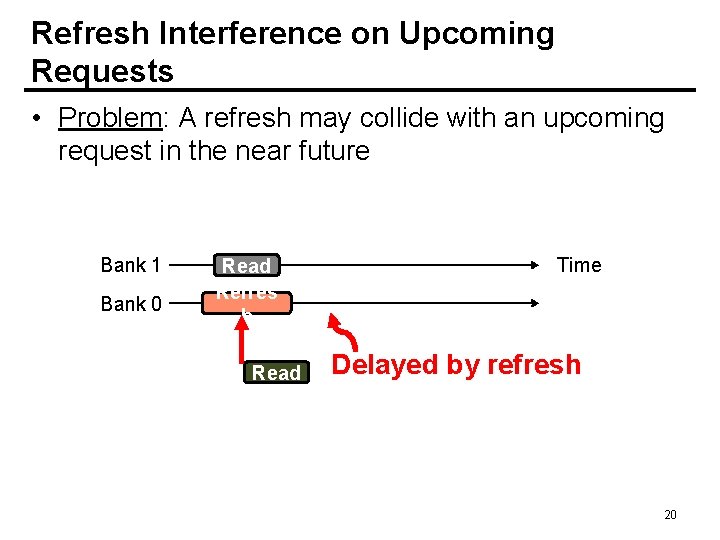
Refresh Interference on Upcoming Requests • Problem: A refresh may collide with an upcoming request in the near future Bank 1 Bank 0 Read Refres h Read Time Delayed by refresh 20
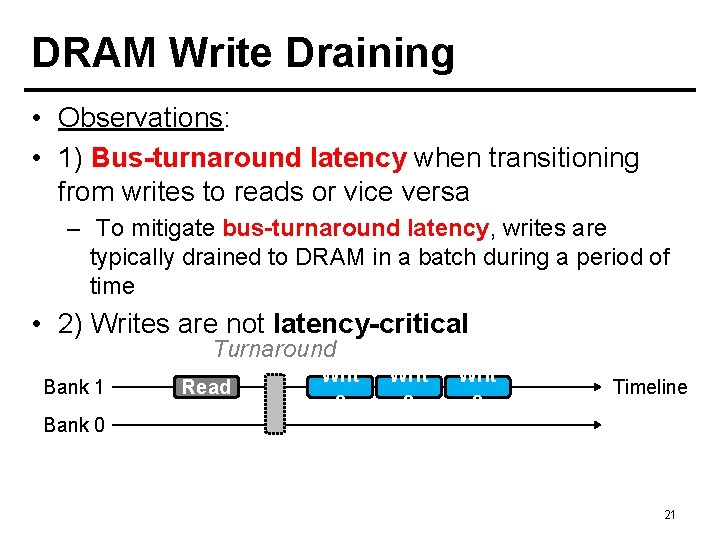
DRAM Write Draining • Observations: • 1) Bus-turnaround latency when transitioning from writes to reads or vice versa – To mitigate bus-turnaround latency, writes are typically drained to DRAM in a batch during a period of time • 2) Writes are not latency-critical Turnaround Bank 1 Read Writ e Timeline Bank 0 21
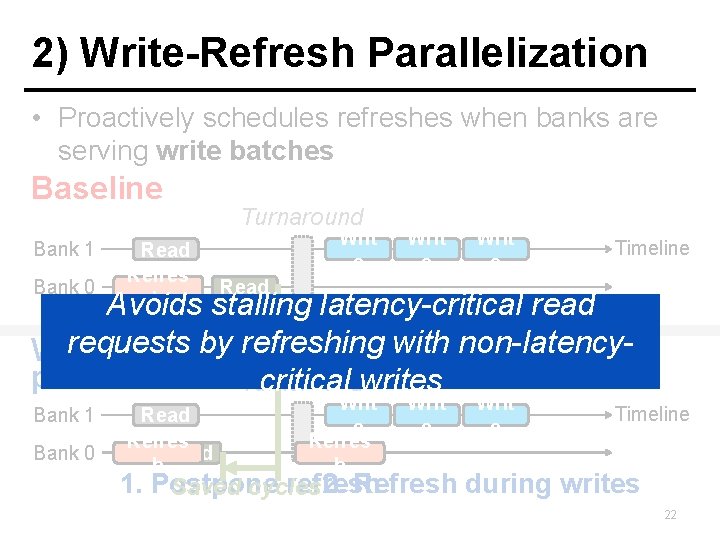
2) Write-Refresh Parallelization • Proactively schedules refreshes when banks are serving write batches Baseline Bank 1 Bank 0 Read Refres h Turnaround Writ e Timeline Read Avoids stalling latency-critical Delayed by refresh read requests by refreshing with non-latency. Write-refresh parallelization. Turnaround critical writes Bank 1 Bank 0 Read Refres Read h Writ e Refres h Writ e Timeline 1. Postpone refresh 2. Refresh during writes Saved cycles 22
Outline • Motivation and Key Ideas • DRAM and Refresh Background • Our Mechanisms – 1. Dynamic Access-Refresh Parallelization (DARP) – 2. Subarray Access-Refresh Parallelization (SARP) • Results 23
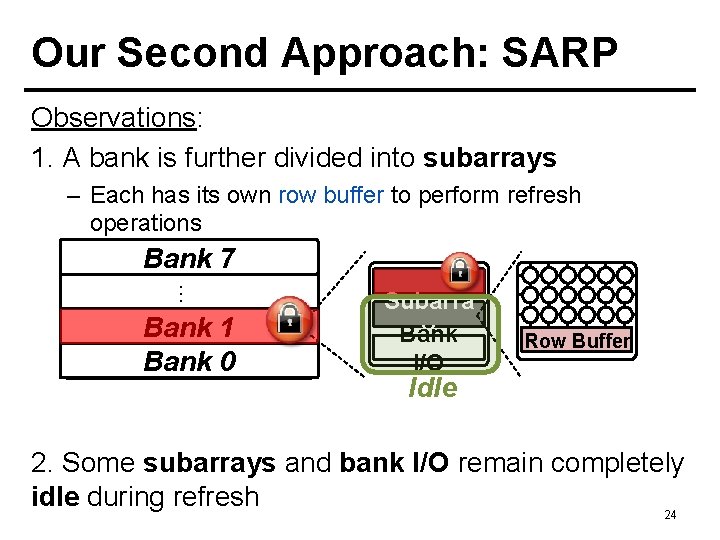
Our Second Approach: SARP Observations: 1. A bank is further divided into subarrays – Each has its own row buffer to perform refresh operations Bank 7 … Bank 1 Bank 0 Subarra y Bank I/O Row Buffer Idle 2. Some subarrays and bank I/O remain completely idle during refresh 24
Our Second Approach: SARP • Subarray Access-Refresh Parallelization (SARP): – Parallelizes refreshes and accesses within a bank 25
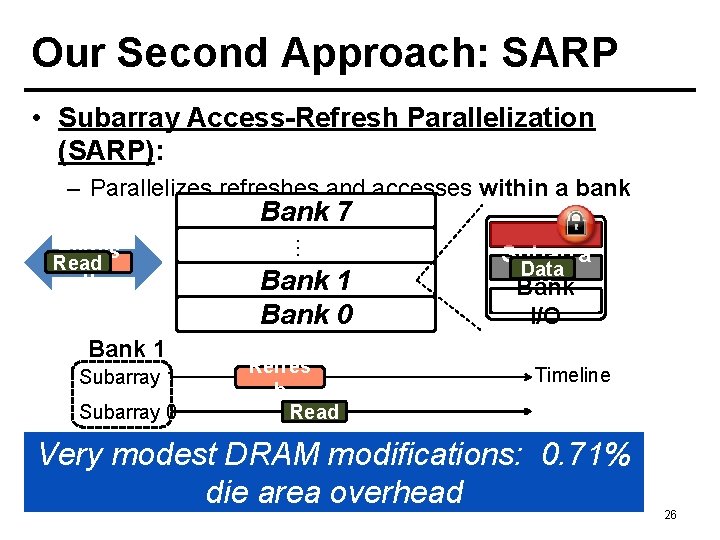
Our Second Approach: SARP • Subarray Access-Refresh Parallelization (SARP): – Parallelizes refreshes and accesses within a bank Bank 7 Bank 1 Subarray 0 … Refres Read h Bank 1 Bank 0 Refres h Read Subarra Data y Bank I/O Timeline Very modest DRAM modifications: 0. 71% die area overhead 26
Outline • • Motivation and Key Ideas DRAM and Refresh Background Our Mechanisms Results 27
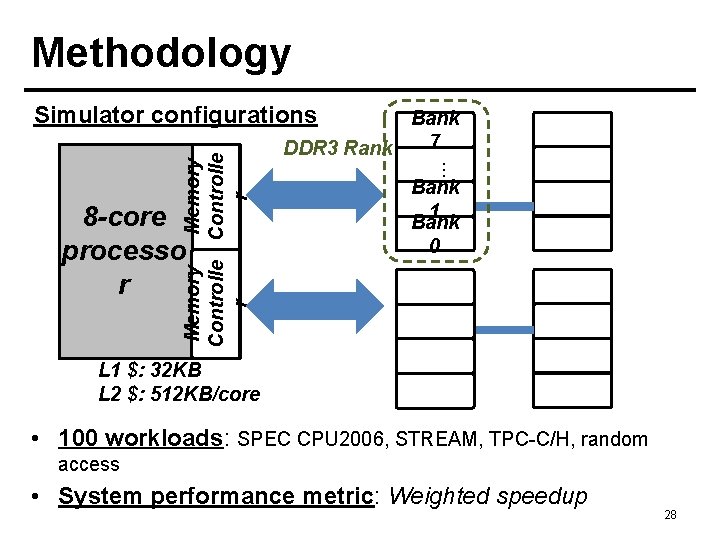
Methodology 8 -core processo r Bank 7 DDR 3 Rank … Memory Controlle r r Simulator configurations Bank 1 Bank 0 L 1 $: 32 KB L 2 $: 512 KB/core • 100 workloads: SPEC CPU 2006, STREAM, TPC-C/H, random access • System performance metric: Weighted speedup 28
![Comparison Points • All-bank refresh [DDR 3, LPDDR 3, …] • Per-bank refresh [LPDDR](http://slidetodoc.com/presentation_image/5e3d0d2d1e4474448cf562a5d73a71cd/image-29.jpg "Comparison Points • All-bank refresh [DDR 3, LPDDR 3, …] • Per-bank refresh [LPDDR")
Comparison Points • All-bank refresh [DDR 3, LPDDR 3, …] • Per-bank refresh [LPDDR 3] • Elastic refresh [Stuecheli et al. , MICRO ‘ 10]: – Postpones refreshes by a time delay based on the predicted rank idle time to avoid interference on memory requests – Proposed to schedule all-bank refreshes without exploiting per-bank refreshes – Cannot parallelize refreshes and accesses within a rank • Ideal (no refresh) 29
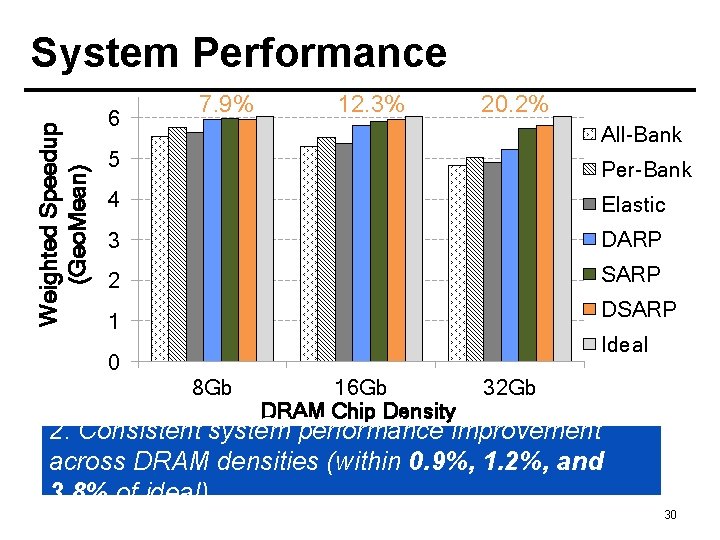
Weighted Speedup (Geo. Mean) System Performance 6 7. 9% 12. 3% 20. 2% All-Bank 5 Per-Bank 4 Elastic 3 DARP 2 SARP DSARP 1 Ideal 0 8 Gb 16 Gb DRAM Chip Density 32 Gb 1. Both DARP & SARP provide performance 2. Consistent system performance improvement acrossand DRAM densitiesthem (within 0. 9%, 1. 2%, and gains combining (DSARP) improves 3. 8% ideal) even of more 30
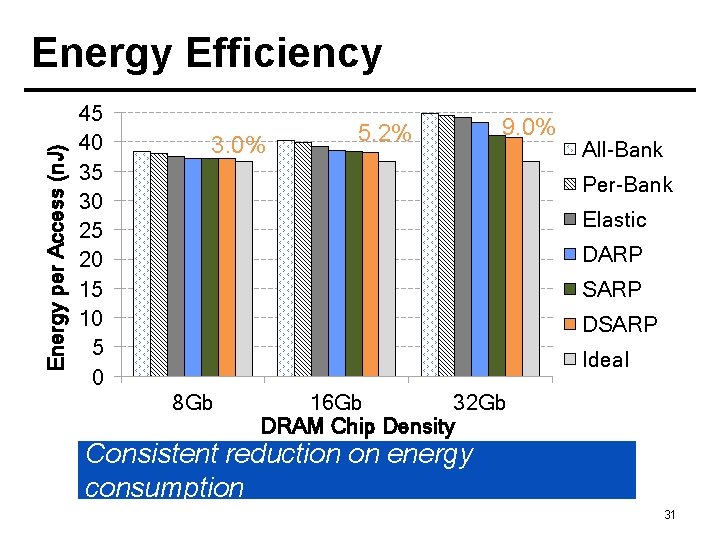
Energy per Access (n. J) Energy Efficiency 45 40 35 30 25 20 15 10 5 0 3. 0% 5. 2% 9. 0% All-Bank Per-Bank Elastic DARP SARP DSARP Ideal 8 Gb 16 Gb 32 Gb DRAM Chip Density Consistent reduction on energy consumption 31
Other Results and Discussion in the Paper • Detailed multi-core results and analysis • Result breakdown based on memory intensity • Sensitivity results on number of cores, subarray counts, refresh interval length, and DRAM parameters • Comparisons to DDR 4 fine granularity refresh 32
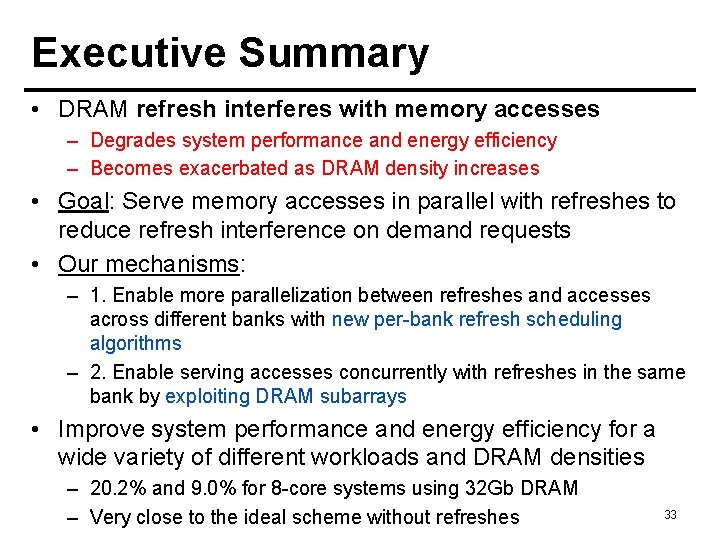
Executive Summary • DRAM refresh interferes with memory accesses – Degrades system performance and energy efficiency – Becomes exacerbated as DRAM density increases • Goal: Serve memory accesses in parallel with refreshes to reduce refresh interference on demand requests • Our mechanisms: – 1. Enable more parallelization between refreshes and accesses across different banks with new per-bank refresh scheduling algorithms – 2. Enable serving accesses concurrently with refreshes in the same bank by exploiting DRAM subarrays • Improve system performance and energy efficiency for a wide variety of different workloads and DRAM densities – 20. 2% and 9. 0% for 8 -core systems using 32 Gb DRAM – Very close to the ideal scheme without refreshes 33
Improving DRAM Performance by Parallelizing Refreshes with Accesses Kevin Chang Donghyuk Lee, Zeshan Chishti, Alaa Alameldeen, Chris Wilkerson, Yoongu Kim, Onur Mutlu
- Slides: 34