
Improving Conceptual Understanding in Intro Stats Patti Frazer
![The Lock 5 Team Kari [Harvard] Penn State Eric [North Carolina] Minnesota Dennis [Iowa](https://slidetodoc.com/presentation_image_h/2c6e641d0155a926c4c139488a802cdb/image-2.jpg "The Lock 5 Team Kari [Harvard] Penn State Eric [North Carolina] Minnesota Dennis [Iowa")

- Slides: 30
Improving Conceptual Understanding in Intro Stats Patti Frazer Lock Kari Lock Morgan Dept of Math, CS, and Stats St. Lawrence University ORMATYC April, 2018 Department of Statistics Penn State University
The Lock 5 Team Kari [Harvard] Penn State Eric [North Carolina] Minnesota Dennis [Iowa State] Miami Dolphins Patti & Robin St. Lawrence
Intro Stats is rapidly increasing in importance. How can we improve this course? • • • Improving student understanding Improving success rates Reducing prerequisites Reducing reliance on algebra and formulas Increasing student interest and retention Increasing faculty enjoyment
How can we do this? Using Simulation Methods to • increase understanding • reduce prerequisites • Increase student success
How can we do this? Keynote Address tomorrow! “The Future of Intro Stats” Addressing broad changes and outcomes Today’s Session: Hands-on workshop on using simulation methods and other materials to improve the Intro Stats course
A Simulation Approach to Hypothesis Tests
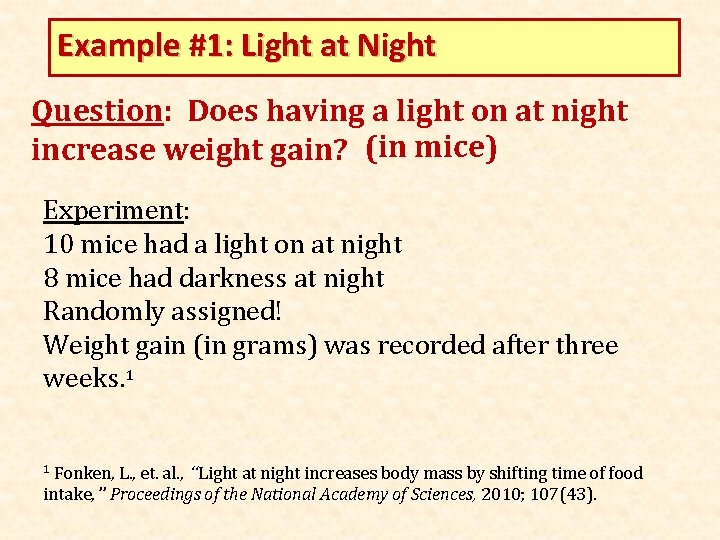
Example #1: Light at Night Question: Does having a light on at night increase weight gain? (in mice) Experiment: 10 mice had a light on at night 8 mice had darkness at night Randomly assigned! Weight gain (in grams) was recorded after three weeks. 1 Fonken, L. , et. al. , “Light at night increases body mass by shifting time of food intake, ” Proceedings of the National Academy of Sciences, 2010; 107(43). 1
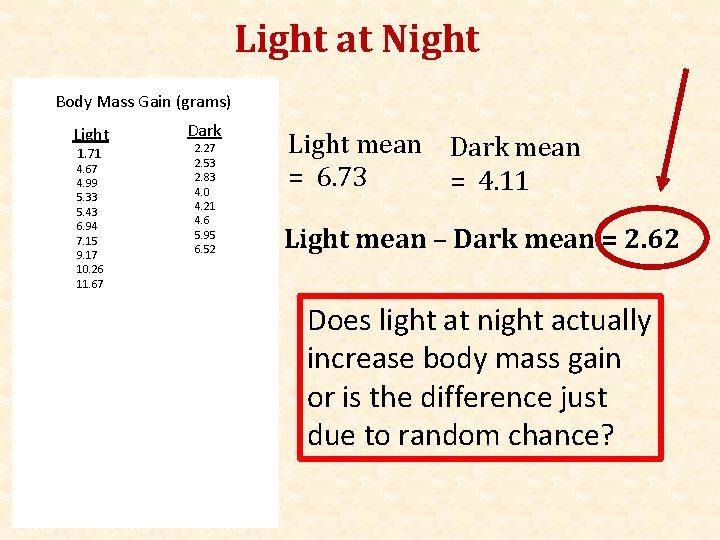
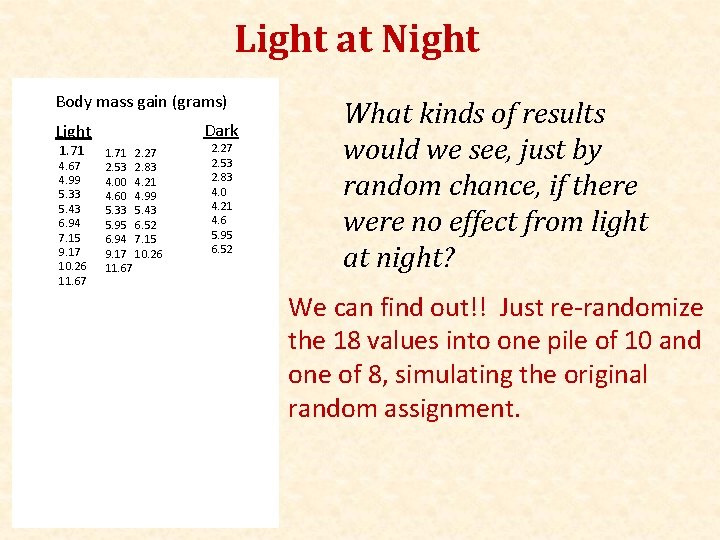
Light at Night Body Mass Gain (grams) Light 1. 71 4. 67 4. 99 5. 33 5. 43 6. 94 7. 15 9. 17 10. 26 11. 67 Dark 2. 27 2. 53 2. 83 4. 0 4. 21 4. 6 5. 95 6. 52 Light mean Dark mean = 6. 73 = 4. 11 Light mean – Dark mean = 2. 62 Does light at night actually increase body mass gain or is the difference just due to random chance?
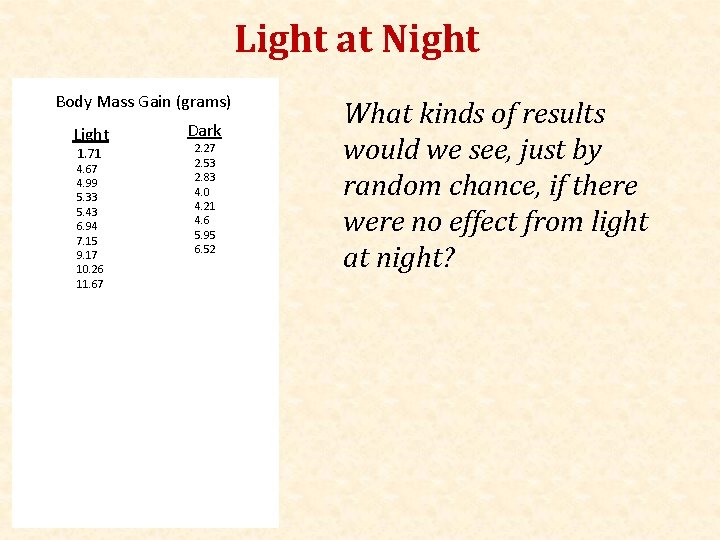
Light at Night Body Mass Gain (grams) Light 1. 71 4. 67 4. 99 5. 33 5. 43 6. 94 7. 15 9. 17 10. 26 11. 67 Dark 2. 27 2. 53 2. 83 4. 0 4. 21 4. 6 5. 95 6. 52 What kinds of results would we see, just by random chance, if there were no effect from light at night?
Light at Night Body mass gain (grams) Dark Light 1. 71 2. 27 4. 67 4. 99 5. 33 5. 43 6. 94 7. 15 9. 17 10. 26 11. 67 2. 53 2. 83 4. 00 4. 21 4. 60 4. 99 5. 33 5. 43 5. 95 6. 52 6. 94 7. 15 9. 17 10. 26 11. 67 2. 27 2. 53 2. 83 4. 0 4. 21 4. 6 5. 95 6. 52 What kinds of results would we see, just by random chance, if there were no effect from light at night? We can find out!! Just re-randomize the 18 values into one pile of 10 and one of 8, simulating the original random assignment.
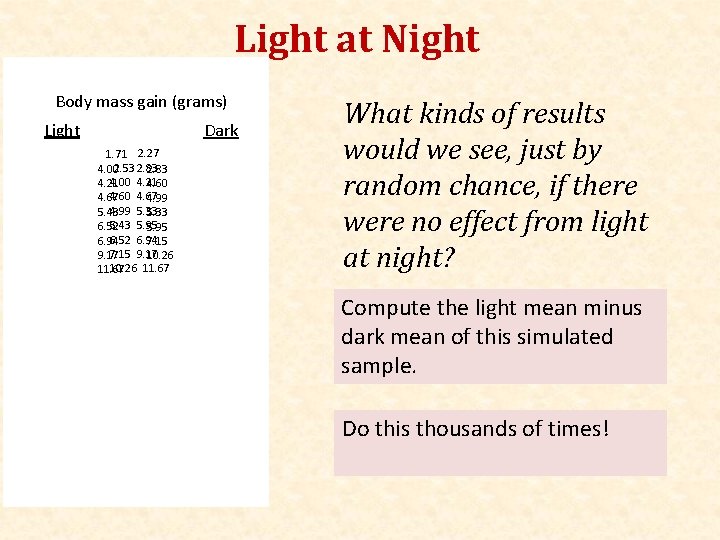
Light at Night Body mass gain (grams) Light Dark 2. 27 1. 71 2. 53 2. 83 4. 00 2. 83 4. 00 4. 21 4. 60 4. 67 4. 99 5. 33 5. 43 5. 33 5. 43 5. 95 6. 52 5. 95 6. 52 6. 94 7. 15 9. 17 10. 26 11. 67 What kinds of results would we see, just by random chance, if there were no effect from light at night? Compute the light mean minus dark mean of this simulated sample. Do this thousands of times!
We need technology!! STATKEY! www. lock 5 stat. com/statkey Free, online, works on all platforms, easy to use!
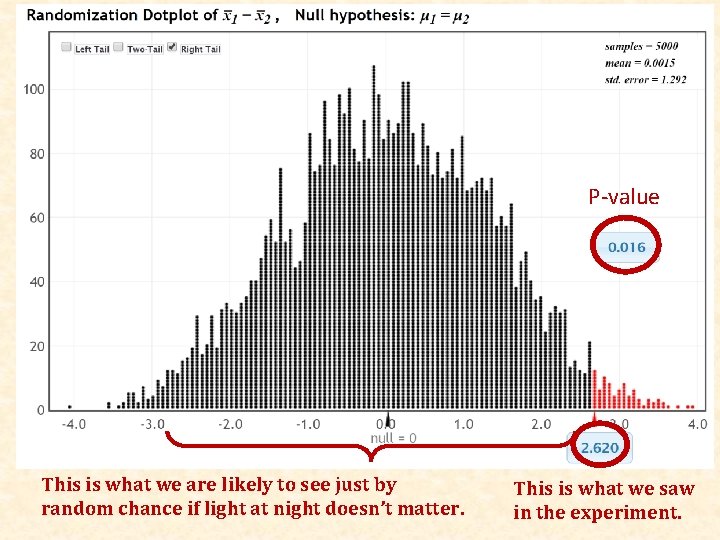
P-value This is what we are likely to see just by random chance if light at night doesn’t matter. This is what we saw in the experiment.
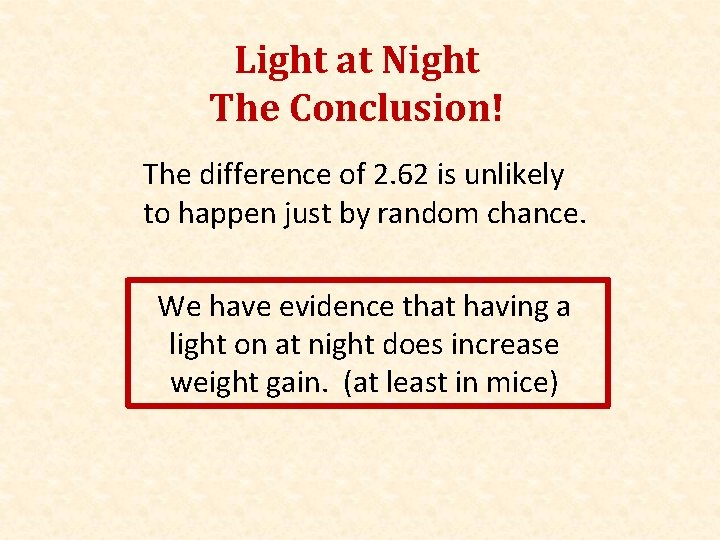
Light at Night The Conclusion! The difference of 2. 62 is unlikely to happen just by random chance. We have evidence that having a light on at night does increase weight gain. (at least in mice)
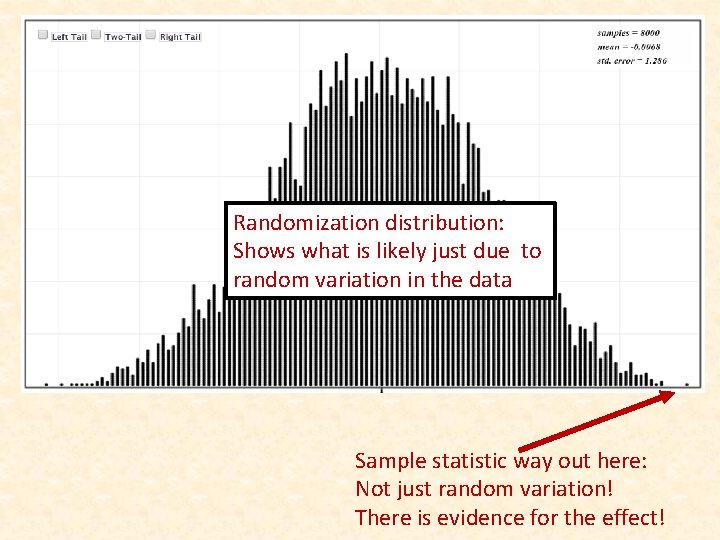
Randomization distribution: Shows what is likely just due to random variation in the data Sample statistic way out here: Not just random variation! There is evidence for the effect!
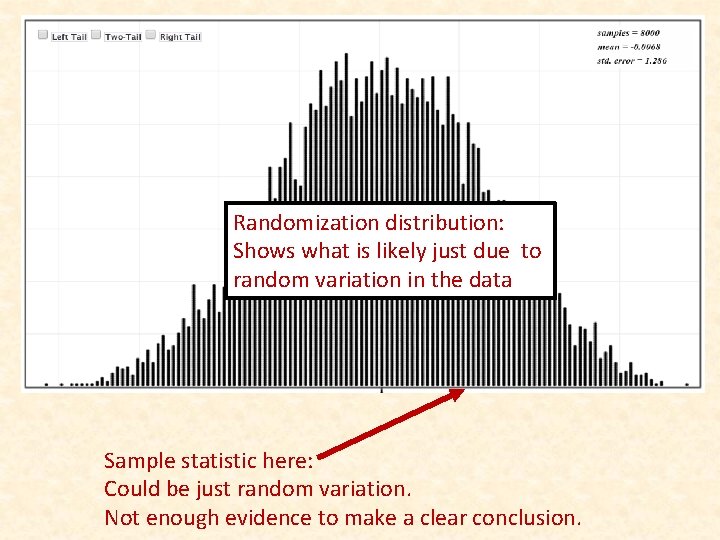
Randomization distribution: Shows what is likely just due to random variation in the data Sample statistic here: Could be just random variation. Not enough evidence to make a clear conclusion.
Randomization Hypothesis Tests • Similar process for all parameters! Enables big picture understanding • Reinforces key concept of random variation • Ties directly (and visually) to understanding key concept of strength of evidence • Helps understanding of p-value: How extreme are sample results if null hypothesis is true? • Very visual! • Low emphasis on algebra and formulas! • Improves student understanding AND student success rates (See Keynote Address tomorrow!) • The way of the future!! (See Keynote Address tomorrow!)
Example #2: A Yes/No Question! Audience participation! What Yes/No question do you want to ask this group? Question: Is the proportion of people who would say “Yes” to this question different than 0. 5? Hypothesis test for a proportion.
Example #3: Malevolent Uniforms Do sports teams with more “malevolent” uniforms get penalized more often?
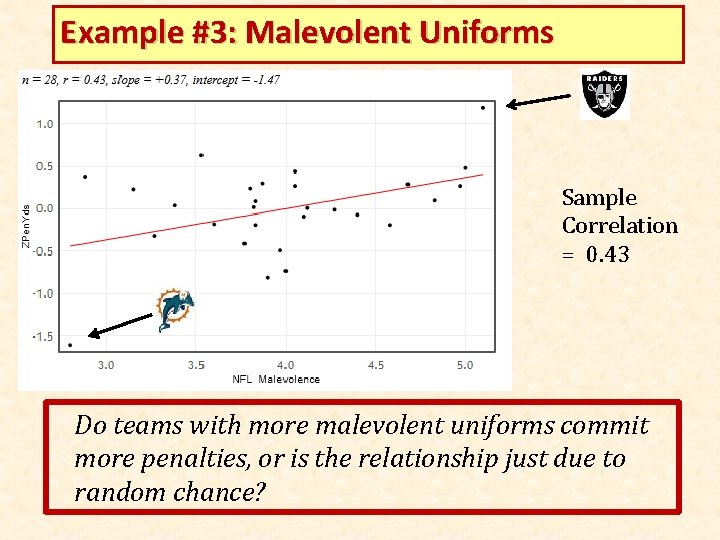
Example #3: Malevolent Uniforms Sample Correlation = 0. 43 Do teams with more malevolent uniforms commit more penalties, or is the relationship just due to random chance?
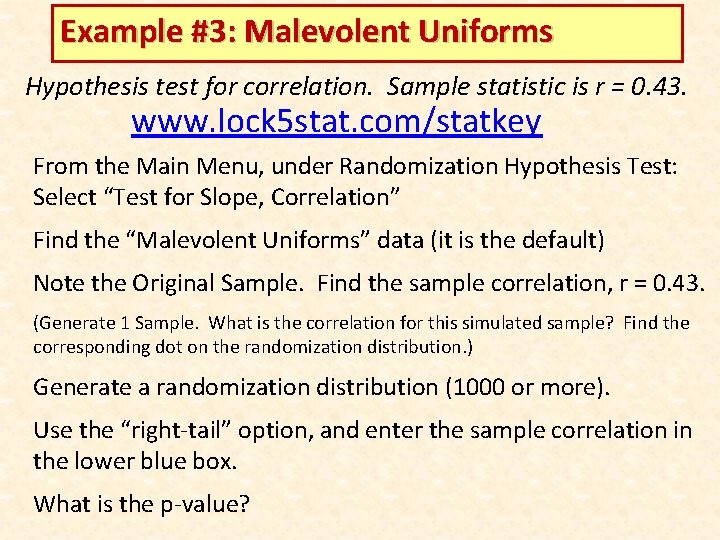
Example #3: Malevolent Uniforms Hypothesis test for correlation. Sample statistic is r = 0. 43. www. lock 5 stat. com/statkey From the Main Menu, under Randomization Hypothesis Test: Select “Test for Slope, Correlation” Find the “Malevolent Uniforms” data (it is the default) Note the Original Sample. Find the sample correlation, r = 0. 43. (Generate 1 Sample. What is the correlation for this simulated sample? Find the corresponding dot on the randomization distribution. ) Generate a randomization distribution (1000 or more). Use the “right-tail” option, and enter the sample correlation in the lower blue box. What is the p-value?
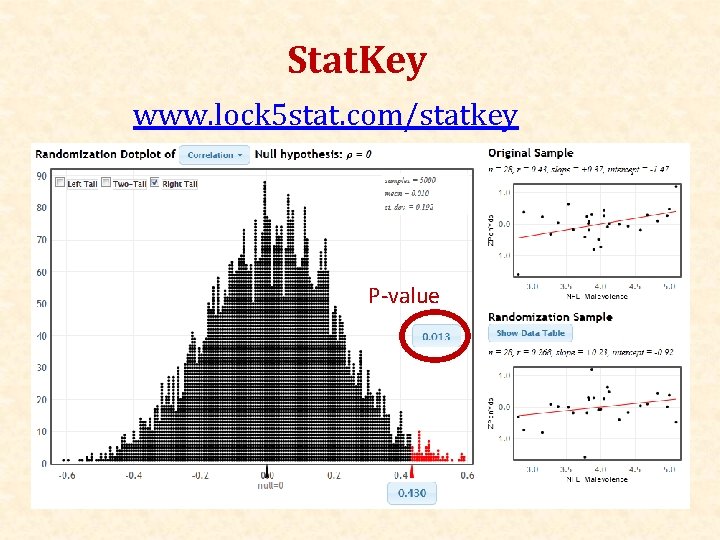
Stat. Key www. lock 5 stat. com/statkey P-value
Malevolent Uniforms The Conclusion! The results seen in the study are unlikely to happen just by random chance (just about 1 out of 100). We have some evidence that teams with more malevolent uniforms get more penalties.
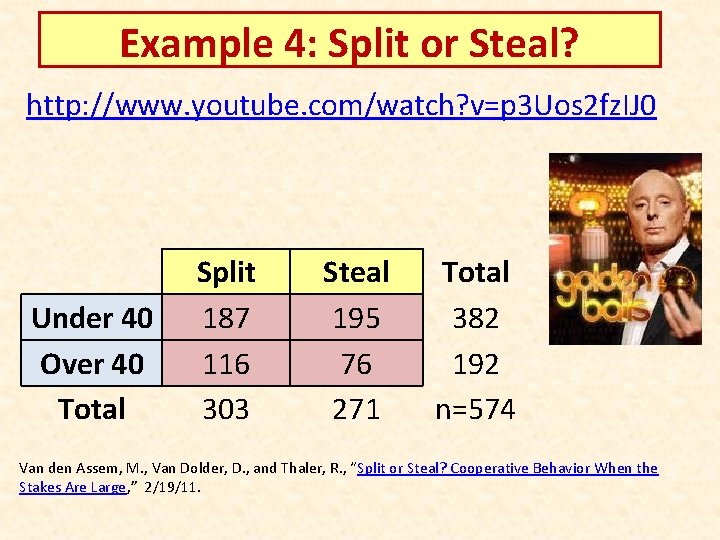
Example 4: Split or Steal? http: //www. youtube. com/watch? v=p 3 Uos 2 fz. IJ 0 Under 40 Over 40 Total Split 187 116 303 Steal 195 76 271 Total 382 192 n=574 Van den Assem, M. , Van Dolder, D. , and Thaler, R. , “Split or Steal? Cooperative Behavior When the Stakes Are Large, ” 2/19/11.
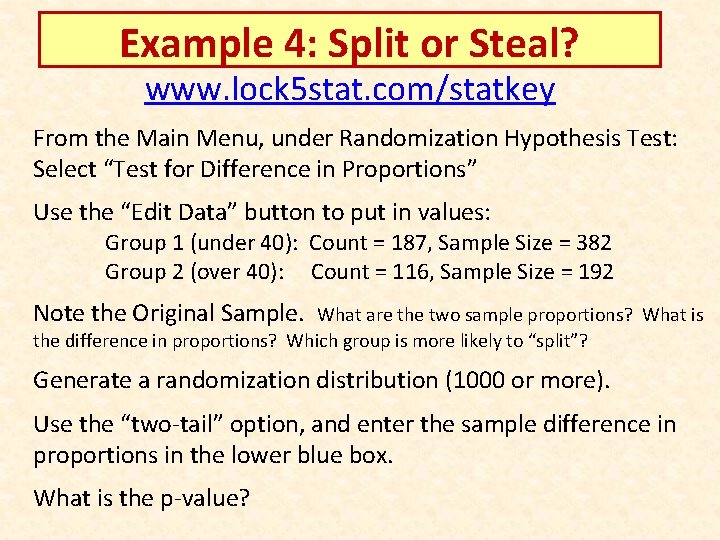
Example 4: Split or Steal? www. lock 5 stat. com/statkey From the Main Menu, under Randomization Hypothesis Test: Select “Test for Difference in Proportions” Use the “Edit Data” button to put in values: Group 1 (under 40): Count = 187, Sample Size = 382 Group 2 (over 40): Count = 116, Sample Size = 192 Note the Original Sample. What are the two sample proportions? What is the difference in proportions? Which group is more likely to “split”? Generate a randomization distribution (1000 or more). Use the “two-tail” option, and enter the sample difference in proportions in the lower blue box. What is the p-value?
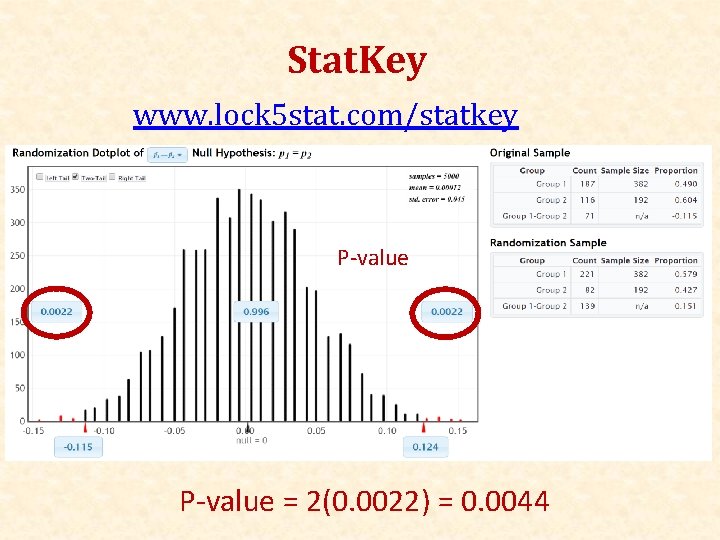
Stat. Key www. lock 5 stat. com/statkey P-value = 2(0. 0022) = 0. 0044
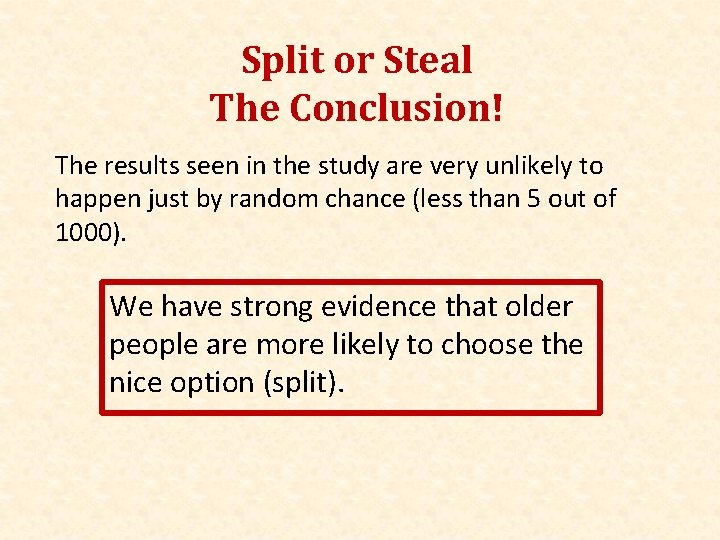
Split or Steal The Conclusion! The results seen in the study are very unlikely to happen just by random chance (less than 5 out of 1000). We have strong evidence that older people are more likely to choose the nice option (split).
Moving beyond Hypothesis Tests: Additional ways to “Improve conceptual understanding in Intro Stat”
Additional Resources www. lock 5 stat. com Statkey • • Free! Easy-to-use! Google App (Don’t need internet) Lots of additional resources for Intro Stats!
www. lock 5 stat. com plock@stlawu. edu klm 47@psu. edu