
IMPROVING COMPLIANCE WITH INTERSOCIETAL ACCREDITATION COMMISSION IAC REPORTING
- Slides: 2
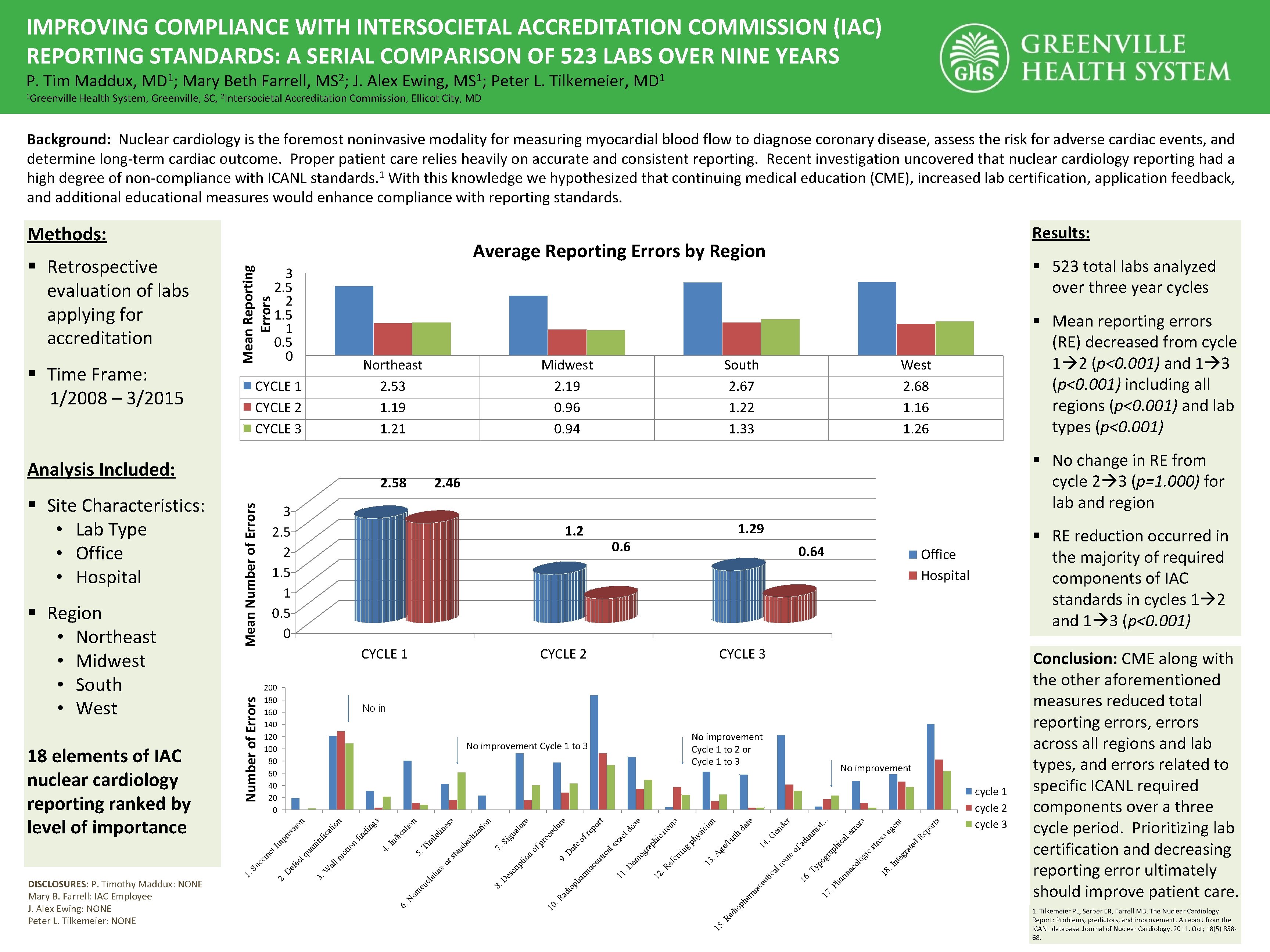
IMPROVING COMPLIANCE WITH INTERSOCIETAL ACCREDITATION COMMISSION (IAC) REPORTING STANDARDS: A SERIAL COMPARISON OF 523 LABS OVER NINE YEARS P. Tim Maddux, MD 1; Mary Beth Farrell, MS 2; J. Alex Ewing, MS 1; Peter L. Tilkemeier, MD 1 1 Greenville Health System, Greenville, SC, 2 Intersocietal Accreditation Commission, Ellicot City, MD Background: Nuclear cardiology is the foremost noninvasive modality for measuring myocardial blood flow to diagnose coronary disease, assess the risk for adverse cardiac events, and determine long-term cardiac outcome. Proper patient care relies heavily on accurate and consistent reporting. Recent investigation uncovered that nuclear cardiology reporting had a high degree of non-compliance with ICANL standards. 1 With this knowledge we hypothesized that continuing medical education (CME), increased lab certification, application feedback, and additional educational measures would enhance compliance with reporting standards. Methods: 3 2. 5 2 1. 5 1 0. 5 0 Northeast 2. 53 1. 19 1. 21 CYCLE 2 CYCLE 3 Analysis Included: West 2. 68 1. 16 1. 29 0. 64 CYCLE 2 CYCLE 3 No improvement Cycle 1 to 2 or Cycle 1 to 3 § RE reduction occurred in the majority of required components of IAC standards in cycles 1 2 and 1 3 (p<0. 001) Office Hospital po Re d te ra eg nt. I 18 ac rm ha. P 17 rts t en ag str e ic og ol og yp. T 16 ss er al ic ph ra eo ut ro al tic eu ac m ar ph io ad. R 15 ro ist in dm fa 14 12 io ad. R 10 rs . . . r de. G en h irt /b . A ge 13 . R ef No improvement te da ia ic ys ph g rin er og em. D 11 n s ic ph ra ex al ic eu t ac m ph ar ite td ac fr eo D at 9. m os e t or ep ur oc pr of n tio ip cr D es 8. ur at cl en om N ed at gn Si 7. eo al W 3. e e ur n tio ta rs lm 5. nd Ti ar m di le za lin tio ca di In 4. ot es s ng n io ni ua tq ec D ef 2. fin ic tif pr ct di at io es sio n n No improvement Cycle 1 to 2 cc in Su 1. DISCLOSURES: P. Timothy Maddux: NONE Mary B. Farrell: IAC Employee J. Alex Ewing: NONE Peter L. Tilkemeier: NONE § Mean reporting errors (RE) decreased from cycle 1 2 (p<0. 001) and 1 3 (p<0. 001) including all regions (p<0. 001) and lab types (p<0. 001) 2. 46 CYCLE 1 Im 18 elements of IAC nuclear cardiology reporting ranked by level of importance South 2. 67 1. 22 1. 33 1. 2 200 180 160 140 120 100 80 60 40 20 0 § 523 total labs analyzed over three year cycles § No change in RE from cycle 2 3 (p=1. 000) for lab and region 3 2. 5 2 1. 5 1 0. 5 0 Mean Number of Errors § Region • Northeast • Midwest • South • West Number of Errors § Site Characteristics: • Lab Type • Office • Hospital Midwest 2. 19 0. 96 0. 94 2. 58 6. § Time Frame: 1/2008 – 3/2015 Average Reporting Errors by Region Mean Reporting Errors § Retrospective evaluation of labs applying for accreditation Results: cycle 1 cycle 2 cycle 3 Conclusion: CME along with the other aforementioned measures reduced total reporting errors, errors across all regions and lab types, and errors related to specific ICANL required components over a three cycle period. Prioritizing lab certification and decreasing reporting error ultimately should improve patient care. 1. Tilkemeier PL, Serber ER, Farrell MB. The Nuclear Cardiology Report: Problems, predictors, and improvement. A report from the ICANL database. Journal of Nuclear Cardiology. 2011. Oct; 18(5) 85868.
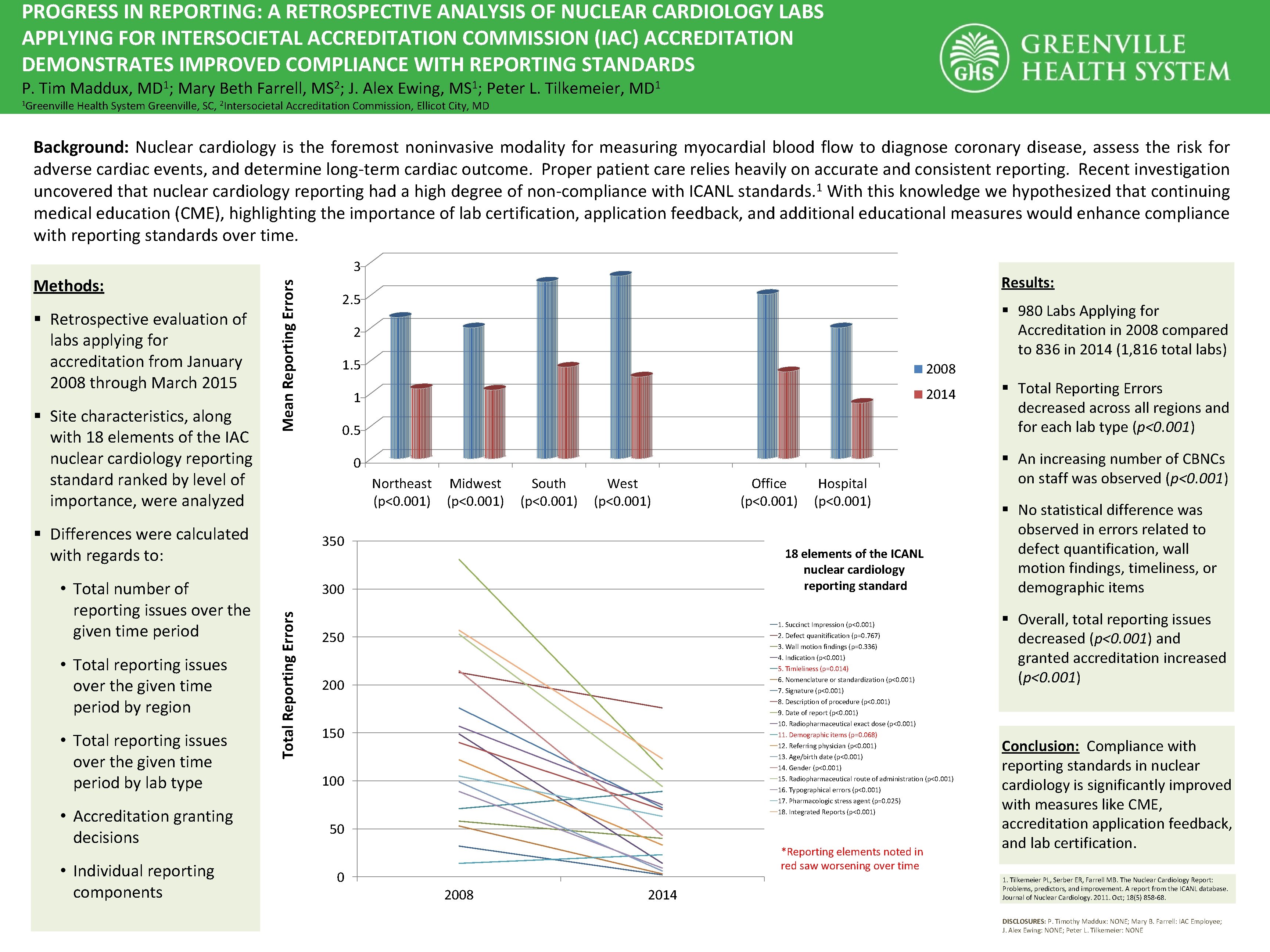
PROGRESS IN REPORTING: A RETROSPECTIVE ANALYSIS OF NUCLEAR CARDIOLOGY LABS APPLYING FOR INTERSOCIETAL ACCREDITATION COMMISSION (IAC) ACCREDITATION DEMONSTRATES IMPROVED COMPLIANCE WITH REPORTING STANDARDS P. Tim Maddux, MD 1; Mary Beth Farrell, MS 2; J. Alex Ewing, MS 1; Peter L. Tilkemeier, MD 1 1 Greenville Health System Greenville, SC, 2 Intersocietal Accreditation Commission, Ellicot City, MD Background: Nuclear cardiology is the foremost noninvasive modality for measuring myocardial blood flow to diagnose coronary disease, assess the risk for adverse cardiac events, and determine long-term cardiac outcome. Proper patient care relies heavily on accurate and consistent reporting. Recent investigation 1 uncovered that nuclear cardiology reporting had a high degree of non-compliance with ICANL standards. With this knowledge we hypothesized that continuing medical education (CME), highlighting the importance of lab certification, application feedback, and additional educational measures would enhance compliance with reporting standards over time. § Retrospective evaluation of labs applying for accreditation from January 2008 through March 2015 § Site characteristics, along with 18 elements of the IAC nuclear cardiology reporting standard ranked by level of importance, were analyzed Mean Reporting Errors Methods: 3 • Total reporting issues over the given time period by lab type • Accreditation granting decisions • Individual reporting components § 980 Labs Applying for Accreditation in 2008 compared to 836 in 2014 (1, 816 total labs) 2 1. 5 2008 2014 1 0. 5 Northeast (p<0. 001) Midwest (p<0. 001) South (p<0. 001) West (p<0. 001) 350 Office (p<0. 001) Hospital (p<0. 001) 18 elements of the ICANL nuclear cardiology reporting standard 300 Total Reporting Errors • Total reporting issues over the given time period by region 2. 5 0 § Differences were calculated with regards to: • Total number of reporting issues over the given time period Results: 1. Succinct Impression (p<0. 001) 2. Defect quanitification (p=0. 767) 3. Wall motion findings (p=0. 336) 4. Indication (p<0. 001) 5. Timleliness (p=0. 014) 6. Nomenclature or standardization (p<0. 001) 7. Signature (p<0. 001) 8. Description of procedure (p<0. 001) 9. Date of report (p<0. 001) 10. Radiopharmaceutical exact dose (p<0. 001) 11. Demographic items (p=0. 068) 12. Referring physician (p<0. 001) 13. Age/birth date (p<0. 001) 14. Gender (p<0. 001) 15. Radiopharmaceutical route of administration (p<0. 001) 16. Typographical errors (p<0. 001) 17. Pharmacologic stress agent (p=0. 025) 18. Integrated Reports (p<0. 001) 250 200 150 100 50 0 *Reporting elements noted in red saw worsening over time 2008 2014 § Total Reporting Errors decreased across all regions and for each lab type (p<0. 001) § An increasing number of CBNCs on staff was observed (p<0. 001) § No statistical difference was observed in errors related to defect quantification, wall motion findings, timeliness, or demographic items § Overall, total reporting issues decreased (p<0. 001) and granted accreditation increased (p<0. 001) Conclusion: Compliance with reporting standards in nuclear cardiology is significantly improved with measures like CME, accreditation application feedback, and lab certification. 1. Tilkemeier PL, Serber ER, Farrell MB. The Nuclear Cardiology Report: Problems, predictors, and improvement. A report from the ICANL database. Journal of Nuclear Cardiology. 2011. Oct; 18(5) 858 -68. DISCLOSURES: P. Timothy Maddux: NONE; Mary B. Farrell: IAC Employee; J. Alex Ewing: NONE; Peter L. Tilkemeier: NONE