
Improving Cognitive Structuresideas for DI K Knox 2008

- Slides: 17
Improving Cognitive Structures—ideas for DI K. Knox 2008
What might be triggers for extra cognitive support in DI for those “difficult but not defiant” ones? A student one or more GL behind A student who chooses not to read or write A student who can’t seem to get math facts A student who “just doesn’t get it” A student who can’t seem to concentrate or have motivation to persist A student who seems to require extrinsic motivation The guesser/passive/distracted/impulsive/ avoidant student who only enjoys art or music
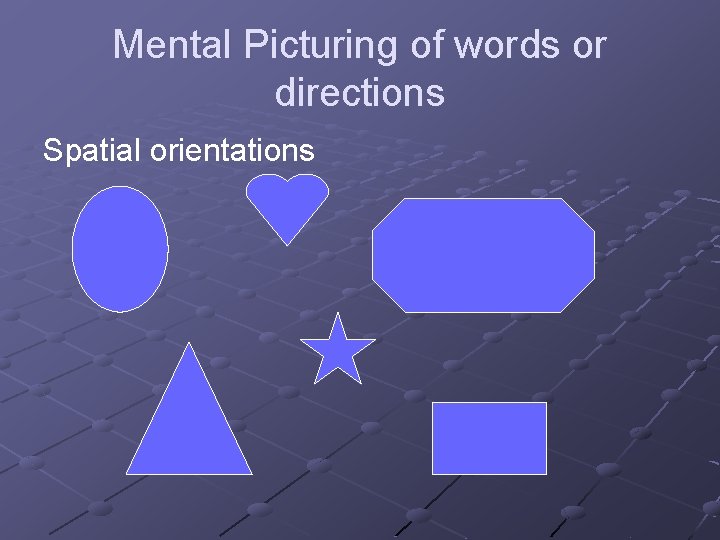
Mental Picturing of words or directions Spatial orientations
Spatial orientation “checks” in online lessons Spatial orientation helps students define types and characteristics of space in various forms. n n n Check facility with observing and using boundaries (math, science, geography), Check the ability to differentiate objects and distinguish relationships, Check the ability to visualize settings. Check and clarify existing mental imagery.
Examples… Use of 3 -D and 2 -D representations Share your own pictures; in lessons promote use of “stop and imagine” from time to time, and then check retention referencing those mental images (ie: visualization of a molecular structure; visualize perimeter, or a setting, going backward on a number line, or an art process, visualize map info—check for retention) Teach perspectives: who is seeing, what is being seen, where the character is focusing, who else is seeing what from a vantage point
Story Structuring As a cognitive tool, stories shape experience into forms with emotional meanings Narrate with skill and emotion: “What’s the story on this? ” “Can we connect with discoverers? ” Whale story The majority of what we want students to “get” is plotted into the story
Metaphor Create metaphors together to frame lessons and provide a framework for retention n To compare and contrast information To make connections across ideas To help focus on relevant information Ask students to consciously identify when they are seeing with their eyes and when they are seeing with their mind. “Consilience can connect”
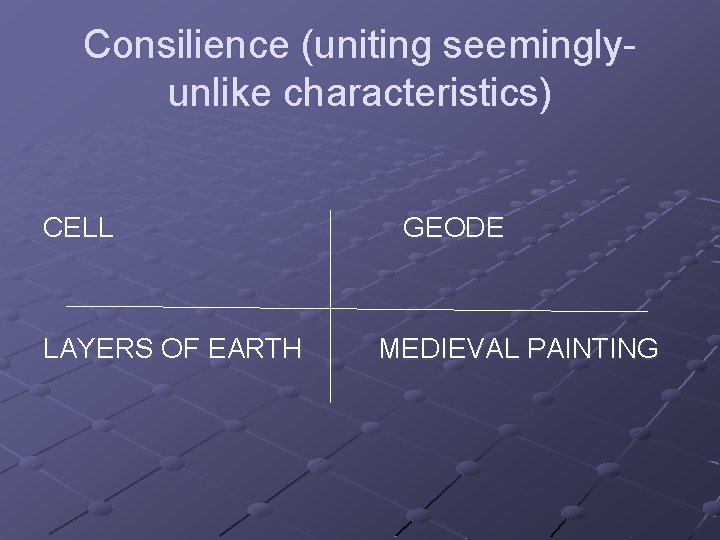
Consilience (uniting seeminglyunlike characteristics) CELL LAYERS OF EARTH GEODE MEDIEVAL PAINTING
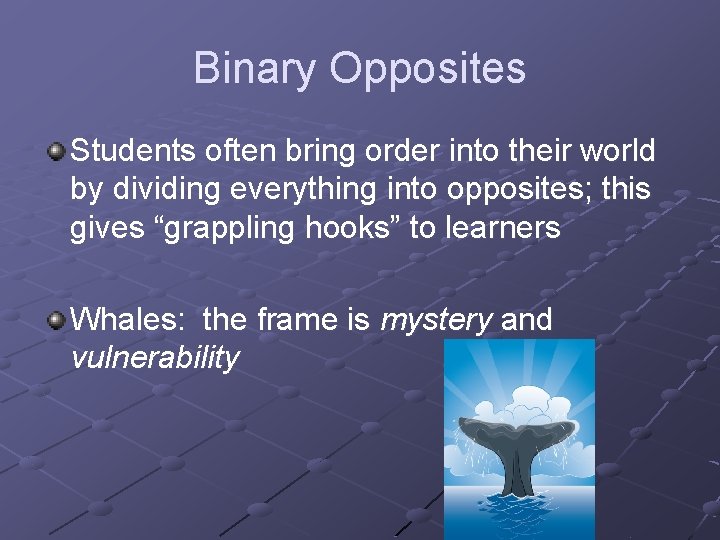
Binary Opposites Students often bring order into their world by dividing everything into opposites; this gives “grappling hooks” to learners Whales: the frame is mystery and vulnerability
Small successes through good pedagogy: Time for chunking and reflective awareness through inquiry; wait time Open “thinking” questions: “Would this always be true? ” “What will happen to this addition problem in base 5? ” “What do you notice? ? ” (uncover naïve thinking) Jokes and humor, silly vocabulary
The answer is… BLUE! Abraham Lincoln! … what is the question? ?
Summary with visuals do oral and visual “summary stops” in direct instruction, include music (optional) and include directed mental visualization/picturing (describe using metaphor) then “Can you see that? What do you notice? From the top what does it look like? ” “Give it back” in quick written or picture form (monitoring thought processes via quick feedback loop)
A sense of Mystery… What would our world be like if we could see radio waves? n What’s in air? How can such huge animals as whales survive on krill? n can we do the same operation in the opposite way in math and get the same result?
Three more ideas to engage students and increase retention: Associations and identification with the Heroic and “the journey” in any subject area Give incomplete outlines Engage by the extremes of experience
Try it yourself! Choose a lesson Choose one of the cognitive structures that you haven’t used before to integrate into the lesson Share your thought(s)
Choose two of these to include in a specific Elluminate session: Story structuring Metaphor “Stop and imagine/picture” or “stop and summarize” Binary opposites to frame understanding A sense of mystery Associations with the heroic or “the journey” “give it back” in quick written or illustrative form Consilience Extremes of experience
National Standards for Online Teaching Rate yourself in each domain and make some notes about how to improve effective engagement with all students