
Improving Classroom Management Skills Using the Ultimate Classroom
- Slides: 15
Improving Classroom Management Skills Using the Ultimate Classroom Control Handbook (c) JIST Works 2006
Getting Control Nearly 8 in 10 teachers say they could teach more effectively if they didn’t have to spend so much time dealing with disruptive students. From a 2004 study conducted by a New York based public policy research organization, Public Agenda (c) JIST Works 2006
Goals of the UCCH Equip teachers with specific classroom management strategies so they can devote more time to teaching. n Create discipline strategies that are immediate, dealing with issues without the need for additional paperwork or conferences. n Help teachers to create a positive learning environment where the need to discipline students is minimized. n (c) JIST Works 2006
The Truth About Classroom Rules The one rule: “If you make it so I can’t teach effectively and you or other students can’t learn effectively then there is a problem. ” n It’s okay to be inconsistent—you can’t deal with every instance of misbehavior. n But be sure to follow through on your threats. n (c) JIST Works 2006
Classroom Management’s Basic Techniques Give them the pause n Look toward the problem n Lower your voice n Walk toward the misbehavior n Show them the “stop” sign n Tap them back to attention n Involve them in the lesson n (c) JIST Works 2006
What to Say When Disciplining Students Let them decide their fate—give them the choice to behave or accept the consequences n Make a positive request rather than point out the problem n Let them know it’s the behavior you don’t like, not them n Don’t take away their dignity n (c) JIST Works 2006
What Every Kid Hates (Using Their Fears to Your Advantage) Loss of free time: keep them after class n Separation from friends: threaten to move them to a different seat n Negative peer pressure: help them to act in a way to avoid a negative peer response n (c) JIST Works 2006
Staying After Class Use names on the board as a conditioning tool n Avoid giving students an audience for their protests n Record the time it takes to get to other classes to know how long you can keep them n (c) JIST Works 2006
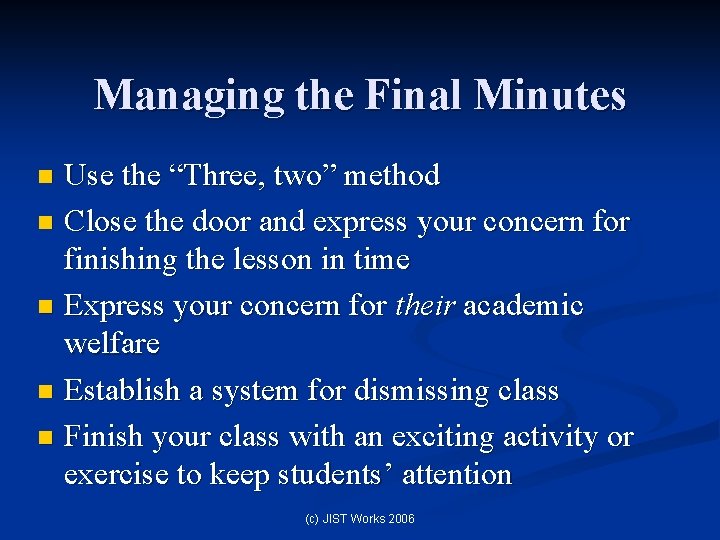
Managing the Final Minutes Use the “Three, two” method n Close the door and express your concern for finishing the lesson in time n Express your concern for their academic welfare n Establish a system for dismissing class n Finish your class with an exciting activity or exercise to keep students’ attention n (c) JIST Works 2006
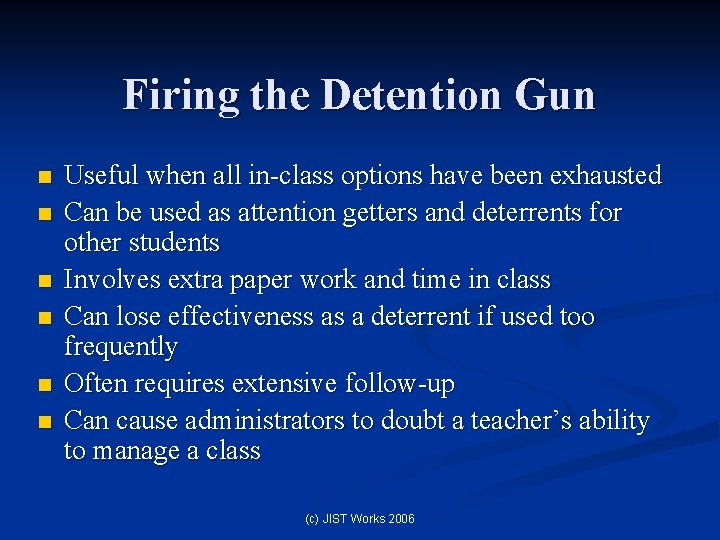
Firing the Detention Gun n n n Useful when all in-class options have been exhausted Can be used as attention getters and deterrents for other students Involves extra paper work and time in class Can lose effectiveness as a deterrent if used too frequently Often requires extensive follow-up Can cause administrators to doubt a teacher’s ability to manage a class (c) JIST Works 2006
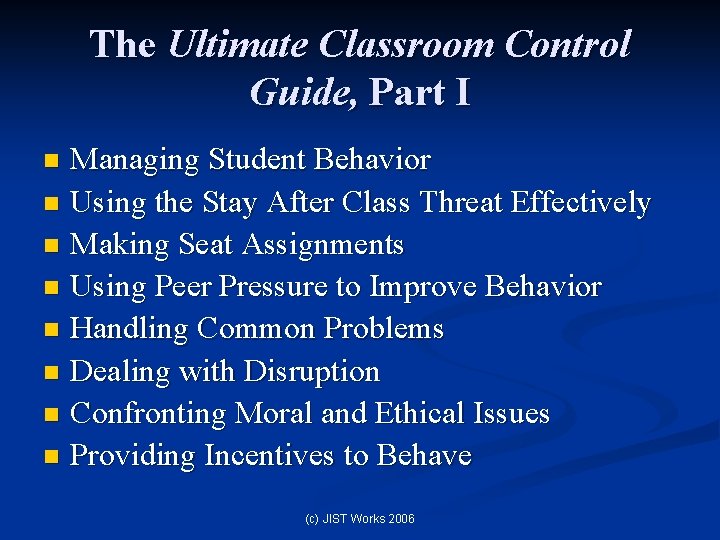
The Ultimate Classroom Control Guide, Part I Managing Student Behavior n Using the Stay After Class Threat Effectively n Making Seat Assignments n Using Peer Pressure to Improve Behavior n Handling Common Problems n Dealing with Disruption n Confronting Moral and Ethical Issues n Providing Incentives to Behave n (c) JIST Works 2006
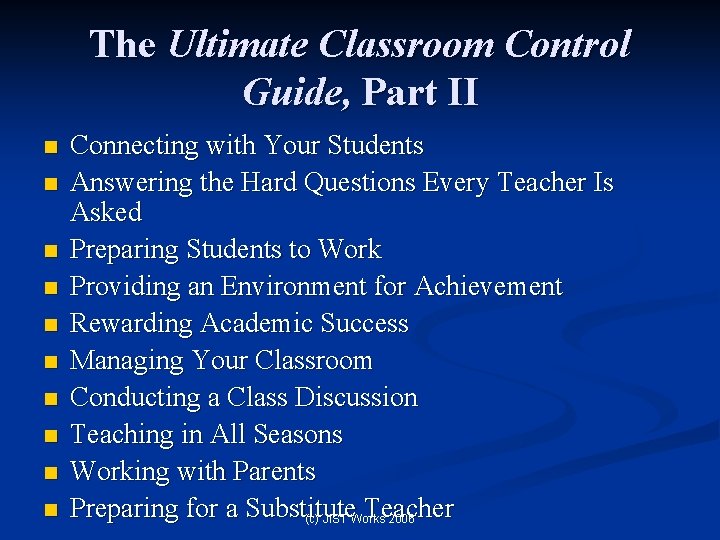
The Ultimate Classroom Control Guide, Part II n n n n n Connecting with Your Students Answering the Hard Questions Every Teacher Is Asked Preparing Students to Work Providing an Environment for Achievement Rewarding Academic Success Managing Your Classroom Conducting a Class Discussion Teaching in All Seasons Working with Parents Preparing for a Substitute Teacher (c) JIST Works 2006
About the Author Dave Foley wrote the UCCH based on experience as an English and Social Studies teacher in junior high and middle schools for 29 years n Named Cadillac, Michigan School District’s “Outstanding Person in Education” in 2002 n Earned a Master’s Degree in Guidance and Counseling at Michigan State University n (c) JIST Works 2006
“The best lesson plans in the world won’t succeed if student misbehavior hamstrings an educator’s attempts to teach. Good classroom management practices are vital to creating an environment where students can learn. ” - Dave Foley, from the Introduction to the UCCH (c) JIST Works 2006
Help Manage Your Classroom with the Ultimate Classroom Control Handbook n n n n n Controlling your class with just one rule What to do when you don’t know what to do A plan for practical jokers and answers for the arrogant Eliminating excuses for not turning in work A surefire cure for academic apathy Looking at things from the student’s point of view Improving performance on standardized tests Dealing with threats, plagiarism, cheating, teasers, and bullies Establishing classroom routines that improve learning and reduce the stress (c)of. JISTteaching Works 2006