
Improving Capacity Sectoring Cell Splitting 9998 1 Sectoring
- Slides: 13
Improving Capacity • Sectoring • Cell Splitting 9/9/98 1
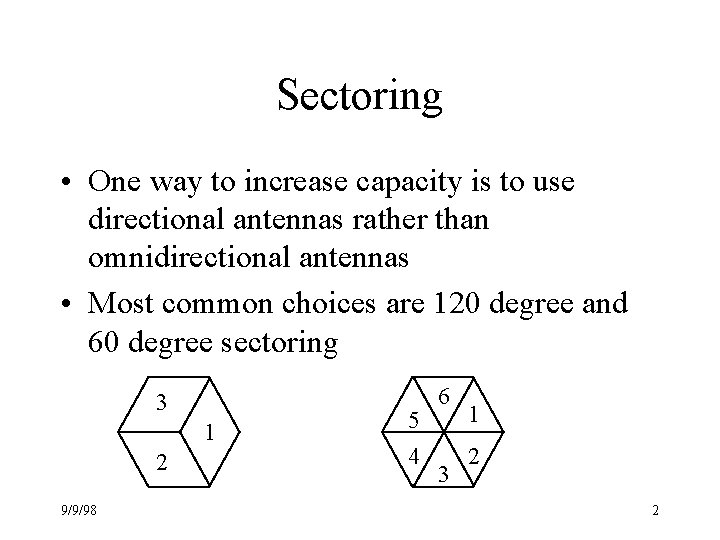
Sectoring • One way to increase capacity is to use directional antennas rather than omnidirectional antennas • Most common choices are 120 degree and 60 degree sectoring 3 1 2 9/9/98 5 4 6 3 1 2 2
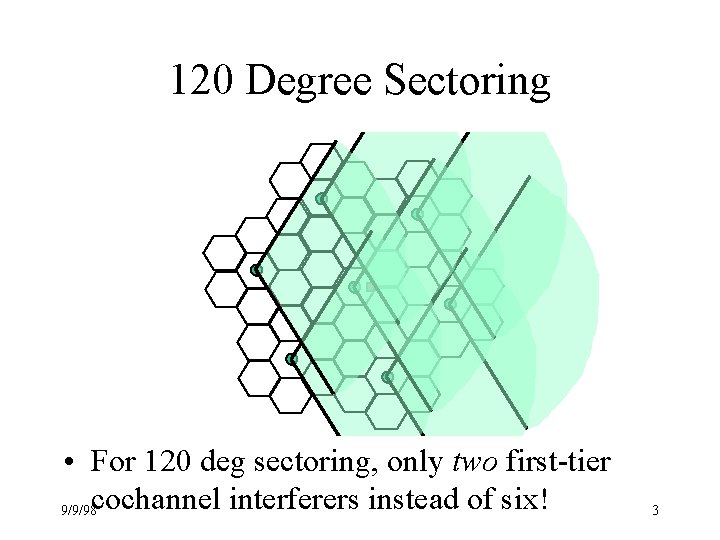
120 Degree Sectoring • For 120 deg sectoring, only two first-tier 9/9/98 cochannel interferers instead of six! 3
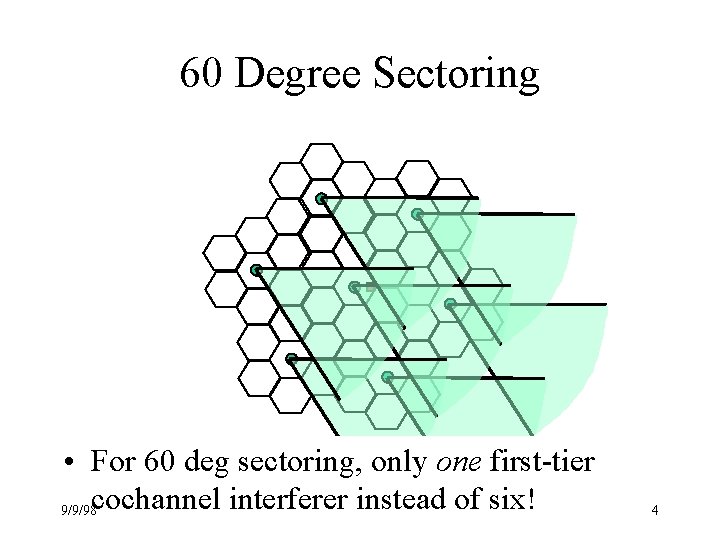
60 Degree Sectoring • For 60 deg sectoring, only one first-tier 9/9/98 cochannel interferer instead of six! 4
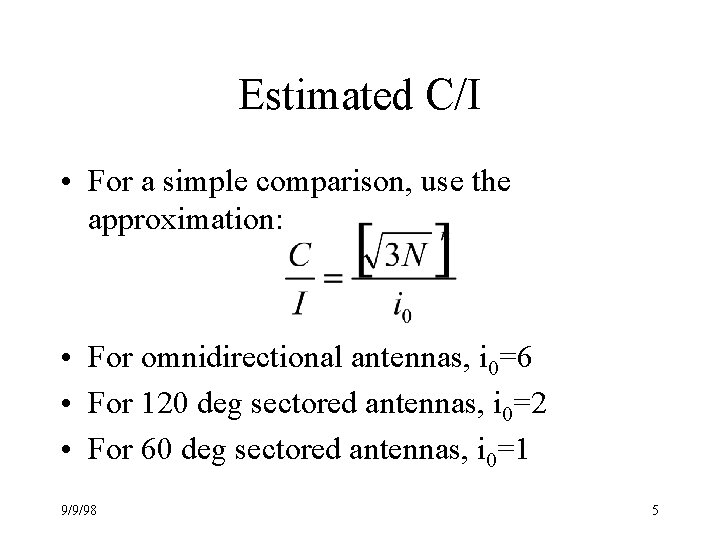
Estimated C/I • For a simple comparison, use the approximation: • For omnidirectional antennas, i 0=6 • For 120 deg sectored antennas, i 0=2 • For 60 deg sectored antennas, i 0=1 9/9/98 5
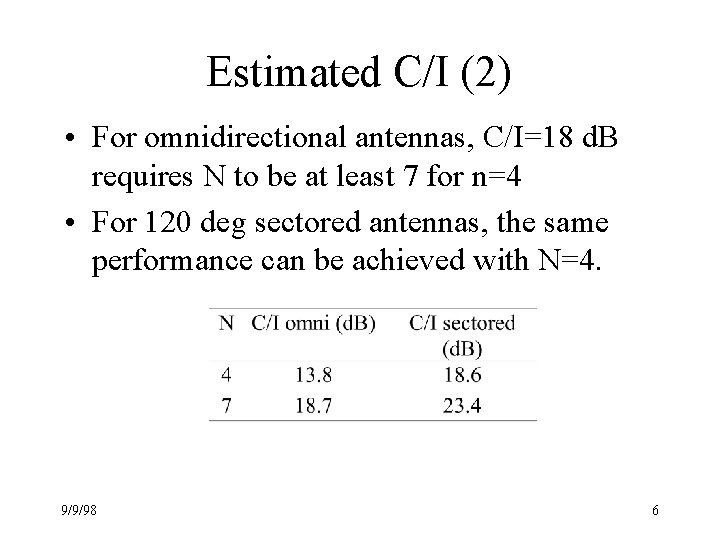
Estimated C/I (2) • For omnidirectional antennas, C/I=18 d. B requires N to be at least 7 for n=4 • For 120 deg sectored antennas, the same performance can be achieved with N=4. 9/9/98 6
Effects on System Capacity • Reducing the cluster size increases the system capacity by improving frequency reuse • However, sectoring reduces the trunking efficiency • Sectoring is more expensive since additional antennas and transmitters are required • Bottom line: net win in capacity, but costs more 9/9/98 7
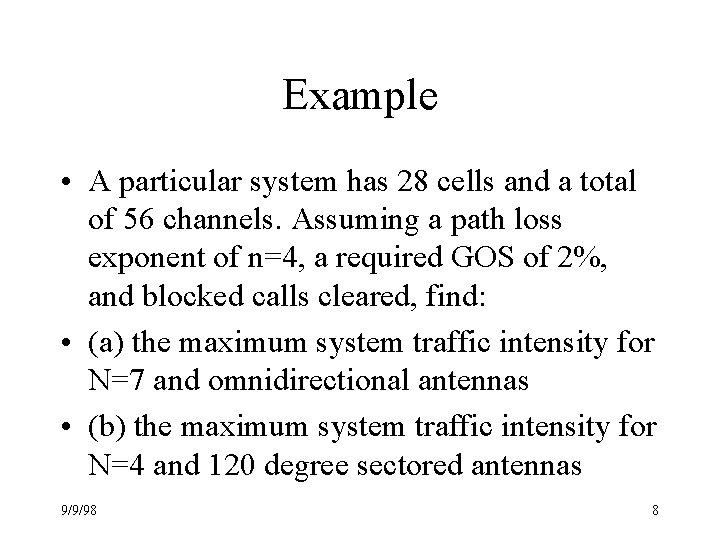
Example • A particular system has 28 cells and a total of 56 channels. Assuming a path loss exponent of n=4, a required GOS of 2%, and blocked calls cleared, find: • (a) the maximum system traffic intensity for N=7 and omnidirectional antennas • (b) the maximum system traffic intensity for N=4 and 120 degree sectored antennas 9/9/98 8
Solution 9/9/98 9
Cell Splitting • As the number of subscribers increases, the capacity of some cells may be exceeded • Desired GOS can be restored by subdividing the cells • Care must be taken to properly assign channel sets to preserve the frequency reuse scheme • Power can be reduced with the same received signal levels in smaller cells 9/9/98 10
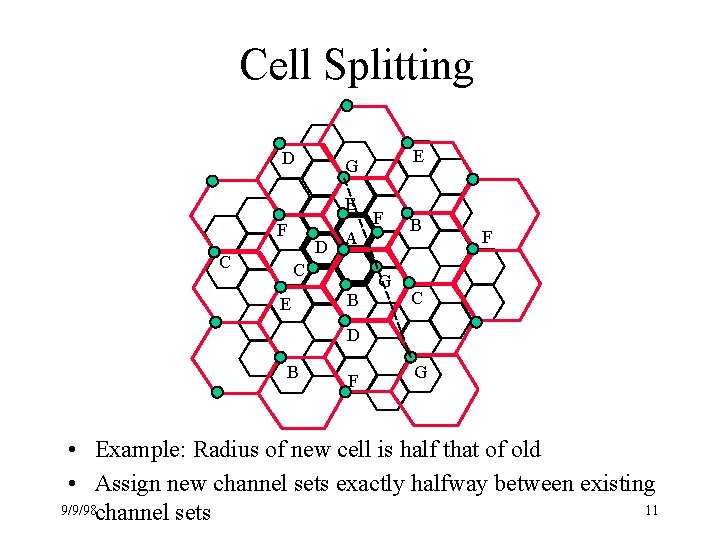
Cell Splitting D E F C D A C E E G B F C D B F G • Example: Radius of new cell is half that of old • Assign new channel sets exactly halfway between existing 9/9/98 channel sets 11
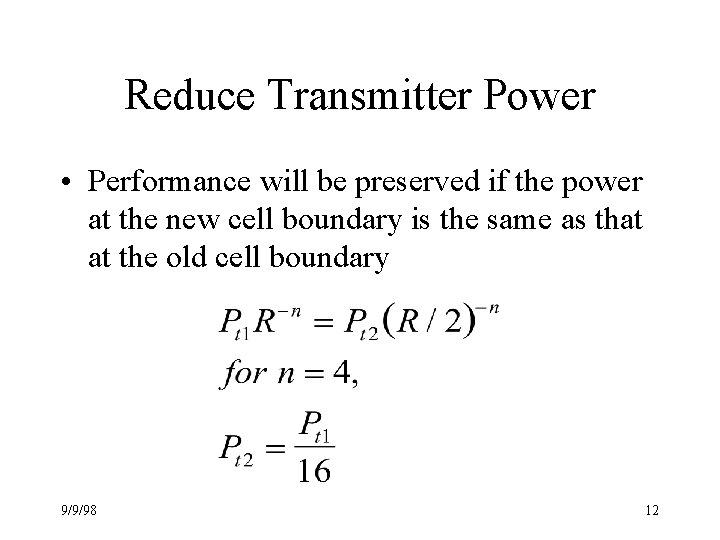
Reduce Transmitter Power • Performance will be preserved if the power at the new cell boundary is the same as that at the old cell boundary 9/9/98 12
What if all cells are not split? • If all cells use Pt 1, smaller cells will experience excess cochannel interference • If all cells use Pt 2, all portions of the larger cells may not be covered • Solution: Divide into two channel groups: one for small cells and one for large 9/9/98 13