
Improving Air Pollution Control at Major Stationary Sources

- Slides: 16
Improving Air Pollution Control at Major Stationary Sources Through the Title V Operating Permit Renewal Process A Presentation by W. Schulte, Esq. , Eastern Environmental Law Center to the New Jersey Clean Air Council April 14, 2010
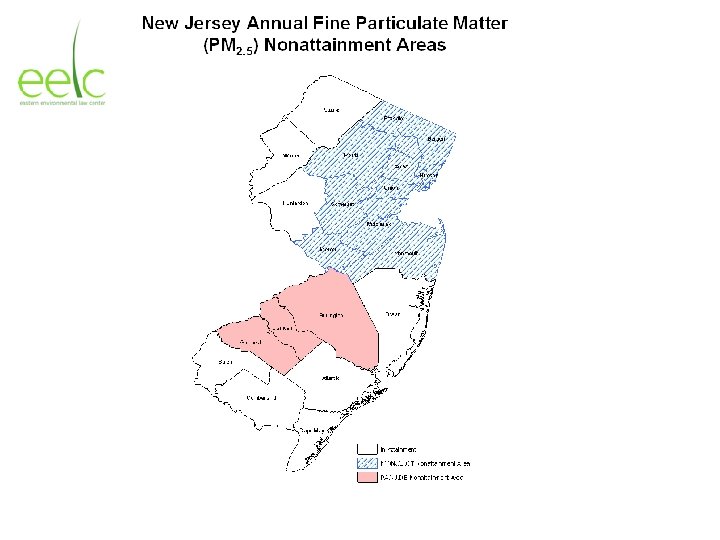
The Problem • Currently the air operating permit renewal process does not require older major stationary sources of air pollution with outdated air pollution control technology to upgrade that technology • Older sources continue to contribute to increased asthma and cancer rates and to Non-Attainment while operating at an economic advantage • Newer Facilities must install the most up to date technology while older Facilities are allowed to continue to operate with less expensive technology
The Solution • 5 year periodic review by the DEP to determine what is the Best Installed Control Technology (BICT) at each category of facility for each CAA criteria pollutant • A law requiring each CAA Title V Facility to upgrade to the Best Installed Control Technology in order to renew its Title V Operating Permit • May be made self-funding by increasing the permit renewal application fee
The Benefits • Cleaner air for citizens to breathe • A way to work towards Attainment status for criteria pollutants • A level economic playing field • No need for extensive economic or cost studies because similar facilities are operating successfully with BICT installed
Case Study - Municipal Solid Waste Incinerators: The Problem • In NJ we have two Municipal Solid Waste Incinerators whose air pollution control technology is materially worse than their competitors • Presently DEP believes it does not have authority to require those Facilities to upgrade their technology
Background Regarding Municipal Solid Waste Incinerators • NJ has five Municipal Solid Waste Incinerators: Camden, Essex, Gloucester, Union, and Warren • Essex County Resource Recovery Facility is the largest – Processes up to 2800 tons of solid waste per day – Went on line about 20 years ago • Camden County Resource Recovery Facility is third largest – Processes up to 1050 tons of solid waste per day – Went on line about 20 years ago
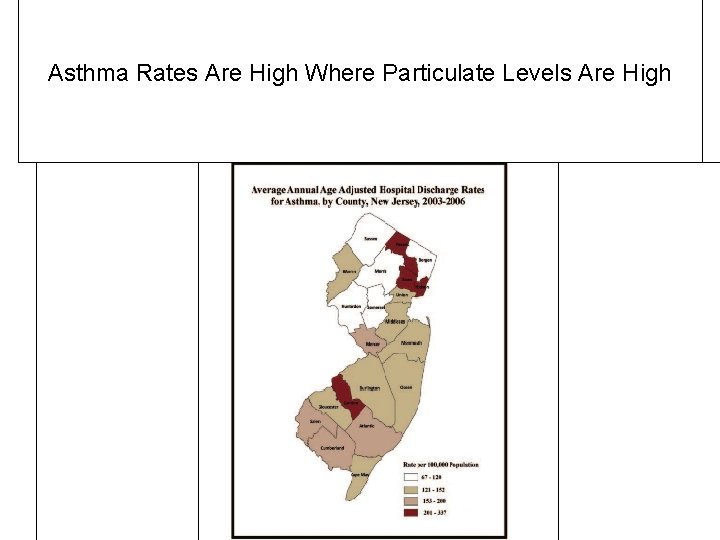
Case Study (Continued) • Essex Facility is located in the Ironbound community of Newark, NJ – Well over half the population of the two Census tracts next to the Facility belongs to a minority group – Over 25% of the population is below the poverty level – According to the NJ Strategic Asthma Plan 2008 -2013, Essex County has highest asthma rates in NJ • Camden Facility is located in Camden, NJ – The two Census tracts next to the Facility are 57. 8 % and 76. 3% Black or African American – 34. 9% and 41. 9% of families in the two Census tracts next to the Facility are below the poverty level – According to NJ Strategic Asthma Plan 2008 -2013, Camden also has some of the highest asthma hospitalization rates and highest emergency room discharge rates for asthma in NJ
Case Study (Cont’d): Particulate Matter Contributes to Asthma – Particulate Matter smaller than 10 microns in diameter (PM 10) can aggravate asthma, cause bronchitis, worsen heart disease and lead to heart attacks – Particulate Matter smaller than 2. 5 microns in diameter (PM 2. 5) is even more harmful because it can be absorbed into lung tissue easier – Other harmful pollutants sometimes adsorb to fine particulates
Asthma Rates Are High Where Particulate Levels Are High
Case Study (Cont’d) Electrostatic Precipitators vs. Fabric Filter Baghouses • ESP’s collect particulates by drawing them to collection plates with an electric charge – Not as effective as Fabric Filter Baghouses – Prone to Malfunctions • Facilities often attribute opacity exceedances to field trips in the ESP’s • Fabric Filter Baghouses are essentially large filters that collect particulates before they are emitted – According to the DEP, fabric filter baghouses achieve half the emissions of particulates per ton of waste combusted that ESP’s do – Fabric Filter Baghouses also help control Hg emission
Case Study (Cont’d) Electrostatic Precipitators vs. Fabric Filter Baghouses • Of New Jersey’s five MSW Incinerators, only two still have ESP’s: Essex and Camden – At the time the Essex and Camden Facilities were built, DEP had concluded that there was no discernible difference between baghouses and ESP’s – Gloucester, Union, and Warren are all equipped with baghouses • The Company that operates the Essex Facility currently operates 41 Incinerators in the US – At least 38 of those Incinerators are equipped with fabric filter baghouses • The Company that operates the Gloucester Facility currently operates 16 Incinerators in the US – 14 of those are equipped with fabric filter baghouses • Fabric Filter Baghouses are clearly the preferred method for controlling particulate emissions and would be BICT under the proposed law
Title V and the Operating Permit Renewal Process • Congress amended the CAA in 1990 to add Title V • Title V requires all major stationary sources of air pollution to have a Title V Operating Permit in order to operate • Title V Permits include emissions limits and monitoring and reporting requirements necessary to assure compliance with the CAA. • EPA may authorize state agencies to serve as the Title V permitting authority – EPA granted full approval to NJ’s Title V program effective November 30, 2001 • Though Title V permits generally do not impose new air quality control measures, states are authorized under the CAA to impose requirements stricter than the Federal law. 42 U. S. C. S. § 7416.
Title V and the Operating Permit Renewal Process • Each Title V Permit has a fixed term not to exceed five years • Upon the expiration of each term the source must apply for a renewal • Each Permit Renewal must go through a public review and comment period • Concerned citizens, community and environmental groups, and even the Newark City Council have requested that the DEP require the Camden and Essex Facilities to upgrade to fabric filter baghouses • DEP maintains that it does not have the authority to do so even though it now acknowledges that baghouses are more effective
Applying The Solution • Periodic 5 year BICT review by DEP – In the 80’s it was not clear that baghouses were more efficient than ESP’s – Today DEP has acknowledged that baghouses are twice as effective as ESPs – DEP should review every five years to see what pollution control technologies are being on a source category basis • Require each Title V Facility to upgrade to BICT in order to renew its Title V Operating Permit
Thank you for your time Questions? 744 Broad Street, Suite 1525 Newark, NJ 07102