
Improving Agricultural Extension Systems for Wider Adoption of

- Slides: 20
Improving Agricultural Extension Systems for Wider Adoption of Technologies: Project highlights and main objectives Yigezu A. Yigezu ICARDA Inception Workshop: Designing Effective Extension Service Delivery Systems for Enhancing Wider Adoption of Agricultural Technologies 17 -18 November, 2016 Beshale Hotel, Addis Ababa, Ethiopia
Outline • Background • Objectives and expected outputs • The new extension strategy • Way forward
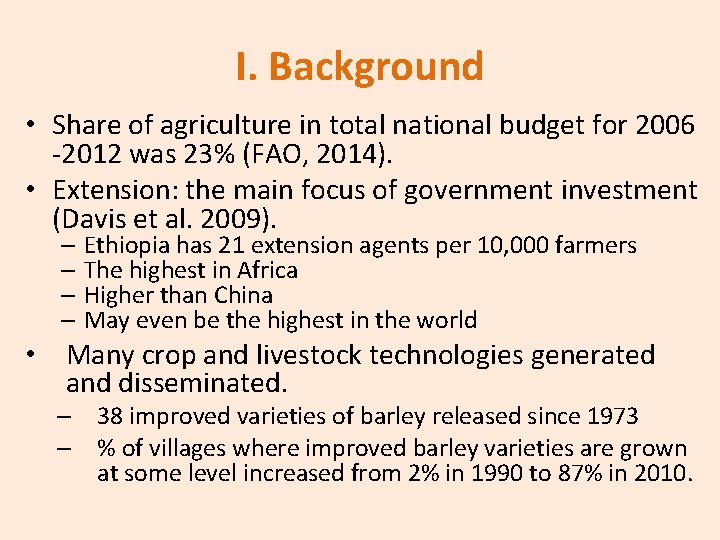
I. Background • Share of agriculture in total national budget for 2006 -2012 was 23% (FAO, 2014). • Extension: the main focus of government investment (Davis et al. 2009). – Ethiopia has 21 extension agents per 10, 000 farmers – The highest in Africa – Higher than China – May even be the highest in the world • Many crop and livestock technologies generated and disseminated. – 38 improved varieties of barley released since 1973 – % of villages where improved barley varieties are grown at some level increased from 2% in 1990 to 87% in 2010.
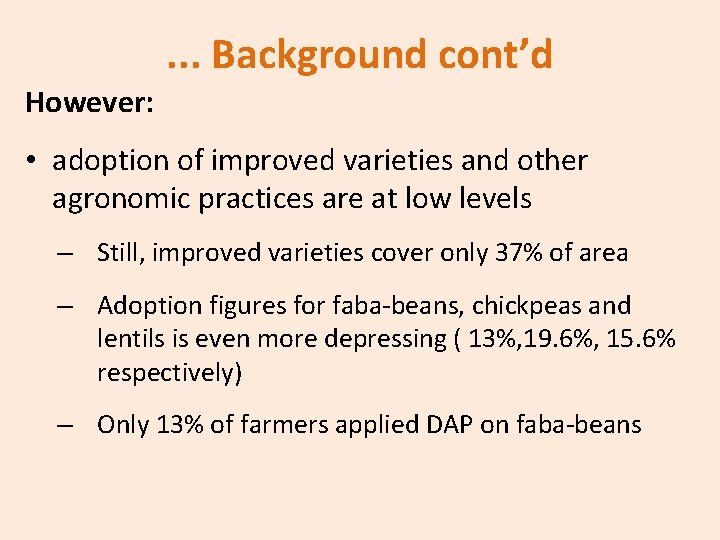
. . . Background cont’d However: • adoption of improved varieties and other agronomic practices are at low levels – Still, improved varieties cover only 37% of area – Adoption figures for faba-beans, chickpeas and lentils is even more depressing ( 13%, 19. 6%, 15. 6% respectively) – Only 13% of farmers applied DAP on faba-beans
. . . Background cont’d However cont’d: • Yigezu et al. , (2014): frequency of extension visits no effect on farmers’ crop and varietal choice. • Tiruneh et al. (2015): farmer-to-farmer extension led to higher adoption of improved barley var. • Focus group discussions in Gumera-Maksegnit: young and less farmers have poor access to credit – Constrained financially to adopt new technologies.
. . . Background cont’d • These facts/findings raise a number of questions • Could it be because: – The extension service delivery system at large is not suitable, appropriate or effective? – There are undesirable tradeoffs between number of extension agents and budget, supplies and facilities available for the DAs to discharge their tasks? – The development agents (DAs) do not have the needed qualifications? • • The training institutions don’t have good curriculum? The training institutions faulty or ineffective recruitment criteria? – The DAs are not motivated
. . . Background cont’d Could it instead be that the extension system is working, DAs are capable and have all they need but: The new technologies are not superior to the local technologies at least in some aspects of the production system? – Farmers are convinced and are interested to adopt the technologies but they don’t have the financial means to do so? – The extension system has managed to create effective demand but the necessary inputs (seeds, fertilizers, machinery, etc. ) are not available. Or, could it be all these and/or others? – These questions made the topic of high priority for research. – When an ADA call for proposal came out, with substantial help from Mr. Solomon Tiruneh (WLRC) and Dr. Chilot Yirga (EIAR), we developed and submitted the proposal. –
II. Project objectives and expected outputs – Project title: Improving Agricultural Extension Systems for Wider Adoption of Technologies – Planned duration of the project: 36 months (July 1, 2016 to June 30, 2019). – Overall Goal: enhance adoption of agricultural technologies through improved extension and credit service delivery systems.
… Project objectives and outputs cont’d – Specific objectives: 1. To design effective and inclusive extension and credit service delivery system(s); 2. To develop and test different extension and changeagent profiles, including relevant capacities and skills for process facilitation particularly for multistakeholder processes; and 3. To create awareness among policy makers for a new direction in the country’s extension service delivery system.
… Project objectives and outputs cont’d Expected outputs of this project are: • Output 1: Existing institutions, systems and approaches relevant to agricultural technology promotion and extension reviewed • Output 2: Innovative technology packages including user-friendly, inclusive and low-risk credit delivery systems designed based on a review/study of the effective demand
… Project objectives and outputs cont’d Expected outputs cont’d • Output 3: At least 3 inclusive and effective models of extension and credit service delivery systems developed and tested • Output 4: Profiles of existing extension and change agents reviewed and new profiles for single and multi-stakeholder processes facilitation developed and tested
… Project objectives and outputs cont’d Expected outputs cont’d • Output 5: At least 3 inclusive and effective models of extension and credit service delivery systems developed and tested • Output 6: Research Results Disseminated. • Output 7: Capacity development
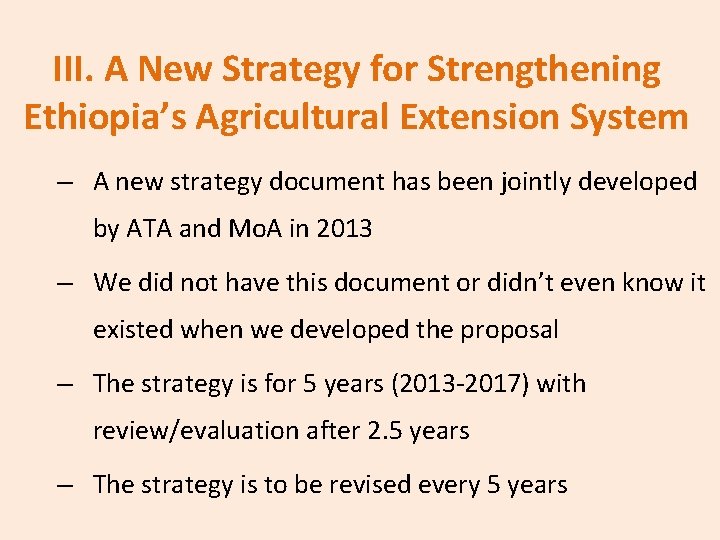
III. A New Strategy for Strengthening Ethiopia’s Agricultural Extension System – A new strategy document has been jointly developed by ATA and Mo. A in 2013 – We did not have this document or didn’t even know it existed when we developed the proposal – The strategy is for 5 years (2013 -2017) with review/evaluation after 2. 5 years – The strategy is to be revised every 5 years
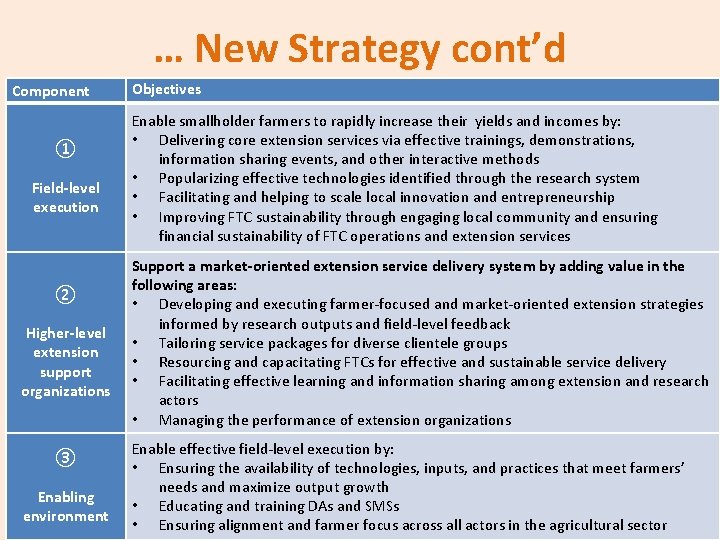
… New Strategy cont’d Component ① Field-level execution ② Higher-level extension support organizations ③ Enabling environment Objectives Enable smallholder farmers to rapidly increase their yields and incomes by: • Delivering core extension services via effective trainings, demonstrations, information sharing events, and other interactive methods • Popularizing effective technologies identified through the research system • Facilitating and helping to scale local innovation and entrepreneurship • Improving FTC sustainability through engaging local community and ensuring financial sustainability of FTC operations and extension services Support a market-oriented extension service delivery system by adding value in the following areas: • Developing and executing farmer-focused and market-oriented extension strategies informed by research outputs and field-level feedback • Tailoring service packages for diverse clientele groups • Resourcing and capacitating FTCs for effective and sustainable service delivery • Facilitating effective learning and information sharing among extension and research actors • Managing the performance of extension organizations Enable effective field-level execution by: • Ensuring the availability of technologies, inputs, and practices that meet farmers’ needs and maximize output growth • Educating and training DAs and SMSs • Ensuring alignment and farmer focus across all actors in the agricultural sector
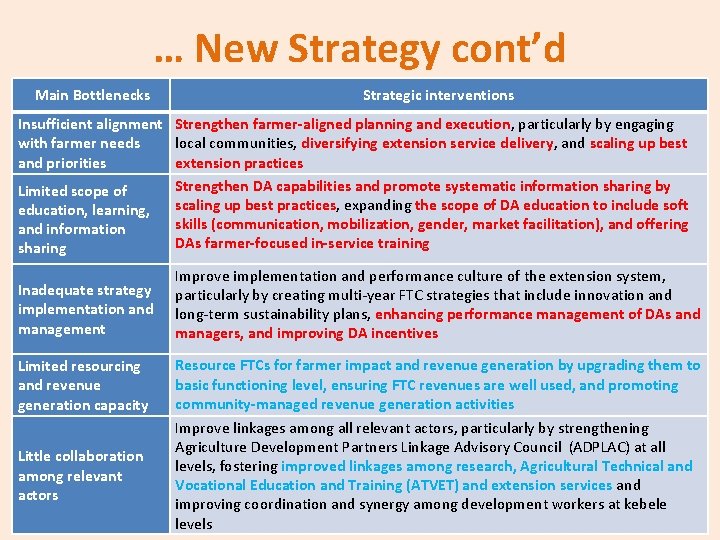
… New Strategy cont’d Main Bottlenecks Strategic interventions Insufficient alignment Strengthen farmer-aligned planning and execution, particularly by engaging with farmer needs local communities, diversifying extension service delivery, and scaling up best and priorities extension practices Strengthen DA capabilities and promote systematic information sharing by Limited scope of scaling up best practices, expanding the scope of DA education to include soft education, learning, skills (communication, mobilization, gender, market facilitation), and offering and information DAs farmer-focused in-service training sharing Inadequate strategy implementation and management Limited resourcing and revenue generation capacity Little collaboration among relevant actors Improve implementation and performance culture of the extension system, particularly by creating multi-year FTC strategies that include innovation and long-term sustainability plans, enhancing performance management of DAs and managers, and improving DA incentives Resource FTCs for farmer impact and revenue generation by upgrading them to basic functioning level, ensuring FTC revenues are well used, and promoting community-managed revenue generation activities Improve linkages among all relevant actors, particularly by strengthening Agriculture Development Partners Linkage Advisory Council (ADPLAC) at all levels, fostering improved linkages among research, Agricultural Technical and Vocational Education and Training (ATVET) and extension services and improving coordination and synergy among development workers at kebele levels
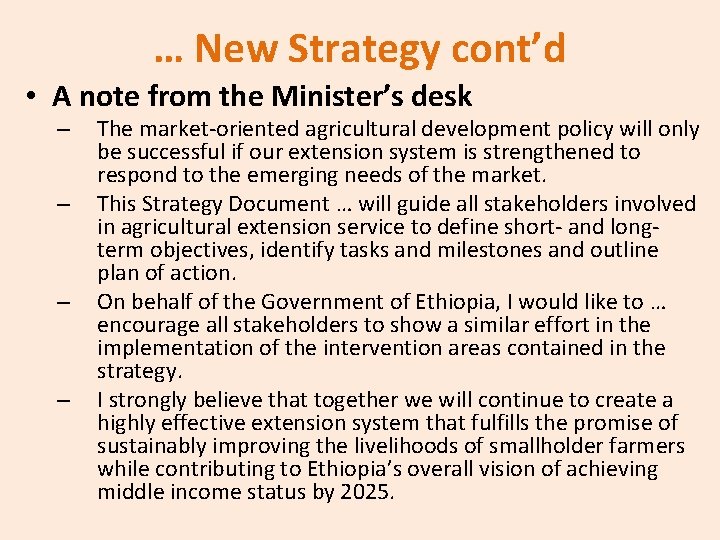
… New Strategy cont’d • A note from the Minister’s desk – – The market-oriented agricultural development policy will only be successful if our extension system is strengthened to respond to the emerging needs of the market. This Strategy Document … will guide all stakeholders involved in agricultural extension service to define short- and longterm objectives, identify tasks and milestones and outline plan of action. On behalf of the Government of Ethiopia, I would like to … encourage all stakeholders to show a similar effort in the implementation of the intervention areas contained in the strategy. I strongly believe that together we will continue to create a highly effective extension system that fulfills the promise of sustainably improving the livelihoods of smallholder farmers while contributing to Ethiopia’s overall vision of achieving middle income status by 2025.
IV. Guiding Principles for our Deliberations – There a number of topical/thematic overlaps between our proposal and the strategy document. – A major focus of this research : • Providing credible, scientifically and statistically defendable evidence (using experimental designs) for supporting or invalidating major statements (assumptions) • Conducting good review of the literature and the strategy and also identify and fill gaps in analysis – God balance between experiments and desk reviews and qualitative analysis.
… Guiding Principles cont’d – Some important topics missing from our proposal that we should take into consideration in our research: • Extension on market orientation of agricultural production • Market information systems • The use of ICTs for extension service delivery • Roles of institutions (e. g. farmer organizations) – We should also make sure to not spread too thinly – Therefore, we have to prioritize.
… Guiding Principles cont’d – The topic can be politically very sensitive – Hence, if we want to have impact on agriculture in the country, we need to navigate carefully • Avoid confrontational approaches but also should not shy away to suggest options for changing the statuesque (when we do this, the presentation matters!!!) • A need for identifying boundaries which we don’t want to cross • Focus on solutions rather than problems – let us be impact oriented – should not be engrossed in problem analysis • Tap into existing/available/potential opportunities
Thank You!