
Improving Accuracy and Saving Time Electronic Vitals Documentation


- Slides: 22
Improving Accuracy and Saving Time: Electronic Vitals Documentation Tamara Brockman, MSN, APRN, CPNP- PC/AC Ifeyinwa Mazeli, BSN, M. Ed Paula Kostuik Neidhard, MS, ARNP, AOCNP University of Cincinnati 1
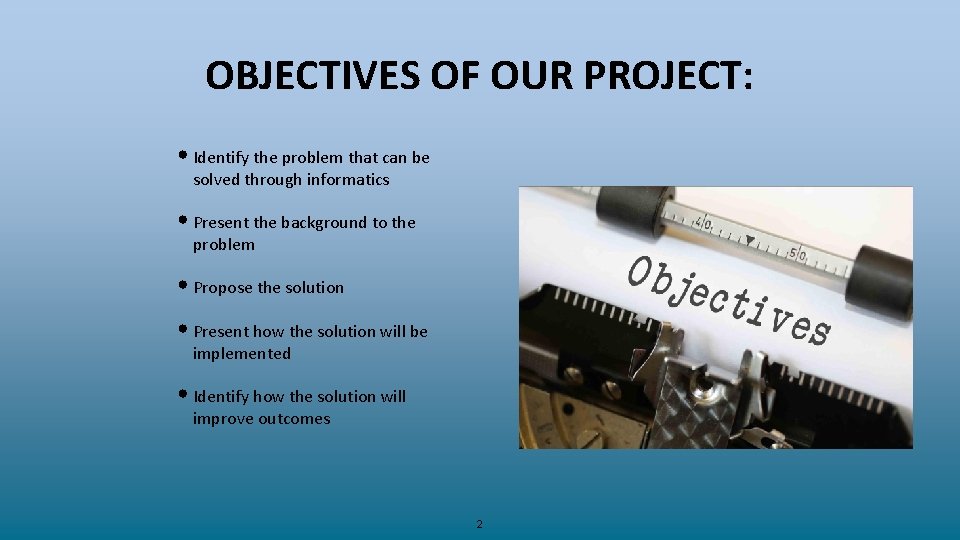
OBJECTIVES OF OUR PROJECT: • Identify the problem that can be solved through informatics • Present the background to the ADD Picture problem • Propose the solution • Present how the solution will be implemented • Identify how the solution will improve outcomes 2
WHY IS THIS A PROBLEM IN ADVANCED CLINICAL PRACTICE TODAY ? “Timely vital signs documentation and effective patient care coordination are more important than ever, as communication delays to critical data can limit the detection of patient deterioration, leading to adverse events" (Yeung, Lapinsky, Granton, Dornan and Cafazzo, 2012, pg. 976). 3
BACKGROUND TO THE PROBLEM: Vital Signs are perhaps most fundamental component of patient evaluation. . . as such vital signs should be accurate, easily accessible to make safe therapeutic decisions. (Smith, Banner, Lozano, Olney, Friedman, 2009) There is currently no utilization of electronic vitals documentation at the University of Cincinnati Medical Center (UCMC) Present day practice is to document vital sign measurements on paper and then at a later time transcribe them the to the Electronic Health Record (EHR) In this electronic age health care providers are still relying on paper documentation to capture one of the most critical pieces of patient data and the literature has shown this to be costly in relation to patient safety, lack of quality, accessibility and poor utilization of evidence based practice At UCMC the use of paper documentation demonstrates a work around style of care the potentially introduces an increase in cost by consuming more staff time used, increased errors, and a loss of overall productivity Use of paper documentation and transcription to EHR is redundant and inefficient in regard to the time it takes to complete, the delay causes unavailability of these measurements in real time, and there is an error rate with this antiquated process causing defects in the workflow (Alexander, Frith and Hoyl, 2019, pg 135). 4
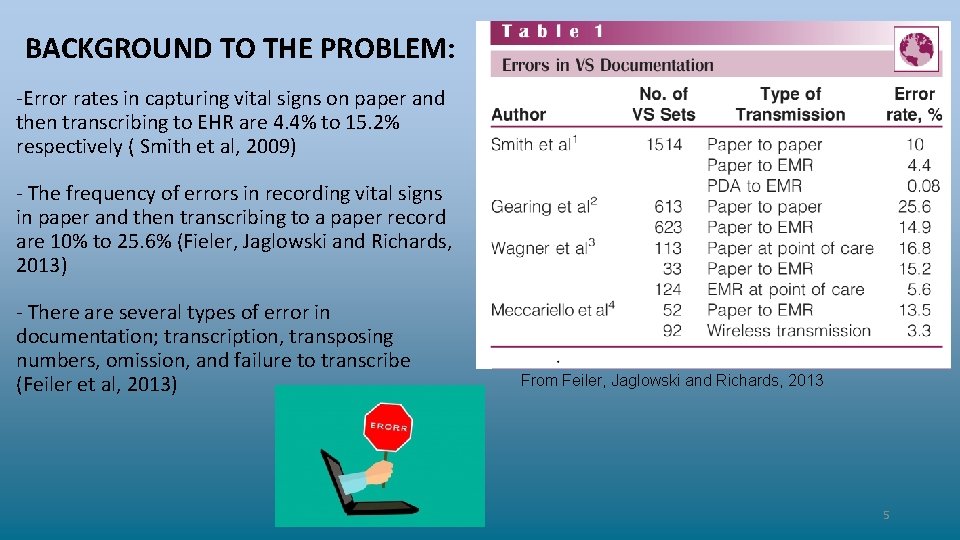
BACKGROUND TO THE PROBLEM: -Error rates in capturing vital signs on paper and then transcribing to EHR are 4. 4% to 15. 2% respectively ( Smith et al, 2009) - The frequency of errors in recording vital signs in paper and then transcribing to a paper record are 10% to 25. 6% (Fieler, Jaglowski and Richards, 2013) - There are several types of error in documentation; transcription, transposing numbers, omission, and failure to transcribe (Feiler et al, 2013) From Feiler, Jaglowski and Richards, 2013 5
BACKGROUND TO THE PROBLEM: • Such errors reduce clarity of records but may also initiate an error that cascades and injures a patient (Alexander et al, 2019). • Errors made thus effect the calculation of the Early Warning Scoring (EWS) algorithm which helps determine how regularly future vital signs observations should be made (Wong, Bonnici, Knight, Morgan, Coombe and Watkinson, 2015). • Errors made also effect the calculations made when using the SOFA (Sequential Organ Failure Assessment) score to determine a change in patient status that can predict morbidity and mortality (Gilli, Remberger, Ringden and Mattsson, 2010). • Vital signs are not being recorded in the EMR in real time causing the sequale of delay in communication between multiple healthcare providers (Stevenson, Israelsson and Bath, 2017) thus increasing the cost of care and preventing medical error. 6
BACKGROUND TO THE PROBLEM: • Healthcare providers spend a considerable amount of time to document clinical information (Wong et al, 2017) • Health care staff spend 12 minutes per patient per day with paper documentation to EHR and 2 minutes per day with wireless documentation (Fieler et al, 2013). • Use of paper documentation and transcription to EHR is redundant and inefficient in regard to the time it takes to complete, the delay causes unavailability of these measurements in real time, and there is an error rate with this antiquated process causing defects in the workflow (Alexander, Frith and Hoyl, 2019, pg 135). • There is a need to evaluate at the fundamental basis for clinical decision making - vital signs; as there are very few reported best practice guidelines for conducting vital sign measurements and recordings (Yeung et al, 2012) • The 2019 patient safety goals set by the Joint Commission to make sure that staff communication is improved by ensuring important test results are delivered to the right staff person on time (Joint Commission International Center for Patient Safety, 2019) and this is not being met at UCMC • In 2006 the Institute for Healthcare Improvement called the 5 Million Lives Campaign sought to reduce the number of medical errors to significantly reduce the rate of morbidity and mortality ( IHI, 2019) and electronic vitals documentation can assist in this 7
Evidenced-based Informatics Concept as a Solution: Although there is overwhelming agreement that vital signs are crucial to both detecting and responding to patient status, the methods in which vital signs are documented in electronic health records (EHR) has received limited attention in the research literature. • Documentation process for vital signs is highly variable between institutions and health care settings • Lack of standard practice guidelines allows for variability of methods used to record patient information • There are very few reported best practice guidelines for conducting vital sign measurement and recordings • Identifying the gaps in healthcare technology, clinical workflows, and environment can inform the design of more effective technology • The lack of evidence-based knowledge regarding the nursing workflow makes it difficult to compare any new process or technology systems to current processes and technologies. Conclusion: More research is indicated related to vital signs and the incorporation of an informatics concept (electronic vital sign documentation) as a solution. ( Yeung, M. S. , Lapinsky, S. E. , Granton, J. T. , Doran, D. M. , Cafazzo, J. A. Examining nursing vital signs documentation workflow: barriers and opportunities in general internal medicine units. Journal of Clinical Nursing, 21, 975 -982. ) 8
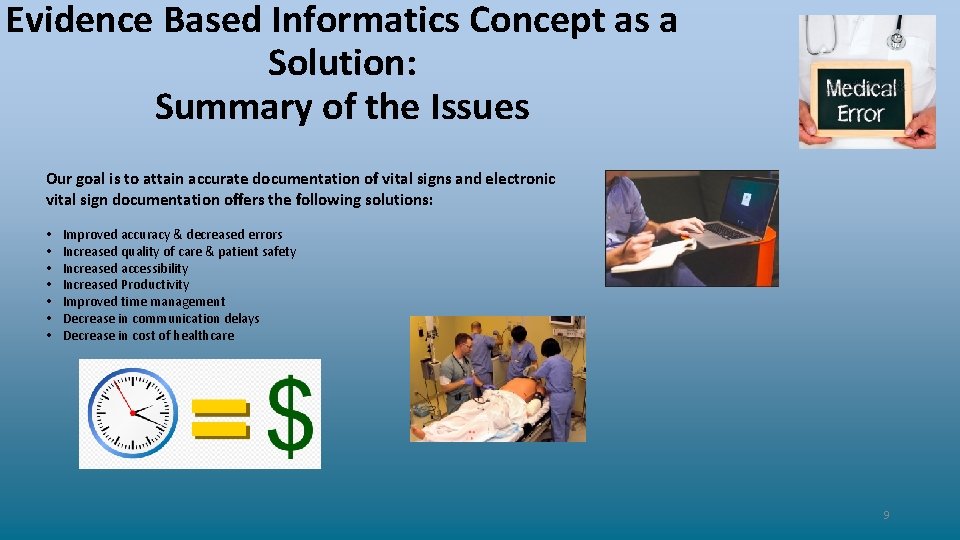
Evidence Based Informatics Concept as a Solution: Summary of the Issues Our goal is to attain accurate documentation of vital signs and electronic vital sign documentation offers the following solutions: • • Improved accuracy & decreased errors Increased quality of care & patient safety Increased accessibility Increased Productivity Improved time management Decrease in communication delays Decrease in cost of healthcare 9
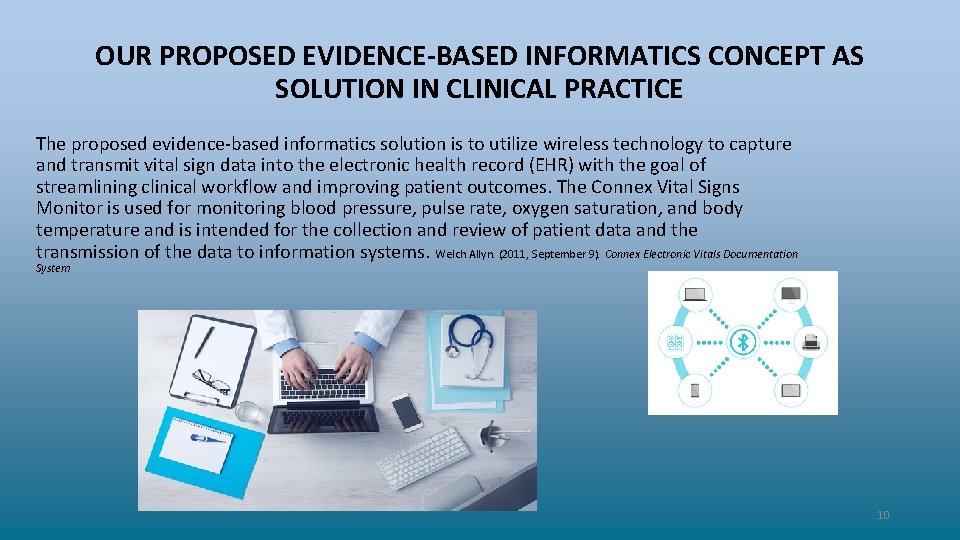
OUR PROPOSED EVIDENCE-BASED INFORMATICS CONCEPT AS SOLUTION IN CLINICAL PRACTICE The proposed evidence-based informatics solution is to utilize wireless technology to capture and transmit vital sign data into the electronic health record (EHR) with the goal of streamlining clinical workflow and improving patient outcomes. The Connex Vital Signs Monitor is used for monitoring blood pressure, pulse rate, oxygen saturation, and body temperature and is intended for the collection and review of patient data and the transmission of the data to information systems. Welch Allyn. (2011, September 9). Connex Electronic Vitals Documentation System 10
IMPLEMENTATION OF THE SOLUTION IN CLINICAL PRACTICE The pilot project will be implemented on a general medical/surgical unit at UCMC. An electronic vitals documentation (EVD) system, Connex by Welch Allyn, will be used. Connex is compatible with the hospital EHR, allowing patient data to be downloaded directly from the point of care. Training will be provided to the nursing staff. Data will also be entered by hand into the EHR for comparison. An informatics nurse will observe the staff obtaining and documenting vital signs and verify the data. Staff will provide feedback by completing a questionnaire. Welch Allyn. (2011, September 9). Connex Electronic Vitals Documentation System 11
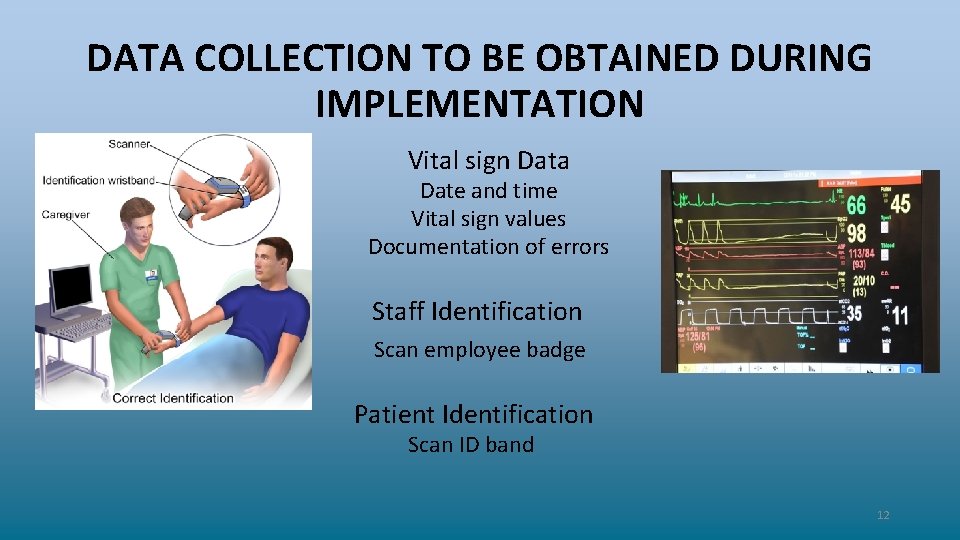
DATA COLLECTION TO BE OBTAINED DURING IMPLEMENTATION Vital sign Data Date and time Vital sign values Documentation of errors Staff Identification Scan employee badge Patient Identification Scan ID band 12
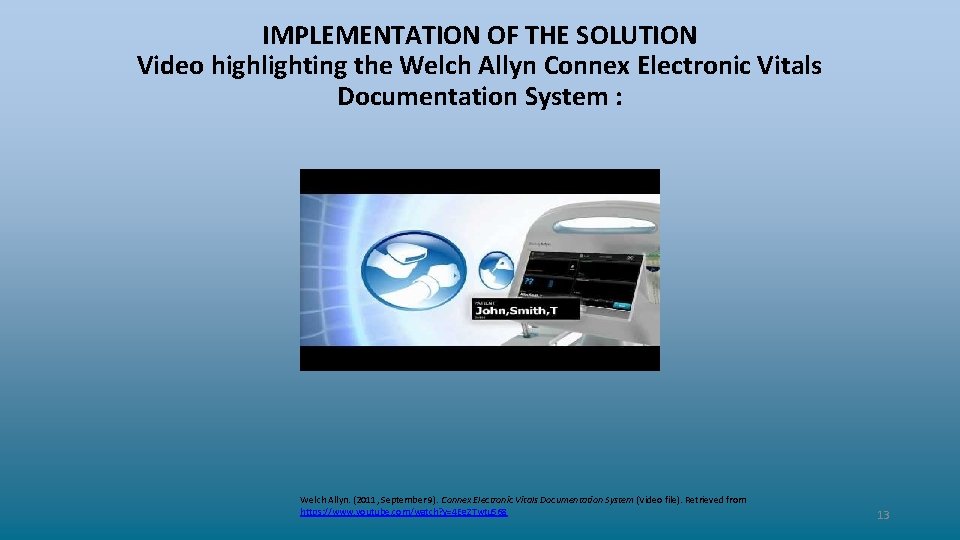
IMPLEMENTATION OF THE SOLUTION Video highlighting the Welch Allyn Connex Electronic Vitals Documentation System : Welch Allyn. (2011, September 9). Connex Electronic Vitals Documentation System (Video file). Retrieved from https: //www. youtube. com/watch? v=4 Eg. ZTwtu 568 13
IMPLEMENTATION OF THE SOLUTION Summary of Connex Electronic Vital Documentation System • flexible and adapts to the environment • system includes monitor, stand software • works with existing infrastructure and interfaces with HER • offers partners in care support services and remote diagnostics • utilizes simple scanning to send vital sign data wirelessly to the EHR from the bedside • allows access to vitals anytime and anywhere Welch Allyn. (2011, September 9). Connex Electronic Vitals Documentation System (Video file). Retrieved from https: //www. youtube. com/watch? v=4 Eg. ZTwtu 568
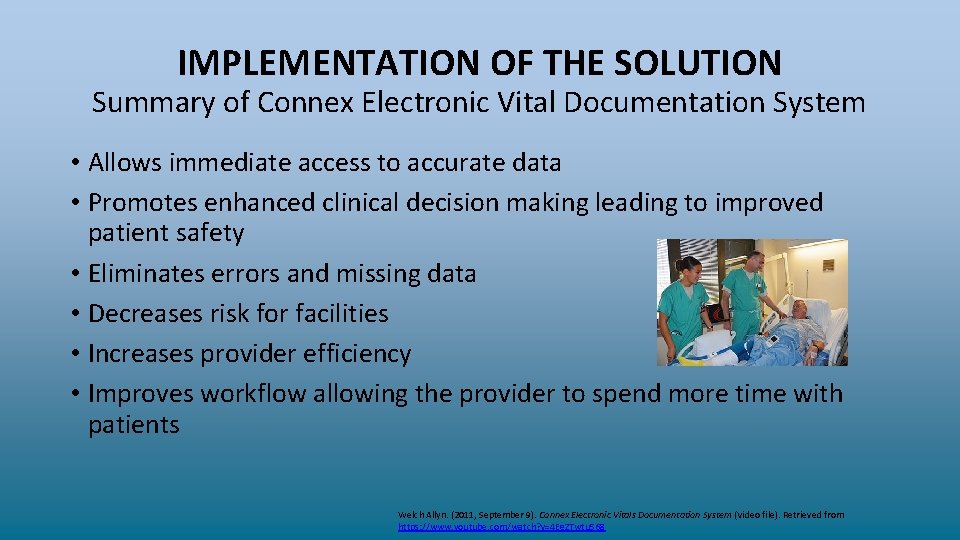
IMPLEMENTATION OF THE SOLUTION Summary of Connex Electronic Vital Documentation System • Allows immediate access to accurate data • Promotes enhanced clinical decision making leading to improved patient safety • Eliminates errors and missing data • Decreases risk for facilities • Increases provider efficiency • Improves workflow allowing the provider to spend more time with patients Welch Allyn. (2011, September 9). Connex Electronic Vitals Documentation System (Video file). Retrieved from https: //www. youtube. com/watch? v=4 Eg. ZTwtu 568
THE RESEARCH SUPPORTING THE PROPOSED IMPROVED OUTCOMES: In Fieler, Jaglowski, & Richards (2013), eliminating errors in vital signs documentations: • Study was done in the hospital to assess the vital signs error before and after implementations of the wireless vita sign data transfer system • Different methods of entering vital signs into medical records are: • Hand written on a paper and enter into a paper documentation system. • Handwritten and entered into patients’ EHR record. • Vital signs entered directly into patients EMR record or transmitted via wireless directly from the vital signs machines into an EMR. 16
Fieler et al continued: • this study was done in 2 separate phases: • Phase 1 - total of 64 vital signs were collected • Phase 2 -66 vital signs were collected • Phase 1 -15 clinicians participated and 64 patients • Phase 2 -13 clinicians participated and 66 patients. • Data was collected on Systolic blood pressure (SBP), Diastolic blood pressure (DBP), HR, temperature, oxygen saturation, Respiration Rate (RR) It was shown that a wireless system: • Reduced Error • Reduced time for vital signs to be accessible in EMR • Improved patient safety 17
In Smith, Banner, Lozano, Olney & Friedman (2009), Connected care: reducing errors through automated vital signs data upload It was found that: • The study was based on the precept that using wireless mobile technology to document and transmit vital signs eliminate the need to write and type out vital signs into patients record. • This flow process decreases documentation errors and improves patient safety. • Purpose was to determine the accuracy of vital sign data collected from an automated vital sign monitor, transmitted through an infrared port to a personal digital assistant, then automatically uploaded into an EMR. • Analysis of the accuracy done on the transmission of the data from vital sign monitor to the EMR reveals: • Baseline error on vital signs done and recorded on paper 4. 4%, automatic vital sign upload system in the same nursing unit reduces error to 0. 66% • Statistical analysis using t test found that there was statistical significance (PG. 001) when using the automated system • This process streamlined patient care flow process and improved efficiency 18
In Stevenson, Petersson, Israelsson, & Bath (2017), factors influencing the quality of vital signs data in electronic health records: a qualitative study It was found that: • improved facilities for electronic documentation of vital signs in patient care reduce inadequate routines in the documentation of vital signs in EHR • Problems of incomplete and inconsistency exit in documentations of vital signs • Routine standardization in monitoring and documenting vital signs reduces these problems and prevents any compromise to patients’ safety. • Improved facilities and devices such as vital signs connectivity can also help to improve vital signs documentation. 19
SUMMARY OF PROPOSED OUTCOMES OF OUR SOLUTION TO THE INFORMATICS PROBLEM These studies have highlighted the effectiveness and benefits of using wireless system in the assessment and documentation of patients’ vital signs. These studies demonstrated improved outcomes such as: • Significant decrease in error in documentation with wireless vital signs devices • Reduced time for vital signs documentation • Reduces time for vital signs to be accessed in EMR thereby improving patients care and safety and intervention where necessary • Streamlined of the flow process with increased efficiency • Standardization in monitoring and documentation of vital signs. The hope is that wireless assessment and monitoring devices will be used and implemented in patients care and assessments. 20
REFERENCES Alexander, S. , Frith, K. & Hoy, H. (2019). Applied Clinical Informatics for Nurses (2 nd ed. ). Burlington, MA: Jones & Bartlett Learning. Fielder, V. K. , Jaglowski, T. , & Richards, K. (2013). Eliminating errors in vital sign documentation. Computers, Informatics, Nursing, 31(9), 422 -427. Gill, K. , Remberger, M. , Ringden, O. , & Mattsson, J. (2010). Sequential organ failure assessment predicts the outcome of SCT recipients admitted to intensive care unit. Bone Marrow Transplantation, 45, 682 -688. Institute for Healthcare Improvement. An overview of the 5 million lives campaign. Retrieved from http: //www. ihi. org. Joint Commission International Center for Patient Safety Goals. Retrieved from http: //www. jointcommission. org. Smith, L. B. , Banner, L. , Lozano, D. , Olney, C. M. , & Friedman, B. (2009). Reducing errors through automated vital signs data upload. Computers, Informatics, Nursing, 27 (5), 318 -323. Stevenson, J. E. , Israelsson, J. , Petersson, G. , & Bath, P. A. (2017). Factors influencing the quality of vital sign data in electronic health records: a qualitative study. Journal of Clinical Nursing 27, 1276 -1286. 21
REFERENCES Wong, D. , Bonnici, T. , Knight, J. , Gerry, S. , Turton, J. , & Watkinson, P. (2017). A ward based time study of paper and electronic for recording vital signs observations. Journal of Medical Informatics Association, 24(4), 717 -721. documentation Wong, D. , Bonnici, T. , Knight, J. , Morgan, L. , Coombes. , P. , & Watkinson, P. (2015). SEND: a system for electronic notification and documentation of vital sign observations. BMC Medical Informatics and Decision Making, 15 (68) 1 -12. Welch Allyn. (2011, September 9). Connex Electronic Vitals Documentation System (Video file). Retrieved from https: //www. youtube. com/watch? v=4 Eg. ZTwtu 568 Welch Allyn. (2011, September 9). Connex Electronic Vitals Documentation System. Retrieved from https: //www. welchallyn. com/en/microsites/connex-clinical-surveillance-system/connex-electronic-vitals-documentation. html Yeung, M. , Lapinsky, S. E. , Granton, J. T. , Doran, D. M. , & Cafazzo, J. A. ((2012). Examining nursing vital signs documentation workflow: and opportunities in general internal medicine units. Journal of Clinical Nursing, 21, 975 -982. barriers . 22