
Improvements Of Sample Design For Rural Statistical Surveys





- Slides: 44
Improvements Of Sample Design For Rural Statistical Surveys In China Michael Steiner National Agricultural Statistics Service United States Department of Agriculture Xian Zude Rural Survey Organization Chinese National Bureau of Statistics
Chinese Census of Agriculture • First National Agricultural Census --- 1996 • Census Questionnaires – 38 sections, 687 data items • Data collection – January 1997 • Data collected for approximately 214, 000 rural households • Approximately 7, 000 interviewers were utilized for data collection
Use of Chinese Census Data • Provides a wealth of crop, livestock and rural household statistics. • Provides estimates of small administrative units. • Provides estimates of rare commodities. • Provides data for a sampling frame.
Chinese Agriculture Statistics • National Bureau of Statistics (NBS) of PR China • Food and Agricultural Statistics Centre (FASC) of NBS --- Chinese Census of Agriculture • Rural Survey Organization (RSO) --Agricultural & Rural Statistics for China – established in 1984 • Since 1996 --- NBS and the National Agricultural Statistics Service (NASS) of the U. S. Department of Agriculture --- cooperative
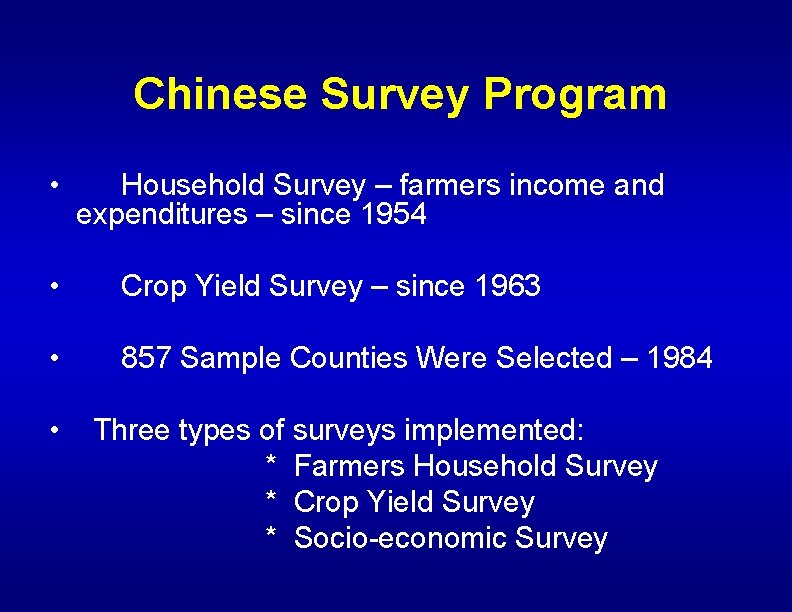
Chinese Survey Program • Household Survey – farmers income and expenditures – since 1954 • Crop Yield Survey – since 1963 • 857 Sample Counties Were Selected – 1984 • Three types of surveys implemented: * Farmers Household Survey * Crop Yield Survey * Socio-economic Survey
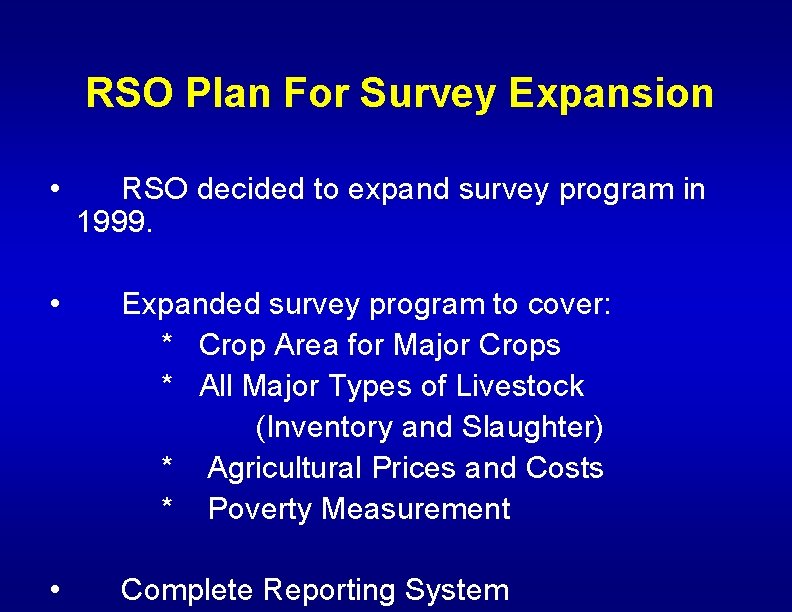
RSO Plan For Survey Expansion • RSO decided to expand survey program in 1999. • Expanded survey program to cover: * Crop Area for Major Crops * All Major Types of Livestock (Inventory and Slaughter) * Agricultural Prices and Costs * Poverty Measurement • Complete Reporting System
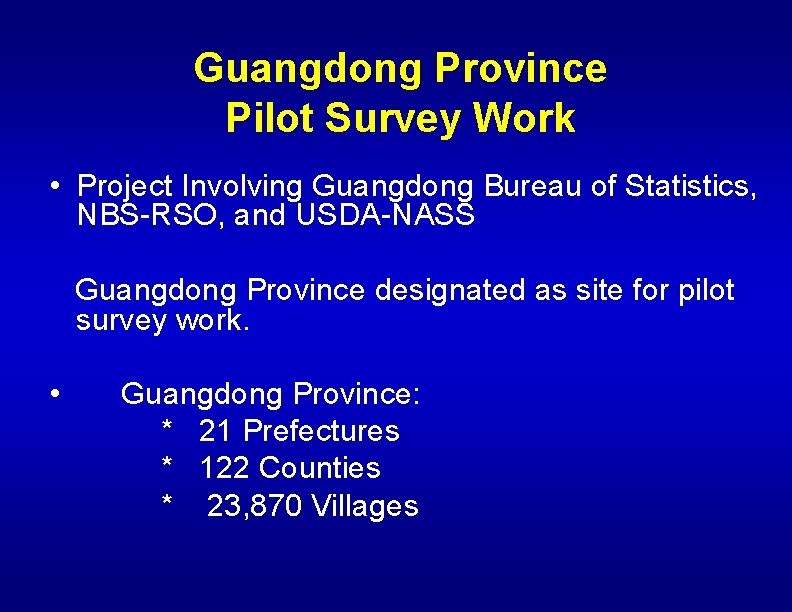
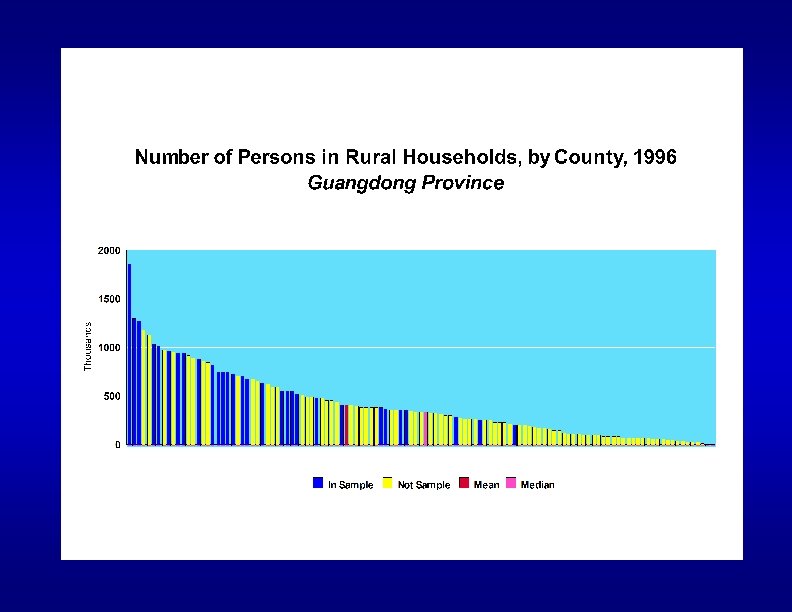
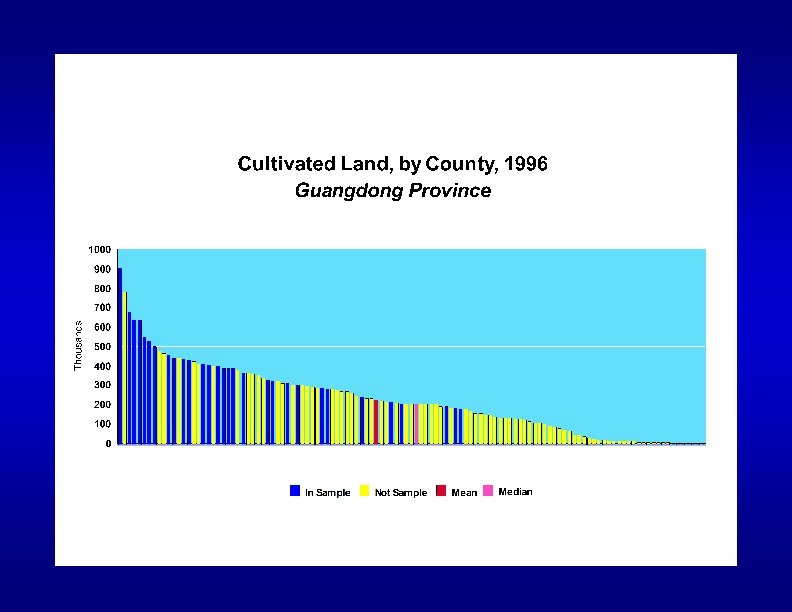
Guangdong Province Pilot Survey Work • Project Involving Guangdong Bureau of Statistics, NBS-RSO, and USDA-NASS Guangdong Province designated as site for pilot survey work. • Guangdong Province: * 21 Prefectures * 122 Counties * 23, 870 Villages
Sampling Alternatives Census Data Useful For Analysis
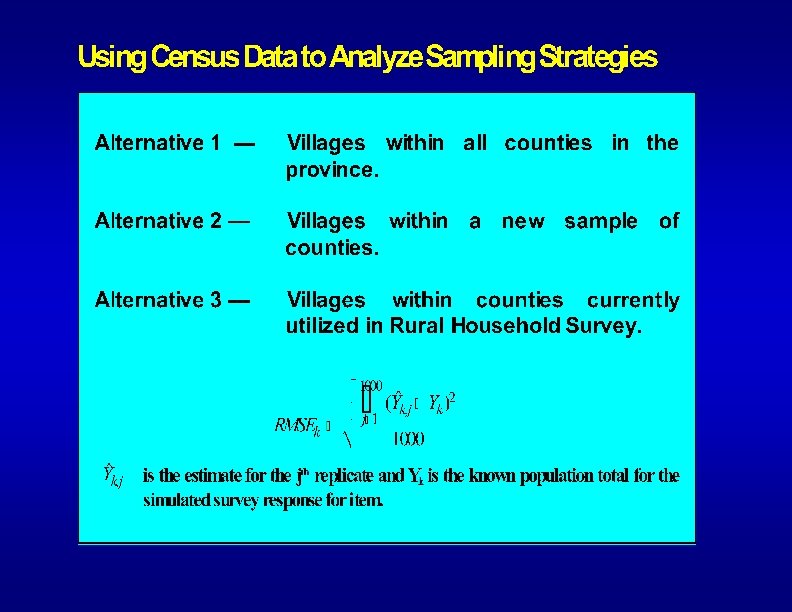
Alternative 1 • Select samples from villages within all counties in a province.
Alternative 2 • Select villages within a NEW sample of counties. • Continue the practice of having samples only in selected counties (not all counties). • Select a new sample of counties and replace the old sample of counties.
Alternative 3 • Select villages with the current sample of counties.
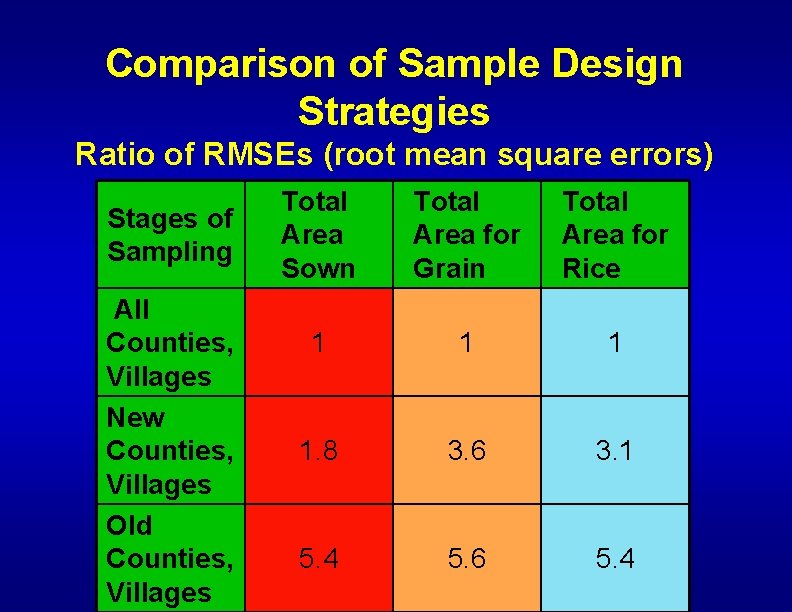
Comparison of Sample Design Strategies Ratio of RMSEs (root mean square errors) Stages of Sampling All Counties, Villages New Counties, Villages Old Counties, Villages Total Area Sown Total Area for Grain Total Area for Rice 1 1. 8 3. 6 3. 1 5. 4 5. 6 5. 4
Methods of Sampling
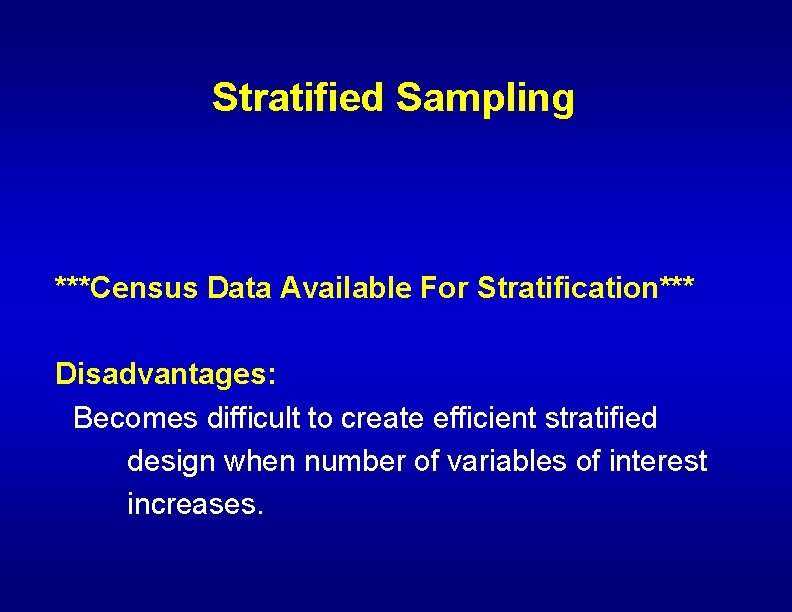
Stratified Sampling ***Census Data Available For Stratification*** Disadvantages: Becomes difficult to create efficient stratified design when number of variables of interest increases.
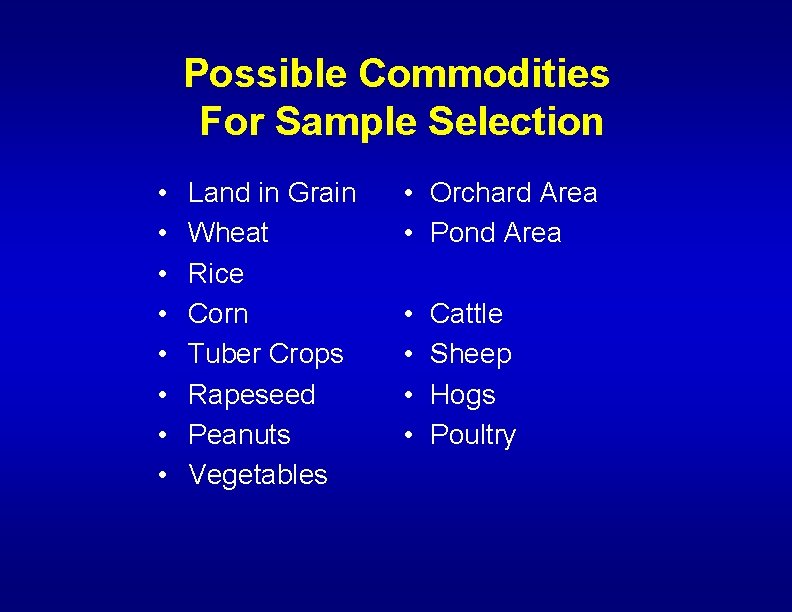
Possible Commodities For Sample Selection • • Land in Grain Wheat Rice Corn Tuber Crops Rapeseed Peanuts Vegetables • Orchard Area • Pond Area • • Cattle Sheep Hogs Poultry
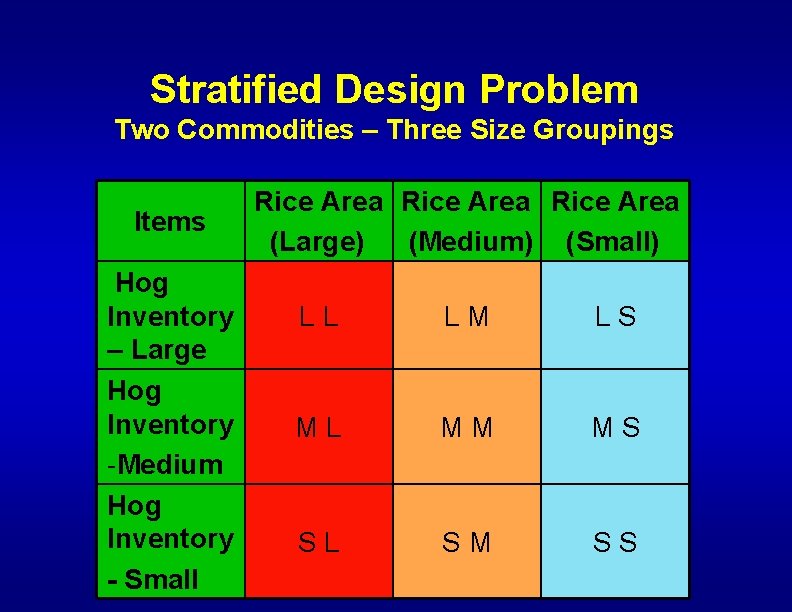
Stratified Design Problem Two Commodities – Three Size Groupings Items Hog Inventory – Large Hog Inventory -Medium Hog Inventory - Small Rice Area (Large) (Medium) (Small) LL LM LS ML MM MS SL SM SS
Methods of Sampling MPPS
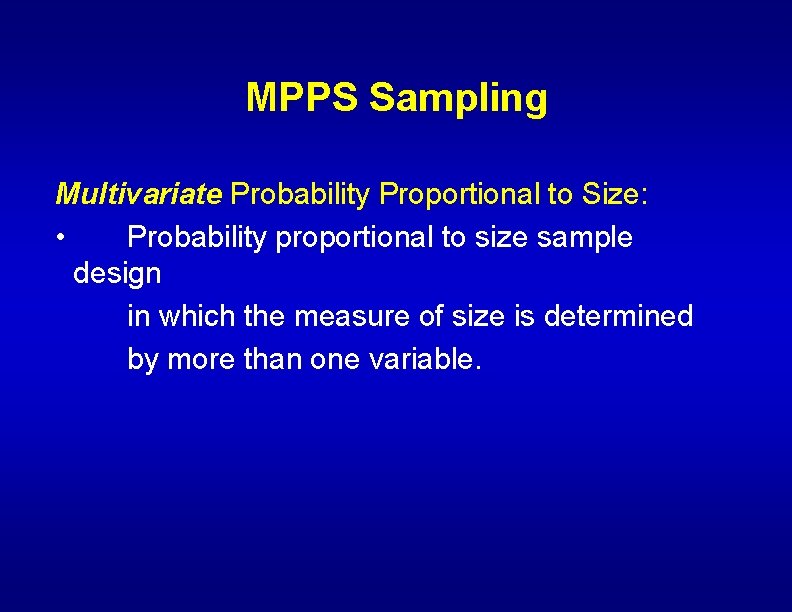
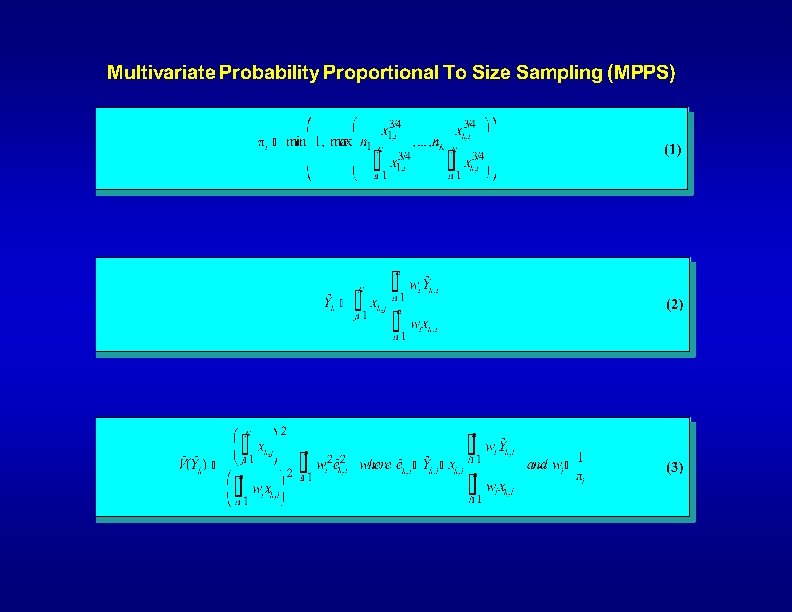
MPPS Sampling Multivariate Probability Proportional to Size: • Probability proportional to size sample design in which the measure of size is determined by more than one variable.
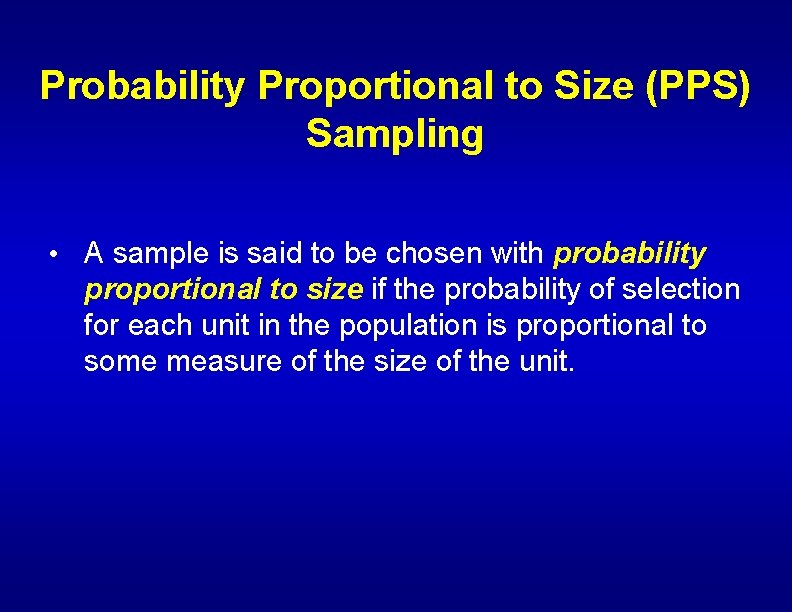
Probability Proportional to Size (PPS) Sampling • A sample is said to be chosen with probability proportional to size if the probability of selection for each unit in the population is proportional to some measure of the size of the unit.
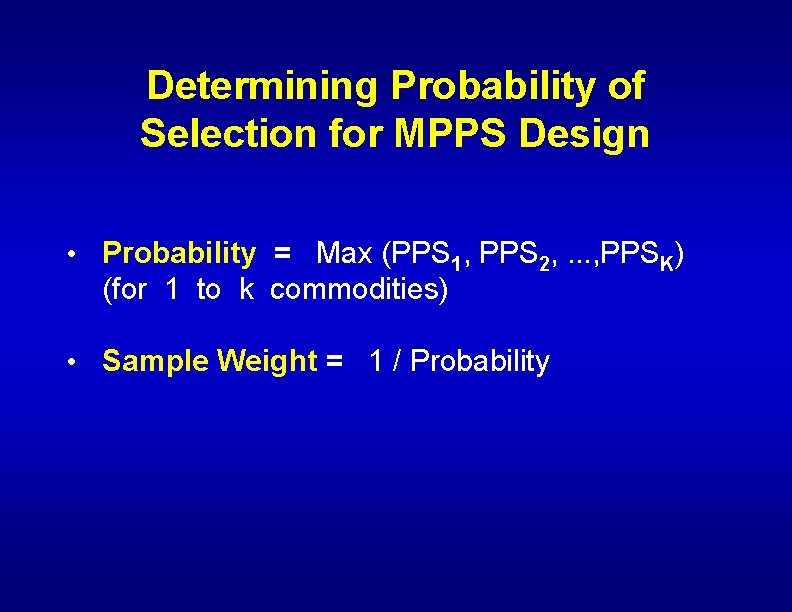
Determining Probability of Selection for MPPS Design • Probability = Max (PPS 1, PPS 2, . . . , PPSK) (for 1 to k commodities) • Sample Weight = 1 / Probability
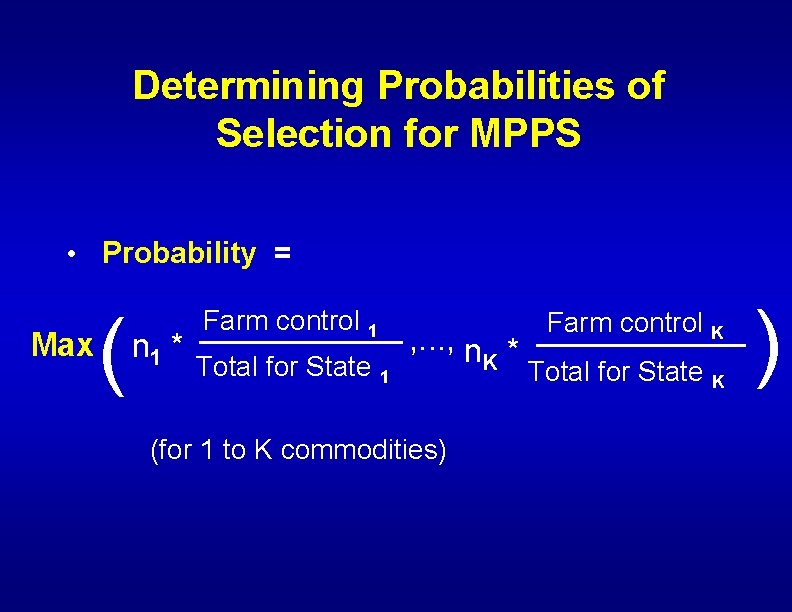
Determining Probabilities of Selection for MPPS • Probability = Max ( n 1 * Farm control 1 Total for State 1 , . . . , n * K (for 1 to K commodities) Farm control K Total for State K )
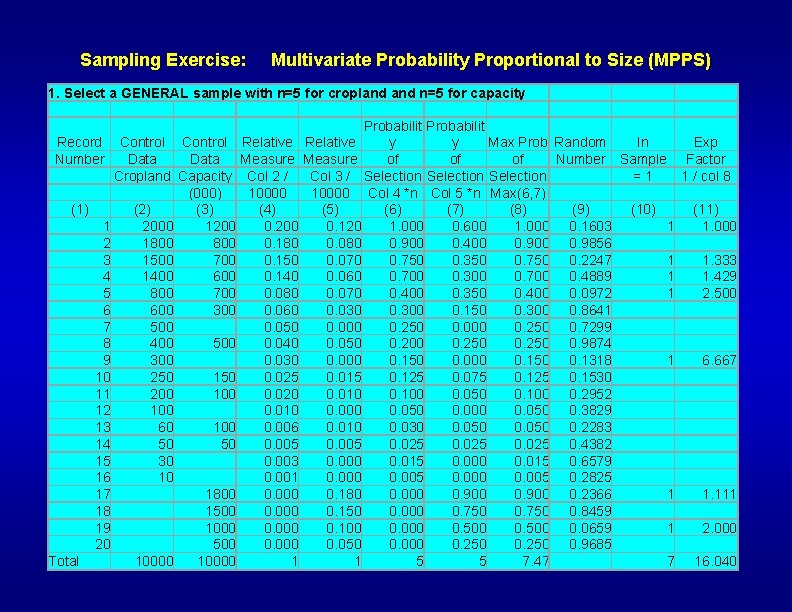
Sampling Exercise: Multivariate Probability Proportional to Size (MPPS) 1. Select a GENERAL sample with n=5 for cropland n=5 for capacity Probabilit Record Control Relative y y Max Prob Random In Exp Number Data Measure of of of Number Sample Factor Cropland Capacity Col 2 / Col 3 / Selection =1 1 / col 8 (000) 10000 Col 4 *n Col 5 *n Max(6, 7) (1) (2) (3) (4) (5) (6) (7) (8) (9) (10) (11) 1 2000 1200 0. 120 1. 000 0. 600 1. 000 0. 1603 1 1. 000 2 1800 0. 180 0. 080 0. 900 0. 400 0. 9856 3 1500 700 0. 150 0. 070 0. 750 0. 350 0. 750 0. 2247 1 1. 333 4 1400 600 0. 140 0. 060 0. 700 0. 300 0. 700 0. 4889 1 1. 429 5 800 700 0. 080 0. 070 0. 400 0. 350 0. 400 0. 0972 1 2. 500 6 600 300 0. 060 0. 030 0. 300 0. 150 0. 300 0. 8641 7 500 0. 050 0. 000 0. 250 0. 7299 8 400 500 0. 040 0. 050 0. 200 0. 250 0. 9874 9 300 0. 030 0. 000 0. 150 0. 1318 1 6. 667 10 250 150 0. 025 0. 015 0. 125 0. 075 0. 125 0. 1530 11 200 100 0. 020 0. 010 0. 100 0. 050 0. 100 0. 2952 12 100 0. 010 0. 000 0. 050 0. 3829 13 60 100 0. 006 0. 010 0. 030 0. 050 0. 2283 14 50 50 0. 005 0. 025 0. 4382 15 30 0. 003 0. 000 0. 015 0. 6579 16 10 0. 001 0. 000 0. 005 0. 2825 17 1800 0. 000 0. 180 0. 000 0. 900 0. 2366 1 1. 111 18 1500 0. 000 0. 150 0. 000 0. 750 0. 8459 19 1000 0. 100 0. 000 0. 500 0. 0659 1 2. 000 20 500 0. 050 0. 000 0. 250 0. 9685 Total 10000 1 1 5 5 7. 47 7 16. 040
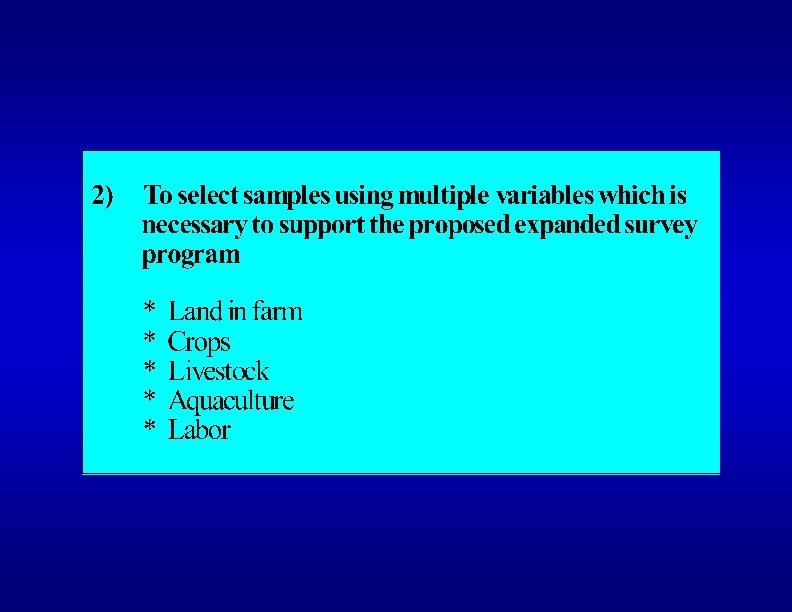
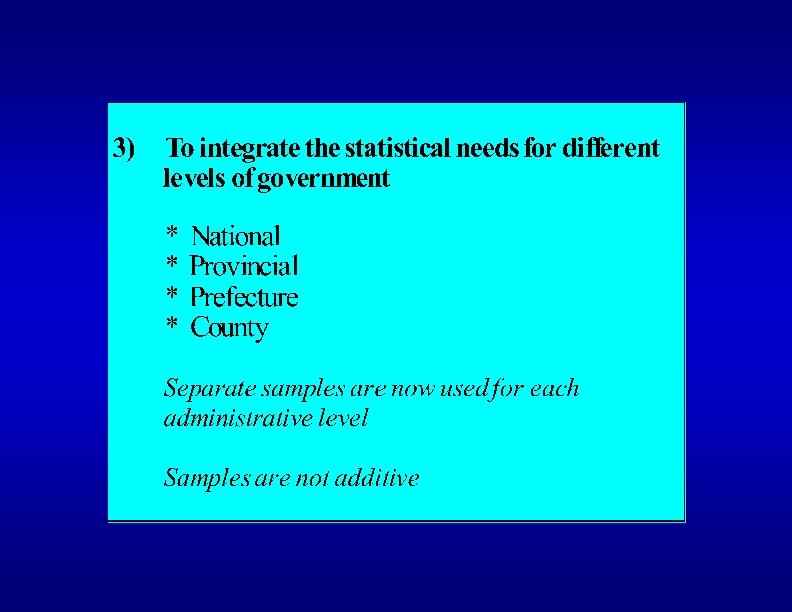
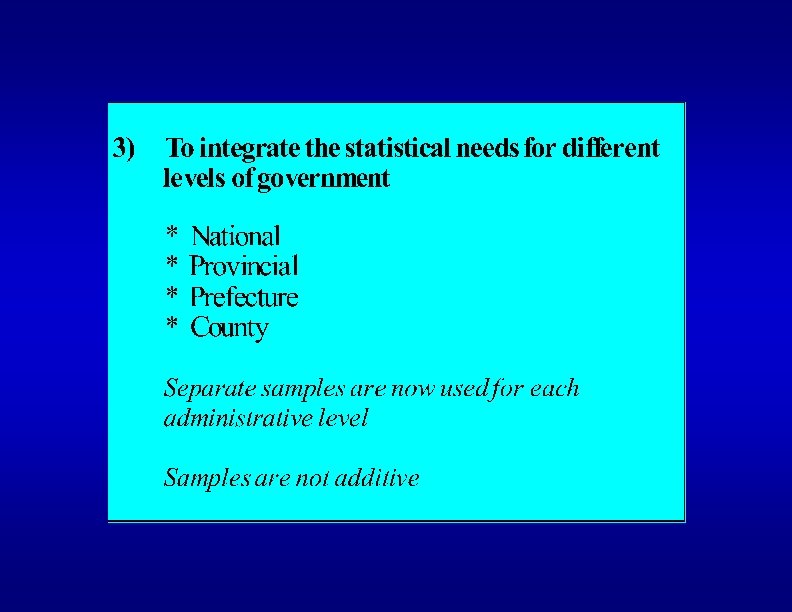
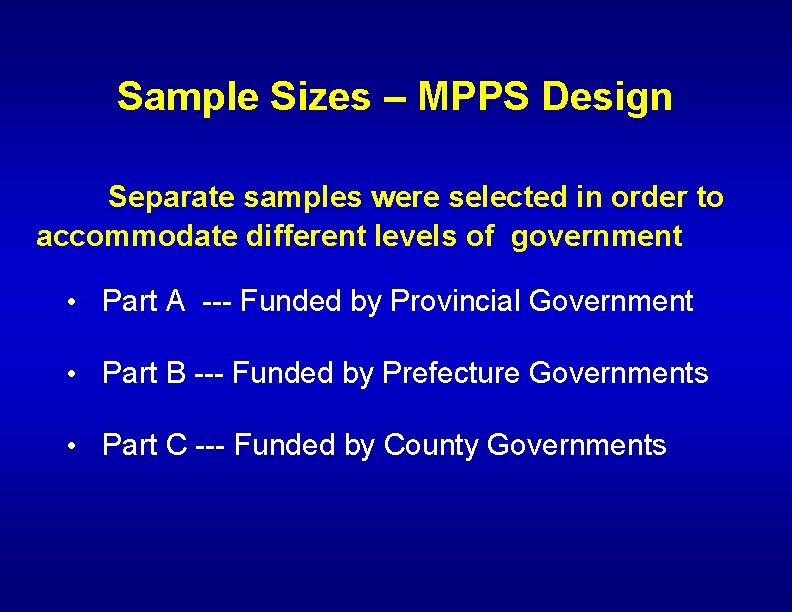
Sample Sizes – MPPS Design Separate samples were selected in order to accommodate different levels of government • Part A --- Funded by Provincial Government • Part B --- Funded by Prefecture Governments • Part C --- Funded by County Governments
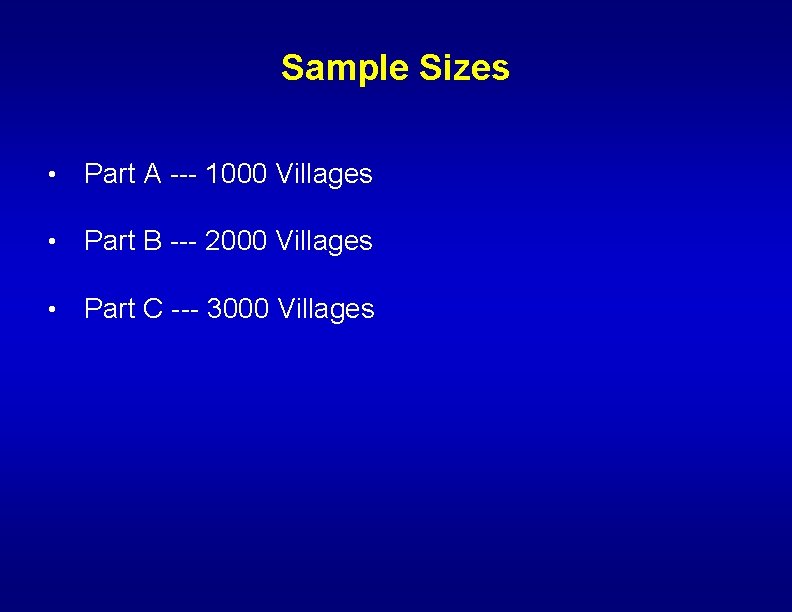
Sample Sizes • Part A --- 1000 Villages • Part B --- 2000 Villages • Part C --- 3000 Villages
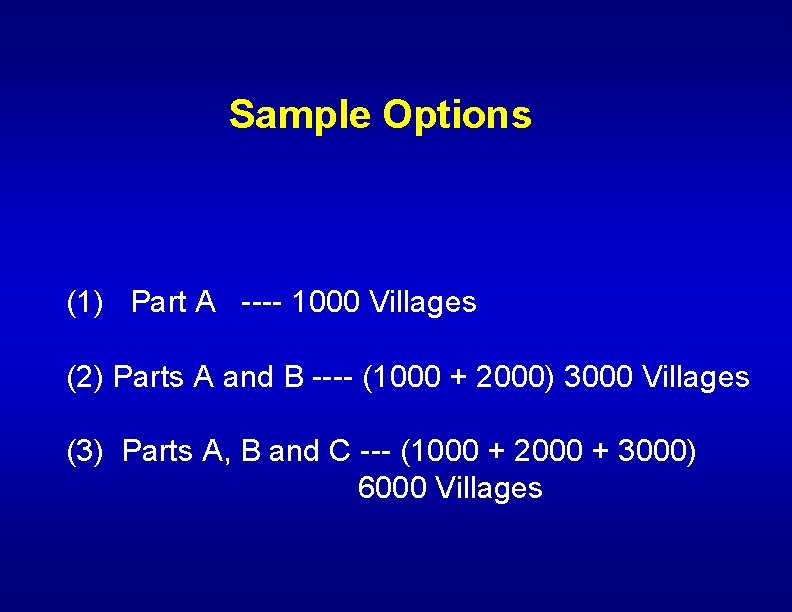
Sample Options (1) Part A ---- 1000 Villages (2) Parts A and B ---- (1000 + 2000) 3000 Villages (3) Parts A, B and C --- (1000 + 2000 + 3000) 6000 Villages
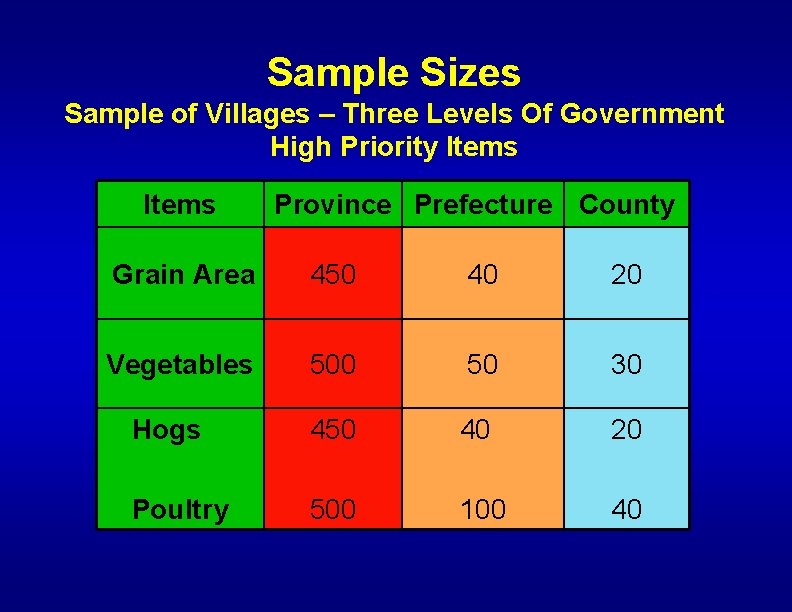
Sample Sizes Sample of Villages – Three Levels Of Government High Priority Items Province Prefecture County Grain Area 450 40 20 Vegetables 500 50 30 Hogs 450 40 20 Poultry 500 100 40
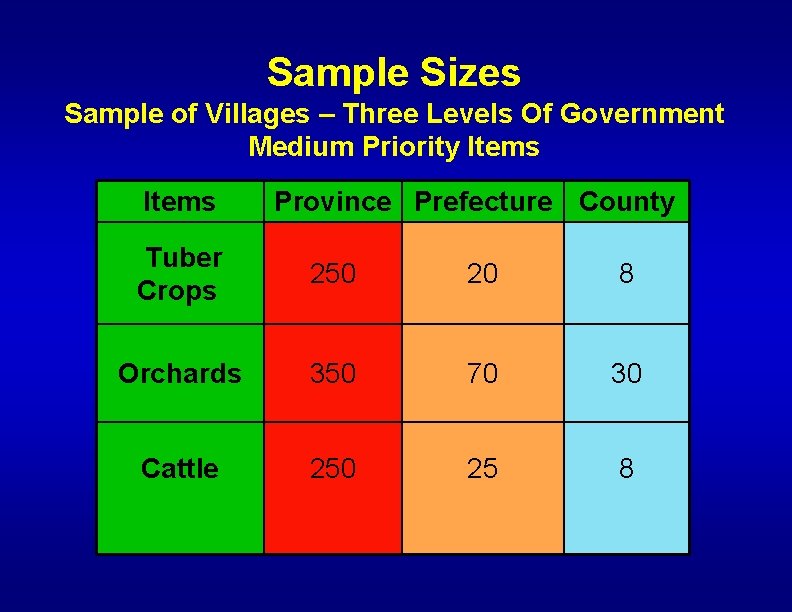
Sample Sizes Sample of Villages – Three Levels Of Government Medium Priority Items Province Prefecture County Tuber Crops 250 20 8 Orchards 350 70 30 Cattle 250 25 8
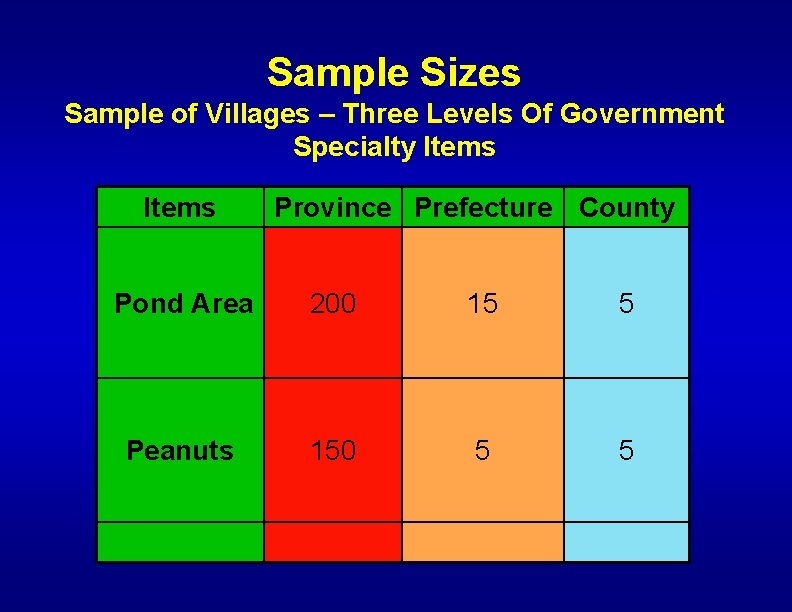
Sample Sizes Sample of Villages – Three Levels Of Government Specialty Items Province Prefecture County Pond Area 200 15 5 Peanuts 150 5 5
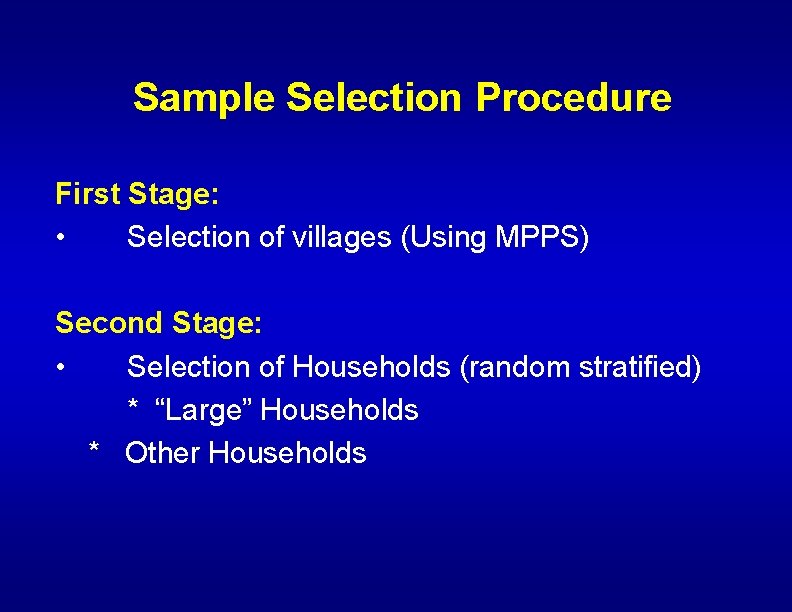
Sample Selection Procedure First Stage: • Selection of villages (Using MPPS) Second Stage: • Selection of Households (random stratified) * “Large” Households * Other Households
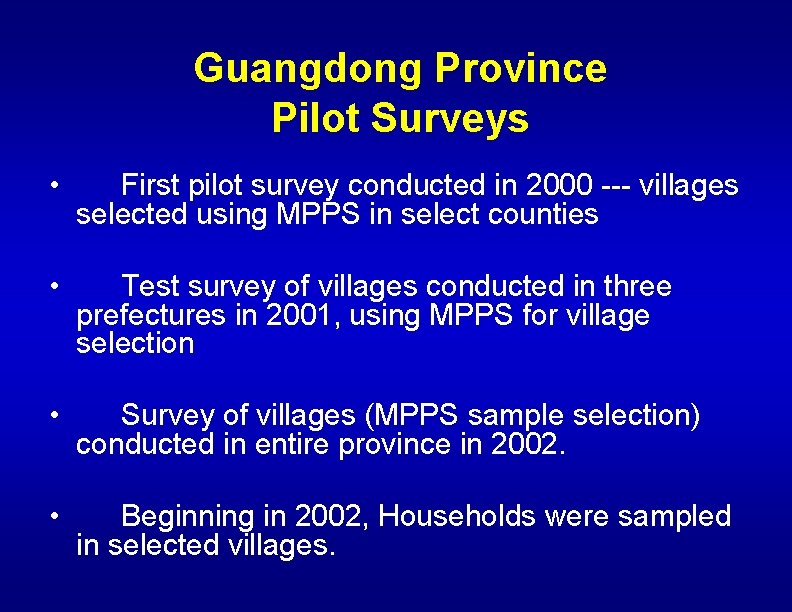
Guangdong Province Pilot Surveys • First pilot survey conducted in 2000 --- villages selected using MPPS in select counties • Test survey of villages conducted in three prefectures in 2001, using MPPS for village selection • Survey of villages (MPPS sample selection) conducted in entire province in 2002. • Beginning in 2002, Households were sampled in selected villages.
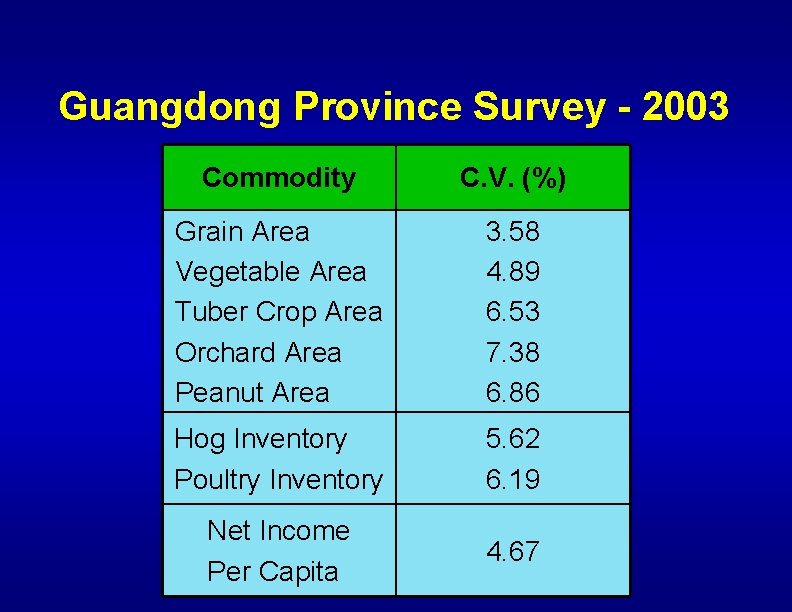
Guangdong Province Survey - 2003 Commodity C. V. (%) Grain Area Vegetable Area Tuber Crop Area Orchard Area Peanut Area 3. 58 4. 89 6. 53 7. 38 6. 86 Hog Inventory Poultry Inventory 5. 62 6. 19 Net Income Per Capita 4. 67
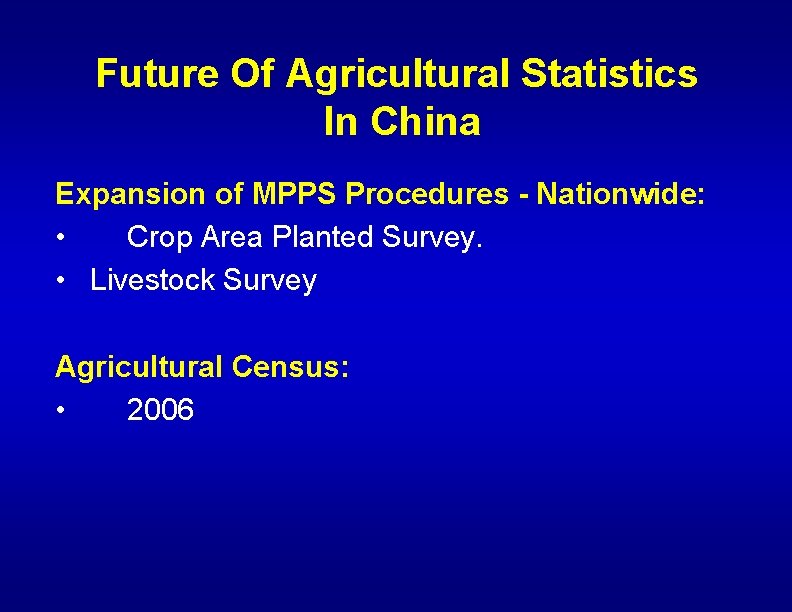
Future Of Agricultural Statistics In China Expansion of MPPS Procedures - Nationwide: • Crop Area Planted Survey. • Livestock Survey Agricultural Census: • 2006