
Improvement of the Nord DRG systems ability to

Improvement of the Nord. DRG systems ability to describe performance - a new logic for comorbidity and/or complications Mona Heurgren Head of Unit for Development of Quality and Efficiency Studies The National Board of Health and Welfare Sweden
Agenda • • • The scoop and benefits of casemix adjustments Background acknowledgements of the project Aims and Method Results Areas of use Discussion about the impact of a new system
The scoop of casemix adjustments • The idea of casemix is to adjust for differences in severity of illness, medical practice or risk of mortality in a defined group of patients/inhabitants or other populations • The current Nord. DRG system adjusts primly for severity of illness and medical practice per case for patients treated in hospitals • The ACG (Adjusted Clinical Groups)-system adjusts for severity of illness in a defined population per patient and year • The IR-system (3 M) adjusts for both severity of illness, medical practise and risk of mortality per case for patients treated in hospitals
Why improve Nord. DRGs ability to adjust for casemix? • To improve how to describe performance with DRGs (ex to be used for productivity and efficiency studies) • A better adjustment for casemix when comparing hospital performance in health care • To improve the analysis of differences in casemix in hospitals • To improve how to describe processes and medical pathways • To develop better prospective payment systems and budgeting tools • To achieve a higher acceptance for DRGs in the professional community
Background • During the last decade there has been an ongoing discussion about the need to improve the Nord. DRGs ability to describe patients comorbidity and/or complications. • The last years the coding of diagnoses and procedures in Swedish hospitals has improved significantly. • Several countries have already done the development work and changes (US, Canada, Australia).
Acknowledgements • The project is financed by the National Board of Health and Welfare (Socialstyrelsen) by grants from the Government • The project group represents a mix of different competences. Economist, physicians, statistician and medical secretary. – – – – – Per Sjöli Mona Heurgren Mats Fernström Ralph Dahlgren Gunnar Henriksson Liselotte Säll Åke Karlsson Anders Jacobsson Martti Virtanen Project leader Project owner Medical advisor Secretary Statistician Technical and medical advisor
The aim of the project • To develop a new logic within the Nord. DRGsystem for comorbidity and/or complications (CClogic) • To produce logic tables and a software product for acceptance tests in primly Sweden and Finland • The project will be finished in June 2010 • Acceptance tests during 2010 -2011
Method • To learn from others; a totally new method would require both more data and resources • Solution • To use the method of the Federal government DRG-office (CMS) in the US, the MS (Medicare Severity) -DRG system • The logic can be found at the internet • Development work • Translate ICD 9 CM to ICD 10 diagnoses • Verify secondary diagnoses significance with volume and cost data (National Patient registry and Case costing database) • Manually grouping and validation of the new logic from both a medical, statistical and economical perspective with respect to the criteria's for changing the Nord. DRG system • Production of definition tables, databases and a grouper to Nord. DRG-CC
Criteria's for changing DRGs • The new group should embrace at least 3% of the original volume • The average cost difference between the new group and the old group should at least be 20% • The variation (cv) in the new groups should decrease with at least 5% • The overall performance in the system should improve or the change must at least not have a negative impact
The Scoop of Nord. DRG-CC • Concerns inpatient care only - Exceptions: Newborns, Rehabilitation, Psychiatric care • The main change is a new level in the logic for comorbidity and/or complications (CC-level): • No CC (cases with no significant comorbidity and/or complications) • CC (cases with moderate comorbidity and/or complications) • MCC (cases with major comorbidity and/or complications)
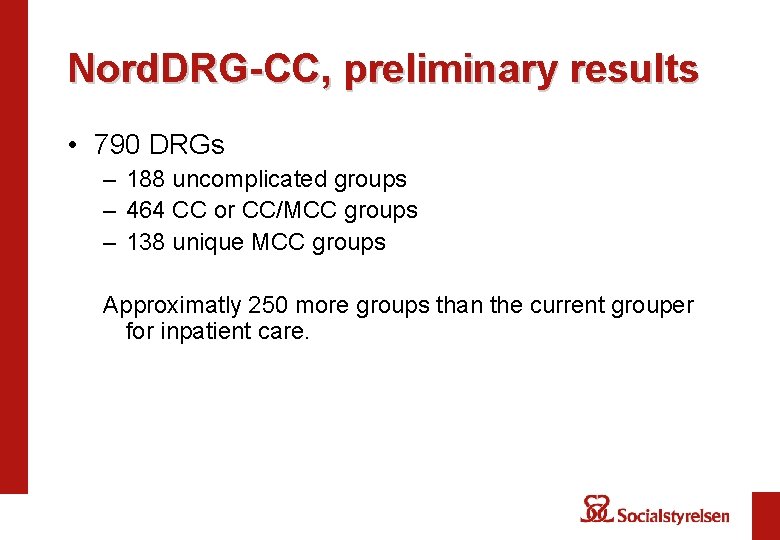
Nord. DRG-CC, preliminary results • 790 DRGs – 188 uncomplicated groups – 464 CC or CC/MCC groups – 138 unique MCC groups Approximatly 250 more groups than the current grouper for inpatient care.
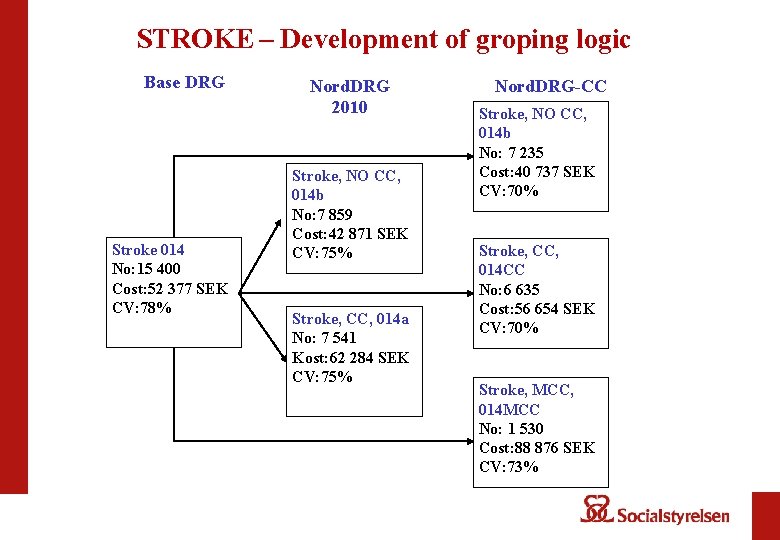
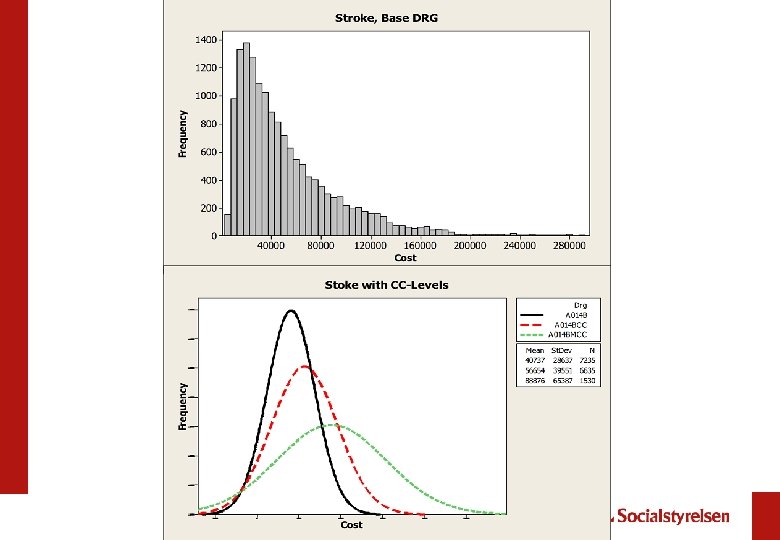
STROKE – Development of groping logic Base DRG Stroke 014 No: 15 400 Cost: 52 377 SEK CV: 78% Nord. DRG 2010 Stroke, NO CC, 014 b No: 7 859 Cost: 42 871 SEK CV: 75% Stroke, CC, 014 a No: 7 541 Kost: 62 284 SEK CV: 75% Nord. DRG-CC Stroke, NO CC, 014 b No: 7 235 Cost: 40 737 SEK CV: 70% Stroke, CC, 014 CC No: 6 635 Cost: 56 654 SEK CV: 70% Stroke, MCC, 014 MCC No: 1 530 Cost: 88 876 SEK CV: 73%
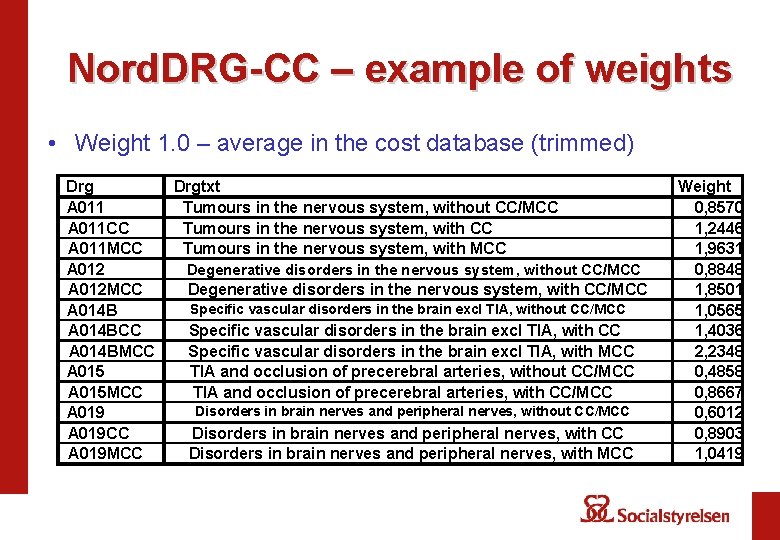
Nord. DRG-CC – example of weights • Weight 1. 0 – average in the cost database (trimmed) Drg A 011 CC A 011 MCC A 012 MCC A 014 BCC A 014 BMCC A 015 MCC A 019 CC A 019 MCC Drgtxt Tumours in the nervous system, without CC/MCC Tumours in the nervous system, with MCC Degenerative disorders in the nervous system, without CC/MCC Degenerative disorders in the nervous system, with CC/MCC Specific vascular disorders in the brain excl TIA, without CC/MCC Specific vascular disorders in the brain excl TIA, with MCC TIA and occlusion of precerebral arteries, without CC/MCC TIA and occlusion of precerebral arteries, with CC/MCC Disorders in brain nerves and peripheral nerves, without CC/MCC Disorders in brain nerves and peripheral nerves, with MCC Weight 0, 8570 1, 2446 1, 9631 0, 8848 1, 8501 1, 0565 1, 4036 2, 2348 0, 4858 0, 8667 0, 6012 0, 8903 1, 0419
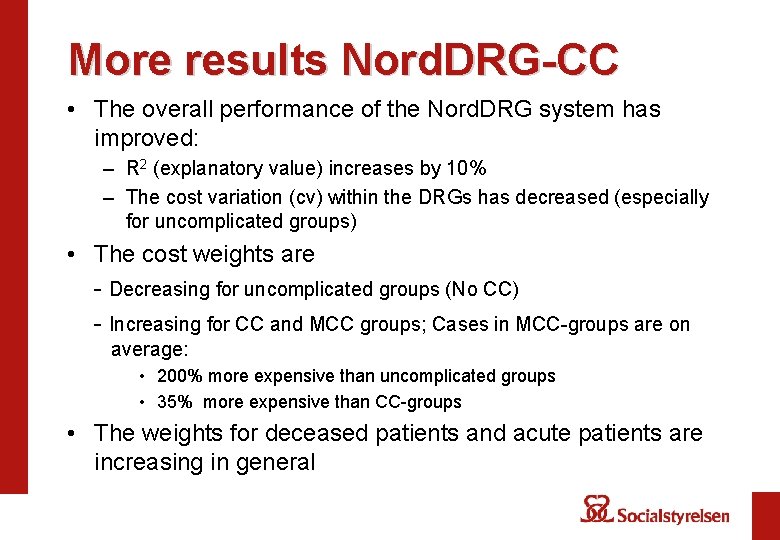
More results Nord. DRG-CC • The overall performance of the Nord. DRG system has improved: – R 2 (explanatory value) increases by 10% – The cost variation (cv) within the DRGs has decreased (especially for uncomplicated groups) • The cost weights are - Decreasing for uncomplicated groups (No CC) - Increasing for CC and MCC groups; Cases in MCC-groups are on average: • 200% more expensive than uncomplicated groups • 35% more expensive than CC-groups • The weights for deceased patients and acute patients are increasing in general
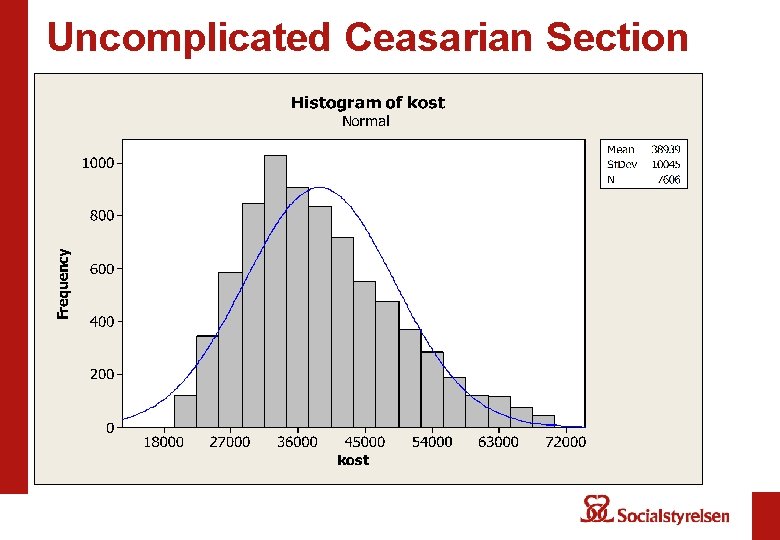
Uncomplicated Ceasarian Section
Conclusions • The Nord. DRG-CC grouper: ü Describes casemix better than the current grouper ü Contributes to reduced variation in the majority of the DRGs ü Improves the performance of the whole system • The coding in Sweden appear to be sufficient • Relatively simple logic, not to much changes to current logic • The grouper software will be ready this summer • Will require more maintenance work?
Areas of use • The Nord. DRG-CC is developed with the aim to improve how to describe performance with DRGs – Better adjustments of casemix for Benchmarking purposes and in productivity and efficiency studies are the main reasons for improvement work – The Nord. DRG-CC can also be used for improvement of reimbursement and budgeting in clinics/hospitals/regions/countries • Other effects on quality – – Acceptance of DRGs among the professionals increases Monitoring and explain variances in clinical pathways Monitoring cost outliers (especially in uncomplicated groups) Improving coding in medical records and registries

Examples from Swedish data
“Quality and Efficiency in Swedish Health Care” • 124 quality indicators in Health Care (Medical results, Patient experiences, Time related availability, Costs) Indicator A 42: 28 -days fatal rate for myocardial infarction, hospitalised patients Ø Trends over time Ø Benchmarking of Regions and hospitals Further analyses/questions: • Can the Nord. DRG-CC system change the ranking of hospitals when Benchmarking quality indicators? • Can the new CC-grouper explain mortality?
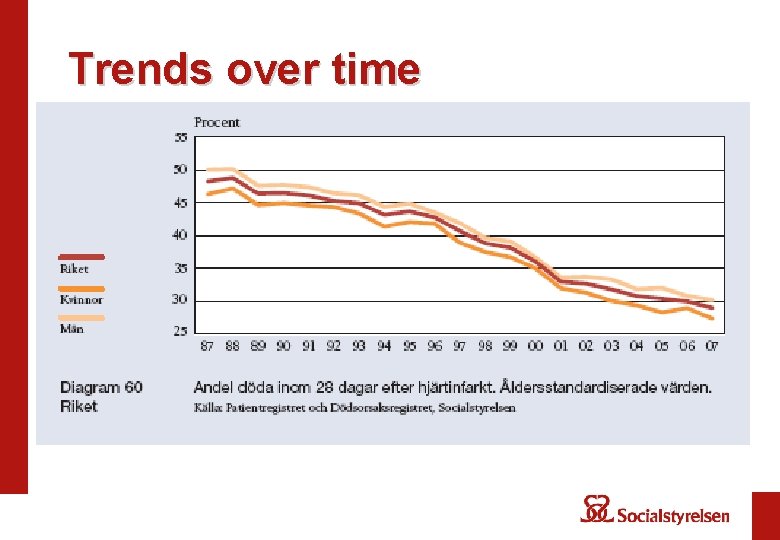
Trends over time
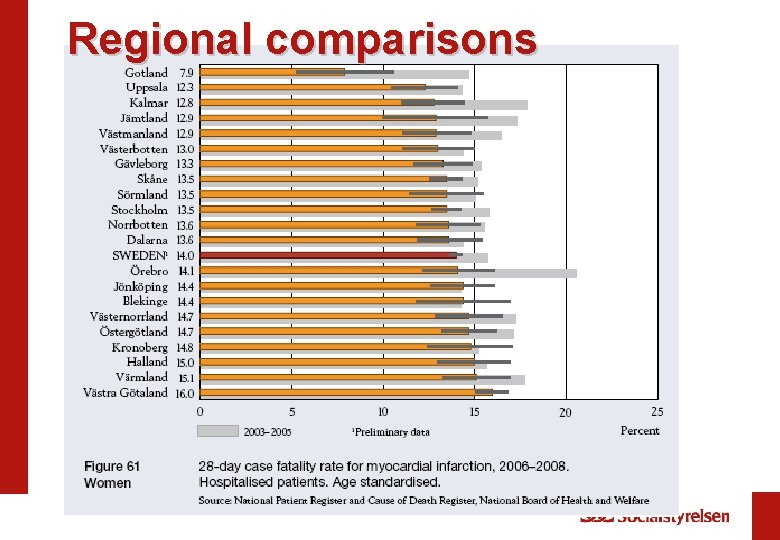
Regional comparisons
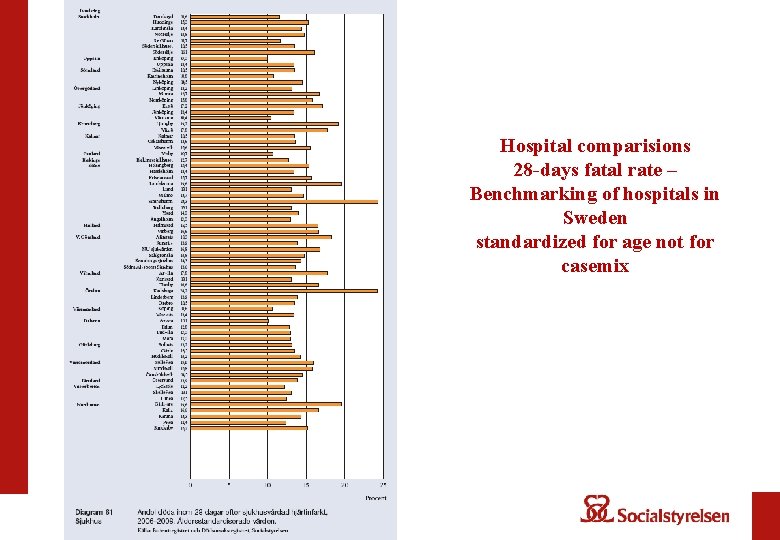
Hospital comparisions 28 -days fatal rate – Benchmarking of hospitals in Sweden standardized for age not for casemix
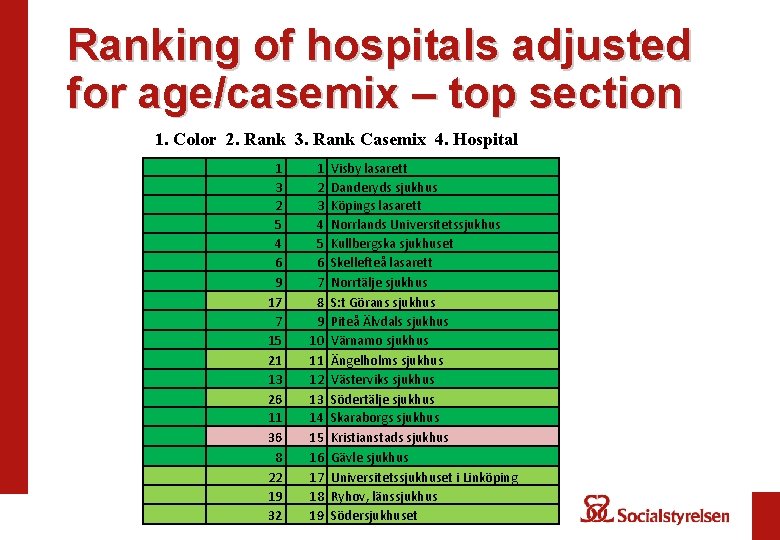
Ranking of hospitals adjusted for age/casemix – top section 1. Color 2. Rank 3. Rank Casemix 4. Hospital 1 3 2 5 4 6 9 17 7 15 21 13 26 11 36 8 22 19 32 1 2 3 4 5 6 7 8 9 10 11 12 13 14 15 16 17 18 19 Visby lasarett Danderyds sjukhus Köpings lasarett Norrlands Universitetssjukhus Kullbergska sjukhuset Skellefteå lasarett Norrtälje sjukhus S: t Görans sjukhus Piteå Älvdals sjukhus Värnamo sjukhus Ängelholms sjukhus Västerviks sjukhus Södertälje sjukhus Skaraborgs sjukhus Kristianstads sjukhus Gävle sjukhus Universitetssjukhuset i Linköping Ryhov, länssjukhus Södersjukhuset
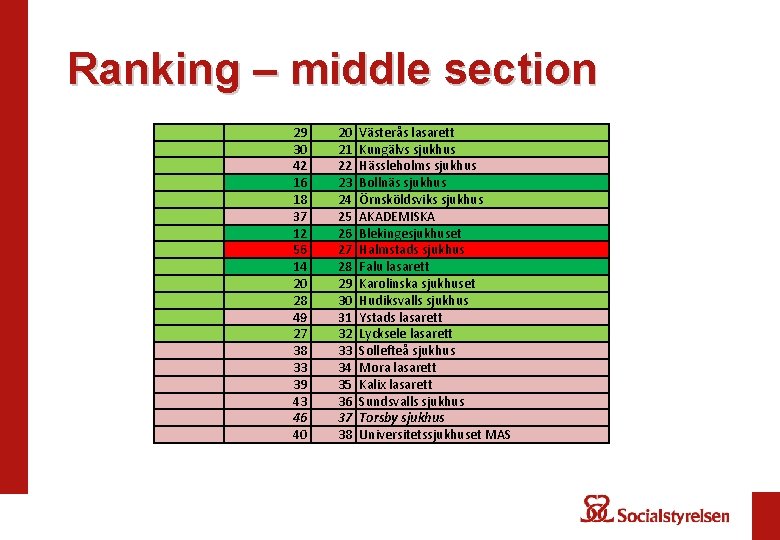
Ranking – middle section 29 30 42 16 18 37 12 56 14 20 28 49 27 38 33 39 43 46 40 20 21 22 23 24 25 26 27 28 29 30 31 32 33 34 35 36 37 38 Västerås lasarett Kungälvs sjukhus Hässleholms sjukhus Bollnäs sjukhus Örnsköldsviks sjukhus AKADEMISKA Blekingesjukhuset Halmstads sjukhus Falu lasarett Karolinska sjukhuset Hudiksvalls sjukhus Ystads lasarett Lycksele lasarett Sollefteå sjukhus Mora lasarett Kalix lasarett Sundsvalls sjukhus Torsby sjukhus Universitetssjukhuset MAS
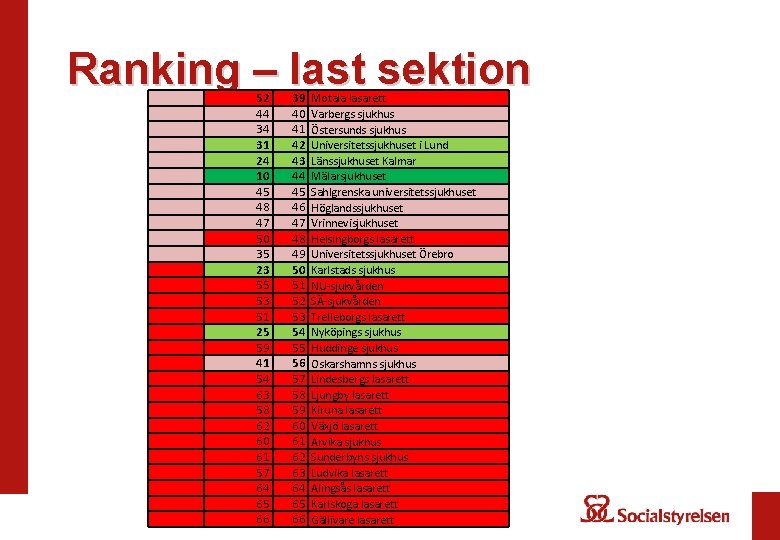
Ranking – last sektion 52 44 34 31 24 10 45 48 47 50 35 23 55 53 51 25 59 41 54 63 58 62 60 61 57 64 65 66 39 40 41 42 43 44 45 46 47 48 49 50 51 52 53 54 55 56 57 58 59 60 61 62 63 64 65 66 Motala lasarett Varbergs sjukhus Östersunds sjukhus Universitetssjukhuset i Lund Länssjukhuset Kalmar Mälarsjukhuset Sahlgrenska universitetssjukhuset Höglandssjukhuset Vrinnevisjukhuset Helsingborgs lasarett Universitetssjukhuset Örebro Karlstads sjukhus NU-sjukvården SÄ-sjukvården Trelleborgs lasarett Nyköpings sjukhus Huddinge sjukhus Oskarshamns sjukhus Lindesbergs lasarett Ljungby lasarett Kiruna lasarett Växjö lasarett Arvika sjukhus Sunderbyns sjukhus Ludvika lasarett Alingsås lasarett Karlskoga lasarett Gällivare lasarett
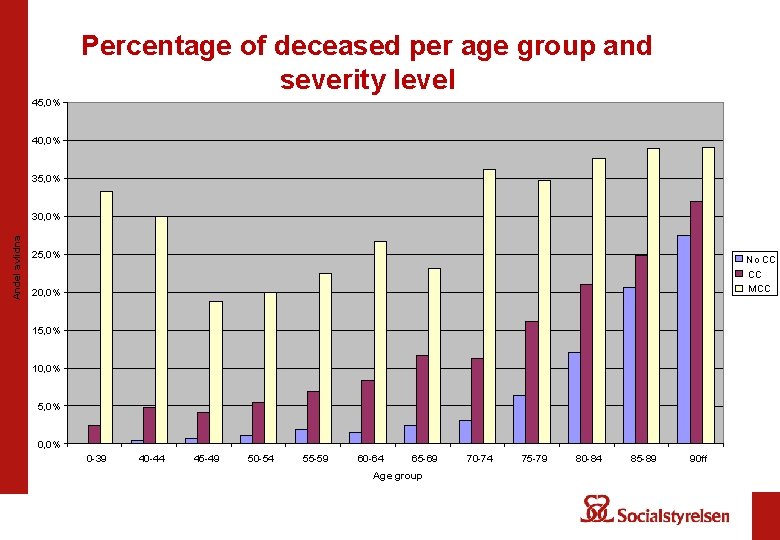
Percentage of deceased per age group and severity level 45, 0% 40, 0% 35, 0% Andel avlidna 30, 0% 25, 0% No CC CC MCC 20, 0% 15, 0% 10, 0% 5, 0% 0 -39 40 -44 45 -49 50 -54 55 -59 60 -64 65 -69 Age group 70 -74 75 -79 80 -84 85 -89 90 ff
Discussion • Is the increased number of groups motivated in the new grouper? • Can the Nord. DRG-CC be of use for Quality and Efficiency studies? • How solid is the DRG-system for poor coding?

Thank you for your attention! For more information: www. socialstyrelsen. se
- Slides: 30