
Improvement of the Monte Carlo Simulation Efficiency of

- Slides: 22
Improvement of the Monte Carlo Simulation Efficiency of a Proton Therapy Treatment Head Based on Proton Tracking Analysis and Geometry Simplifications Miguel A. Cortés-Giraldo*, José M. Quesada, M. Isabel Gallardo (Universidad de Sevilla) Harald Paganetti (Massachusetts General Hospital - Boston, MA, USA) (*) e-mail: miancortes@us. es 6 th DITANET Topical Workshop on Particle Detection Techniques Seville (Spain) November 8 th, 2011
Contents § § Introduction Methods Results Conclusions
§ § Introduction Methods Results Conclusions
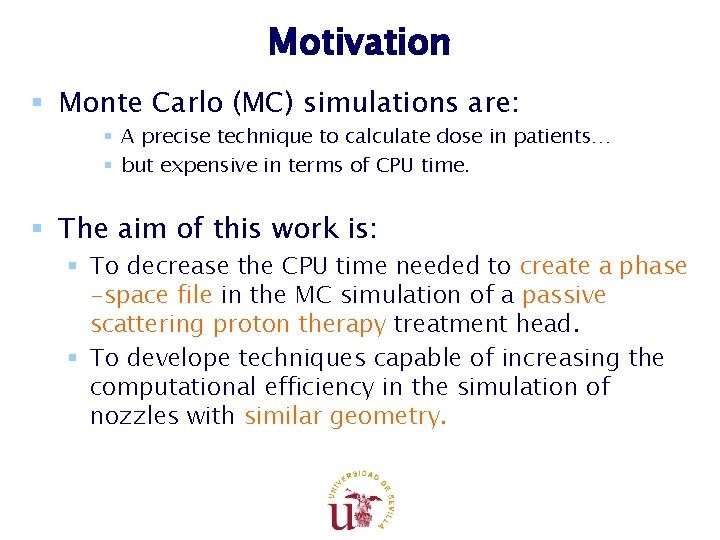
Motivation § Monte Carlo (MC) simulations are: § A precise technique to calculate dose in patients… § but expensive in terms of CPU time. § The aim of this work is: § To decrease the CPU time needed to create a phase -space file in the MC simulation of a passive scattering proton therapy treatment head. § To develope techniques capable of increasing the computational efficiency in the simulation of nozzles with similar geometry.
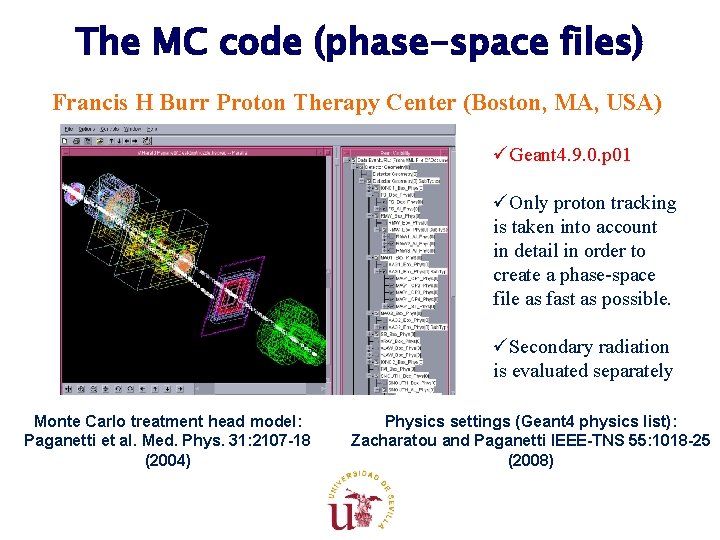
The MC code (phase-space files) Francis H Burr Proton Therapy Center (Boston, MA, USA) üGeant 4. 9. 0. p 01 üOnly proton tracking is taken into account in detail in order to create a phase-space file as fast as possible. üSecondary radiation is evaluated separately Monte Carlo treatment head model: Paganetti et al. Med. Phys. 31: 2107 -18 (2004) Physics settings (Geant 4 physics list): Zacharatou and Paganetti IEEE-TNS 55: 1018 -25 (2008)
§ § Introducton Methods Results Conclusions
Methodology § The efficiency improvement is evaluated for various nozzle set-ups: § Covering the energy range of the proton beam. § Output efficiency: 25 -cm (maximum) and 12 cm diameter snout (most typical case in proton therapy). § Validation with published results. (Paganetti et al. Med. Phys. 31: 2107 -18, 2004. ) § Identical computational conditions.
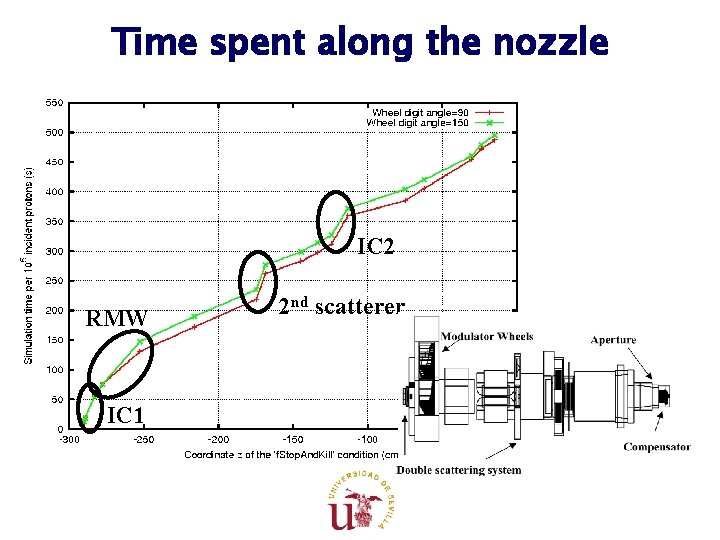
Time spent along the nozzle IC 2 RMW IC 1 2 nd scatterer
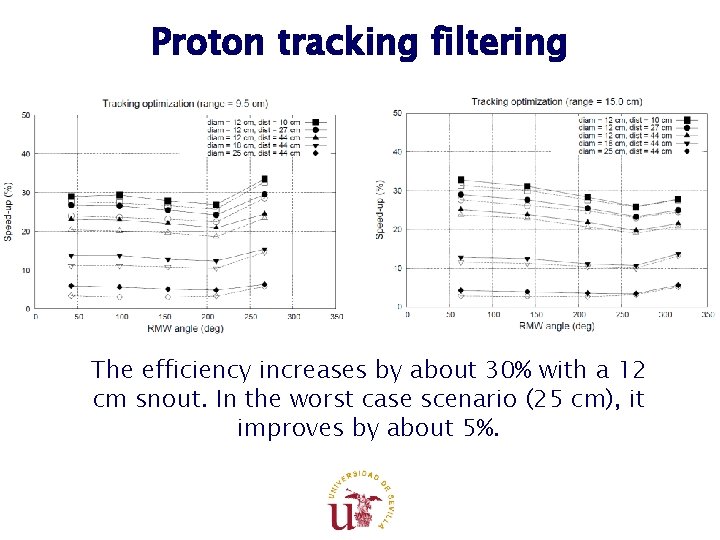
Proton tracking filtering § The basic idea is to terminate the tracking of protons which, very likely, will not reach the aperture
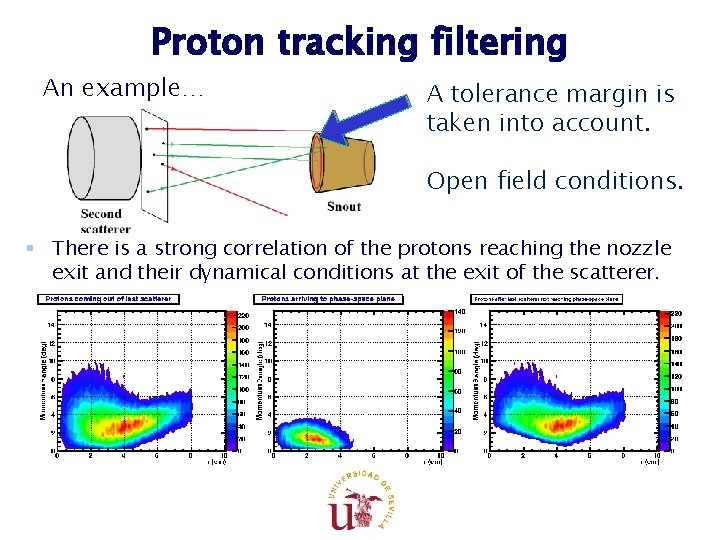
Proton tracking filtering An example… A tolerance margin is taken into account. Open field conditions. § There is a strong correlation of the protons reaching the nozzle exit and their dynamical conditions at the exit of the scatterer.
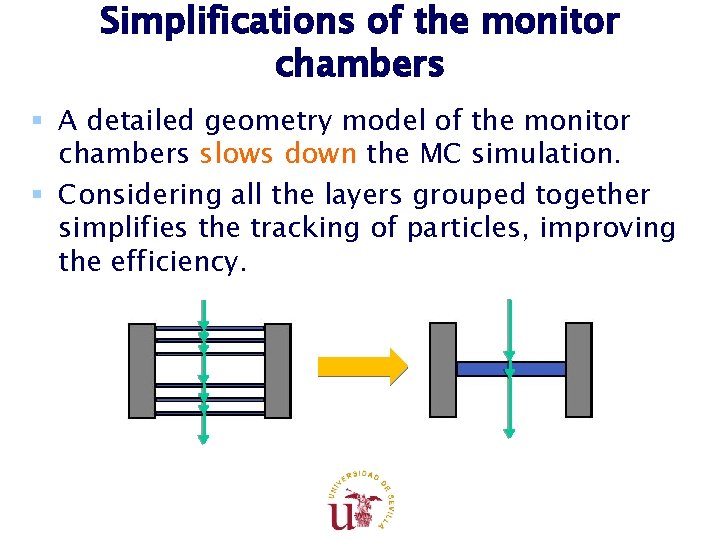
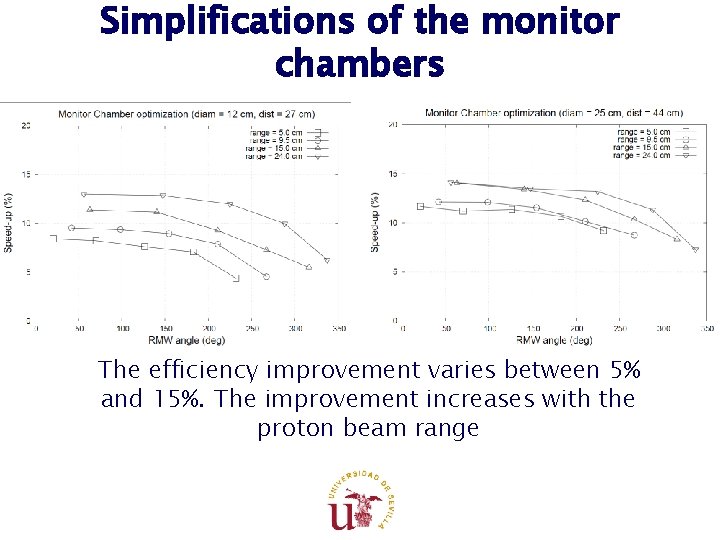
Simplifications of the monitor chambers § A detailed geometry model of the monitor chambers slows down the MC simulation. § Considering all the layers grouped together simplifies the tracking of particles, improving the efficiency.
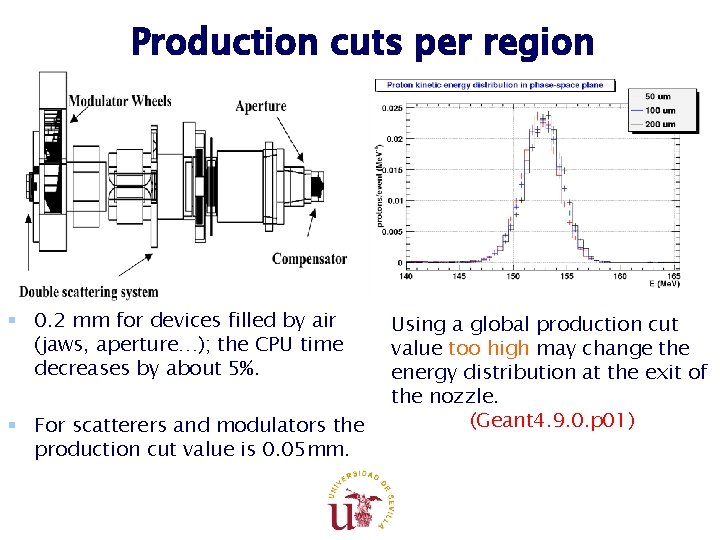
Production cuts per region § Production cut: key parameter in Geant 4 simulations. § The secondary production cut value is higher in regions filled by air (magnets, jaws…) § The scattering and modulation devices require a lower value of the production cuts.
§ § Introduction Methods Results Conclusions
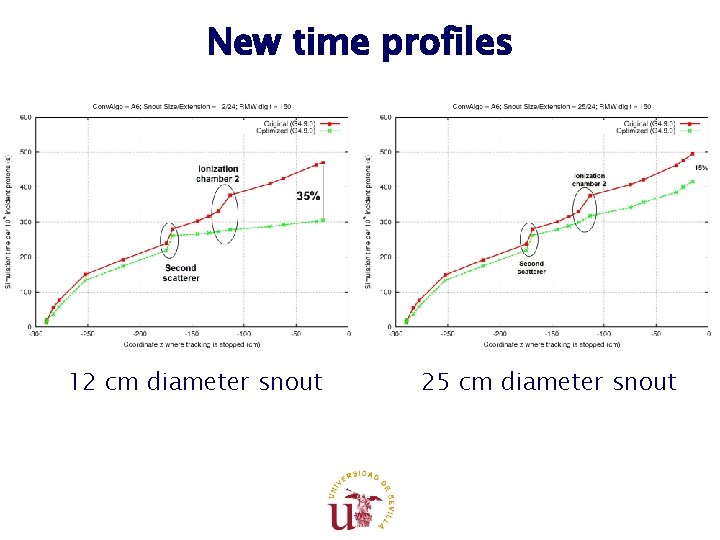
Proton tracking filtering The efficiency increases by about 30% with a 12 cm snout. In the worst case scenario (25 cm), it improves by about 5%.
Simplifications of the monitor chambers The efficiency improvement varies between 5% and 15%. The improvement increases with the proton beam range
Production cuts per region § 0. 2 mm for devices filled by air (jaws, aperture…); the CPU time decreases by about 5%. § For scatterers and modulators the production cut value is 0. 05 mm. Using a global production cut value too high may change the energy distribution at the exit of the nozzle. (Geant 4. 9. 0. p 01)
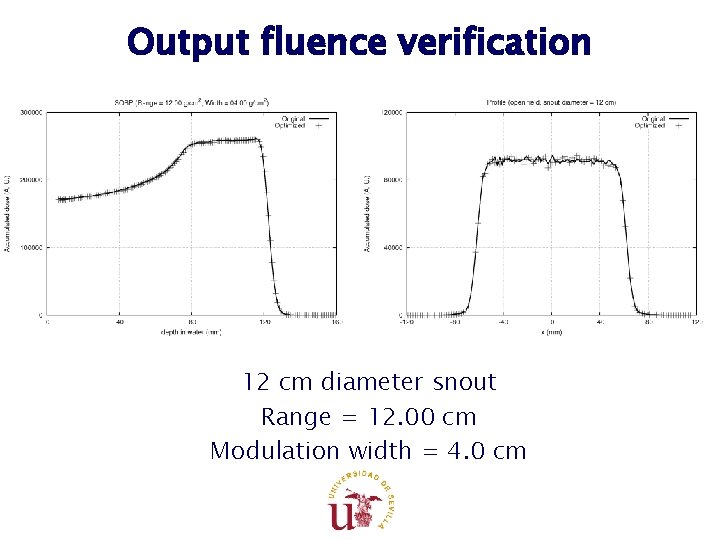
Output fluence verification 12 cm diameter snout Range = 12. 00 cm Modulation width = 4. 0 cm
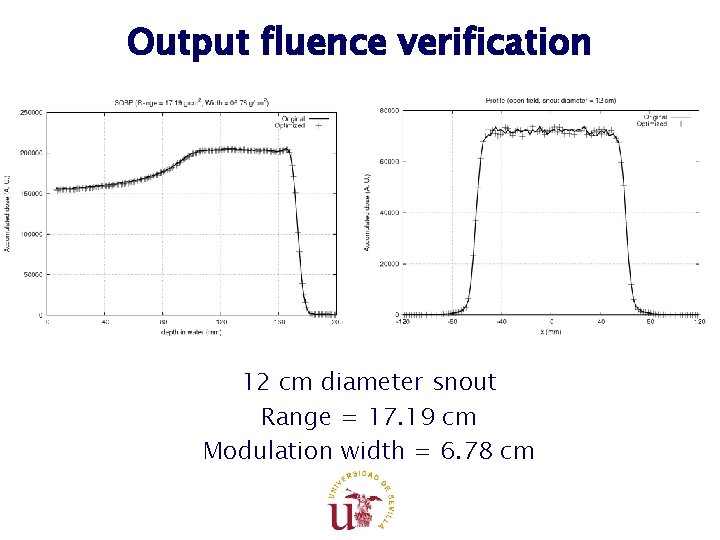
Output fluence verification 12 cm diameter snout Range = 17. 19 cm Modulation width = 6. 78 cm
New time profiles 12 cm diameter snout 25 cm diameter snout
§ § Introduction Methods Results Conclusions
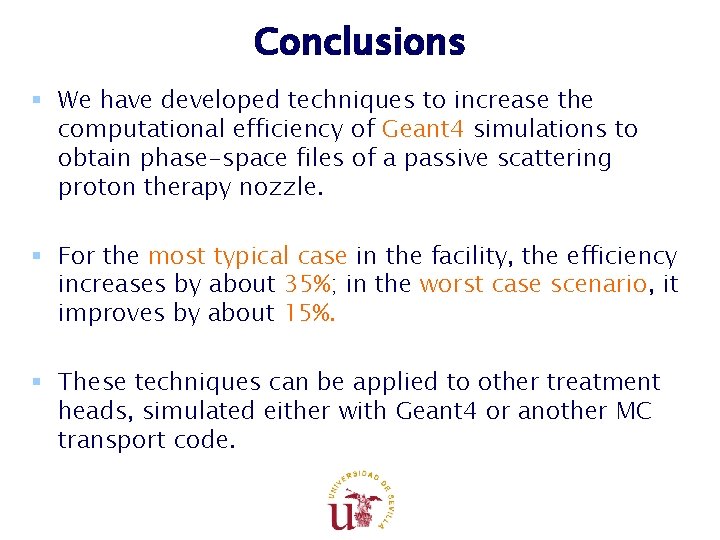
Conclusions § We have developed techniques to increase the computational efficiency of Geant 4 simulations to obtain phase-space files of a passive scattering proton therapy nozzle. § For the most typical case in the facility, the efficiency increases by about 35%; in the worst case scenario, it improves by about 15%. § These techniques can be applied to other treatment heads, simulated either with Geant 4 or another MC transport code.
Acknowledgements § Ministerio de Ciencia e Innovación (P 07 -FQM-02894 y FIS 2008 -04189). § Junta de Andalucía (FPA 2008 -04972 -C 03 -02). § PO 1 Grant. § Physics Research group at Dep. Radiation Oncology (Massachusetts General Hospital, Boston, MA, USA).