
Improved Sepsis Recognition and Survival Following Initiation of
- Slides: 1
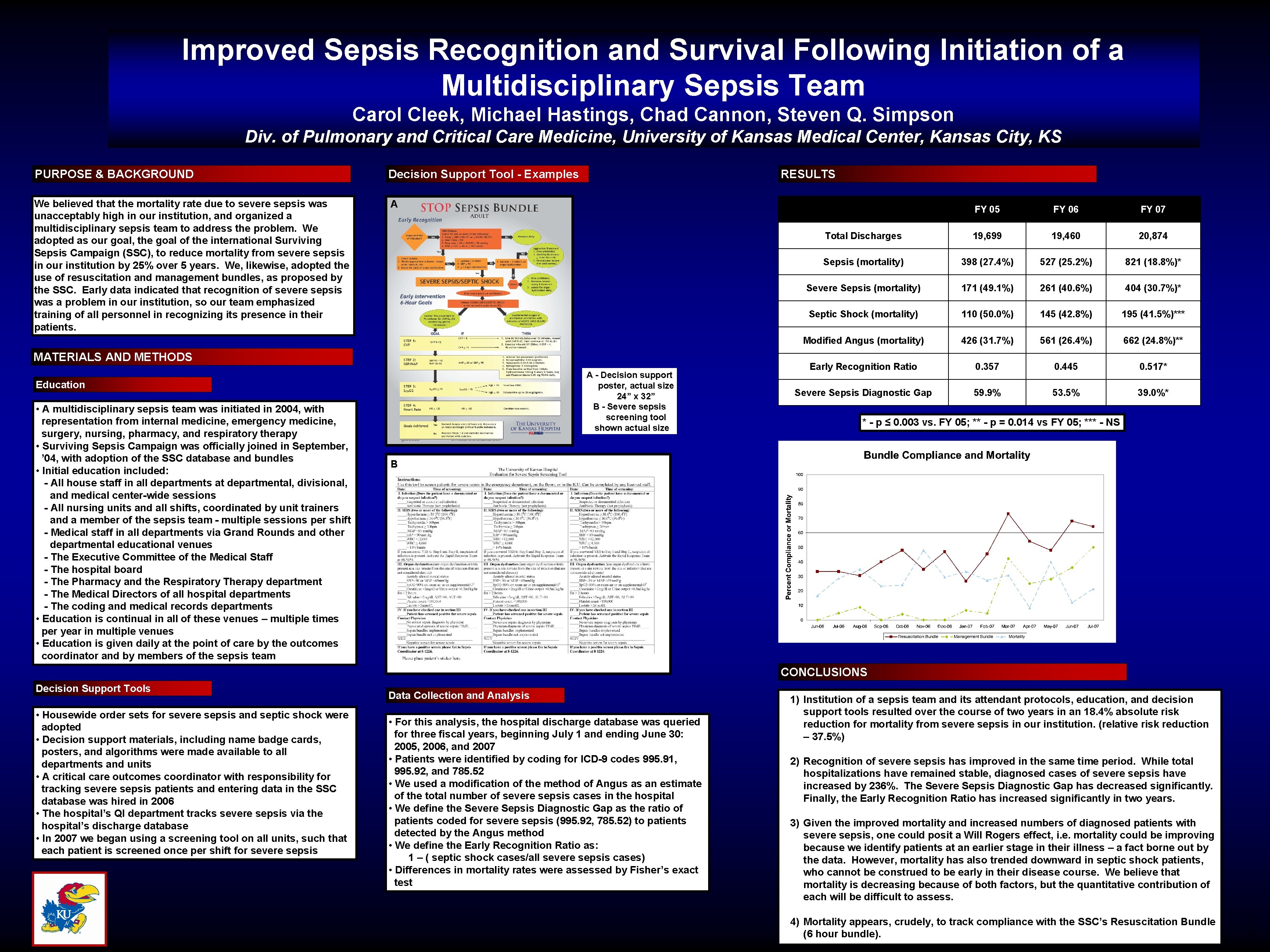
Improved Sepsis Recognition and Survival Following Initiation of a Multidisciplinary Sepsis Team Carol Cleek, Michael Hastings, Chad Cannon, Steven Q. Simpson Div. of Pulmonary and Critical Care Medicine, University of Kansas Medical Center, Kansas City, KS PURPOSE & BACKGROUND Decision Support Tool - Examples We believed that the mortality rate due to severe sepsis was unacceptably high in our institution, and organized a multidisciplinary sepsis team to address the problem. We adopted as our goal, the goal of the international Surviving Sepsis Campaign (SSC), to reduce mortality from severe sepsis in our institution by 25% over 5 years. We, likewise, adopted the use of resuscitation and management bundles, as proposed by the SSC. Early data indicated that recognition of severe sepsis was a problem in our institution, so our team emphasized training of all personnel in recognizing its presence in their patients. A RESULTS MATERIALS AND METHODS A - Decision support poster, actual size 24” x 32” B - Severe sepsis screening tool shown actual size Education • A multidisciplinary sepsis team was initiated in 2004, with representation from internal medicine, emergency medicine, surgery, nursing, pharmacy, and respiratory therapy • Surviving Sepsis Campaign was officially joined in September, ’ 04, with adoption of the SSC database and bundles • Initial education included: - All house staff in all departments at departmental, divisional, and medical center-wide sessions - All nursing units and all shifts, coordinated by unit trainers and a member of the sepsis team - multiple sessions per shift - Medical staff in all departments via Grand Rounds and other departmental educational venues - The Executive Committee of the Medical Staff - The hospital board - The Pharmacy and the Respiratory Therapy department - The Medical Directors of all hospital departments - The coding and medical records departments • Education is continual in all of these venues – multiple times per year in multiple venues • Education is given daily at the point of care by the outcomes coordinator and by members of the sepsis team FY 05 FY 06 FY 07 Total Discharges 19, 699 19, 460 20, 874 Sepsis (mortality) 398 (27. 4%) 527 (25. 2%) 821 (18. 8%)* Severe Sepsis (mortality) 171 (49. 1%) 261 (40. 6%) 404 (30. 7%)* Septic Shock (mortality) 110 (50. 0%) 145 (42. 8%) 195 (41. 5%)*** Modified Angus (mortality) 426 (31. 7%) 561 (26. 4%) 662 (24. 8%)** Early Recognition Ratio 0. 357 0. 445 0. 517* Severe Sepsis Diagnostic Gap 59. 9% 53. 5% 39. 0%* * - p ≤ 0. 003 vs. FY 05; ** - p = 0. 014 vs FY 05; *** - NS B CONCLUSIONS Decision Support Tools • Housewide order sets for severe sepsis and septic shock were adopted • Decision support materials, including name badge cards, posters, and algorithms were made available to all departments and units • A critical care outcomes coordinator with responsibility for tracking severe sepsis patients and entering data in the SSC database was hired in 2006 • The hospital’s QI department tracks severe sepsis via the hospital’s discharge database • In 2007 we began using a screening tool on all units, such that each patient is screened once per shift for severe sepsis Data Collection and Analysis • For this analysis, the hospital discharge database was queried for three fiscal years, beginning July 1 and ending June 30: 2005, 2006, and 2007 • Patients were identified by coding for ICD-9 codes 995. 91, 995. 92, and 785. 52 • We used a modification of the method of Angus as an estimate of the total number of severe sepsis cases in the hospital • We define the Severe Sepsis Diagnostic Gap as the ratio of patients coded for severe sepsis (995. 92, 785. 52) to patients detected by the Angus method • We define the Early Recognition Ratio as: 1 – ( septic shock cases/all severe sepsis cases) • Differences in mortality rates were assessed by Fisher’s exact test 1) Institution of a sepsis team and its attendant protocols, education, and decision support tools resulted over the course of two years in an 18. 4% absolute risk reduction for mortality from severe sepsis in our institution. (relative risk reduction – 37. 5%) 2) Recognition of severe sepsis has improved in the same time period. While total hospitalizations have remained stable, diagnosed cases of severe sepsis have increased by 236%. The Severe Sepsis Diagnostic Gap has decreased significantly. Finally, the Early Recognition Ratio has increased significantly in two years. 3) Given the improved mortality and increased numbers of diagnosed patients with severe sepsis, one could posit a Will Rogers effect, i. e. mortality could be improving because we identify patients at an earlier stage in their illness – a fact borne out by the data. However, mortality has also trended downward in septic shock patients, who cannot be construed to be early in their disease course. We believe that mortality is decreasing because of both factors, but the quantitative contribution of each will be difficult to assess. 4) Mortality appears, crudely, to track compliance with the SSC’s Resuscitation Bundle printed by (6 hour bundle). www. postersession. com