
Improve Physical Function Role of Postural Stability Exercise
Improve Physical Function Role of Postural Stability Exercise Ian Mc. Lagan - Physiotherapist Whole System Approach to Falls Prevention Workshop 2 nd Sept 2014 www. shropscommunityhealth. nhs. uk
• Ageing affects all of us • Sedentary behavior accelerates the loss of performance – can be as much as 1 -2% per annum from age 30 www. shropscommunityhealth. nhs. uk
Function for life Wash hair comfortably? 20% women and 14% men >50 do not have sufficient shoulder flexibility www. shropscommunityhealth. nhs. uk
Function for life • Confident of getting out of a chair without using arms 25% women and 7% men aged 70 -74 do not have sufficient leg power www. shropscommunityhealth. nhs. uk
Physical Functional Ability • • Strength Power Flexibility Endurance Balance Mobility Transfer skills www. shropscommunityhealth. nhs. uk
How much is enough? • Older adults should aim to be active daily • Over a week should add up to 150 minutes of moderate intensity activity in bouts of 10 minutes or more www. shropscommunityhealth. nhs. uk
Plus • Undertake physical activity to improve muscle strength on at least two days a week www. shropscommunityhealth. nhs. uk
Plus • Those at risk of Falls should incorporate physical activity to improve balance on at least two days a week www. shropscommunityhealth. nhs. uk
Plus • All older adults should minimise the amount of time spent being sedentary for extended periods www. shropscommunityhealth. nhs. uk

Postural Stability Exercise Programme Warm Up Circulation booster Mobilisers Stretches Strength Balance Cool Down www. shropscommunityhealth. nhs. uk
FITT Frequency Intensity Time Type www. shropscommunityhealth. nhs. uk
Progressive Specific adaptation to imposed demand www. shropscommunityhealth. nhs. uk
In over 75 s three months of strength training rejuvenates up to 20 years worth of lost strength www. shropscommunityhealth. nhs. uk
Postural Stability i. e. balance • Ability to maintain the body in equilibrium either static (at rest) or dynamic (moving) www. shropscommunityhealth. nhs. uk
Where do we get the information from in order to balance • Eyes • Muscles and joints in body (proprioception) • Inner ears (vestibular system) www. shropscommunityhealth. nhs. uk
Balance/Equilibrium • The process of maintaining the centre of gravity over base of support whilst static or moving www. shropscommunityhealth. nhs. uk

Strategies • Ankle Strategy • Hip Strategy • Stepping Strategy www. shropscommunityhealth. nhs. uk
Programmes held in Shrewsbury Oswestry Whitchurch Market Drayton Bridgnorth Church Stretton Ludlow www. shropscommunityhealth. nhs. uk
Exercise Programmes 100 programmes 10, 000 attendances www. shropscommunityhealth. nhs. uk
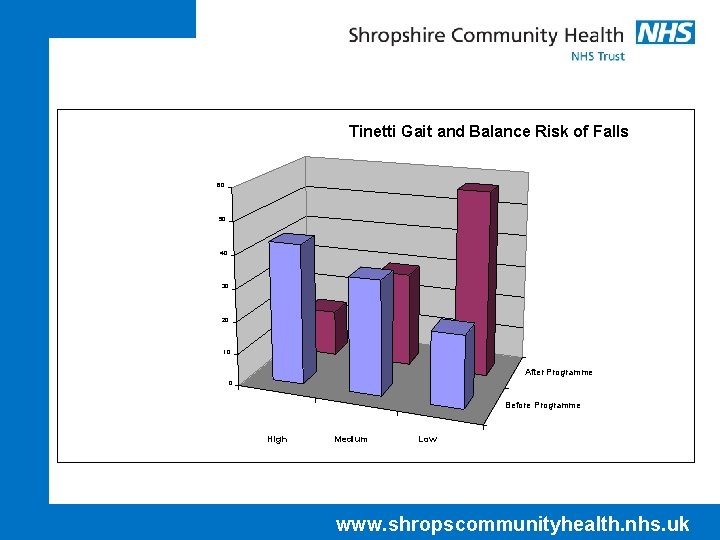
Tinetti Gait and Balance Risk of Falls 60 50 40 30 20 10 After Programme 0 Before Programme High Medium Low www. shropscommunityhealth. nhs. uk
• Man does not cease to play because he grows old. Man grows old because he ceases to play. (George Bernard Shaw) • If I’d known I was going to live this long I would have taken better care of myself. (Dubey Blake) www. shropscommunityhealth. nhs. uk
Exercise • Reduces the loss of functional capability to ½% per annum www. shropscommunityhealth. nhs. uk
- Slides: 22