
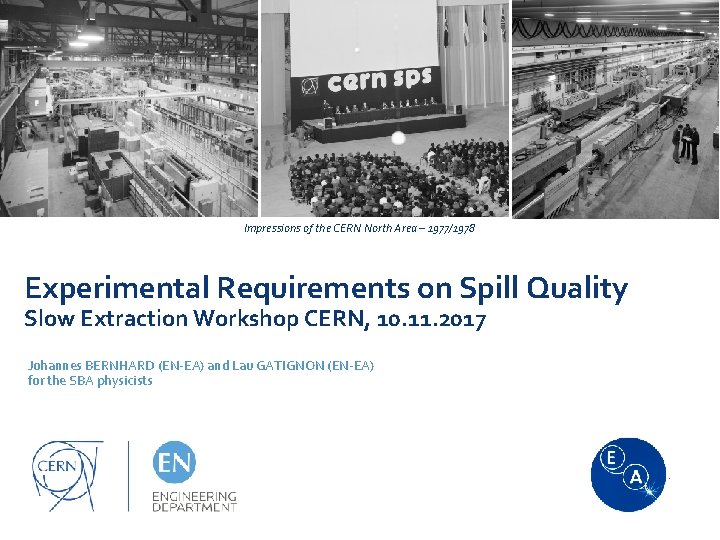
Impressions of the CERN North Area 19771978 Experimental
- Slides: 16
Impressions of the CERN North Area – 1977/1978 Experimental Requirements on Spill Quality Slow Extraction Workshop CERN, 10. 11. 2017 Johannes BERNHARD (EN-EA) and Lau GATIGNON (EN-EA) for the SBA physicists
Our Users and their Requirements • Fixed target experiments • • Precision studies (QCD, standard model, BSM physics) Constant running in the order of 150 -200 days/year High intensity beams with slow extraction, sometimes limited by RP Typically only limited by instantaneous rate and integrated intensity per spill • Test beams • Campaigns for detector R&D and calibrations, typically 1 -2 weeks/year • ‘Volatile’ environment with a wide range of demands on particles types and intensities • Nowadays more and more requests for medium to high intensity beams for test of LHC experiment upgrades • Irradiation facilities • Outreach J. Bernhard, 10 -11 -2017 Experimental Requirements on Spill Quality 2
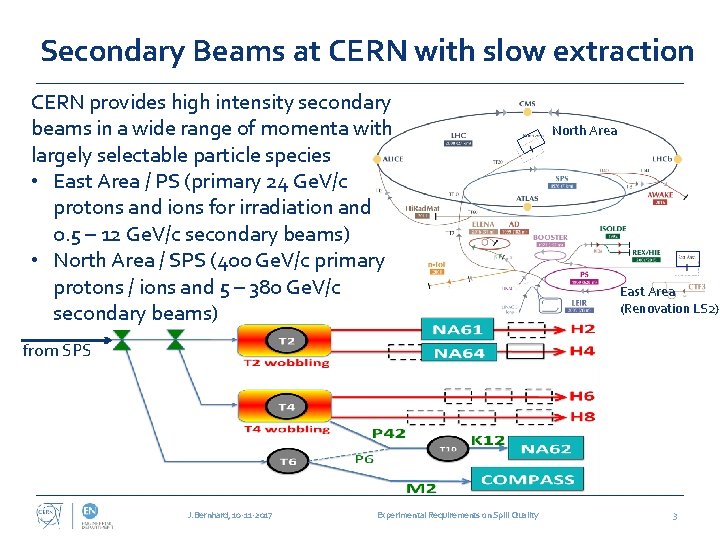
Secondary Beams at CERN with slow extraction CERN provides high intensity secondary beams in a wide range of momenta with largely selectable particle species • East Area / PS (primary 24 Ge. V/c protons and ions for irradiation and 0. 5 – 12 Ge. V/c secondary beams) • North Area / SPS (400 Ge. V/c primary protons / ions and 5 – 380 Ge. V/c secondary beams) North Area East Area (Renovation LS 2) from SPS J. Bernhard, 10 -11 -2017 Experimental Requirements on Spill Quality 3
Experiments in the CERN North Area • The NA experiments all rely critically on slow extraction. • They are rate limited, mainly during the flat top. Their instantaneous rate is given in events per seconds, their integrated luminosity is proportional to integrated time on flat top. This assumes that they get enough flux to saturate their data-taking rate. • Integrated time on flat top = Duty-cycle x Length of run (x efficiency) • The number of events per second is limited by dead-time (signal length, event size, etc) and by pile-up (proportional to at least the square of the instantaneous rate). • For a given flux and flat top length the optimum instantaneous rate is achieved for a spill structure as flat as possible (from low frequency to RF). J. Bernhard, 10 -11 -2017 Experimental Requirements on Spill Quality 4
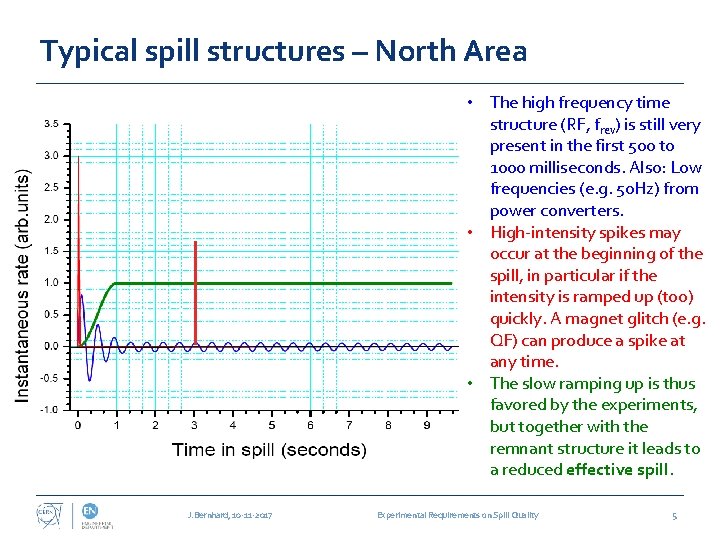
Typical spill structures – North Area • The high frequency time structure (RF, frev) is still very present in the first 500 to 1000 milliseconds. Also: Low frequencies (e. g. 50 Hz) from power converters. • High-intensity spikes may occur at the beginning of the spill, in particular if the intensity is ramped up (too) quickly. A magnet glitch (e. g. QF) can produce a spike at any time. • The slow ramping up is thus favored by the experiments, but together with the remnant structure it leads to a reduced effective spill. J. Bernhard, 10 -11 -2017 Experimental Requirements on Spill Quality 5
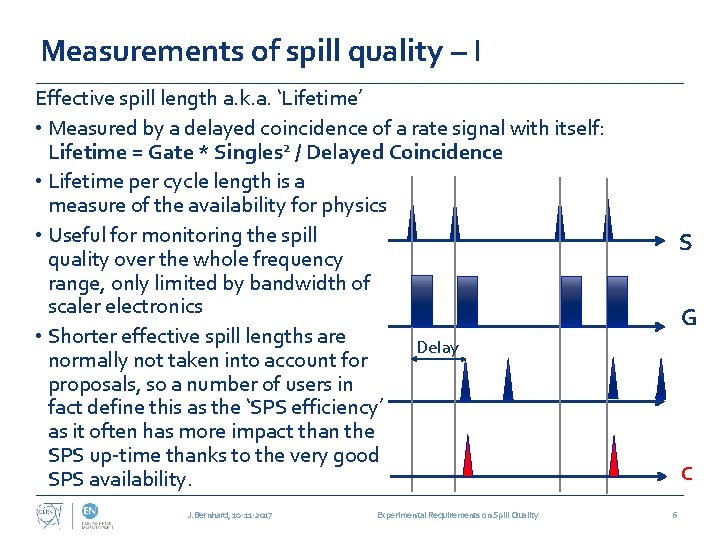
Measurements of spill quality – I Effective spill length a. k. a. ‘Lifetime’ • Measured by a delayed coincidence of a rate signal with itself: Lifetime = Gate * Singles 2 / Delayed Coincidence • Lifetime per cycle length is a measure of the availability for physics • Useful for monitoring the spill quality over the whole frequency range, only limited by bandwidth of scaler electronics • Shorter effective spill lengths are Delay normally not taken into account for proposals, so a number of users in fact define this as the ‘SPS efficiency’ as it often has more impact than the SPS up-time thanks to the very good SPS availability. J. Bernhard, 10 -11 -2017 Experimental Requirements on Spill Quality S G C 6
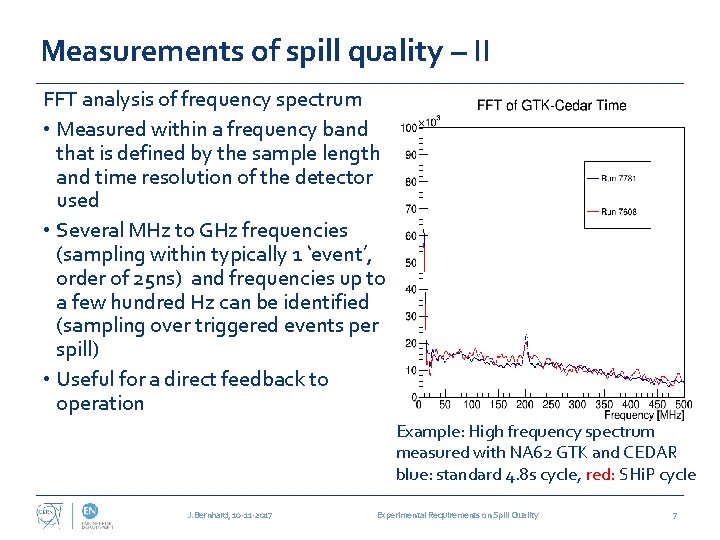
Measurements of spill quality – II FFT analysis of frequency spectrum • Measured within a frequency band that is defined by the sample length and time resolution of the detector used • Several MHz to GHz frequencies (sampling within typically 1 ‘event’, order of 25 ns) and frequencies up to a few hundred Hz can be identified (sampling over triggered events per spill) • Useful for a direct feedback to operation Example: High frequency spectrum measured with NA 62 GTK and CEDAR blue: standard 4. 8 s cycle, red: SHi. P cycle J. Bernhard, 10 -11 -2017 Experimental Requirements on Spill Quality 7
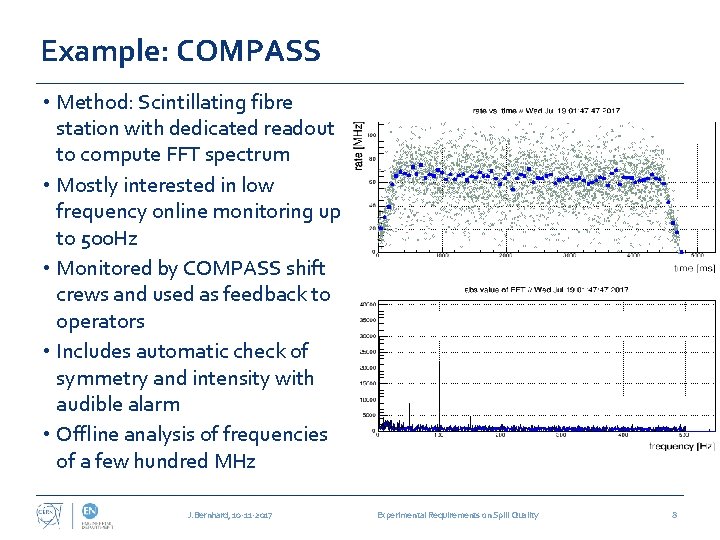
Example: COMPASS • Method: Scintillating fibre station with dedicated readout to compute FFT spectrum • Mostly interested in low frequency online monitoring up to 500 Hz • Monitored by COMPASS shift crews and used as feedback to operators • Includes automatic check of symmetry and intensity with audible alarm • Offline analysis of frequencies of a few hundred MHz J. Bernhard, 10 -11 -2017 Experimental Requirements on Spill Quality 8
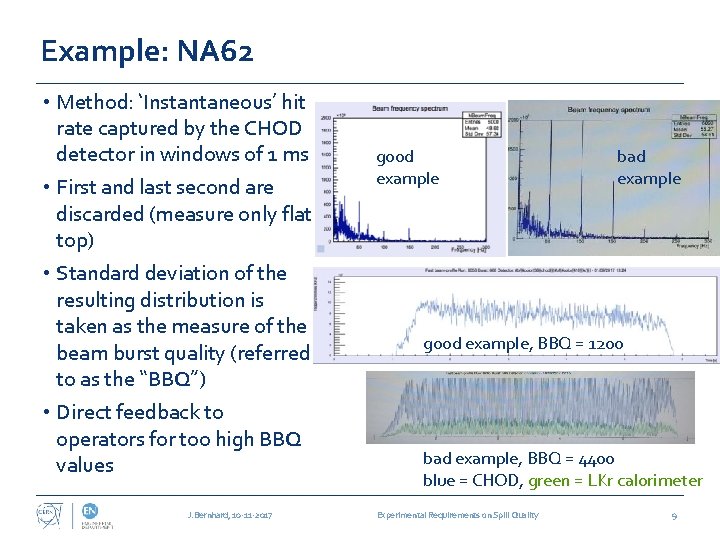
Example: NA 62 • Method: ‘Instantaneous’ hit rate captured by the CHOD detector in windows of 1 ms • First and last second are discarded (measure only flat top) • Standard deviation of the resulting distribution is taken as the measure of the beam burst quality (referred to as the “BBQ”) • Direct feedback to operators for too high BBQ values J. Bernhard, 10 -11 -2017 good example bad example good example, BBQ = 1200 bad example, BBQ = 4400 blue = CHOD, green = LKr calorimeter Experimental Requirements on Spill Quality 9
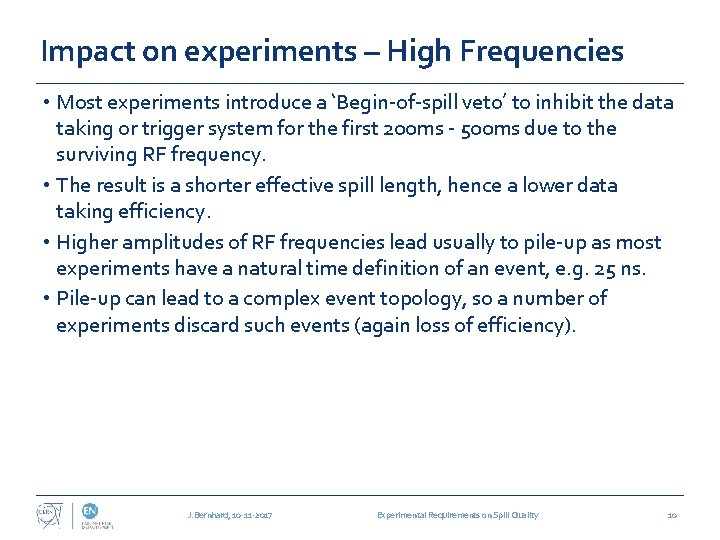
Impact on experiments – High Frequencies • Most experiments introduce a ‘Begin-of-spill veto’ to inhibit the data taking or trigger system for the first 200 ms - 500 ms due to the surviving RF frequency. • The result is a shorter effective spill length, hence a lower data taking efficiency. • Higher amplitudes of RF frequencies lead usually to pile-up as most experiments have a natural time definition of an event, e. g. 25 ns. • Pile-up can lead to a complex event topology, so a number of experiments discard such events (again loss of efficiency). J. Bernhard, 10 -11 -2017 Experimental Requirements on Spill Quality 10
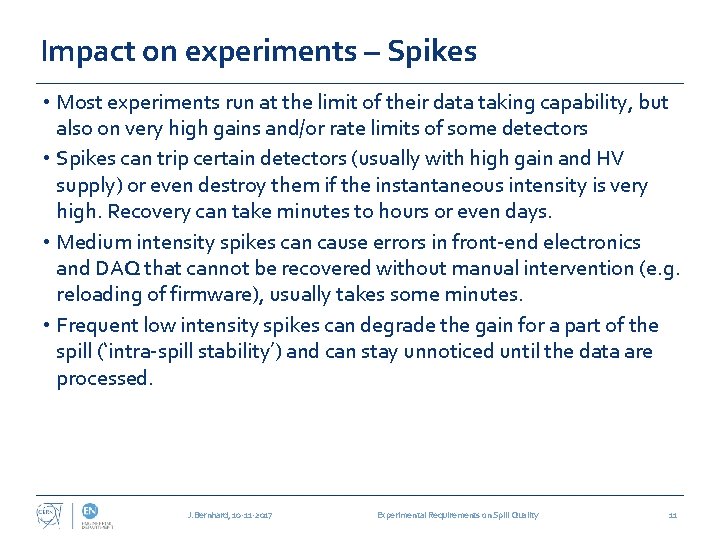
Impact on experiments – Spikes • Most experiments run at the limit of their data taking capability, but also on very high gains and/or rate limits of some detectors • Spikes can trip certain detectors (usually with high gain and HV supply) or even destroy them if the instantaneous intensity is very high. Recovery can take minutes to hours or even days. • Medium intensity spikes can cause errors in front-end electronics and DAQ that cannot be recovered without manual intervention (e. g. reloading of firmware), usually takes some minutes. • Frequent low intensity spikes can degrade the gain for a part of the spill (‘intra-spill stability’) and can stay unnoticed until the data are processed. J. Bernhard, 10 -11 -2017 Experimental Requirements on Spill Quality 11
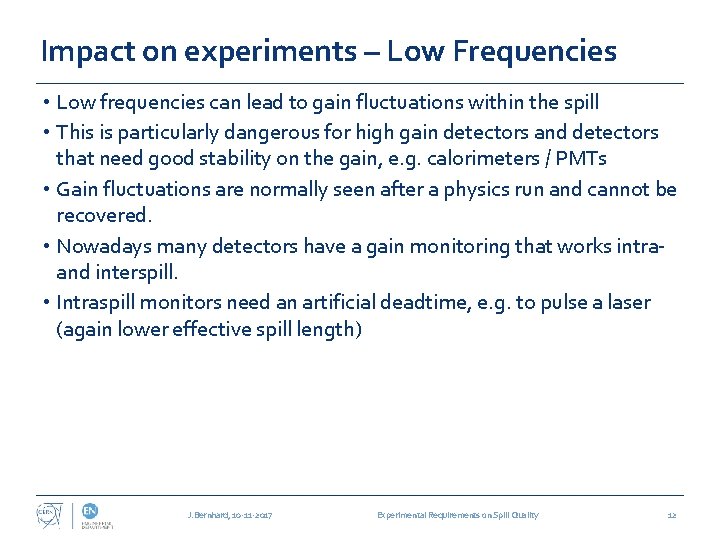
Impact on experiments – Low Frequencies • Low frequencies can lead to gain fluctuations within the spill • This is particularly dangerous for high gain detectors and detectors that need good stability on the gain, e. g. calorimeters / PMTs • Gain fluctuations are normally seen after a physics run and cannot be recovered. • Nowadays many detectors have a gain monitoring that works intraand interspill. • Intraspill monitors need an artificial deadtime, e. g. to pulse a laser (again lower effective spill length) J. Bernhard, 10 -11 -2017 Experimental Requirements on Spill Quality 12
Possible Improvements • Recent improvements on experimental side • Self-recovering DAQ: In case of a intensity related crash, the DAQ resets itself and continues running without manual intervention • Spill monitoring and FFT analysis with dedicated detectors and direct feedback to the operators • Possible improvements for the accelerator side • Display the effective spill length on Page 1 • Active monitoring / alarms ? • Raise awareness (gain of 1% effective spill length = 1. 5 days of operation per year!) • Additional instrumentation for a low frequency compensation with ion beams? J. Bernhard, 10 -11 -2017 Experimental Requirements on Spill Quality 13
Conclusion • The high-rate experiments in the North Area rely critically on the highest sustainable instantaneous rates and on maximum duty cycle for maximum precision and/or sensitivity. • Recently main perturbations were 50 (and 30 or 65) Hz, RF residuals, spikes (at the beginning of the spill or from QF), and slow variations. • Regular monitoring has proven crucial for improving the spill structure. Part of the input must come from the experiments, e. g. by providing effective spill on Page 1 and by making more detailed plots permanently available in the CCC. • A lot of work has been done by SLAWG and SPS-OP and the impressive progress is acknowledged and highly appreciated by the experiments. Any further improvement will increase the physics output even more (e. g. NA 62 is still spill limited). • A last thought: Reconsidering the flat top to slightly longer times could further improve the duty cycle. J. Bernhard, 10 -11 -2017 Experimental Requirements on Spill Quality 14
Thank you for your attention! … and a big thank you to BE-OP and SLAWG for all improvements plus TE-EPC for solving the QF ripple! Acknowledgements: L. Gatignon, N. Doble, N. Charitonidis, N. Lurkin and NA 62, J. Barth and COMPASS for helping to prepare this talk
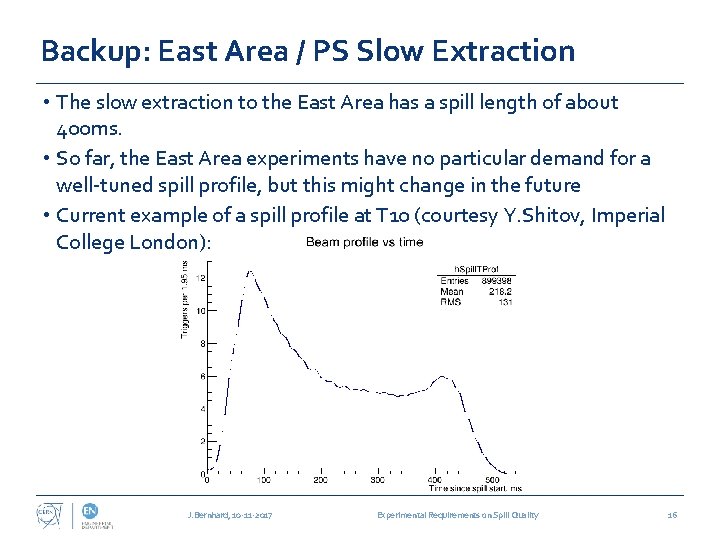
Backup: East Area / PS Slow Extraction • The slow extraction to the East Area has a spill length of about 400 ms. • So far, the East Area experiments have no particular demand for a well-tuned spill profile, but this might change in the future • Current example of a spill profile at T 10 (courtesy Y. Shitov, Imperial College London): J. Bernhard, 10 -11 -2017 Experimental Requirements on Spill Quality 16