
IMPRESSIONISM Upper Middle Class Scenes of Leisure Landscapes
- Slides: 14
IMPRESSIONISM Upper Middle Class Scenes of Leisure, Landscapes, & Urban Scenes of the 1870 s & Beyond
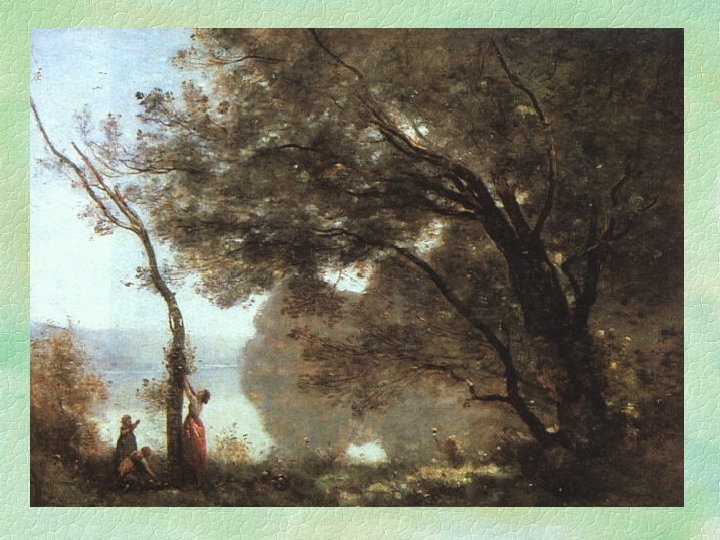
Impressionism’s Roots § Finished paintings were produced in a studio before the following innovators § The following artists worked in a naturalistic style, and painted out of doors l l John Constable-British painter who entered works in the Paris Salons Barbizon School - 1830 s & 40 s - group of French artists who worked en plein air Jean-Baptiste-Camille Corot - soft focus scenes of the French countryside Édouard Manet
Claude Monet & a new vision § Paintings & ideas before 1872 l l quick oil sketches are equal to “finished” works paintings should be naive & untainted by the adult intellect paintings tend to have harsh light & dark areas uses vibrant colors, black & white § Paintings & ideas after 1872 l Impression: Sunrise ( or Sunset? ), 1872 • source of group’s name - 1 st used derisively by critic l Views of Argenteuil, suburb where he lived
Claude Monet & a new vision § Paintings of the 1870 s & 80 s § Monet’s House at Argenteuil, 1873, o/c, 23¾ x 29” • dabs of paint capture the shifting quality of light off of surfaces • the world of light moves, as does the human eye • black not used for shadows - instead complementary colors put together in short strokes produce shading • Monet’s own prejudices are evident in the subject matter– happy, upper middle class places of leisure – images of industry are in harmony with pleasure spots
Claude Monet & a new vision § Paintings of the 1890 s l Series of paintings of one subject each haystacks, poplars, a church façade • focusing on light & color at particular moments • each canvas represents a different moment l Rouen Cathedral: The Portal in Sun, 1894, o/c 39¼” x 26” • otherwise gray surface reflects different colors of the spectrum at different times of day § Paintings at Giverny l uniting of self & nature in garden imagery
Pierre-Auguste Renoir § Moulin de la Galette, 1876, o/c, 4’ 3½” x 5’ 9” l l l old pancake mill turned into a dance hall w/ an open courtyard Renoir replaced regular seedy clientele with young, happy artist friends & models used short strokes of color to capture dappled light through trees on moving forms relaxed poses invite viewer into scene even blacks & browns of clothing are shot through with vivid color highlights
Pierre-Auguste Renoir § Luncheon of the Boating Party, 1881, o/c, 4’ 3” x 5’ 8” l l l represents the young & beautiful at a restaurant near a venue for rowing still using short strokes, he created more solid forms composed the groupings based upon triangles instead of randomly placing forms
Edgar Degas & Movement § Depicted bodies in motion: middle class people, working women (dancers, laundresses), women bathers, racehorses, etc. § The Tub, c. 1885 -6, pastel, 27½ x 27½” l unusual viewpoint with asymmetrical placement of figure • influences - Japanese prints & photography • short strokes of pastel chalk l Young Dancer Fourteen Years Old, 1880 -1, bronze with cloth, 39½”h (originally painted wax & cloth)
Mary Cassatt § Expatriate American protege of Degas § Lydia in a Loge, Wearing a Pearl Necklace, 1879, o/c, 31½ x 23” l l l subjects limited to those acceptable for a proper upper middle class woman mirror image behind shows others “being seen” & looking at others at the Paris Opera short, vibrant strokes of color intersecting diagonals of balcony and leaning woman Lydia modeled in light & dark
Mary Cassatt § Maternal Caress, 1891, drypoint, soft-ground etching, aquatint, 14¾ x 10¾” l influence of Japanese prints • subtle contours & outlines, • flat patterning & negative spaces • unusual angled viewpoint from above l l perceptive, intimate portrayals or women interacting with each other & with children subjects relate to the ukiyo-e (floating world) images of the Japanese geisha
Berthe Morisot § French female artist who joined the Impressionists & exhibited with them § In the Dining Room, 1886, o/c, 24 x 19¾” l l loose, free brushstroke celebrated her womanly vision & more delicate touch honors women in their accepted roles believed in the need for greater equality continued to paint even after marriage
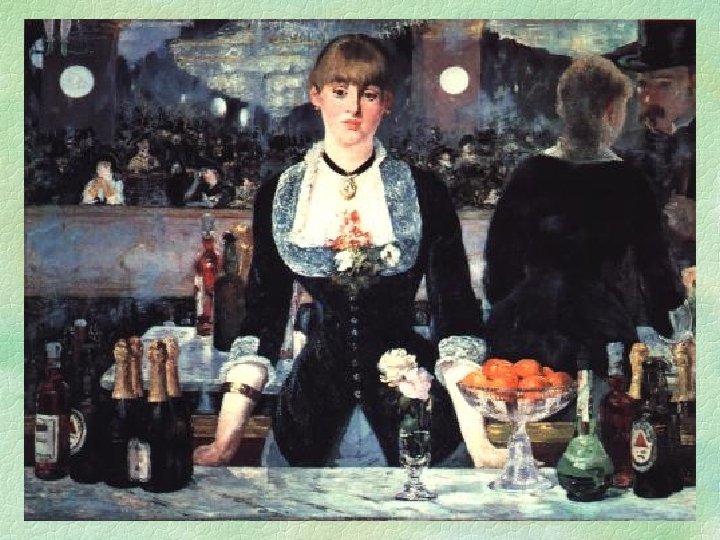
Édouard Manet § A Bar at the Folies-Bergère, 1881 -2, o/c, 37¾ x 51¼” l l A study in light, reflection, and color What is represented in this painting? • Who is the woman and where is she? • Who are the people around her? l What is the meaning of this work? • Does the artist have a message? • How does the painting make you feel?