
IMPRESSIONISM The Impressionist style of painting developed in
- Slides: 12
IMPRESSIONISM: The Impressionist style of painting developed in the late 1870 s in France. The artists sought to represent objects in their atmospheric veil, enveloped with light and air; it was not to paint local colors, but the effects of light under which everything momentarily changes color. They were an intellectual and social group of painters whose members sought to bring about a radical power shift in the world of art.
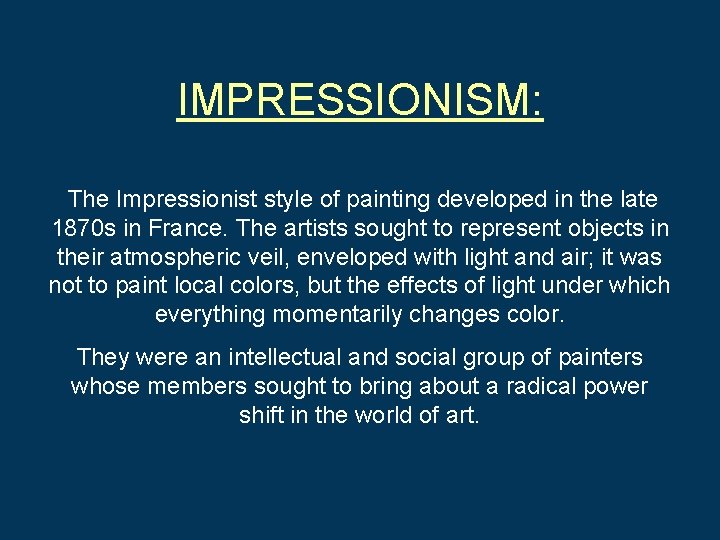
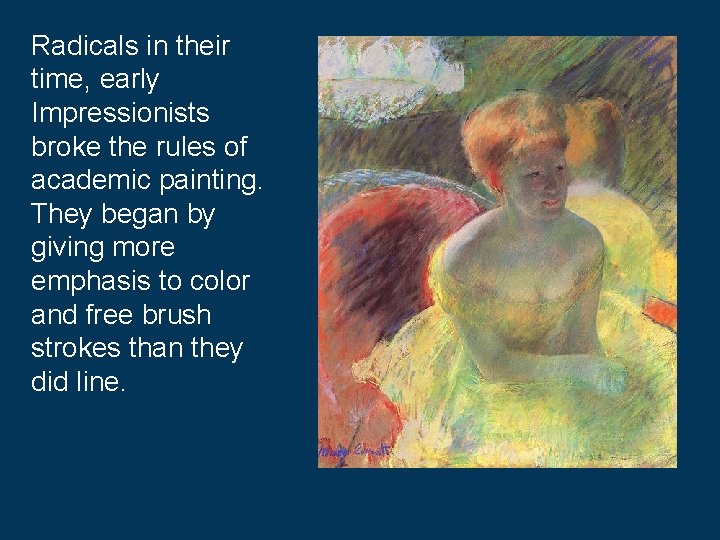
Impressionism was a 19 th-century art movement that began as a loose association of Paris-based artists whose independent exhibitions brought them to prominence in the 1870 s and 1880 s. Mary Cassatt Lydia Leaning on Her Arms 1879
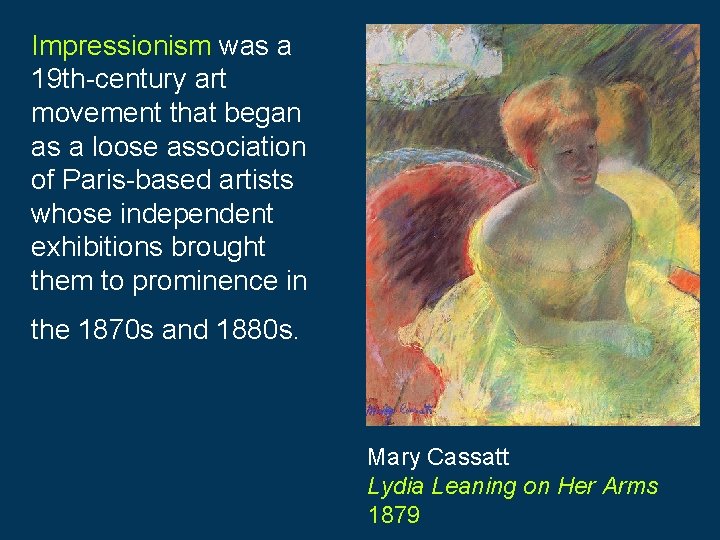
The name of the movement is derived from the title of a Claude Monet work, Impression, Sunrise
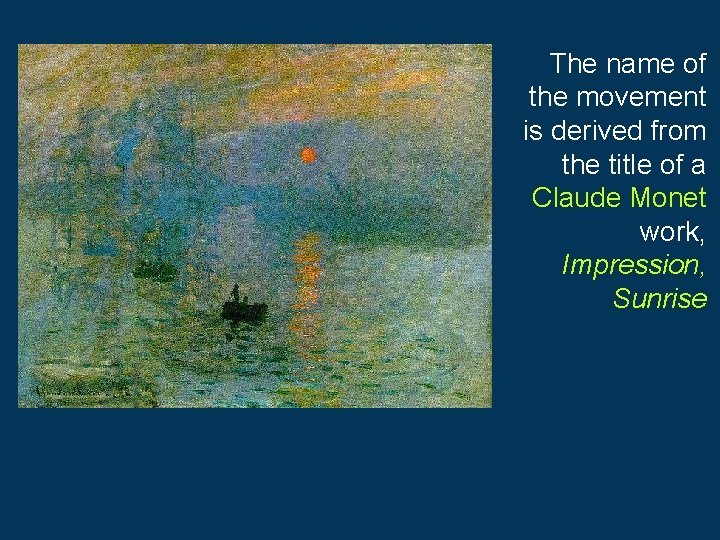
Characteristics of Impressionist paintings include relatively small, thin, yet visible brush strokes and emphasis on the accurate depiction of light in its changing qualities. Armand Guillaumin (1841– 1927), Sunset at Ivry 1873
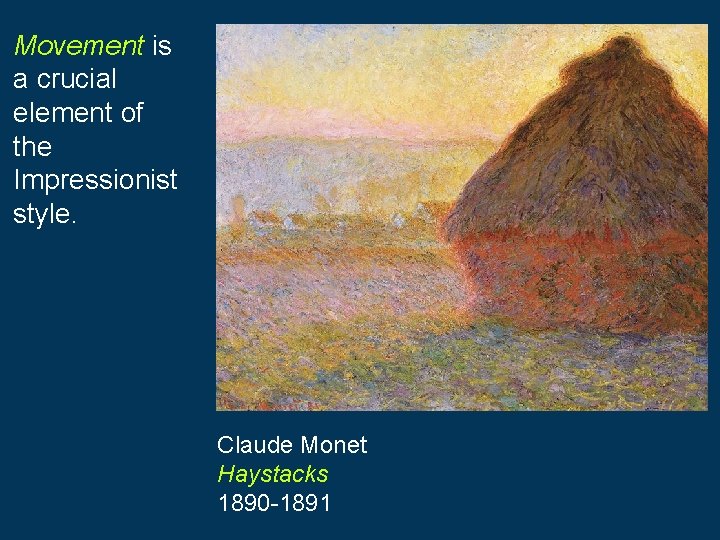
Movement is a crucial element of the Impressionist style. Claude Monet Haystacks 1890 -1891
Radicals in their time, early Impressionists broke the rules of academic painting. They began by giving more emphasis to color and free brush strokes than they did line.
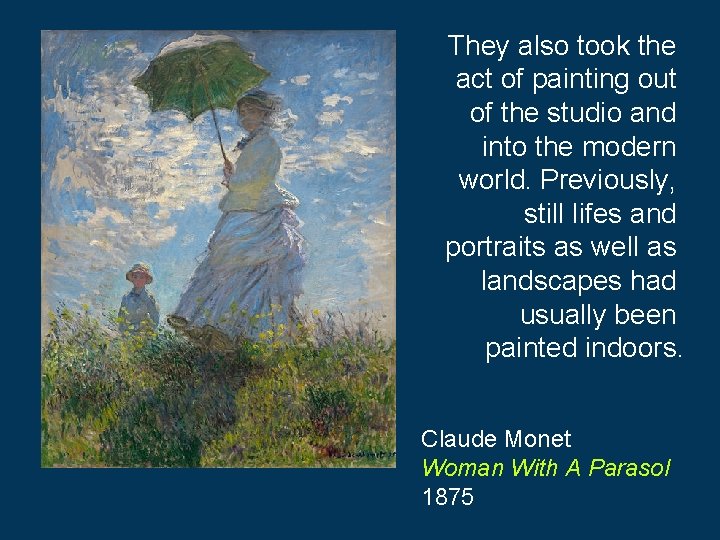
They also took the act of painting out of the studio and into the modern world. Previously, still lifes and portraits as well as landscapes had usually been painted indoors. Claude Monet Woman With A Parasol 1875
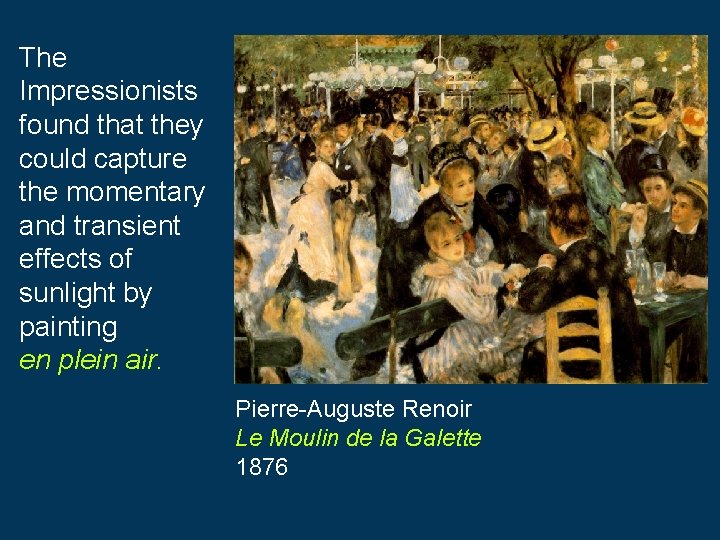
The Impressionists found that they could capture the momentary and transient effects of sunlight by painting en plein air. Pierre-Auguste Renoir Le Moulin de la Galette 1876
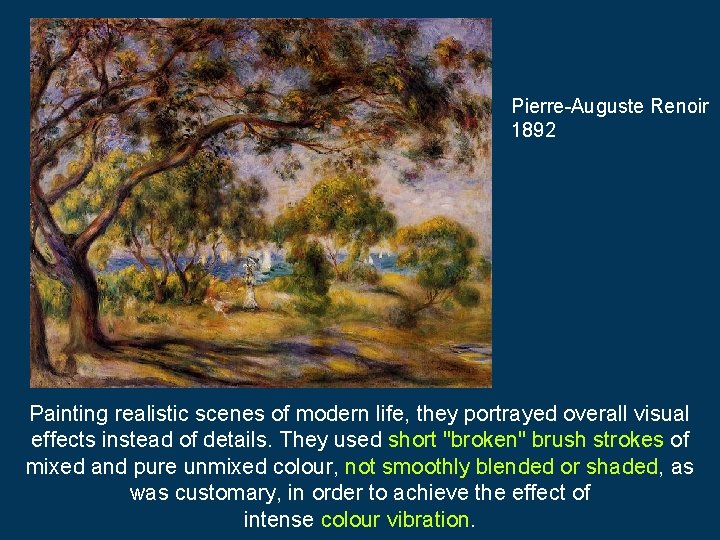
Pierre-Auguste Renoir 1892 Painting realistic scenes of modern life, they portrayed overall visual effects instead of details. They used short "broken" brush strokes of mixed and pure unmixed colour, not smoothly blended or shaded, as was customary, in order to achieve the effect of intense colour vibration.
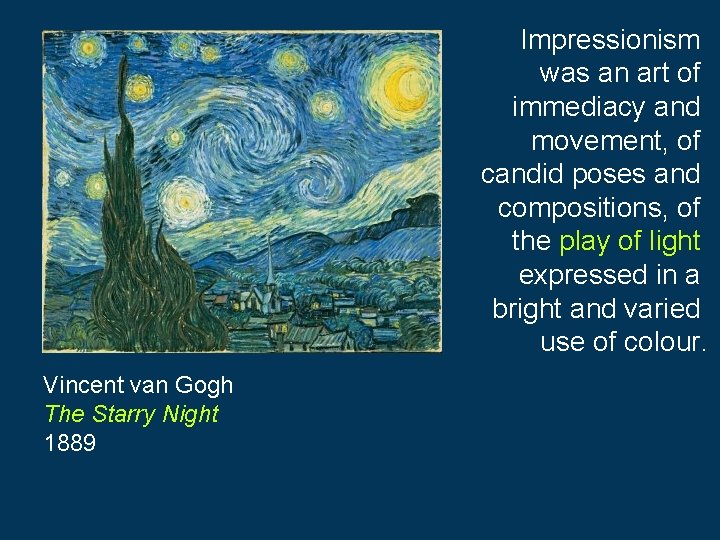
Impressionism was an art of immediacy and movement, of candid poses and compositions, of the play of light expressed in a bright and varied use of colour. Vincent van Gogh The Starry Night 1889
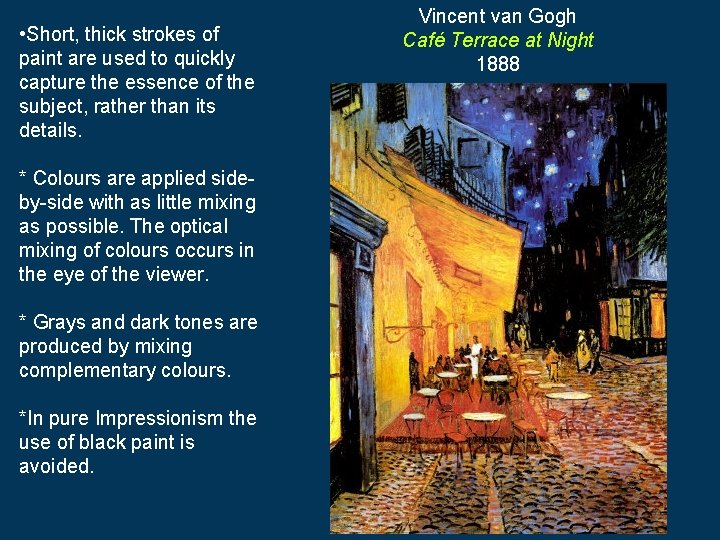
• Short, thick strokes of paint are used to quickly capture the essence of the subject, rather than its details. * Colours are applied sideby-side with as little mixing as possible. The optical mixing of colours occurs in the eye of the viewer. * Grays and dark tones are produced by mixing complementary colours. *In pure Impressionism the use of black paint is avoided. Vincent van Gogh Café Terrace at Night 1888
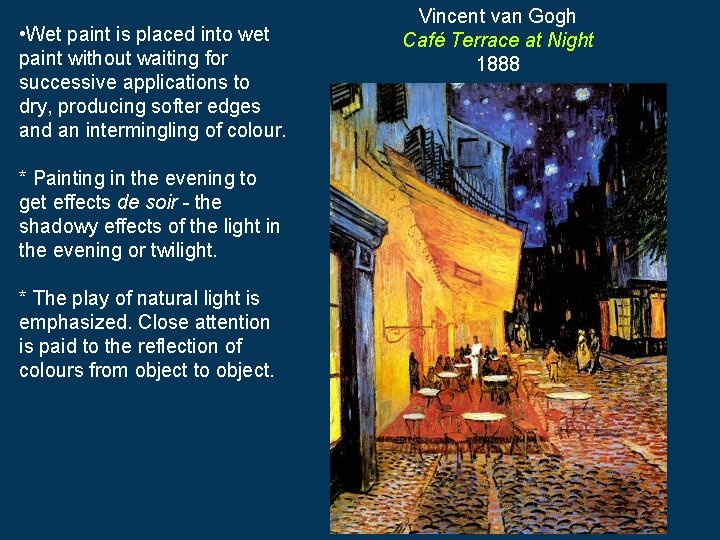
• Wet paint is placed into wet paint without waiting for successive applications to dry, producing softer edges and an intermingling of colour. * Painting in the evening to get effects de soir - the shadowy effects of the light in the evening or twilight. * The play of natural light is emphasized. Close attention is paid to the reflection of colours from object to object. Vincent van Gogh Café Terrace at Night 1888