
Impossibility Results CAP PRAM SNOW FLP COS 418518
Impossibility Results: CAP, PRAM, SNOW, & FLP COS 418/518: (Advanced) Distributed Systems Lecture 18 Mike Freedman & Wyatt Lloyd
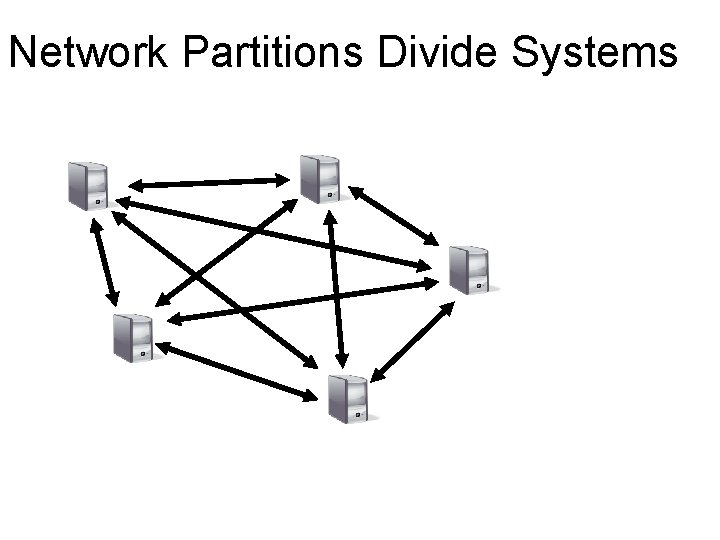
Network Partitions Divide Systems
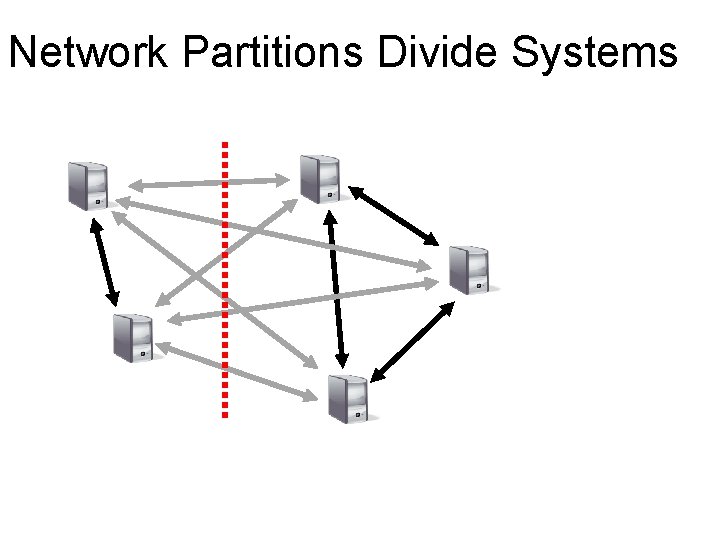
Network Partitions Divide Systems
How Can We Handle Partitions? • Atomic Multicast? • Bayou? • Dynamo? • Paxos? • RAFT? • COPS? • Spanner?
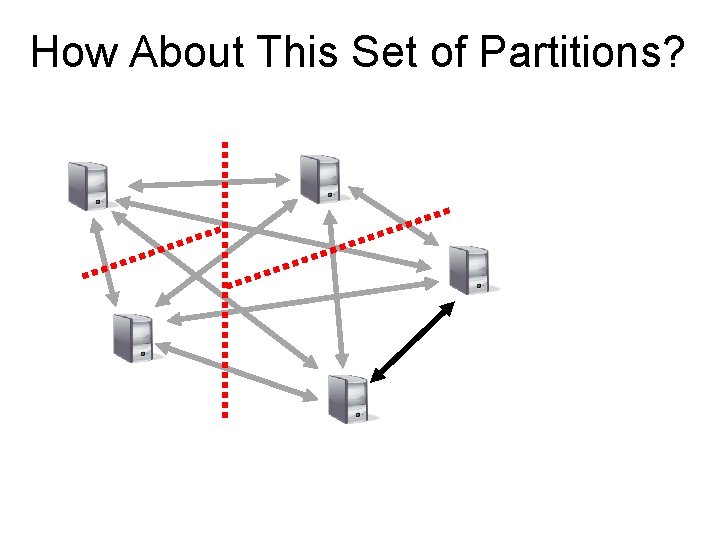
How About This Set of Partitions?
Fundamental Tradeoff? • Replicas appear to be a single machine, but lose availability during a network partition • OR • All replicas remain available during a network partition but do not appear to be a single machine
CAP Theorem Preview • You cannot achieve all three of: 1. Consistency 2. Availability 3. Partition-Tolerance • Partition Tolerance => Partitions Can Happen • Availability => All Sides of Partition Continue • Consistency => Replicas Act Like Single Machine • Specifically, Linearizability
Linearizability (refresher) • All replicas execute operations in some total order • That total order preserves the real-time ordering between operations • If operation A completes before operation B begins, then A is ordered before B in real-time • If neither A nor B completes before the other begins, then there is no real-time order • (But there must be some total order)
CAP Conjecture [Brewer 00] • From keynote lecture by Eric Brewer (2000) • History: Eric started Inktomi, early Internet search site based around “commodity” clusters of computers • Using CAP to justify “BASE” model: Basically Available, Soft-state services with Eventual consistency • Popular interpretation: 2 -out-of-3 • Consistency (Linearizability) • Availability • Partition Tolerance: Arbitrary crash/network failures
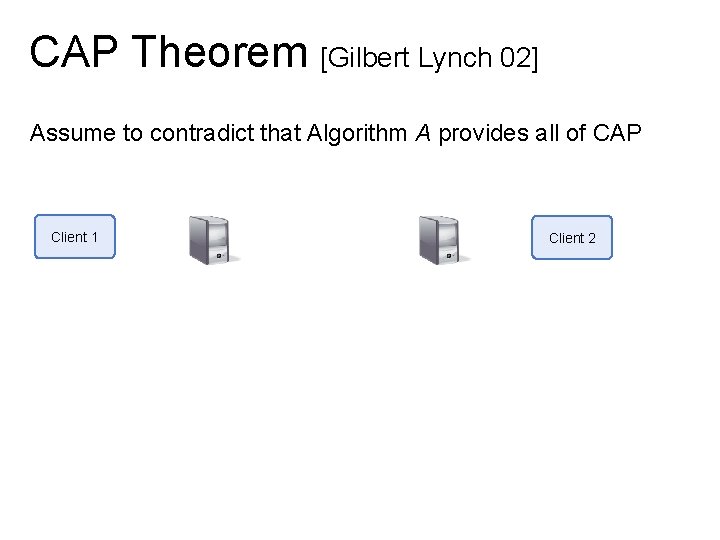
CAP Theorem [Gilbert Lynch 02] Assume to contradict that Algorithm A provides all of CAP Client 1 Client 2
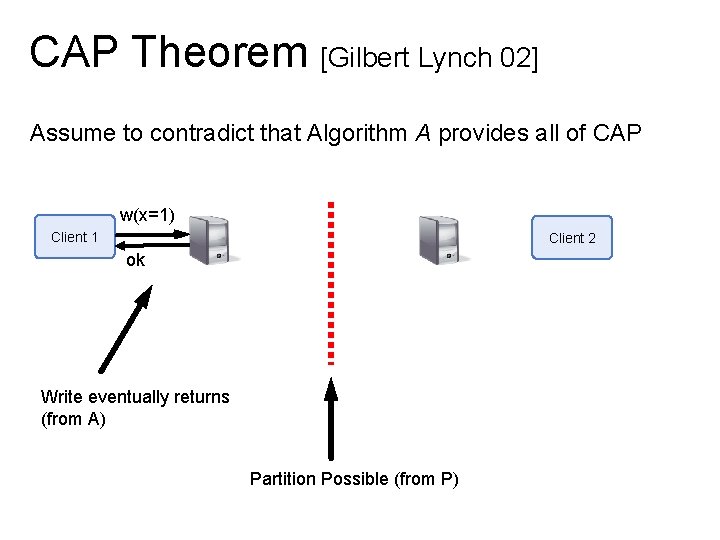
CAP Theorem [Gilbert Lynch 02] Assume to contradict that Algorithm A provides all of CAP w(x=1) Client 1 Client 2 ok Write eventually returns (from A) Partition Possible (from P)
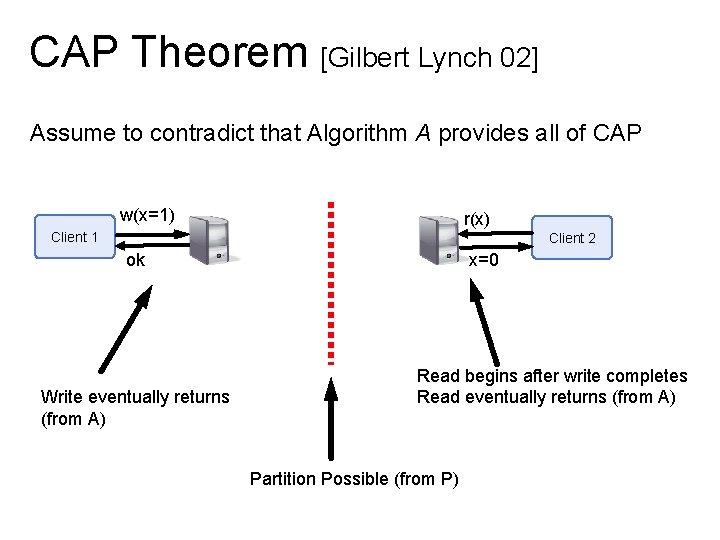
CAP Theorem [Gilbert Lynch 02] Assume to contradict that Algorithm A provides all of CAP w(x=1) r(x) Client 1 Client 2 ok Write eventually returns (from A) x=0 Read begins after write completes Read eventually returns (from A) Partition Possible (from P)
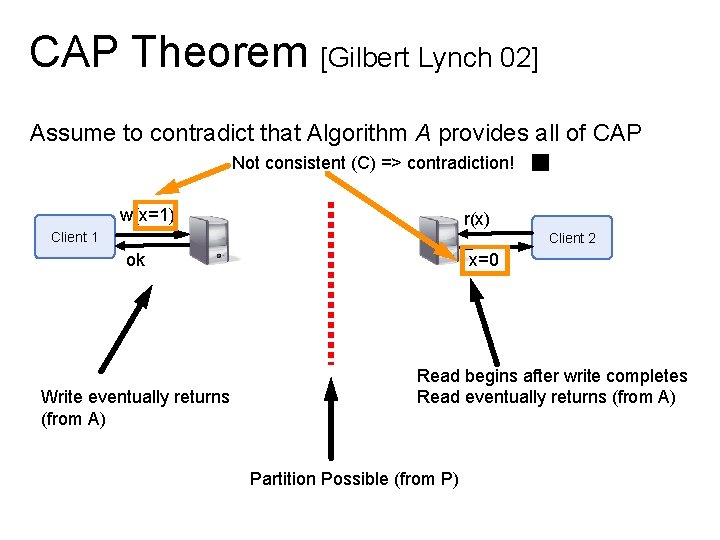
CAP Theorem [Gilbert Lynch 02] Assume to contradict that Algorithm A provides all of CAP Not consistent (C) => contradiction! w(x=1) r(x) Client 1 Client 2 ok Write eventually returns (from A) x=0 Read begins after write completes Read eventually returns (from A) Partition Possible (from P)
CAP Interpretation Part 1 • Cannot “choose” no partitions • 2 -out-of-3 interpretation doesn’t make sense • Instead, availability OR consistency? • i. e. , fundamental tradeoff between availability and consistency • When designing system must choose one or the other, both are not possible
CAP Interpretation Part 2 • It is a theorem, with a proof, that you understand! • Cannot “beat” CAP Theorem • Can engineer systems to make partitions extremely rare, however, and then just take the rare hit to availability (or consistency)
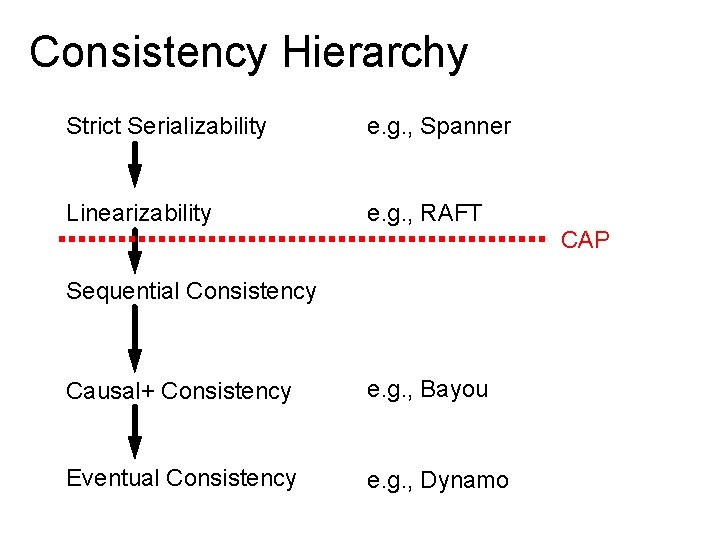
Consistency Hierarchy Strict Serializability e. g. , Spanner Linearizability e. g. , RAFT CAP Sequential Consistency Causal+ Consistency e. g. , Bayou Eventual Consistency e. g. , Dynamo
Impossibility Results Useful!!!! • Fundamental tradeoff in design space • Must make a choice • Avoids wasting effort trying to achieve the impossible • Tells us the best-possible systems we can build!
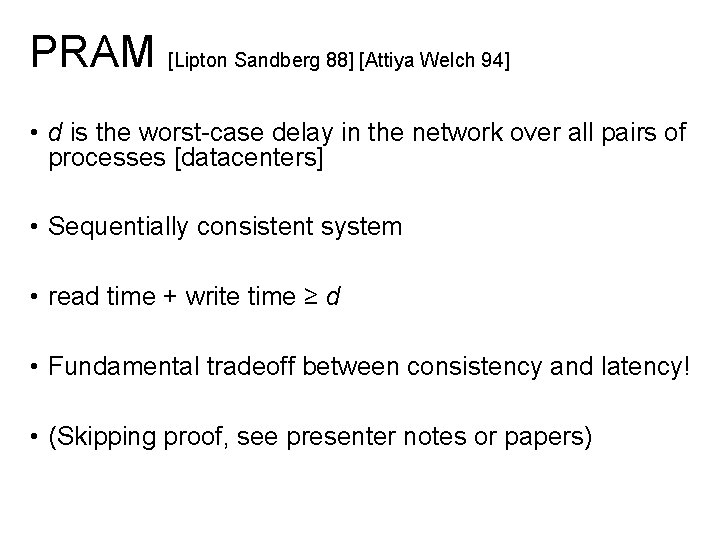
PRAM [Lipton Sandberg 88] [Attiya Welch 94] • d is the worst-case delay in the network over all pairs of processes [datacenters] • Sequentially consistent system • read time + write time ≥ d • Fundamental tradeoff between consistency and latency! • (Skipping proof, see presenter notes or papers)
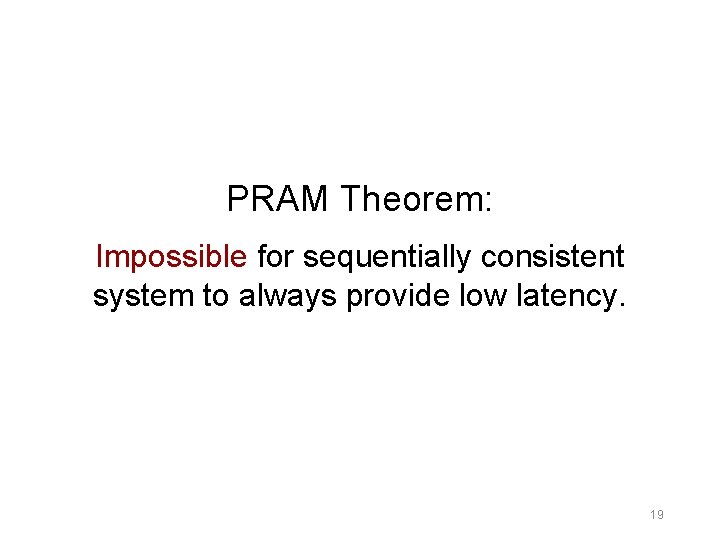
PRAM Theorem: Impossible for sequentially consistent system to always provide low latency. 19
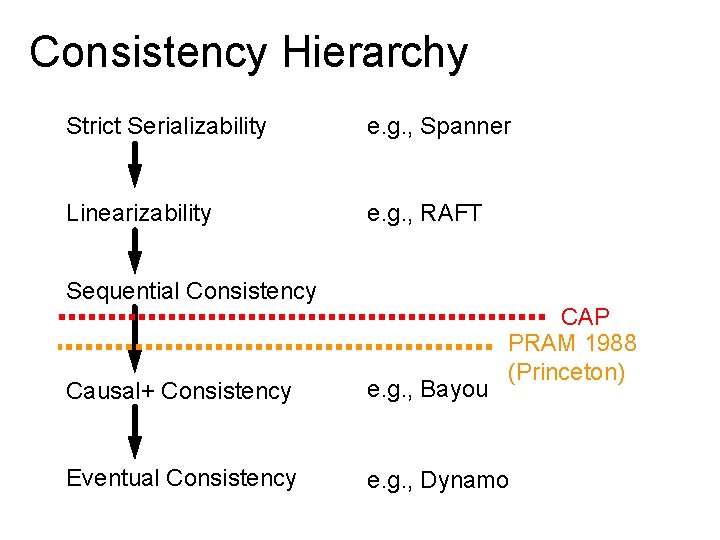
Consistency Hierarchy Strict Serializability e. g. , Spanner Linearizability e. g. , RAFT Sequential Consistency CAP PRAM 1988 (Princeton) Causal+ Consistency e. g. , Bayou Eventual Consistency e. g. , Dynamo
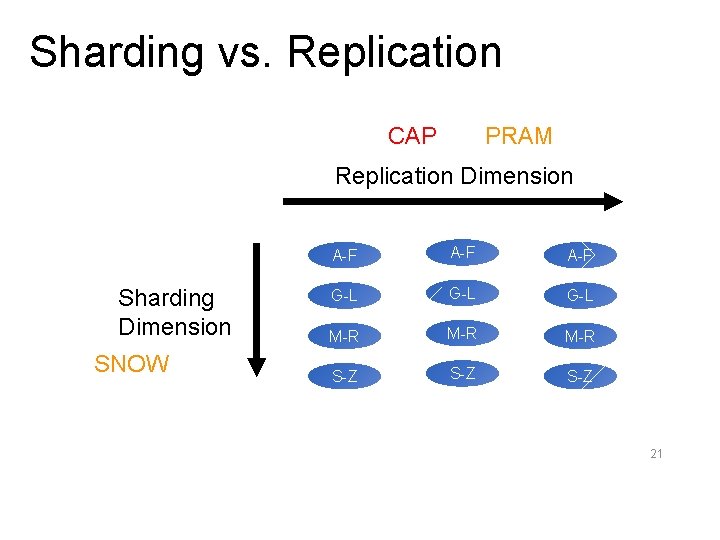
Sharding vs. Replication CAP PRAM Replication Dimension Sharding Dimension SNOW A-F A-F G-L G-L M-R M-R S-Z S-Z 21
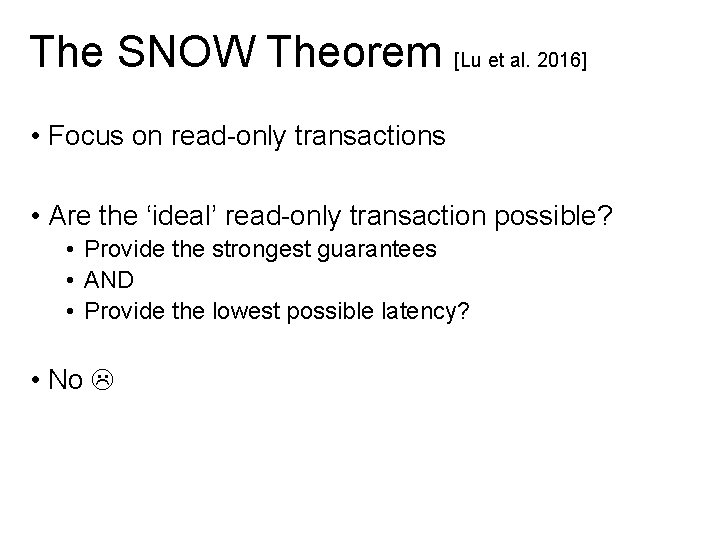
The SNOW Theorem [Lu et al. 2016] • Focus on read-only transactions • Are the ‘ideal’ read-only transaction possible? • Provide the strongest guarantees • AND • Provide the lowest possible latency? • No
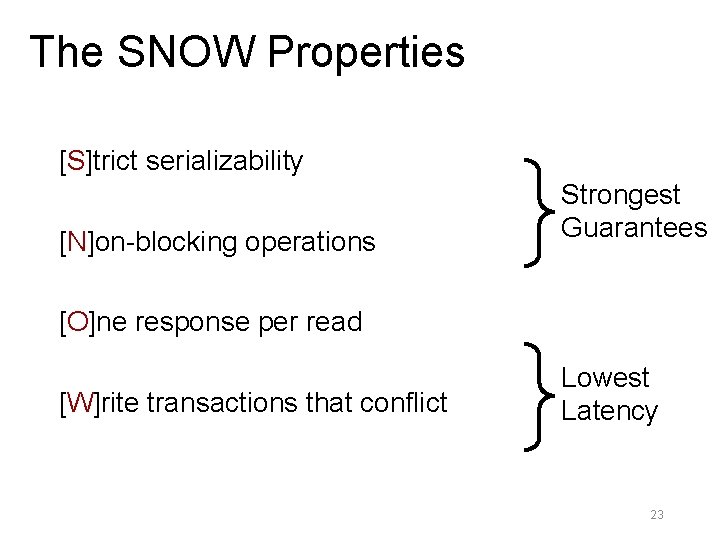
The SNOW Properties [S]trict serializability [N]on-blocking operations Strongest Guarantees [O]ne response per read [W]rite transactions that conflict Lowest Latency 23
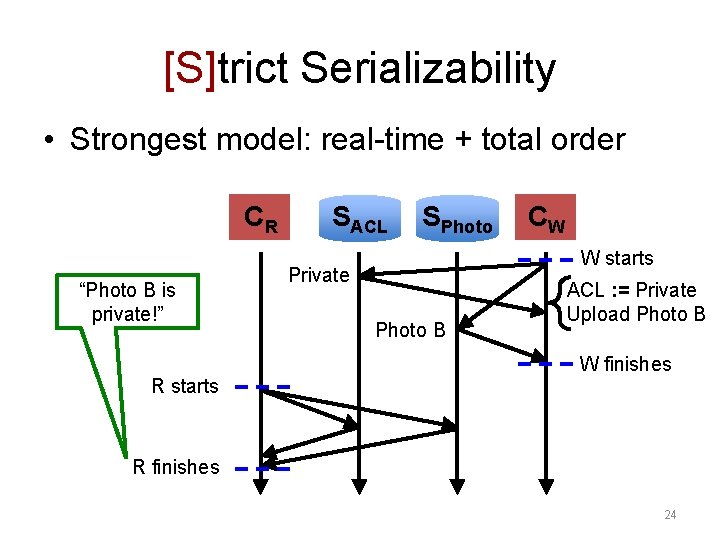
[S]trict Serializability • Strongest model: real-time + total order CR “Photo B is private!” R starts SACL SPhoto CW W starts Private Photo B ACL : = Private Upload Photo B W finishes R finishes 24
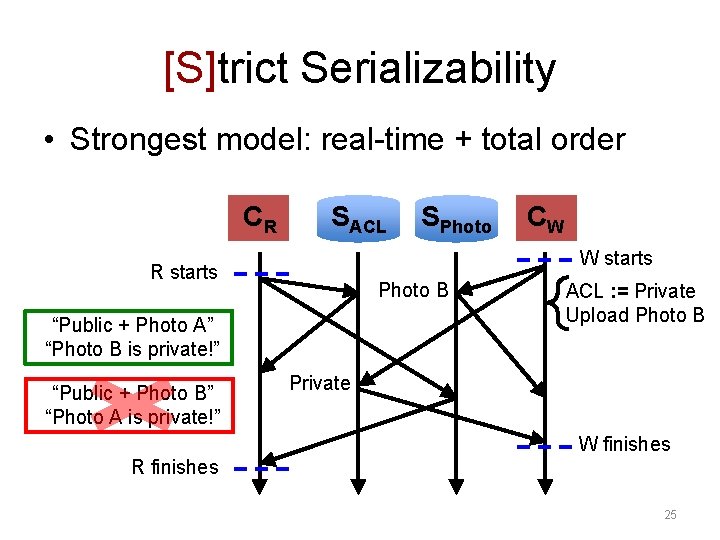
[S]trict Serializability • Strongest model: real-time + total order CR SACL CW W starts R starts Photo B “Public + Photo A” “Photo B is private!” “Public + Photo B” “Photo A is private!” SPhoto ACL : = Private Upload Photo B Private W finishes R finishes 25
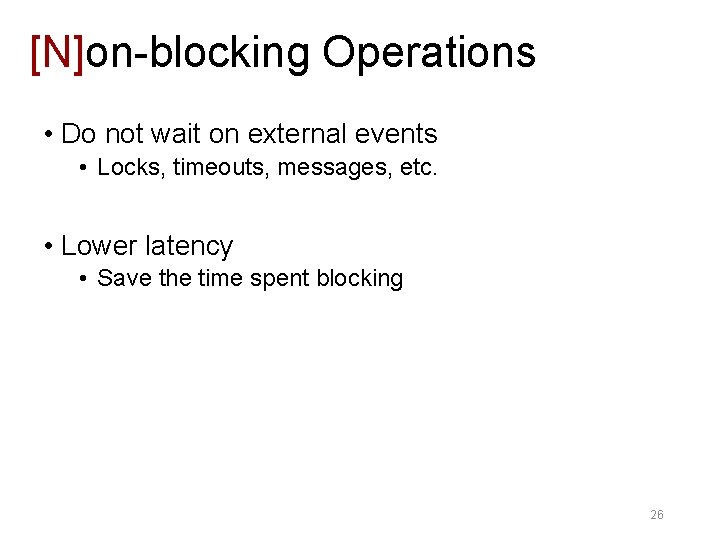
[N]on-blocking Operations • Do not wait on external events • Locks, timeouts, messages, etc. • Lower latency • Save the time spent blocking 26
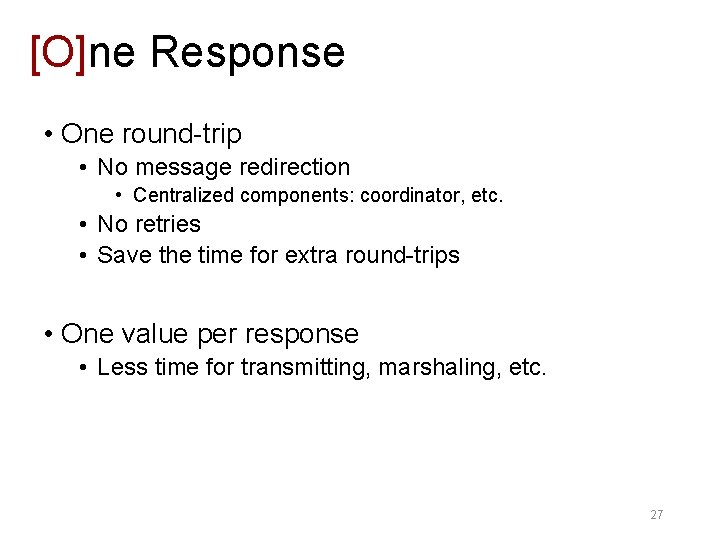
[O]ne Response • One round-trip • No message redirection • Centralized components: coordinator, etc. • No retries • Save the time for extra round-trips • One value per response • Less time for transmitting, marshaling, etc. 27
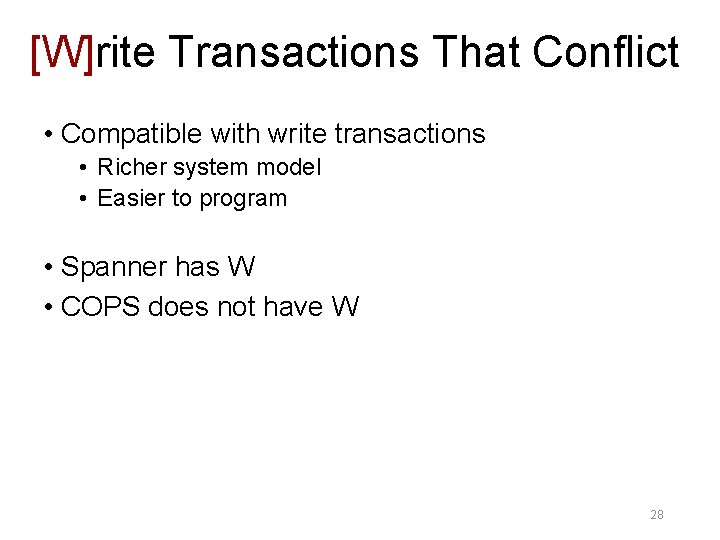
[W]rite Transactions That Conflict • Compatible with write transactions • Richer system model • Easier to program • Spanner has W • COPS does not have W 28
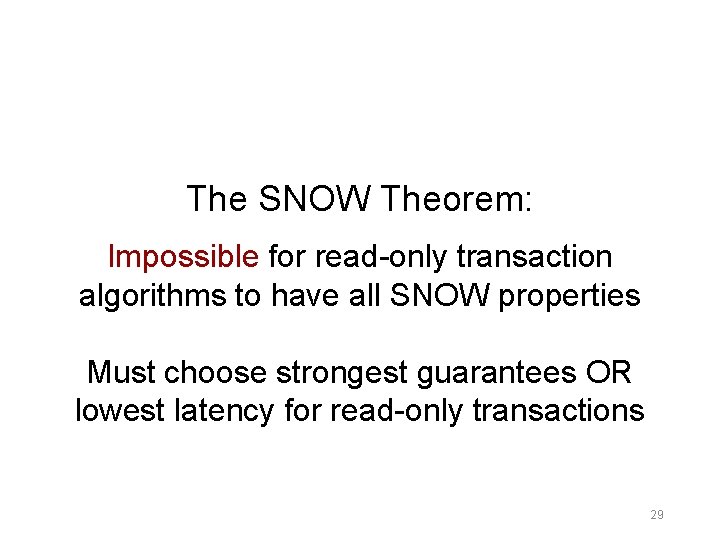
The SNOW Theorem: Impossible for read-only transaction algorithms to have all SNOW properties Must choose strongest guarantees OR lowest latency for read-only transactions 29
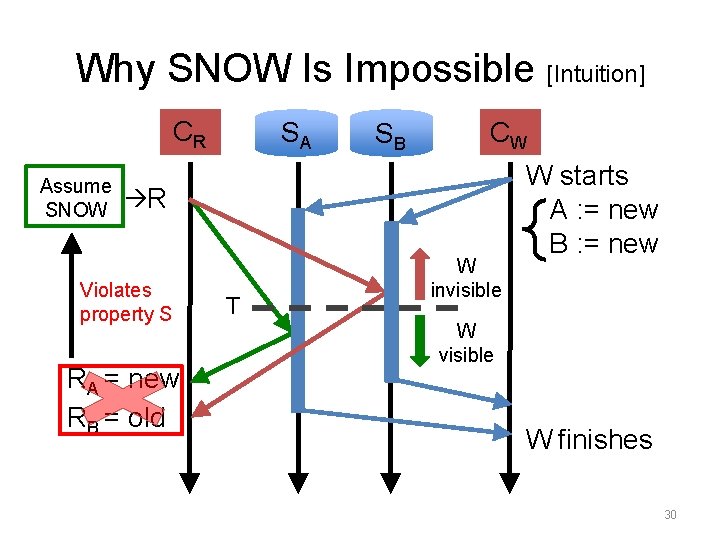
Why SNOW Is Impossible [Intuition] CR Assume SNOW SA SB CW R Violates property S RA = new RB = old T W invisible W starts A : = new B : = new W visible W finishes 30
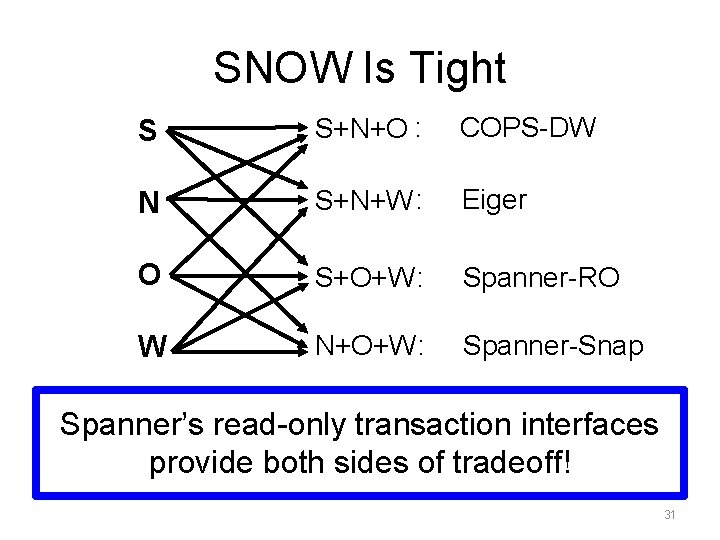
SNOW Is Tight S S+N+O : COPS-DW N S+N+W : Eiger O S+O+W : Spanner-RO W N+O+W : Spanner-Snap Spanner’s read-only transaction interfaces provide both sides of tradeoff! 31
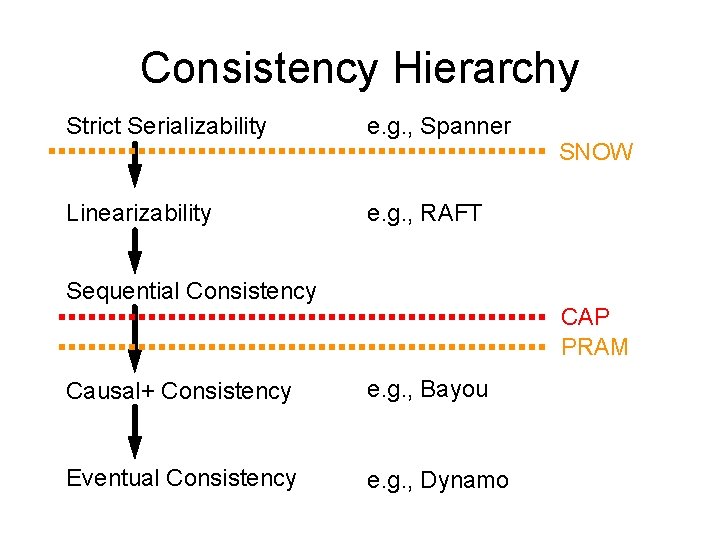
Consistency Hierarchy Strict Serializability e. g. , Spanner Linearizability e. g. , RAFT Sequential Consistency SNOW CAP PRAM Causal+ Consistency e. g. , Bayou Eventual Consistency e. g. , Dynamo
“FLP” Result • No deterministic 1 -crash-robust consensus algorithm exists with asynchronous communication 33
FLP is the original impossibility result for distributed systems! • Useful interpretation: no consensus algorithm can always reach consensus with an asynchronous network – Do not believe such claims! • Led to lots and lots of theoretical work – (Consensus is possible when the network is reasonably well-behaved) 34
Conclusion • Impossibility results tell you choices you must make in the design of your systems • CAP: Fundamental tradeoff between availability and strong consistency (for replication) • PRAM: Fundamental tradeoff between latency and strong consistency (for replication) • SNOW: Fundamental tradeoff between latency and strong guarantees (for sharding) 35
- Slides: 35