
Impossibility of Distributed Consensus with One Faulty Process
Impossibility of Distributed Consensus with One Faulty Process Michael J. Fischer Nancy A. Lynch Michael S. Paterson Presented by: Oren D. Rubin
: Agenda v Motivation v The Consensus Problem v Goal v Assumptions v. Terminology v. Main
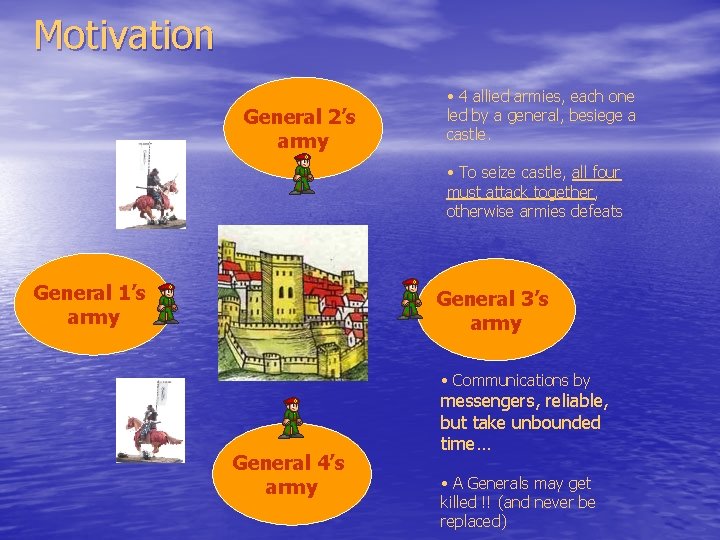
Motivation General 2’s army • 4 allied armies, each one led by a general, besiege a castle. • To seize castle, all four must attack together, otherwise armies defeats General 1’s army General 3’s army • Communications by General 4’s army messengers, reliable, but take unbounded time… • A Generals may get killed !! (and never be replaced)
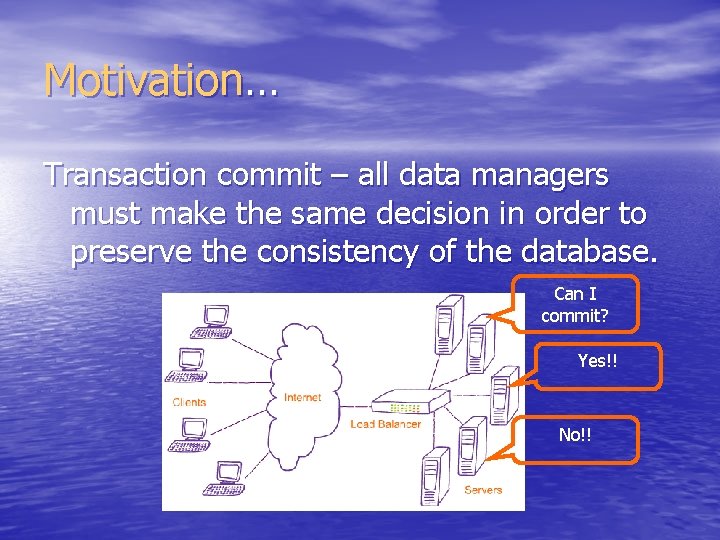
Motivation… Transaction commit – all data managers must make the same decision in order to preserve the consistency of the database. Can I commit? Yes!! No!!
The Consensus Problem • There is a set of distributed processes with initial values {0, 1} – This strengthen the impossibility result and simplifies the discussion. • They must all decide on the same value {0, 1}, based on their initial states. • There must be some initial state of the process set for which the reached decision is 0 and another for which it is 1. – To avoid trivial consensus protocols (which always result in the same decision) • Some “non-faulty” processes eventually decide on some value and this decision is irrevocable
Goal No completely asynchronous consensus protocol can tolerate even a single unannounced process death (no Byzantine failures).
Assumptions Processing is completely asynchronous v Reliable, includes “atomic broadcast” (virtual synchrony), could be out of order. v No assumptions about the relative speeds of processes. v Unknown delay time in message delivery. v No access to synchronized clocks (no time outs). v No ability to detect the death of a process.

Terminology • System Model - message passing based. – message is a pair of (p, m) : destination process and message value • N (>1) processes • The message system – Holds a message buffer • Unbounded. – Supports operations • Send(p, m) - places (p, m) in message buffer. • Receive(p) – extract a message (p, m) from the message buffer (m is delivered) or return “null” (finite number of times).
Terminology. . . • Process – automaton, finite or infinite states (deterministic). Each process p comprises an internal state – Input register Xp - fixed initial value. – output register Yp - initialed with ‘b’ (blank), fixed after rewritten. – Internal storage - unbounded, fixed initial value. Performs atomic steps (A. K. A. events) composed of – Receive a message (could be “null”). – Changes state (depending on message received). – Sends finite set of messages to other processes • Configuration – system’s global state, comprises all processes’ internal states and the message buffer – Initial configuration: initial states for all processes and message buffer is empty. – A step takes one configuration to another (completely determined by (p, m) ).
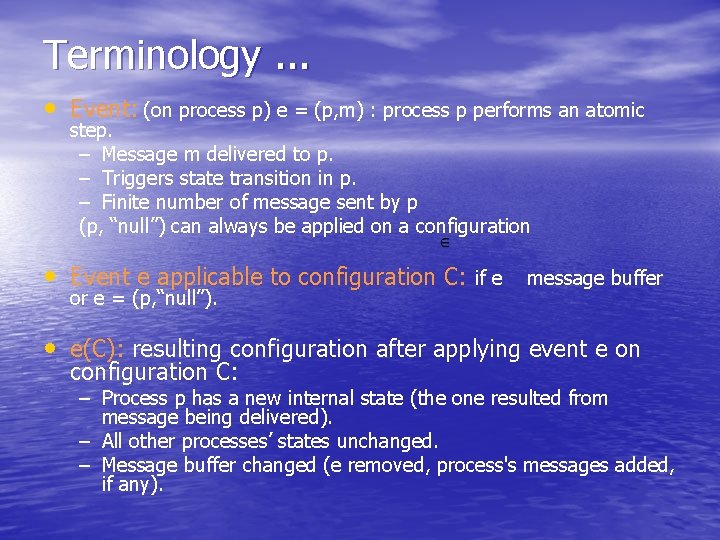
Terminology. . . • Event: (on process p) e = (p, m) : process p performs an atomic step. – Message m delivered to p. – Triggers state transition in p. – Finite number of message sent by p (p, “null”) can always be applied on a configuration • Event e applicable to configuration C: if e or e = (p, “null”). message buffer • e(C): resulting configuration after applying event e on configuration C: – Process p has a new internal state (the one resulted from message being delivered). – All other processes’ states unchanged. – Message buffer changed (e removed, process's messages added, if any).
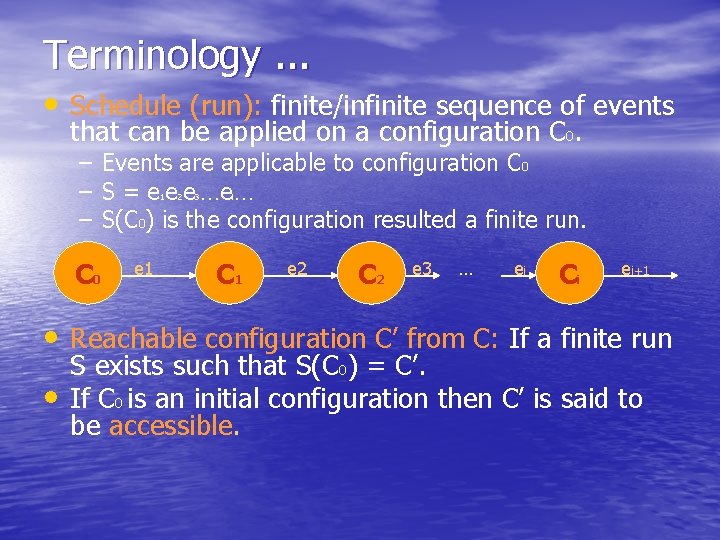
Terminology. . . • Schedule (run): finite/infinite sequence of events that can be applied on a configuration C 0. – Events are applicable to configuration C 0 – S = e e e …e … – S(C 0) is the configuration resulted a finite run. 1 C 0 e 1 2 3 i C 1 e 2 C 2 e 3 … ei Ci ei+1 • Reachable configuration C’ from C: If a finite run • S exists such that S(C 0) = C’. If C 0 is an initial configuration then C’ is said to be accessible.
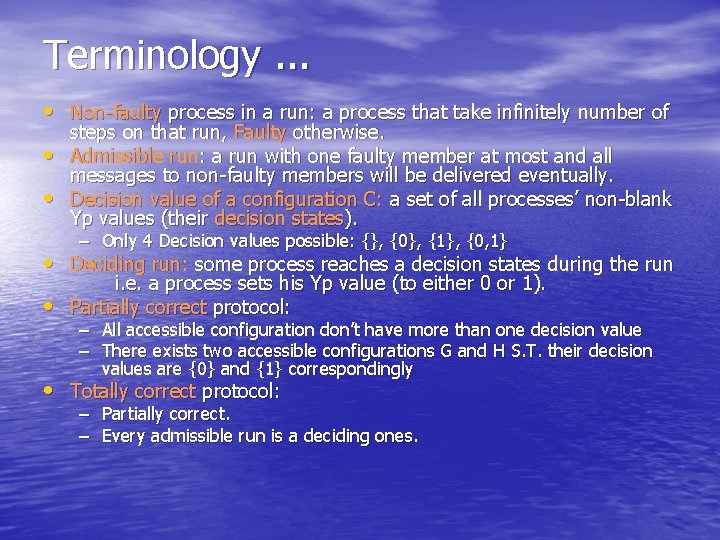
Terminology. . . • Non-faulty process in a run: a process that take infinitely number of • • steps on that run, Faulty otherwise. Admissible run: a run with one faulty member at most and all messages to non-faulty members will be delivered eventually. Decision value of a configuration C: a set of all processes’ non-blank Yp values (their decision states). – Only 4 Decision values possible: {}, {0}, {1}, {0, 1} • Deciding run: some process reaches a decision states during the run • i. e. a process sets his Yp value (to either 0 or 1). Partially correct protocol: – All accessible configuration don’t have more than one decision value – There exists two accessible configurations G and H S. T. their decision values are {0} and {1} correspondingly • Totally correct protocol: – Partially correct. – Every admissible run is a deciding ones.
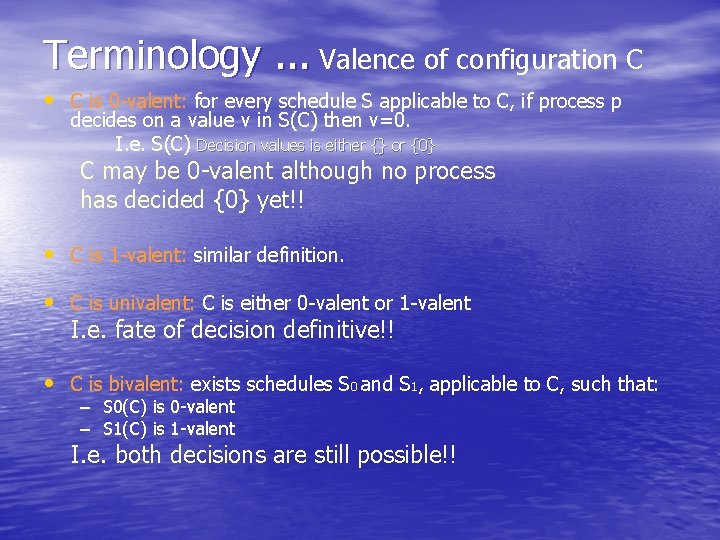
Terminology. . . Valence of configuration C • C is 0 -valent: for every schedule S applicable to C, if process p decides on a value v in S(C) then v=0. I. e. S(C) Decision values is either {} or {0} C may be 0 -valent although no process has decided {0} yet!! • C is 1 -valent: similar definition. • C is univalent: C is either 0 -valent or 1 -valent I. e. fate of decision definitive!! • C is bivalent: exists schedules S 0 and S 1, applicable to C, such that: – S 0(C) is 0 -valent – S 1(C) is 1 -valent I. e. both decisions are still possible!!
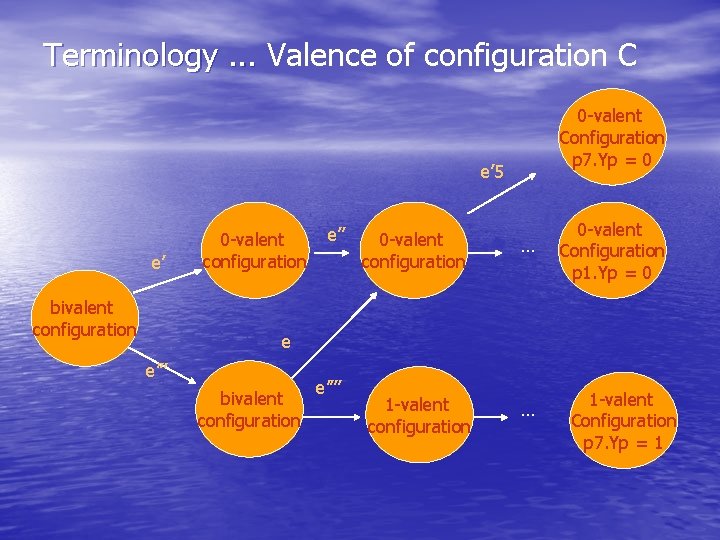
Terminology. . . Valence of configuration C 0 -valent Configuration p 7. Yp = 0 e’ 5 e’ bivalent configuration 0 -valent configuration e’’ 0 -valent configuration … 0 -valent Configuration p 1. Yp = 0 e e’’’ bivalent configuration e’’’’ 1 -valent configuration … 1 -valent Configuration p 7. Yp = 1
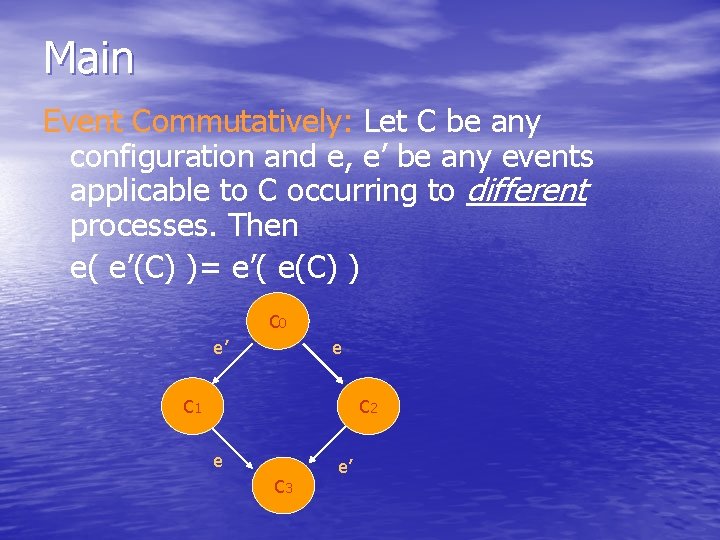
Main Event Commutatively: Let C be any configuration and e, e’ be any events applicable to C occurring to different processes. Then e( e’(C) )= e’( e(C) ) C 0 e’ e C 1 C 2 e C 3 e’

Main • Schedule Commutatively: Let C be any configuration and S, S’ be any events applicable to C occurring to different processes. Then • S( S’(C) )= S’( S(C) ) C 0 S’ S C 1 C 2 S C 3 S’

Main • Event Commutatively Proof: – Internal states of the process involved are mutual excluded. – The message buffer is a set. • Schedule Commutatively Proof: – e e e …e …e e’ e’ e’ …e’ 1 2 3 i n 1 2 3 i S m S’ – e e e …e …e’ e’ …e’ m – e’ e e e …e …e e’ e’ …e’ m 1 1 2 3 1 i 2 1 3 i n n 2 2 3 i – e’ e’ e’ …e’ e e e …e …e 1 2 3 S’ i m 1 2 3 i S n

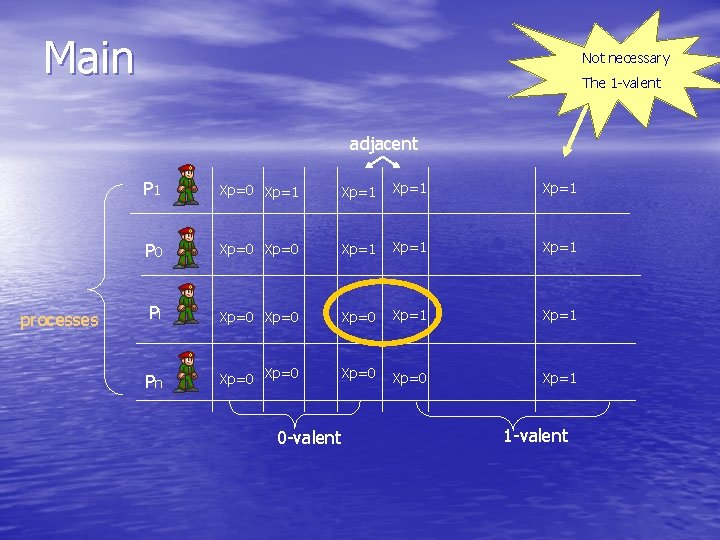
Main • Lemma 1: Every Totally correct protocol has an initial configuration C that is bivalent – – There is an initial configuration C that is 0 -valent There is an initial configuration C that is 1 -valent 0 1 – Let’s assume the contrary, that all configuration are univalent (since the protocol is partial correct). • Adjacent configuration: 2 configurations are adjacent is they differ in only one process’s (process pi) Xp value. There must exist adjacent configurations C 0, C 1 S. T. C 0 is 0 -valent and C 1 is 1 -valent (next slide). Take any admissible deciding run (with schedule S) where process pi takes no steps (one faulty process allowed). S can be applied to both C 0 and C 1 and they both will reach the same decision value (since nothing changes except pi’s Xp value which is untouched). decision value=1 C 0 is bivalent. decision value=0 C 1 is bivalent. Contradiction!!!
Main Not necessary The 1 -valent adjacent processes P 1 Xp=0 Xp=1 P 0 Xp=0 Xp=1 Pi Xp=0 Xp=1 Pn Xp=0 Xp=1 0 -valent 1 -valent
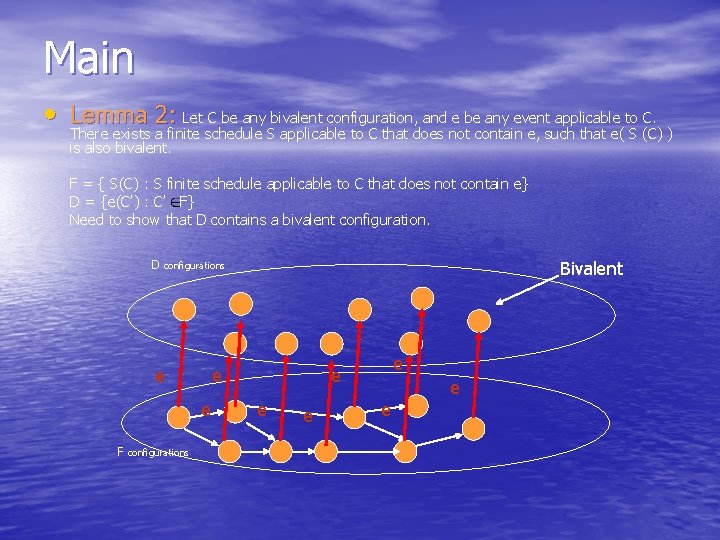
Main • Lemma 2: Let C be any bivalent configuration, and e be any event applicable to C. There exists a finite schedule S applicable to C that does not contain e, such that e( S (C) ) is also bivalent. F = { S(C) : S finite schedule applicable to C that does not contain e} D = {e(C’) : C’ F} Need to show that D contains a bivalent configuration. Bivalent D configurations e e e F configurations e e e
Main Assume the contrary, D doesn’t have a bivalent configuration • Neighbors configuration: configuration C 0 and C 1 are neighbors if one resulted from the other in one step e’ = (p’, m’) There exists neighbors C 0, C 1 S. T. C 1=e’(C 0) or C 0=e’(C 1) And that D 1=e(D 0), D 0=e(D 1) are 1 -valent and 0 -valent correspondingly (next slide)
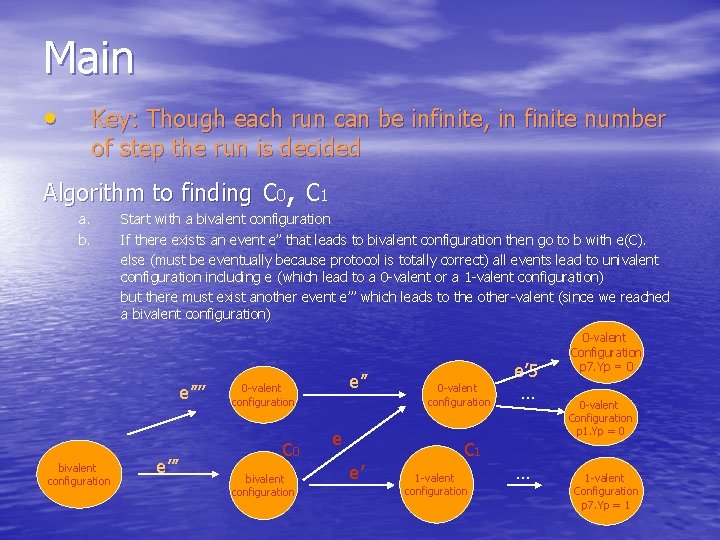
Main • Key: Though each run can be infinite, in finite number of step the run is decided Algorithm to finding C 0, C 1 a. b. Start with a bivalent configuration If there exists an event e’’ that leads to bivalent configuration then go to b with e(C). else (must be eventually because protocol is totally correct) all events lead to univalent configuration including e (which lead to a 0 -valent or a 1 -valent configuration) but there must exist another event e’’’ which leads to the other-valent (since we reached a bivalent configuration) e’’’’ bivalent configuration e’’’ e’’ 0 -valent configuration C 0 bivalent configuration e 0 -valent configuration e’ 5 … 0 -valent Configuration p 7. Yp = 0 0 -valent Configuration p 1. Yp = 0 C 1 e’ 1 -valent configuration … 1 -valent Configuration p 7. Yp = 1
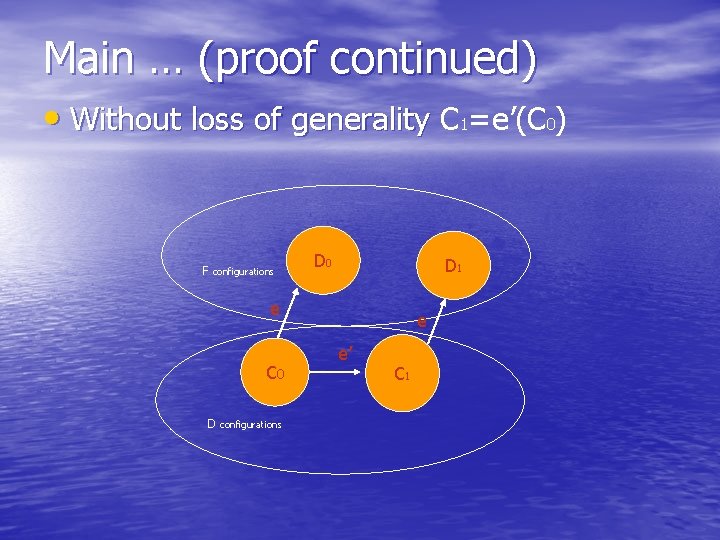
Main … (proof continued) • Without loss of generality C 1=e’(C 0) F configurations D 0 D 1 e C 0 D configurations e e’ C 1
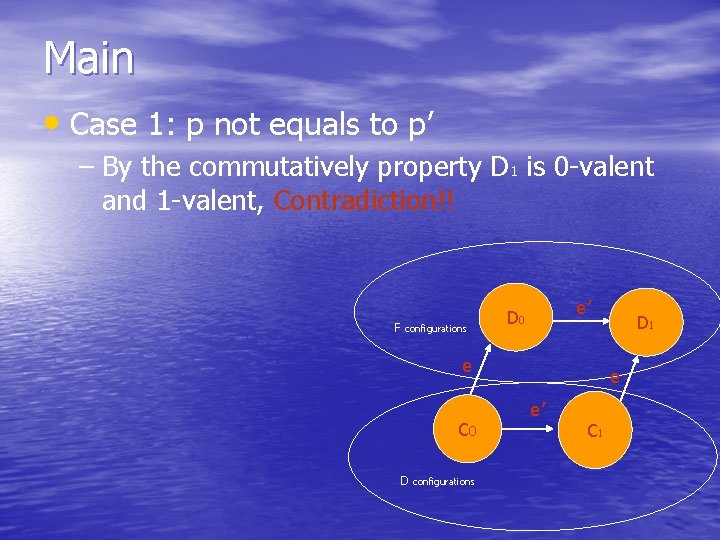
Main • Case 1: p not equals to p’ – By the commutatively property D 1 is 0 -valent and 1 -valent, Contradiction!! F configurations e’ D 0 e C 0 D configurations D 1 e e’ C 1
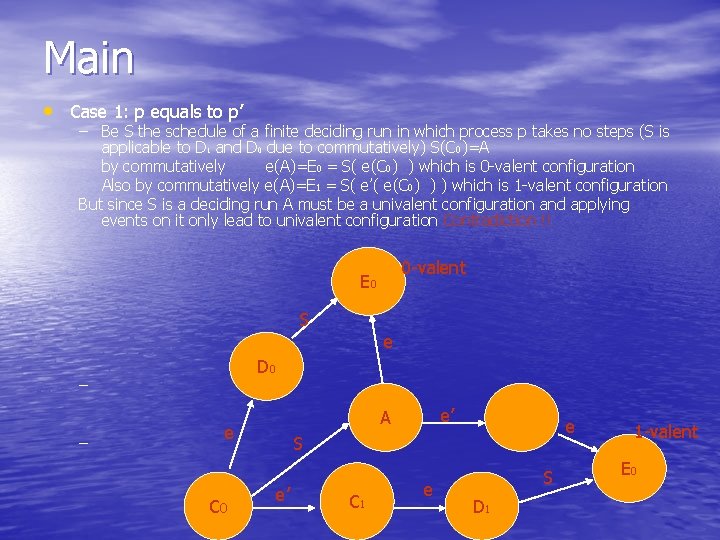
Main • Case 1: p equals to p’ – Be S the schedule of a finite deciding run in which process p takes no steps (S is applicable to D 1 and D 0 due to commutatively) S(C 0)=A by commutatively e(A)=E 0 = S( e(C 0) ) which is 0 -valent configuration Also by commutatively e(A)=E 1 = S( e’( e(C 0) ) ) which is 1 -valent configuration But since S is a deciding run A must be a univalent configuration and applying events on it only lead to univalent configuration Contradiction !! 0 -valent E 0 S e D 0 – – e C 0 e’ A e S e’ C 1 e S D 1 1 -valent E 0
Main… finally • The last 2 contradictions proved that D contains a bivalent configuration. • The idea: postpone the event that leads to a univalent configuration by that delaying the decision. • The algorithm: a. Execution begins with the bivalent configuration C 0 which is promised. b. we order the messages in the message buffer, according to the time they were sent, earliest first. c. We go over the processes in a round robin fashion (infinitely), for each process: • Let m be the first message in the message buffer destined to the process in • • the head of the queue or “null” By lemma 2 there exists a bivalent configuration C’ S. T. C’ is reachable from C by a schedule S in which (p, m) is the last step applied. We apply S. since all messages are delivered this infinite run is admissible.

THE END
- Slides: 27