
Imposing Liberalism The Haudenosaunee Confederacy Conflicting World Views

Imposing Liberalism
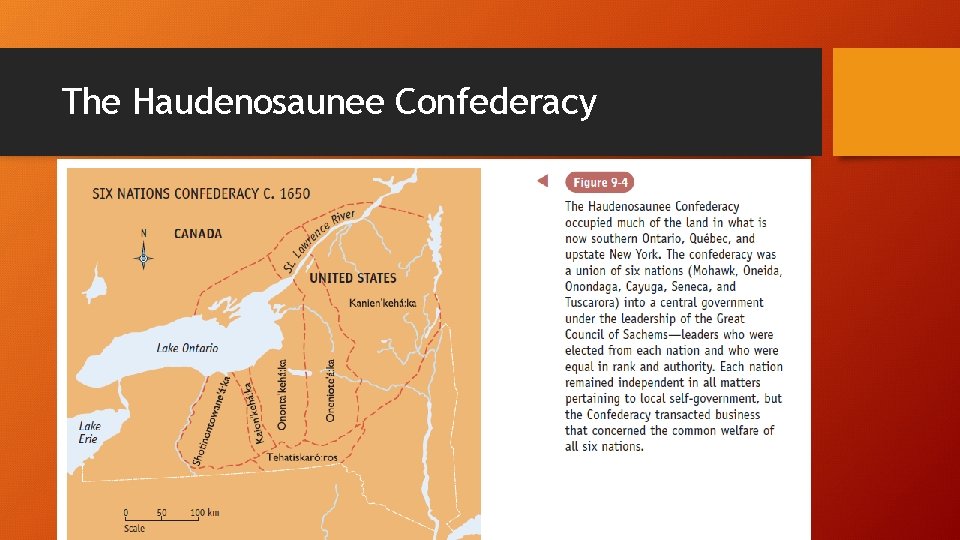
The Haudenosaunee Confederacy
Conflicting World Views • The various conceptual differences between the traditional ideology of the Aboriginal peoples and the emerging liberalism of the immigrant society would eventually lead to misunderstandings in areas such as land ownership, education, work, and governance. • As more immigrants arrived from Europe, more land was needed to accommodate them. By 1812, European settlers outnumbered. Aboriginal peoples by a ratio of 10 to 1 in eastern Canada. Treaties were negotiated that allowed newcomers to claim the land First Nations inhabited in exchange for promises of compensation in the form of annual payments, social and economic benefits, and the continued use of some land resources. Many First Nations leaders wanted peace and harmony with the European settlers who were pressing in upon them, but, above all, they wanted to protect and preserve their way of life.
The Treaties and Conflict • By the time of Confederation in 1867, 123 treaties and land surrenders had already been negotiated in British North America. By 1975 and the James Bay Agreement, there were 500. • Many contemporary conflicts between individual First Nations and Canadian governments have resulted from some of these agreements. Some of the reasons for these conflicts include the following: • The British didn’t Trust Oral Agreements • Deals were brokered through Interpreters who either didn’t fully grasp the languages or were dishonest • European attitudes of cultural superiority
Attempts at Assimilation • In their efforts to have Aboriginal peoples adopt liberal ideology and a European way of life (a process known as assimilation), successive Canadian governments used several different means. One of these was the residential school system (mandatory boarding schools for Aboriginal children that had the primary goal of assimilating them into Western cultures and traditions) • Another method used in attempting assimilation was enfranchisement (giving non-Aboriginal rights to First Nations’ men to entice them to give up their official Indian status and become part of mainstream Euro-Canadian society)
The White Paper v. the Red Paper • Pg. 310 -311 • White Paper – was the attempt to abolish status, treaties and everything else that kept First Nations and Inuit people distinct from the rest of the people in Canada • Red Paper – was the rebuttal of the white paper by Aboriginal leaders that denounced the premise and propositions of the white paper and staked the claim of the First Nations and Inuit to the rights and holdings the treaties promised them. Further more, they pointed out that crown lands were really aboriginal lands that were held by the crown and aboriginal rights were only subject to change when First Nations and Inuit people desired that change to occur.
- Slides: 6