
IMPORTEXPORT VALUATION AND PROCEDURE By G SHIVADASS Executive
IMPORT/EXPORT VALUATION AND PROCEDURE By: G. SHIVADASS Executive Partner Lakshmi Kumaran & Sridharan, Attorneys © COPYRIGHT 2012, LAKSHMI KUMARAN & SRIDHARAN, ATTORNEYS
TOPICS COVERED IN THIS PRESENTATION § Valuation under Customs Law § Transaction Value Method § Import Valuation § Export Valuation © COPYRIGHT 2012, LAKSHMI KUMARAN & SRIDHARAN, ATTORNEYS 2

VALUATION UNDER CUSTOM LAW
VALUATION UNDER CUSTOM LAW § Sec 2(41) - ‘Value’ – means value determined in accordance with S. 14 § New S. 14 applicable since 2007 § Two methods of valuation § Tariff Value Method – Sec 14(2) § Transaction Value Method – Sec 14(1) § Customs Valuation Rules § Customs Valuation (Determination of Value of Imported Goods) Rules, 2007 § Customs Valuation (Determination of Value of Export Goods) Rules, 2007 © COPYRIGHT 2012, LAKSHMI KUMARAN & SRIDHARAN, ATTORNEYS 4
TRAIFF VALUE METHOD § Ad valorem duties to be calculated on tariff values fixed by the Board § Tariff values can be fixed for any class of imported or export goods § Notified in the official gazette § Notification No. 36/2001 -Cus. (N. T. ), dated 3. 8. 2001 © COPYRIGHT 2012, LAKSHMI KUMARAN & SRIDHARAN, ATTORNEYS 5

TRANSACTION VALUE METHOD
EVOLUTION • S. 14 and Customs Valuation Rules based on 1. GATT Article VII – Valuation for Customs Purposes – lays down general principles of valuation (presently, the WTO Valuation Agreement) 2. Agreement on Implementation of Art. VII of GATTMultilateral agreement for – A fair, uniform and neutral system of valuation – System consistent with commercial practices © COPYRIGHT 2012, LAKSHMI KUMARAN & SRIDHARAN, ATTORNEYS 7
Article 1 of Implementation Agreement § Customs value of imported goods shall be “Transaction Value” provided – § No restrictions as to the disposition of goods by buyer § No consideration for which value cant be determined § The buyer and seller are not related © COPYRIGHT 2012, LAKSHMI KUMARAN & SRIDHARAN, ATTORNEYS 8
SECTION 14 “ …. . the value of the imported goods and export goods shall be the transaction value of such goods, that is to say, the price actually paid or payable for the goods when sold for export to India for delivery at the time and place of importation, or as the case may be, for export from India for delivery at the time and place of exportation, where the buyer and seller of the goods are not related and price is the sole consideration for the sale subject to such other conditions as may be specified in the rules made in this behalf : …” © COPYRIGHT 2012, LAKSHMI KUMARAN & SRIDHARAN, ATTORNEYS 9
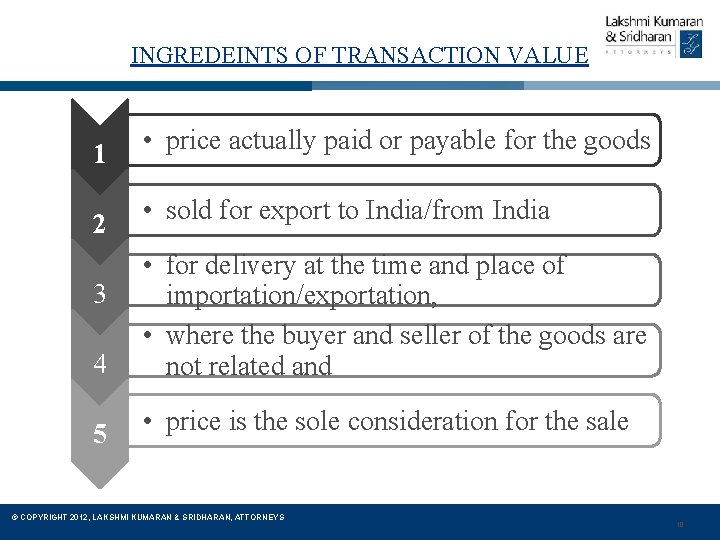
INGREDEINTS OF TRANSACTION VALUE 1 • price actually paid or payable for the goods 2 • sold for export to India/from India 4 • for delivery at the time and place of importation/exportation, • where the buyer and seller of the goods are not related and 5 • price is the sole consideration for the sale 3 © COPYRIGHT 2012, LAKSHMI KUMARAN & SRIDHARAN, ATTORNEYS 10
CONDITIONS FOR ACCEPTING TRANSACTION VALUE § Section 14 (1)& Rule 3(2) § Buyer and seller should not be related § Price should be the sole consideration for the sale § No restriction on buyer for disposal of goods; which substantially affect the value of goods § Sale should not be subject to conditions of which value cannot be determined § No further consideration to seller of which adjustment cannot be made © COPYRIGHT 2012, LAKSHMI KUMARAN & SRIDHARAN, ATTORNEYS 11
SOLD FOR EXPORTATION § There must be a sale for export to the country of importation (India) § Sale can be made in high seas to be imported into India § Advisory Opinion 14. 1: only transaction involving an actual international transfer of goods § Applicable when goods are cleared from a bonded warehouse to the DTA § Charges after importation should not be included in the customs value. © COPYRIGHT 2012, LAKSHMI KUMARAN & SRIDHARAN, ATTORNEYS 13
PRICE IS THE SOLE CONSIDARATION § If there is other consideration, it should be added to the transaction value • Activities on account of buyer for which adjustment is not provided in rule 10 – not to be added to price • If price is subject to a condition for which value cannot be determined – T. V. is rejected. © COPYRIGHT 2012, LAKSHMI KUMARAN & SRIDHARAN, ATTORNEYS 14
INCLUSION TO THE ASSESSABLE VALUE RULE 10 OF CVR 2007 § Rule 10 – cost and services to be included if not already included in the price paid or payable § 10(1)(a) - Incurred by the buyer for the imported goods § Commissions and brokerage except buying commissions § Cost of containers being one with the goods § Labour and material cost for packing © COPYRIGHT 2012, LAKSHMI KUMARAN & SRIDHARAN, ATTORNEYS 15
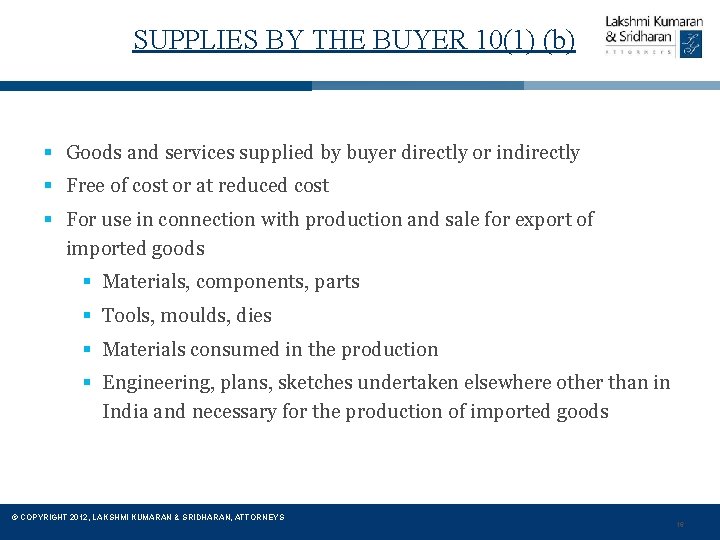
SUPPLIES BY THE BUYER 10(1) (b) § Goods and services supplied by buyer directly or indirectly § Free of cost or at reduced cost § For use in connection with production and sale for export of imported goods § Materials, components, parts § Tools, moulds, dies § Materials consumed in the production § Engineering, plans, sketches undertaken elsewhere other than in India and necessary for the production of imported goods © COPYRIGHT 2012, LAKSHMI KUMARAN & SRIDHARAN, ATTORNEYS 16
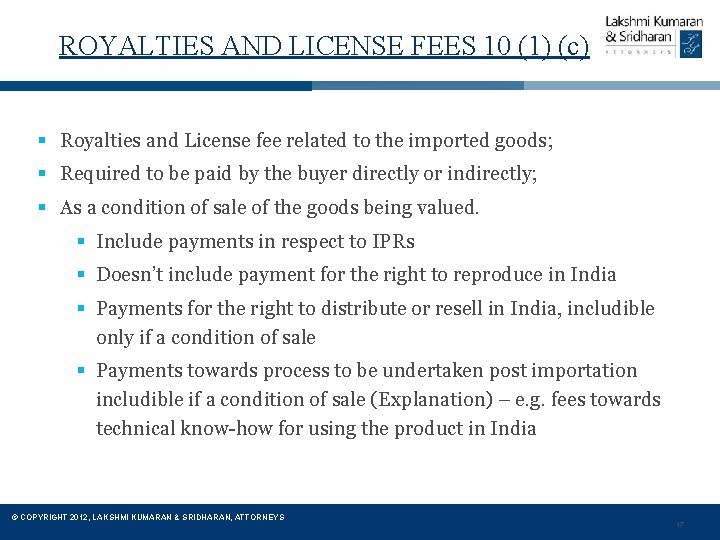
ROYALTIES AND LICENSE FEES 10 (1) (c) § Royalties and License fee related to the imported goods; § Required to be paid by the buyer directly or indirectly; § As a condition of sale of the goods being valued. § Include payments in respect to IPRs § Doesn’t include payment for the right to reproduce in India § Payments for the right to distribute or resell in India, includible only if a condition of sale § Payments towards process to be undertaken post importation includible if a condition of sale (Explanation) – e. g. fees towards technical know-how for using the product in India © COPYRIGHT 2012, LAKSHMI KUMARAN & SRIDHARAN, ATTORNEYS 17
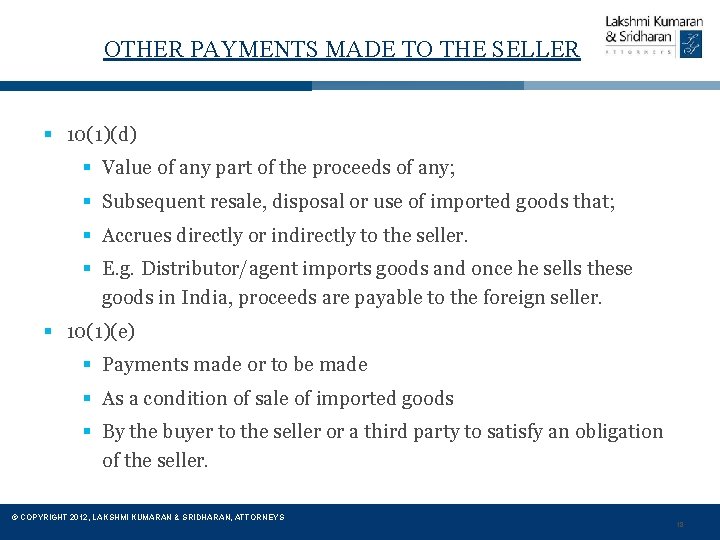
OTHER PAYMENTS MADE TO THE SELLER § 10(1)(d) § Value of any part of the proceeds of any; § Subsequent resale, disposal or use of imported goods that; § Accrues directly or indirectly to the seller. § E. g. Distributor/agent imports goods and once he sells these goods in India, proceeds are payable to the foreign seller. § 10(1)(e) § Payments made or to be made § As a condition of sale of imported goods § By the buyer to the seller or a third party to satisfy an obligation of the seller. © COPYRIGHT 2012, LAKSHMI KUMARAN & SRIDHARAN, ATTORNEYS 18
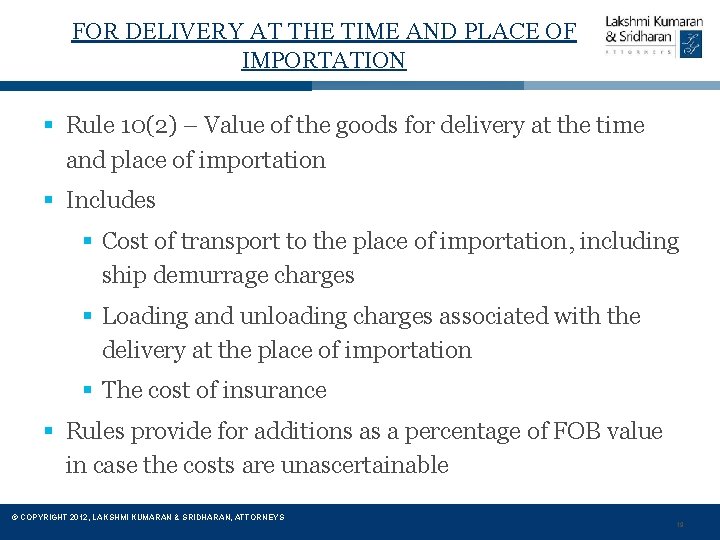
FOR DELIVERY AT THE TIME AND PLACE OF IMPORTATION § Rule 10(2) – Value of the goods for delivery at the time and place of importation § Includes § Cost of transport to the place of importation, including ship demurrage charges § Loading and unloading charges associated with the delivery at the place of importation § The cost of insurance § Rules provide for additions as a percentage of FOB value in case the costs are unascertainable © COPYRIGHT 2012, LAKSHMI KUMARAN & SRIDHARAN, ATTORNEYS 19
OTHER ADDITIONS § Rule 10(4) – no other additions shall be made in determining T. V. except as provided for in Rule 10. § Rule 10(3) – Additions shall be made on the basis of objective and quantifiable data © COPYRIGHT 2012, LAKSHMI KUMARAN & SRIDHARAN, ATTORNEYS 20
EXCLUSION FROM ASSESSABLE VALUE § Following charges are to be excluded – Interpretative Note to R. 3 § Erection, testing and commissioning charges – port importation expenses § Cost of transport after importation § Duties and taxes in India § Payments that do not relate to imported goods § Bank charges for bank services © COPYRIGHT 2012, LAKSHMI KUMARAN & SRIDHARAN, ATTORNEYS 21
REJECTION OF DECLARED VALUE § Rule 11 – importer or his agent has to furnish a declaration – detailed disclosure relating value of imported goods § Proper officer – truth and accuracy of information furnished § Wrong declaration is an offence § Rule 12 – value declared can be rejected-AO has doubts regarding the truth or accuracy § Rule 3(4) – if value cannot be determined under Rule 3 – determined by proceeding sequentially through Rule 4 -9 © COPYRIGHT 2012, LAKSHMI KUMARAN & SRIDHARAN, ATTORNEYS 22
TRANSACTION VALUE OF DECLARED GOODS- RULE 4 § If Rule 3 value is unacceptable, value of imported good; § T. V. of identical goods § Sold for export to India § Imported at or about the same time as that of the goods being valued § Goods in comparison shouldn’t have been provisionally assessed § Rule 4(3) – More than one T. V. of Identical goods, lowest of such value should be taken © COPYRIGHT 2012, LAKSHMI KUMARAN & SRIDHARAN, ATTORNEYS 23
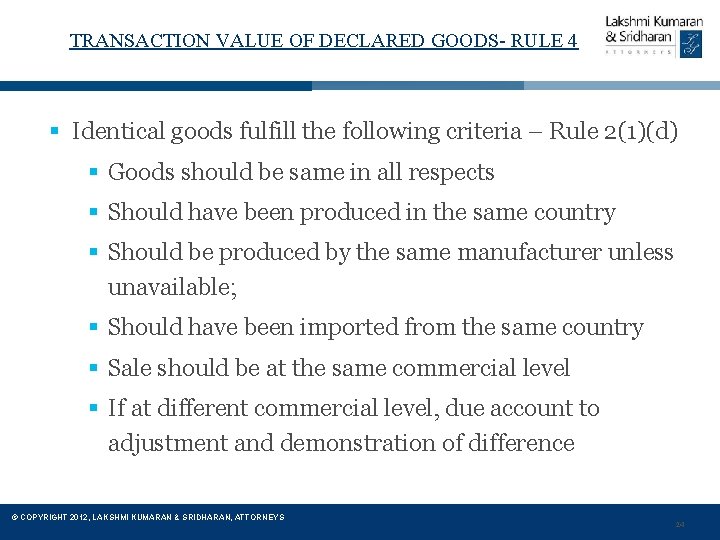
TRANSACTION VALUE OF DECLARED GOODS- RULE 4 § Identical goods fulfill the following criteria – Rule 2(1)(d) § Goods should be same in all respects § Should have been produced in the same country § Should be produced by the same manufacturer unless unavailable; § Should have been imported from the same country § Sale should be at the same commercial level § If at different commercial level, due account to adjustment and demonstration of difference © COPYRIGHT 2012, LAKSHMI KUMARAN & SRIDHARAN, ATTORNEYS 24
TRANSACTION VALUE OF SIMILAR GOODS § If Rule 3 or rule 4 value cannot be accepted; T. V. of similar goods imported at or about the same time § Goods in comparison shouldn’t have been provisionally assessed § Distinction regards identical goods – in case of similar goods, it is enough if they like characteristics and perform same function © COPYRIGHT 2012, LAKSHMI KUMARAN & SRIDHARAN, ATTORNEYS 25
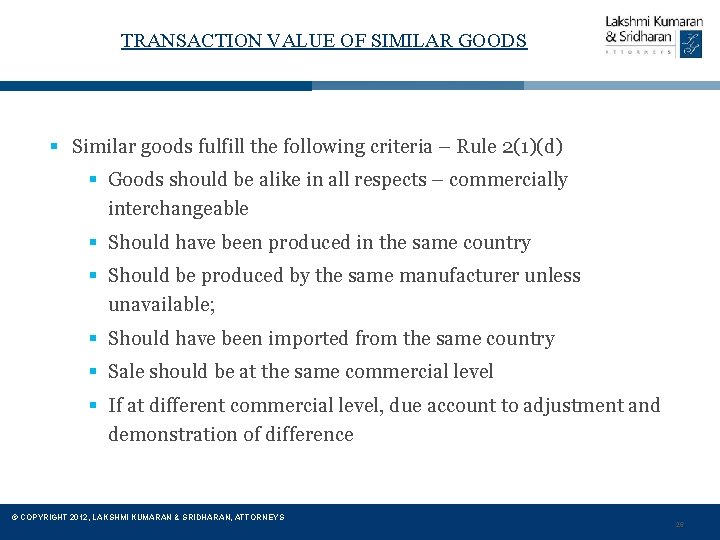
TRANSACTION VALUE OF SIMILAR GOODS § Similar goods fulfill the following criteria – Rule 2(1)(d) § Goods should be alike in all respects – commercially interchangeable § Should have been produced in the same country § Should be produced by the same manufacturer unless unavailable; § Should have been imported from the same country § Sale should be at the same commercial level § If at different commercial level, due account to adjustment and demonstration of difference © COPYRIGHT 2012, LAKSHMI KUMARAN & SRIDHARAN, ATTORNEYS 26
RULE 6 § If the value can’t be determined under Rules 3, 4 and 5 § the value shall be deductive under rule 7, § otherwise, computed value under rule 8. § At the request of the importer + approval of the proper officer, Rule 8 can be used first © COPYRIGHT 2012, LAKSHMI KUMARAN & SRIDHARAN, ATTORNEYS 27
DEDUCTIVE VALUE- RULE 7 § When Rule 3, 4 and 5 not acceptable/available – but products are sold in India § A. V. calculated by reducing post-importation costs and expenses from the selling price § Price only after processing of imported goods- processing costs to be deducted § Price at or about the time goods are being valued § If not, date within 90 days of importation © COPYRIGHT 2012, LAKSHMI KUMARAN & SRIDHARAN, ATTORNEYS 28
COMPUTED VALUE- RULE 8 § Computed value shall consist of the sum of: § the cost or value of materials for producing imported goods; § amount for profit and general expenses usually reflected in sales of similar goods; § the cost or value of all other expenses under sub-rule (2) of rule 10 § Used in cases of buyer and seller being related and producer supplies necessary costing © COPYRIGHT 2012, LAKSHMI KUMARAN & SRIDHARAN, ATTORNEYS 29
RESUDIAL METHOD- RULE 9 § A best judgment method – where value cannot be determined under preceding rules § Reasonable means consistent with the principles and general provisions of these rules and available data § The value arrived shall not exceed price of like goods sold for import to India © COPYRIGHT 2012, LAKSHMI KUMARAN & SRIDHARAN, ATTORNEYS 30
PROHIBITIONS IN DETERMINING THE VALUE § Use of selling price in India of goods produced in India § System of accepting highest of the alternatives § Price of goods prevalent in the country of exportation § Price of goods for export to a country other than India § Minimum customs values § Arbitrary or fictitious value © COPYRIGHT 2012, LAKSHMI KUMARAN & SRIDHARAN, ATTORNEYS 31
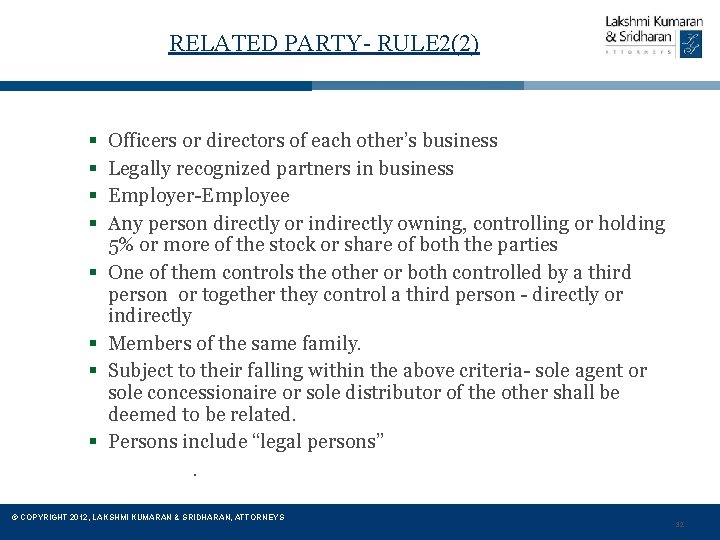
RELATED PARTY- RULE 2(2) § § § § Officers or directors of each other’s business Legally recognized partners in business Employer-Employee Any person directly or indirectly owning, controlling or holding 5% or more of the stock or share of both the parties One of them controls the other or both controlled by a third person or together they control a third person - directly or indirectly Members of the same family. Subject to their falling within the above criteria- sole agent or sole concessionaire or sole distributor of the other shall be deemed to be related. Persons include “legal persons”. © COPYRIGHT 2012, LAKSHMI KUMARAN & SRIDHARAN, ATTORNEYS 32
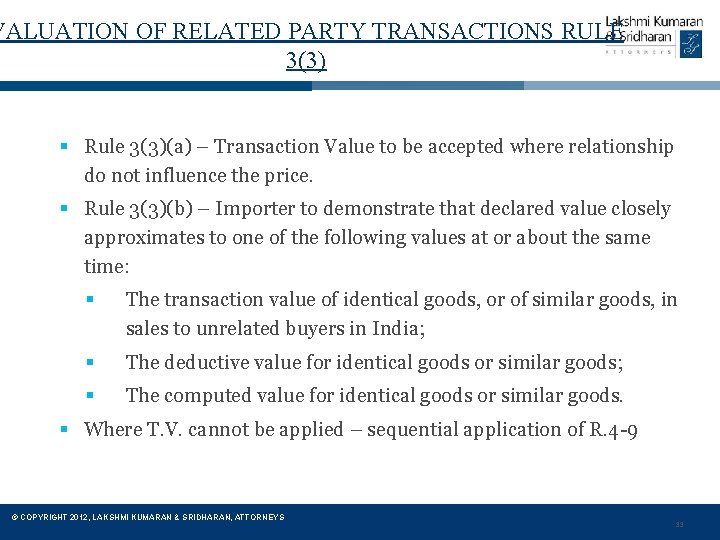
VALUATION OF RELATED PARTY TRANSACTIONS RULE 3(3) § Rule 3(3)(a) – Transaction Value to be accepted where relationship do not influence the price. § Rule 3(3)(b) – Importer to demonstrate that declared value closely approximates to one of the following values at or about the same time: § The transaction value of identical goods, or of similar goods, in sales to unrelated buyers in India; § The deductive value for identical goods or similar goods; § The computed value for identical goods or similar goods. § Where T. V. cannot be applied – sequential application of R. 4 -9 © COPYRIGHT 2012, LAKSHMI KUMARAN & SRIDHARAN, ATTORNEYS 33
EXPORT VALUATION
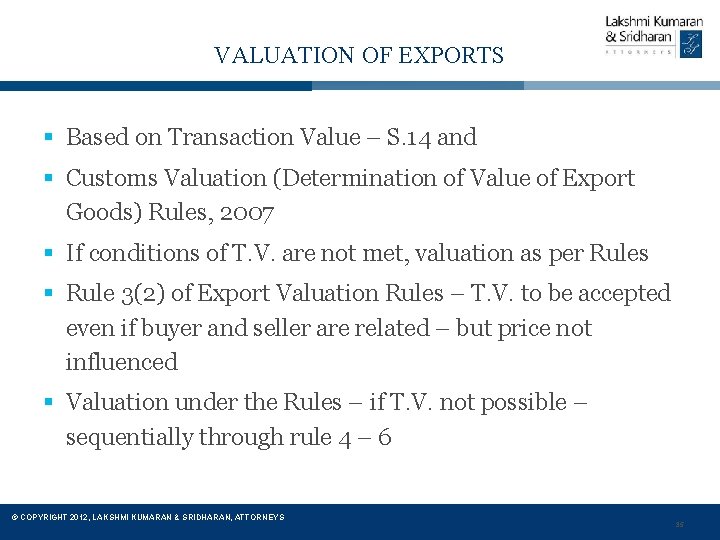
VALUATION OF EXPORTS § Based on Transaction Value – S. 14 and § Customs Valuation (Determination of Value of Export Goods) Rules, 2007 § If conditions of T. V. are not met, valuation as per Rules § Rule 3(2) of Export Valuation Rules – T. V. to be accepted even if buyer and seller are related – but price not influenced § Valuation under the Rules – if T. V. not possible – sequentially through rule 4 – 6 © COPYRIGHT 2012, LAKSHMI KUMARAN & SRIDHARAN, ATTORNEYS 35
VALUATION OF EXPORTS § Export Value by Comparison – Rule 4 § T. V. of Goods of like kind and quality – identical or similar – commercially interchangeable – R. 2(1)(a) § Exported at or about the same time § To other buyers in the same destination country § If not, another destination country is considered § Computed Value – Rule 5 if R. 4 is inapplicable – on the basis of § Cost of production of export goods § Charges for deign or brand § An amount towards profit § Residual Method – Rule 6 when R. 4 & 5 inapplicable § Best judgment method similar to import valuation © COPYRIGHT 2012, LAKSHMI KUMARAN & SRIDHARAN, ATTORNEYS 36
IMPORT PROCEDURE
IMPORT PROCEDURE § Person in charge of Conveyance – Import manifesto (IGM) submitted – ‘entry inwards’ granted § Self Assessment based on RMS in respect of specified importers § IEC code number from DGFT prior to filing Bo. E § Importer – Submission of Bill of Entry with relevant docs – contains description, value, quantity, exemption notification, classification – Sec 46 § White Bill of Entry - home consumption - cleared on payment of customs duty § Yellow Bill of Entry – warehousing - ‘into bond Bill of Entry’ as bond is executed – no duty is paid and imported goods are transferred to warehouse § Green Bill of Entry - clearance from warehouse on payment of customs duty - ex-bond clearance. © COPYRIGHT 2012, LAKSHMI KUMARAN & SRIDHARAN, ATTORNEYS 38
IMPORT PROCEDURE § Bill of Entry is noted - Goods are assessed to duty, examined and pre-audit is carried out - Customs duty is paid after assessment. § Rate of customs duty on the day of noting § Self Assessment under Section 17 § Payment under protest § Provisional assessment – Section 18 § On importer’s request if unable to make SA § Deemed necessary to carry out tests § Necessary to make further enquiry § Final Assessment – difference paid or refund © COPYRIGHT 2012, LAKSHMI KUMARAN & SRIDHARAN, ATTORNEYS 39
IMPORT PROCEDURE § Out of customs charge for clearance issued § After that, port dues, demurrage and other charges are paid and goods are cleared. § Goods can be disposed of if not cleared from port within 30 days – Sec 48 © COPYRIGHT 2012, LAKSHMI KUMARAN & SRIDHARAN, ATTORNEYS 40
SELF ASSESSMENT PROCEDURE Introduced during Budget speech 2011 -2012 ALL IMPORTERS/EXPORTERS Already prevalent in Excise & Service Tax Extended to Customs Trade Facilitation Measure Procedure is same for exports & imports To quicken the clearance of cargo © COPYRIGHT 2012, LAKSHMI KUMARAN & SRIDHARAN, ATTORNEYS 41
NEED FOR SELF ASSESSMENT Underlying Reason § To reconcile 2 conflicting interests (Customs Checks vs. Faster Clearance) § To allow release of the goods on the basis of self-assessment § Without examination of the goods – Green Channel § To enable the importer to have possession of the goods § Also interests of the government are protected by resorting to On-Site Post Clearance Audit (OSPCA) © COPYRIGHT 2012, LAKSHMI KUMARAN & SRIDHARAN, ATTORNEYS 42
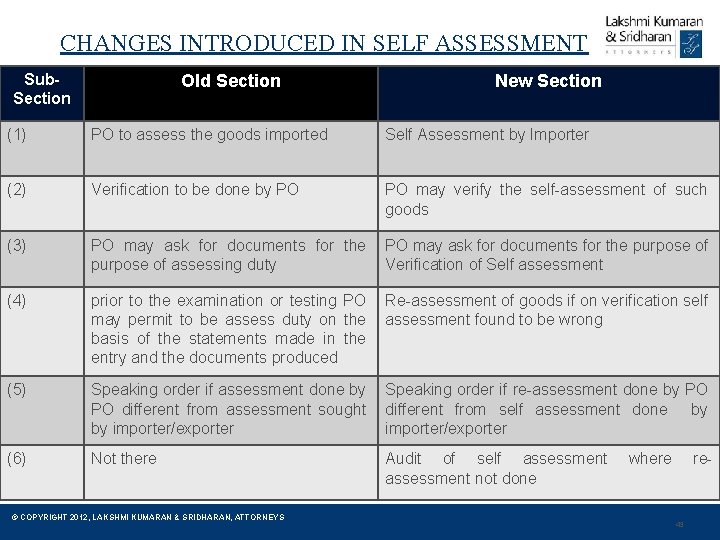
CHANGES INTRODUCED IN SELF ASSESSMENT Sub. Section Old Section New Section (1) PO to assess the goods imported Self Assessment by Importer (2) Verification to be done by PO PO may verify the self-assessment of such goods (3) PO may ask for documents for the purpose of assessing duty PO may ask for documents for the purpose of Verification of Self assessment (4) prior to the examination or testing PO may permit to be assess duty on the basis of the statements made in the entry and the documents produced Re-assessment of goods if on verification self assessment found to be wrong (5) Speaking order if assessment done by PO different from assessment sought by importer/exporter Speaking order if re-assessment done by PO different from self assessment done by importer/exporter (6) Not there Audit of self assessment not done © COPYRIGHT 2012, LAKSHMI KUMARAN & SRIDHARAN, ATTORNEYS where re- 43
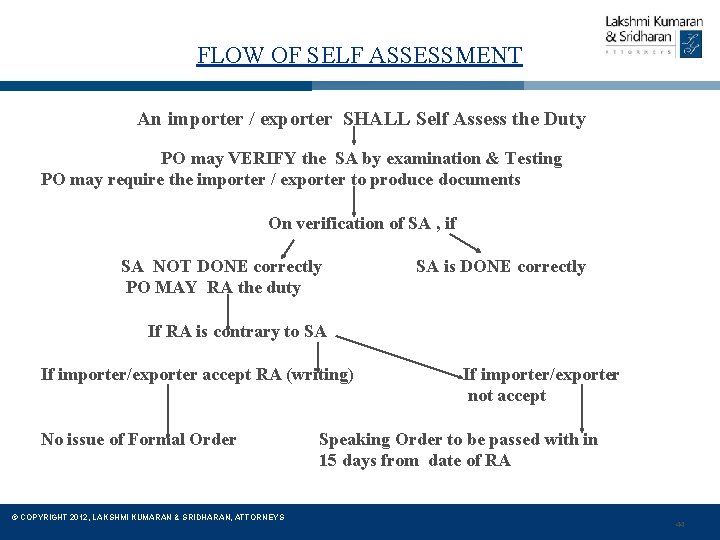
FLOW OF SELF ASSESSMENT An importer / exporter SHALL Self Assess the Duty PO may VERIFY the SA by examination & Testing PO may require the importer / exporter to produce documents On verification of SA , if SA NOT DONE correctly PO MAY RA the duty SA is DONE correctly If RA is contrary to SA If importer/exporter accept RA (writing) No issue of Formal Order © COPYRIGHT 2012, LAKSHMI KUMARAN & SRIDHARAN, ATTORNEYS If importer/exporter not accept Speaking Order to be passed with in 15 days from date of RA 44
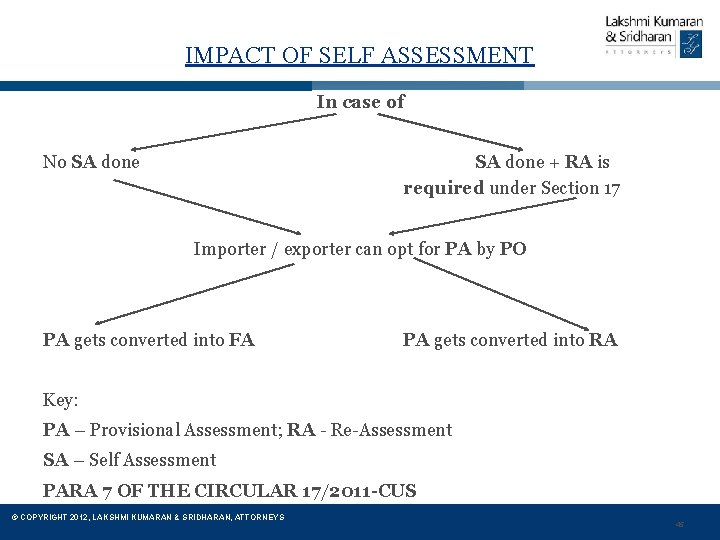
IMPACT OF SELF ASSESSMENT In case of No SA done + RA is required under Section 17 Importer / exporter can opt for PA by PO PA gets converted into FA PA gets converted into RA Key: PA – Provisional Assessment; RA - Re-Assessment SA – Self Assessment PARA 7 OF THE CIRCULAR 17/2011 -CUS © COPYRIGHT 2012, LAKSHMI KUMARAN & SRIDHARAN, ATTORNEYS 45
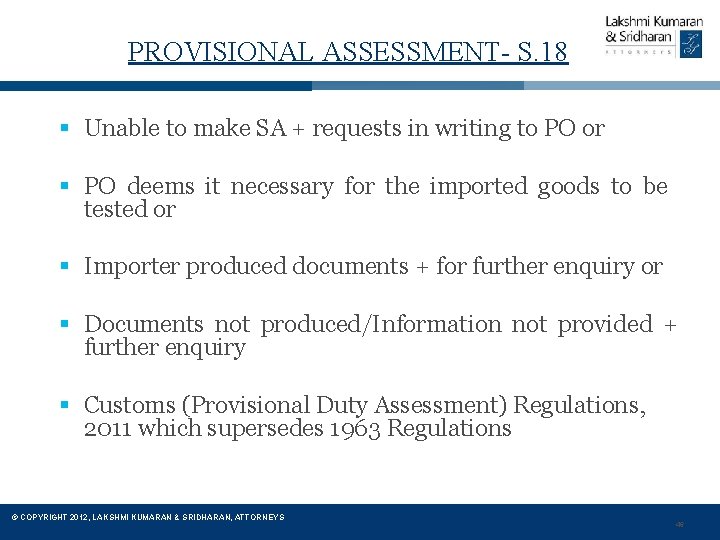
PROVISIONAL ASSESSMENT- S. 18 § Unable to make SA + requests in writing to PO or § PO deems it necessary for the imported goods to be tested or § Importer produced documents + for further enquiry or § Documents not produced/Information not provided + further enquiry § Customs (Provisional Duty Assessment) Regulations, 2011 which supersedes 1963 Regulations © COPYRIGHT 2012, LAKSHMI KUMARAN & SRIDHARAN, ATTORNEYS 46
EXPORT PROCEDURE
EXPORT PROCEDURE § Loading in conveyance after ‘Entry Outward’ is sanctioned § Person in charge of conveyance submission of ‘Export Manifest’ § Exporter to obtain IEC number from DGFT - registered with Export Promotion Council if export benefits claimed § Export is required to submit Shipping Bill with required documents for obtaining permission to export. § Shipping Bill for export of goods under claim for duty drawback § Shipping Bill for export of dutiable goods - this should be yellow colour § Shipping bill for export of duty free goods - it should be white colour § shipping bill for export of duty free goods ex-bond - i. e. from bonded store room - it should be pink colour § Shipping Bill for export under DEPB scheme - Blue colour. © COPYRIGHT 2012, LAKSHMI KUMARAN & SRIDHARAN, ATTORNEYS 48
EXPORT PROCEDURE § FEMA formalities - GR/SDF/Softex form is required to be submitted. § The shipping bill is noted, goods are assessed and examined. Export duty is paid, if applicable. § Customs check for advance licenses, restriction and prohibitions § If export is under export incentives, relevant documents are checked and certified. Then proof of export is obtained on ARE-1 § Conveyance can leave only after ‘Let Export’ order is issued. © COPYRIGHT 2012, LAKSHMI KUMARAN & SRIDHARAN, ATTORNEYS 49

© COPYRIGHT 2012, LAKSHMI KUMARAN & SRIDHARAN, ATTORNEYS
- Slides: 49