
Important Theories Zone of Proximal Development With support
- Slides: 1
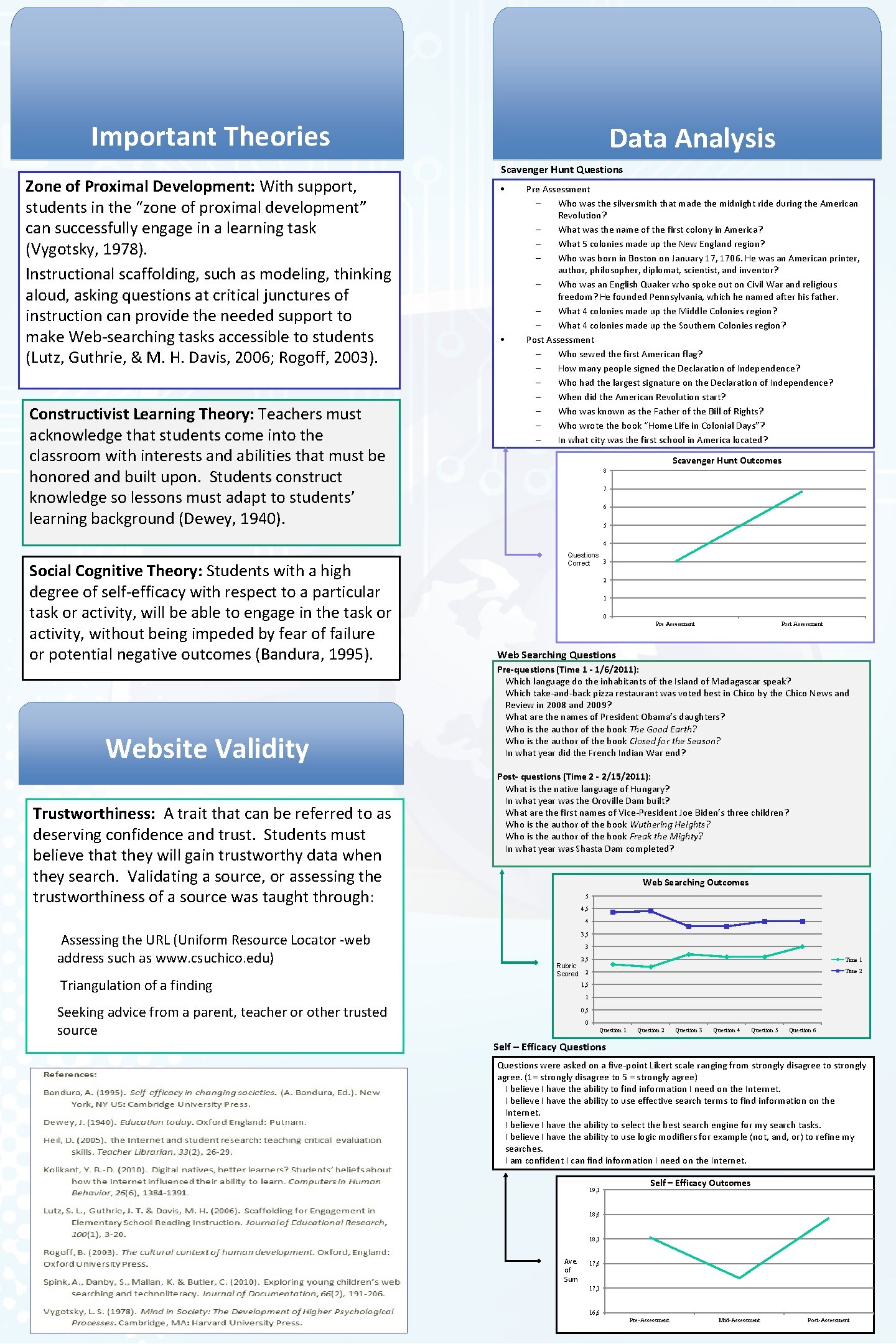
Important Theories Zone of Proximal Development: With support, students in the “zone of proximal development” can successfully engage in a learning task (Vygotsky, 1978). Instructional scaffolding, such as modeling, thinking aloud, asking questions at critical junctures of instruction can provide the needed support to make Web-searching tasks accessible to students (Lutz, Guthrie, & M. H. Davis, 2006; Rogoff, 2003). Constructivist Learning Theory: Teachers must acknowledge that students come into the classroom with interests and abilities that must be honored and built upon. Students construct knowledge so lessons must adapt to students’ learning background (Dewey, 1940). Data Analysis Scavenger Hunt Questions • • Pre Assessment – Who was the silversmith that made the midnight ride during the American Revolution? – What was the name of the first colony in America? – What 5 colonies made up the New England region? – Who was born in Boston on January 17, 1706. He was an American printer, author, philosopher, diplomat, scientist, and inventor? – Who was an English Quaker who spoke out on Civil War and religious freedom? He founded Pennsylvania, which he named after his father. – What 4 colonies made up the Middle Colonies region? – What 4 colonies made up the Southern Colonies region? Post Assessment – Who sewed the first American flag? – How many people signed the Declaration of Independence? – Who had the largest signature on the Declaration of Independence? – When did the American Revolution start? – Who was known as the Father of the Bill of Rights? – Who wrote the book “Home Life in Colonial Days”? – In what city was the first school in America located? Scavenger Hunt Outcomes 8 7 6 5 4 Social Cognitive Theory: Students with a high degree of self-efficacy with respect to a particular task or activity, will be able to engage in the task or activity, without being impeded by fear of failure or potential negative outcomes (Bandura, 1995). Website Validity Trustworthiness: A trait that can be referred to as deserving confidence and trust. Students must believe that they will gain trustworthy data when they search. Validating a source, or assessing the trustworthiness of a source was taught through: Questions 3 Correct 2 1 0 Pre Assessment Post Assessment Web Searching Questions Pre-questions (Time 1 - 1/6/2011): Which language do the inhabitants of the Island of Madagascar speak? Which take-and-back pizza restaurant was voted best in Chico by the Chico News and Review in 2008 and 2009? What are the names of President Obama’s daughters? Who is the author of the book The Good Earth? Who is the author of the book Closed for the Season? In what year did the French Indian War end? Post- questions (Time 2 - 2/15/2011): What is the native language of Hungary? In what year was the Oroville Dam built? What are the first names of Vice-President Joe Biden’s three children? Who is the author of the book Wuthering Heights? Who is the author of the book Freak the Mighty? In what year was Shasta Dam completed? Web Searching Outcomes 5 4, 5 4 Assessing the URL (Uniform Resource Locator -web address such as www. csuchico. edu) Triangulation of a finding 3, 5 3 2, 5 Time 1 Rubric Scored 2 Time 2 1, 5 1 Seeking advice from a parent, teacher or other trusted source 0, 5 0 Question 1 Question 2 Question 3 Question 4 Question 5 Question 6 Self – Efficacy Questions were asked on a five-point Likert scale ranging from strongly disagree to strongly agree. (1= strongly disagree to 5 = strongly agree) I believe I have the ability to find information I need on the Internet. I believe I have the ability to use effective search terms to find information on the Internet. I believe I have the ability to select the best search engine for my search tasks. I believe I have the ability to use logic modifiers for example (not, and, or) to refine my searches. I am confident I can find information I need on the Internet. 19, 1 Self – Efficacy Outcomes 18, 6 18, 1 Ave. of Sum 17, 6 17, 1 16, 6 Pre-Assessment Mid-Assessment Post-Assessment