
Important terms in eukaryotic cell division Chromosome threadlike

- Slides: 39
Important terms in eukaryotic cell division • Chromosome = threadlike structures that are composed of DNA + protein • replication = process whereby DNA is identically copied (before cell division) • mitosis = division of the nucleus • cytokinesis = division of the cytoplasm • chromatin = DNA + protein complex that is thin and fibrous; it will condense into distinct chromosomes during cell division
Why do cells divide? • Reproduction • Replacement of damaged cells • Growth of new cells
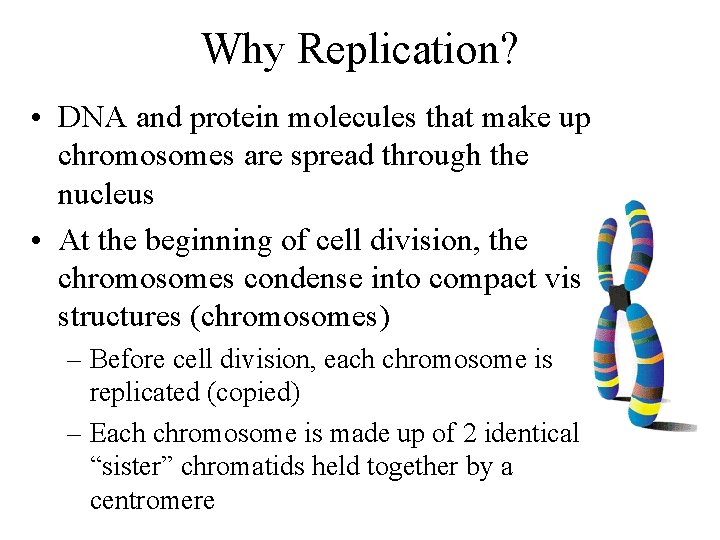
Why Replication? • DNA and protein molecules that make up chromosomes are spread through the nucleus • At the beginning of cell division, the chromosomes condense into compact visible structures (chromosomes) – Before cell division, each chromosome is replicated (copied) – Each chromosome is made up of 2 identical “sister” chromatids held together by a centromere
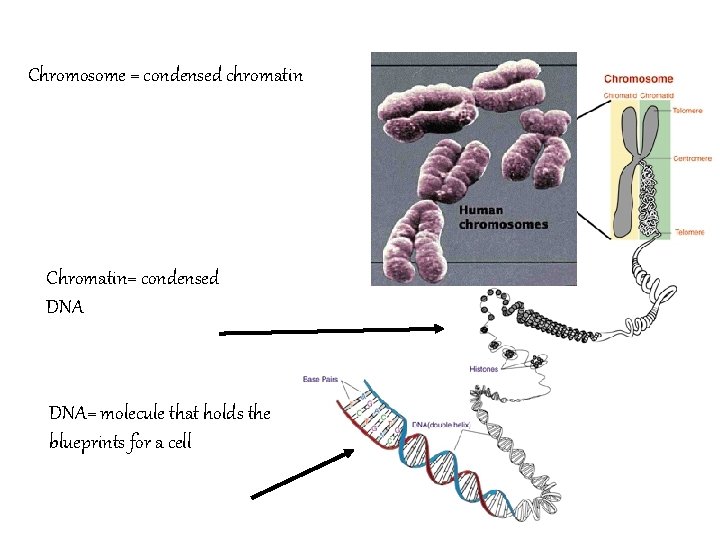
Chromosome = condensed chromatin Chromatin= condensed DNA= molecule that holds the blueprints for a cell
Chromosomes • Genetic information is passed on from one generation to the next through chromosomes • Every organism has a specific number of chromosomes (ex: humans = 46, carrots = 18) • Chromosomes are not visible in most cells except in cell division
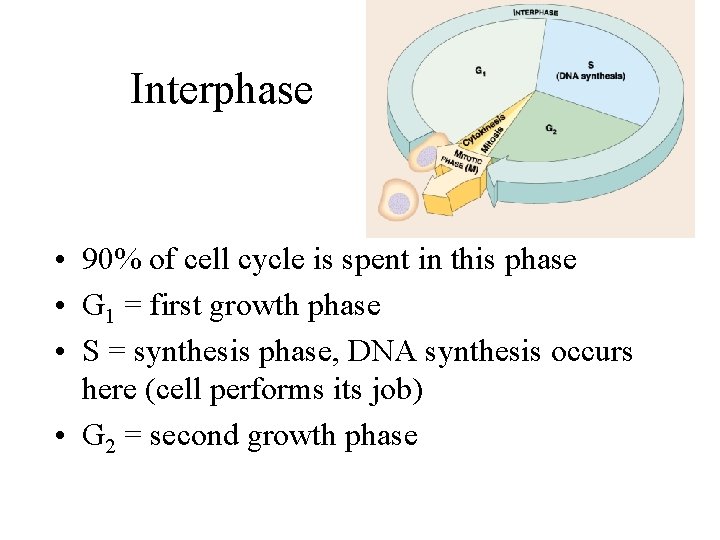
Interphase • 90% of cell cycle is spent in this phase • G 1 = first growth phase • S = synthesis phase, DNA synthesis occurs here (cell performs its job) • G 2 = second growth phase
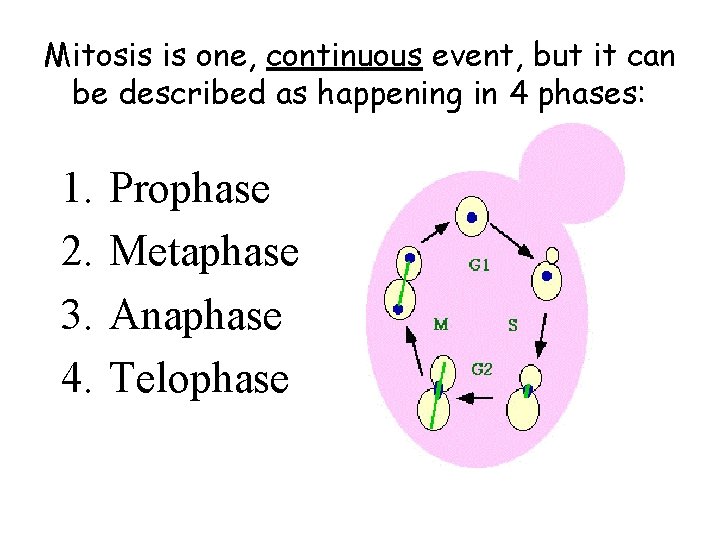
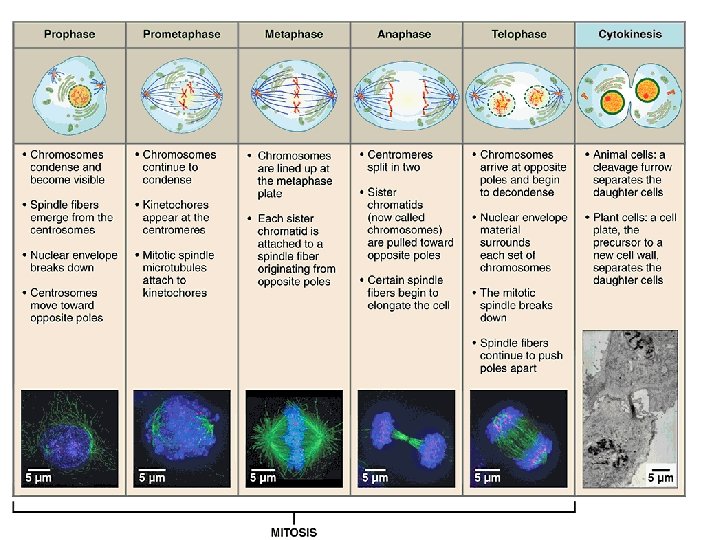
Mitosis is one, continuous event, but it can be described as happening in 4 phases: 1. 2. 3. 4. Prophase Metaphase Anaphase Telophase
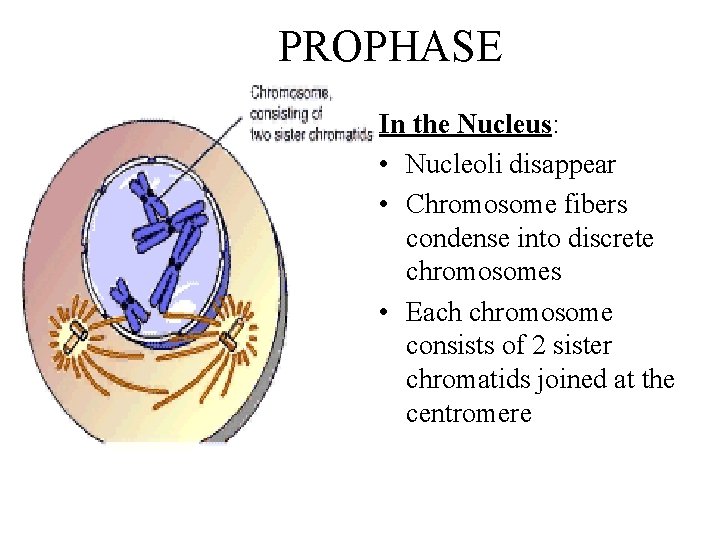
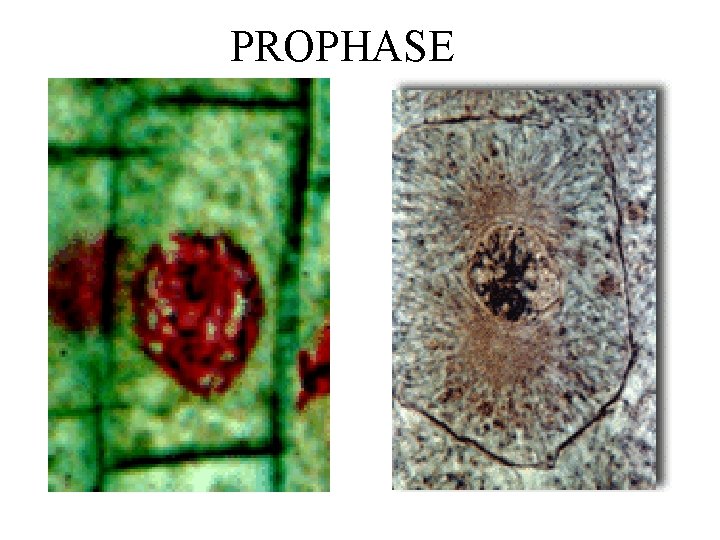
PROPHASE In the Nucleus: • Nucleoli disappear • Chromosome fibers condense into discrete chromosomes • Each chromosome consists of 2 sister chromatids joined at the centromere
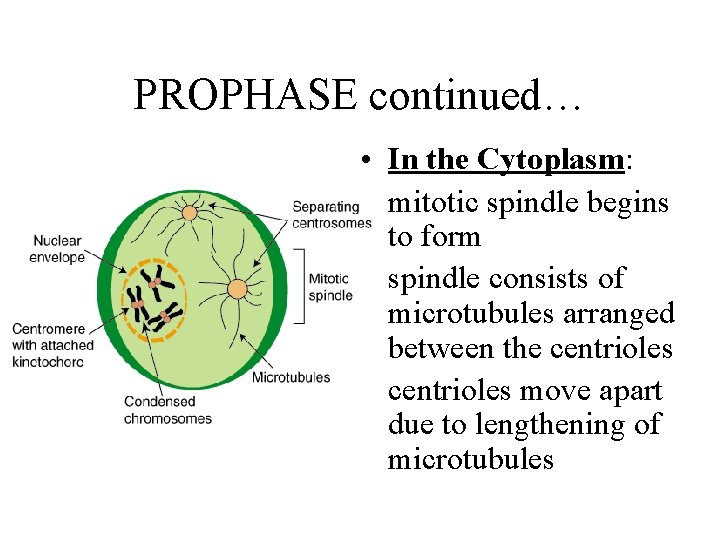
PROPHASE continued… • In the Cytoplasm: • mitotic spindle begins to form • spindle consists of microtubules arranged between the centrioles • centrioles move apart due to lengthening of microtubules
PROPHASE
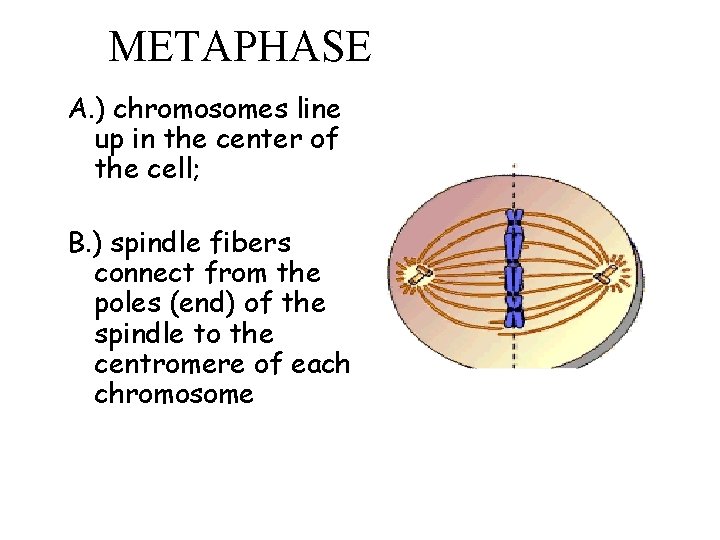
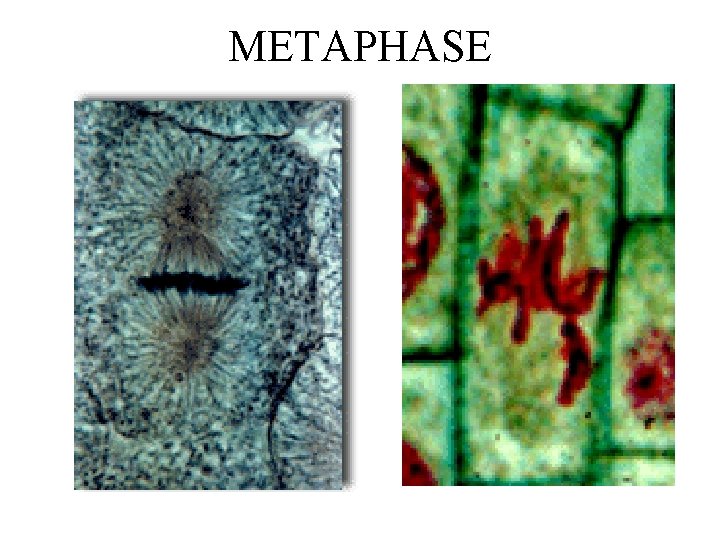
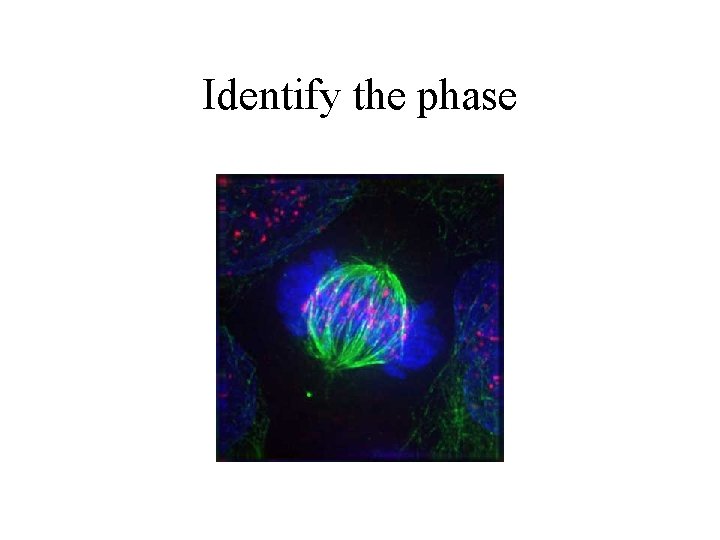
METAPHASE A. ) chromosomes line up in the center of the cell; B. ) spindle fibers connect from the poles (end) of the spindle to the centromere of each chromosome
METAPHASE
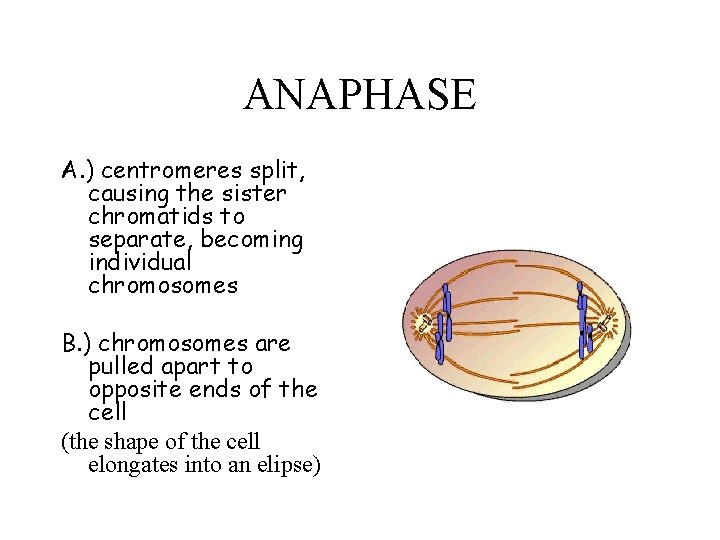
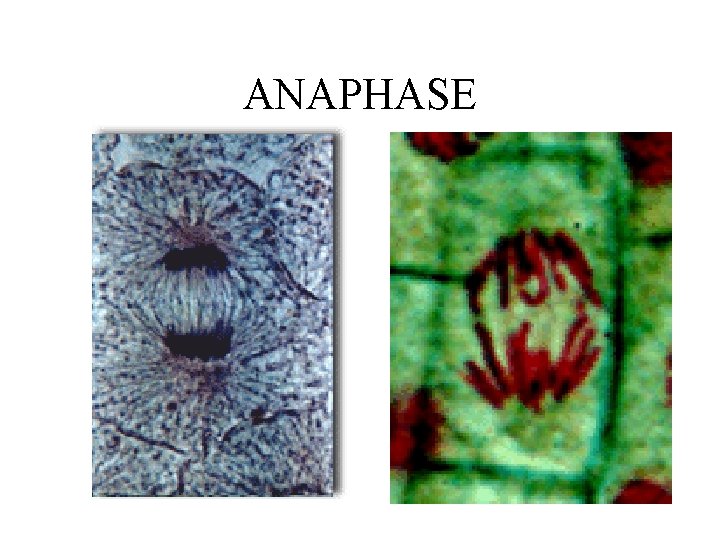
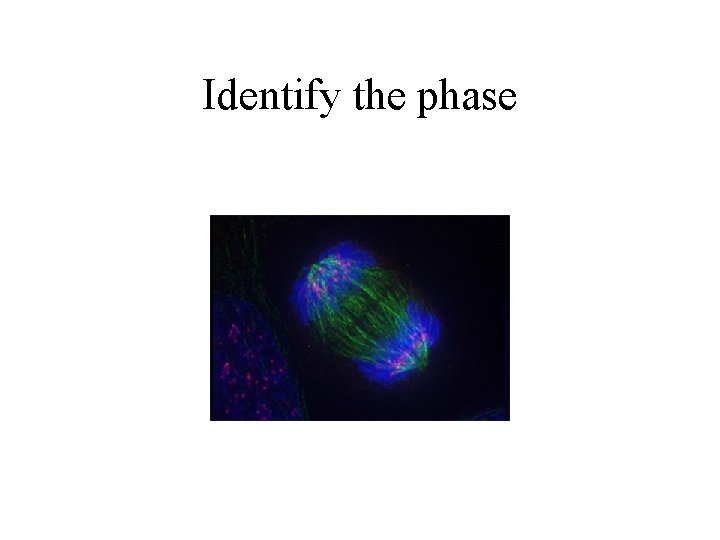
ANAPHASE A. ) centromeres split, causing the sister chromatids to separate, becoming individual chromosomes B. ) chromosomes are pulled apart to opposite ends of the cell (the shape of the cell elongates into an elipse)
ANAPHASE
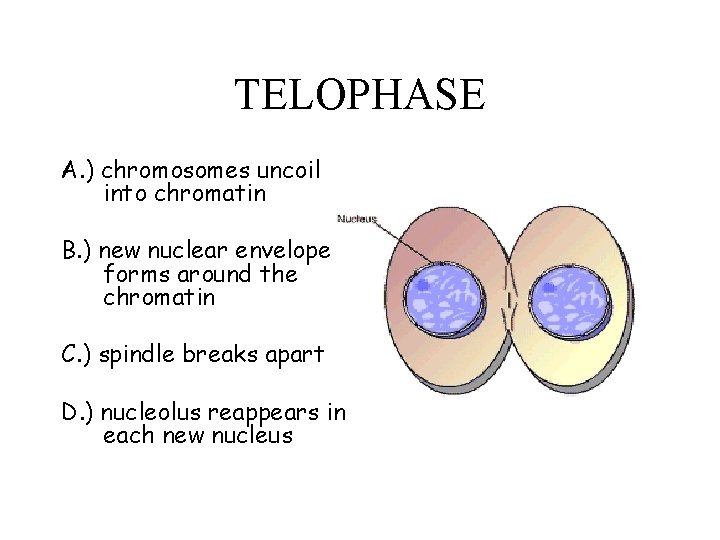
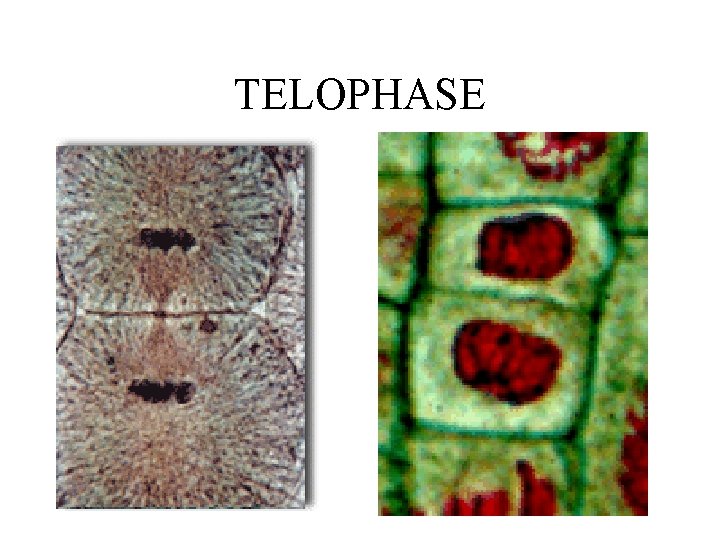
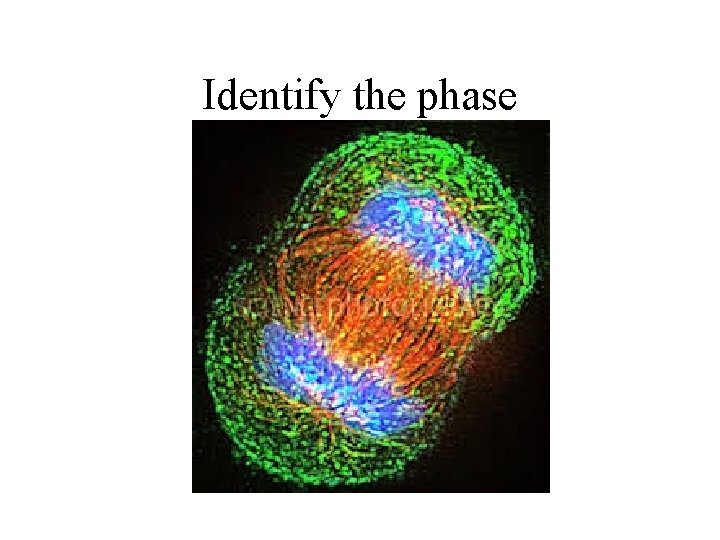
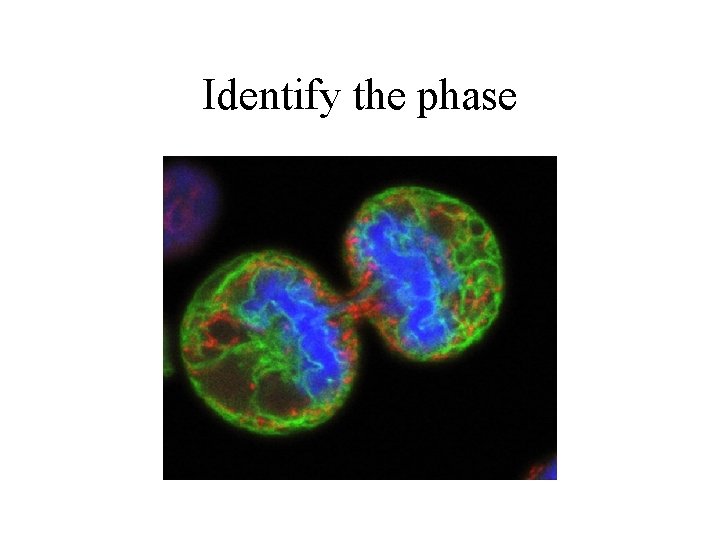
TELOPHASE A. ) chromosomes uncoil into chromatin B. ) new nuclear envelope forms around the chromatin C. ) spindle breaks apart D. ) nucleolus reappears in each new nucleus
TELOPHASE
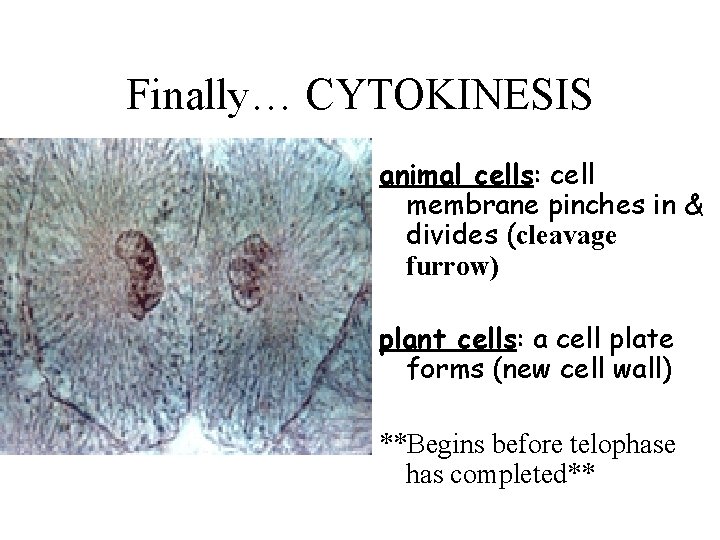
Finally… CYTOKINESIS animal cells: cell membrane pinches in & divides (cleavage furrow) plant cells: a cell plate forms (new cell wall) **Begins before telophase has completed**
Identify the phase
Identify the phase
Identify the phase
Identify the phase
Meiosis
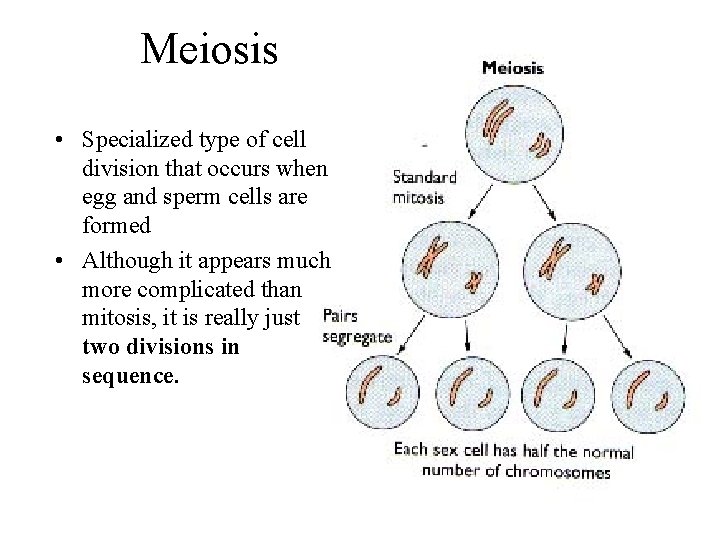
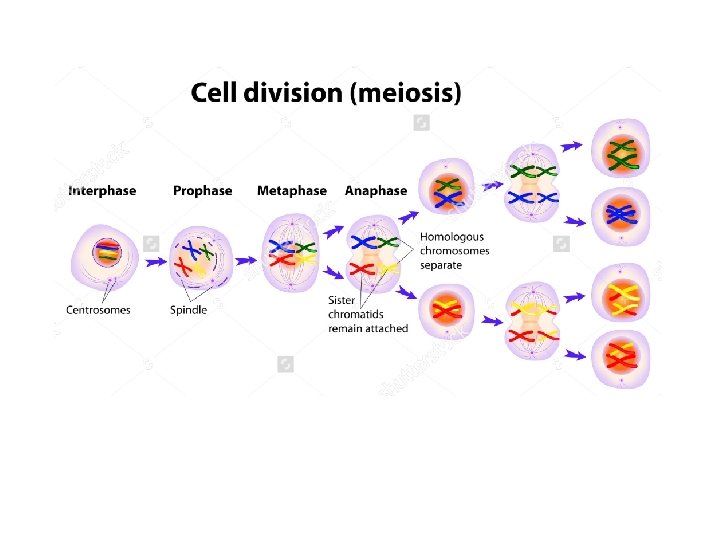
Meiosis • Specialized type of cell division that occurs when egg and sperm cells are formed • Although it appears much more complicated than mitosis, it is really just two divisions in sequence.
MEIOSIS I • Meiosis I, the first of the two divisions, is often called reduction division, since it is here that the chromosome number is reduced from 46 to 23. *remember this must happen for us to get half our chromosomes from our dad and half from our mom!
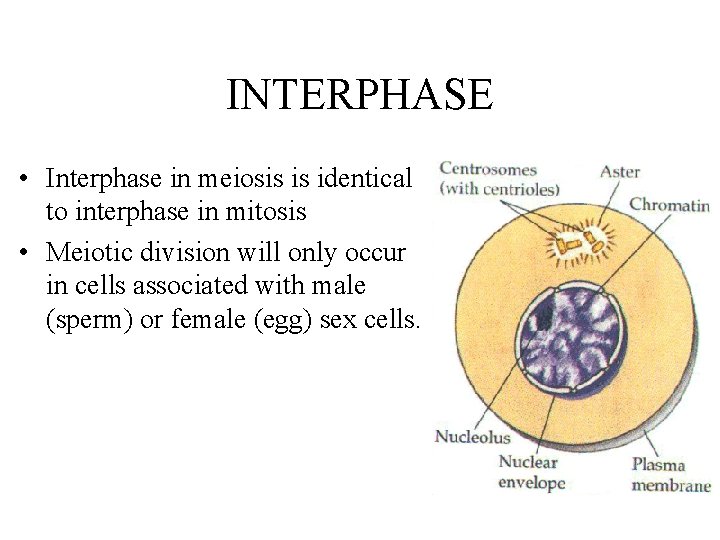
INTERPHASE • Interphase in meiosis is identical to interphase in mitosis • Meiotic division will only occur in cells associated with male (sperm) or female (egg) sex cells.
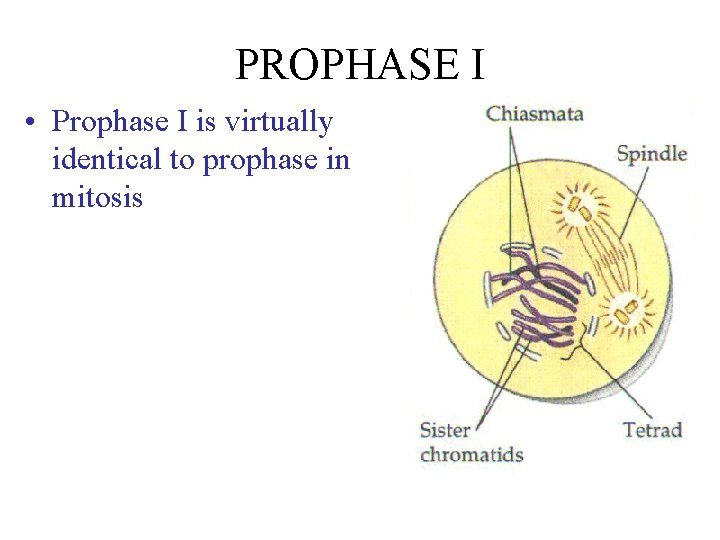
PROPHASE I • Prophase I is virtually identical to prophase in mitosis
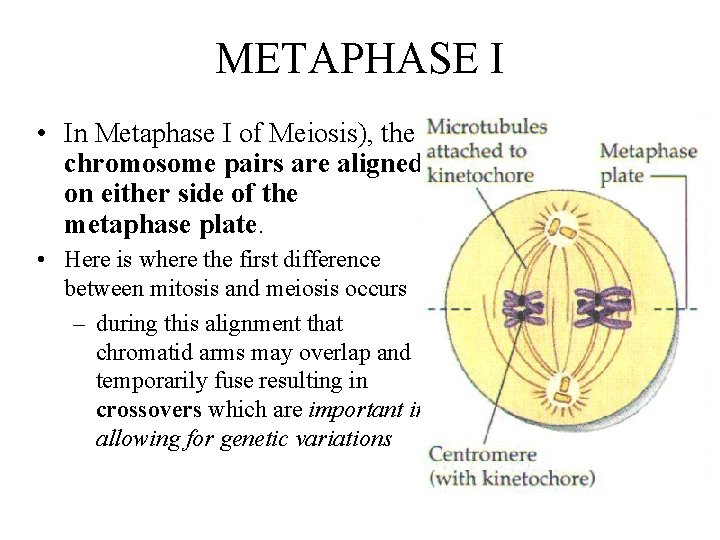
METAPHASE I • In Metaphase I of Meiosis), the chromosome pairs are aligned on either side of the metaphase plate. • Here is where the first difference between mitosis and meiosis occurs – during this alignment that chromatid arms may overlap and temporarily fuse resulting in crossovers which are important in allowing for genetic variations
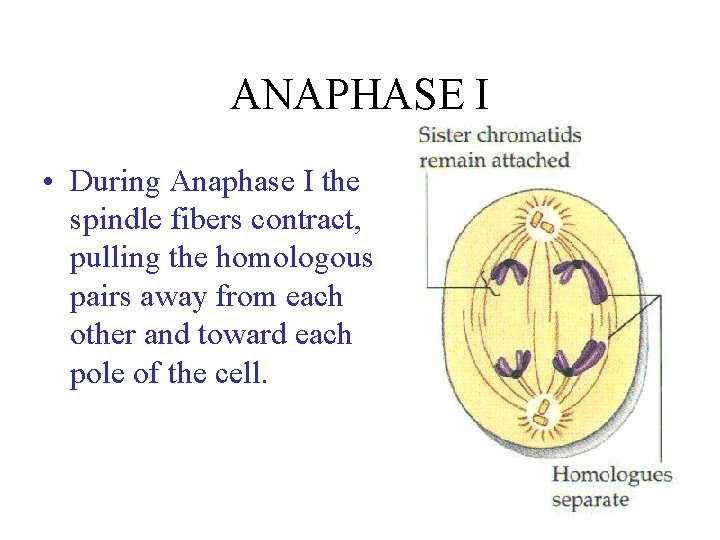
ANAPHASE I • During Anaphase I the spindle fibers contract, pulling the homologous pairs away from each other and toward each pole of the cell.
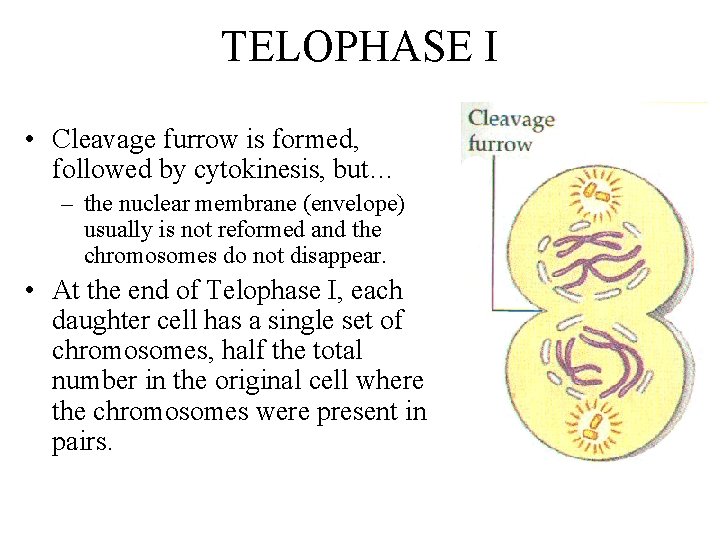
TELOPHASE I • Cleavage furrow is formed, followed by cytokinesis, but… – the nuclear membrane (envelope) usually is not reformed and the chromosomes do not disappear. • At the end of Telophase I, each daughter cell has a single set of chromosomes, half the total number in the original cell where the chromosomes were present in pairs.
MEIOSIS II • Meiosis II = a simple division of the two cells created in meiosis one. • Basically the process repeats to form two more cells with chromosomes different from the parent cell.
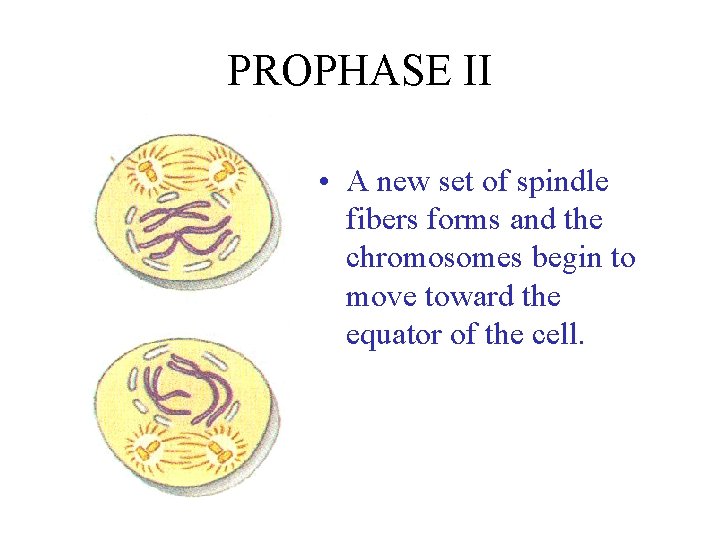
PROPHASE II • A new set of spindle fibers forms and the chromosomes begin to move toward the equator of the cell.
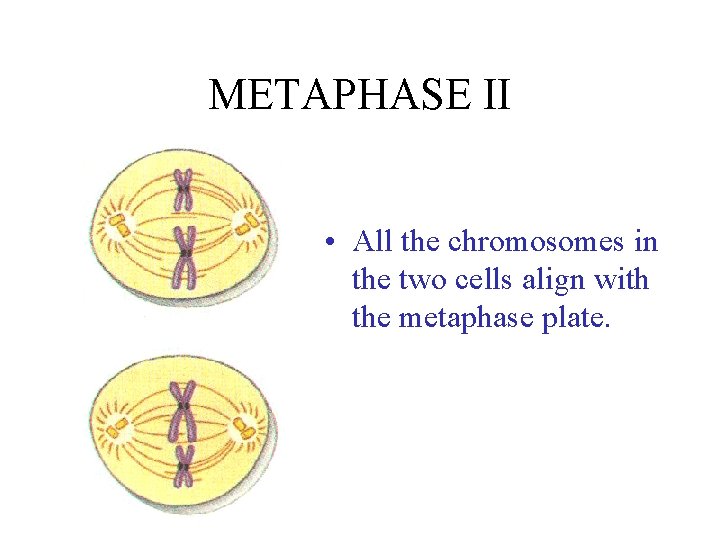
METAPHASE II • All the chromosomes in the two cells align with the metaphase plate.
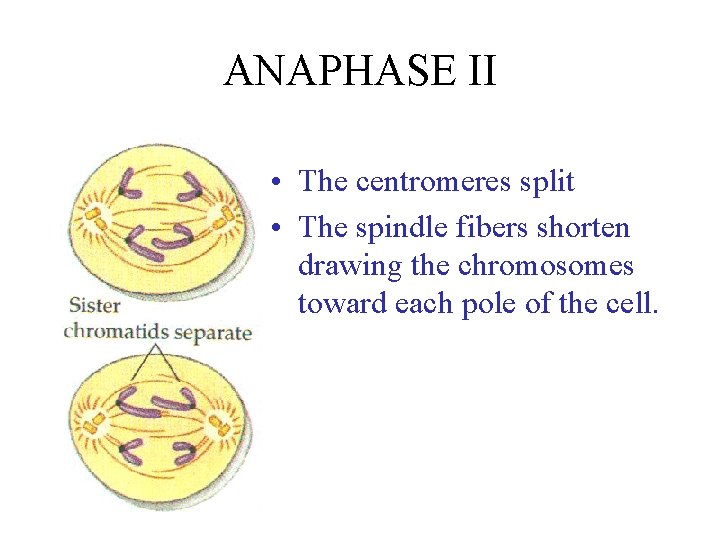
ANAPHASE II • The centromeres split • The spindle fibers shorten drawing the chromosomes toward each pole of the cell.
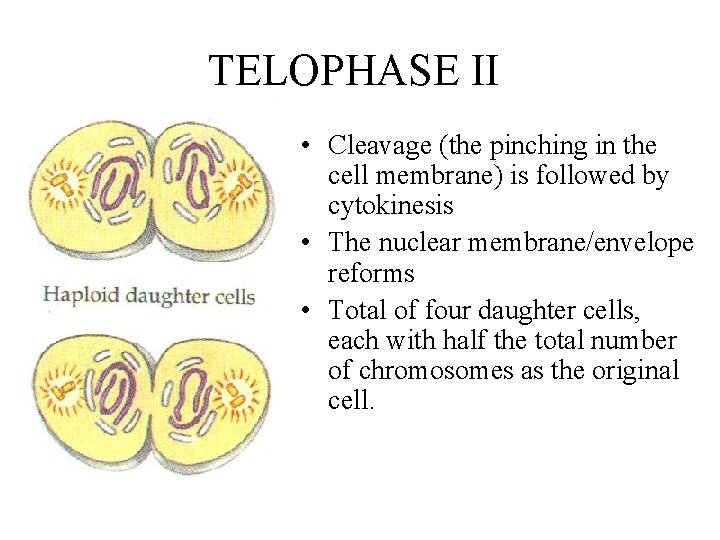
TELOPHASE II • Cleavage (the pinching in the cell membrane) is followed by cytokinesis • The nuclear membrane/envelope reforms • Total of four daughter cells, each with half the total number of chromosomes as the original cell.
• In the case of male structures, all four cells will eventually develop into typical sperm cells. • In the case of female life cycles in “higher” organisms, three of the cells will typically abort, and only one haploid cell will develop into an egg cell
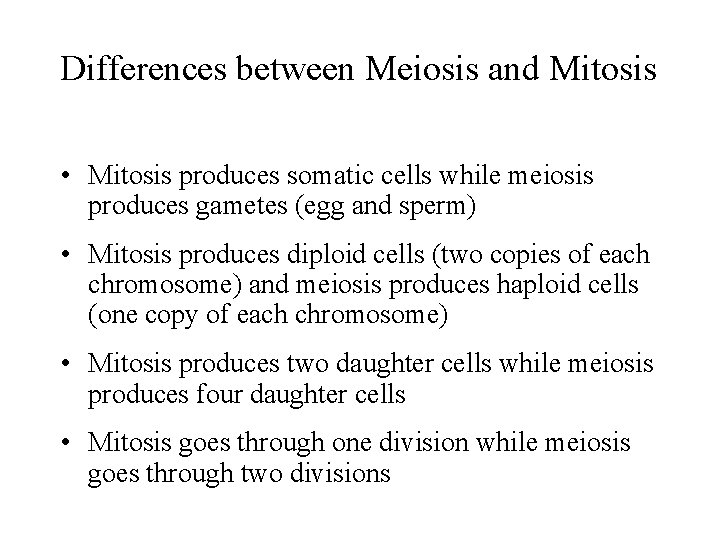
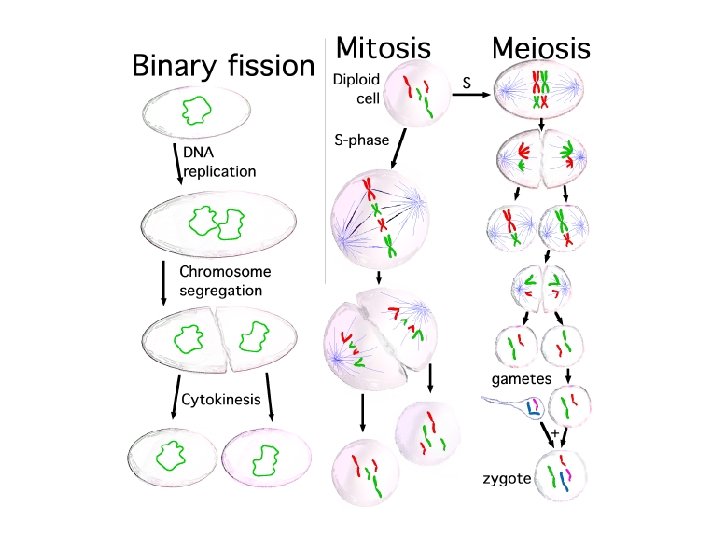
Differences between Meiosis and Mitosis • Mitosis produces somatic cells while meiosis produces gametes (egg and sperm) • Mitosis produces diploid cells (two copies of each chromosome) and meiosis produces haploid cells (one copy of each chromosome) • Mitosis produces two daughter cells while meiosis produces four daughter cells • Mitosis goes through one division while meiosis goes through two divisions